Product Description
Antique Sumba Comb 1 SOLD
Material: Tortoiseshell
Style: East Sumba, Indonesia
Size: Height 17 cm, Width 14.5 cm
Order Number: MHAASC1
On entering puberty young women in Sumba wore intricately carved tortoiseshell called hai kara jangga. They were also worn by adult noblewomen.
The combs are worn upright over the brow or high on the head, like a crown, and held in place by ribbons or a band. They are hand carved from mottled tortoiseshell or occasionally from buffalo horn. After they have been carved and polished, they are curved horizontally to a semi-circle.
The combs follow a basic formula: an upper pierced top, followed by a band of solid tortoiseshell displaying engraved linear geometric decoration and then the teeth.
This one has bilaterally symmetrical cocks silhouetted and perched on top of antlered deer. Antlered deer symbolise royalty. The fighting cocks represent the upper world of the spirits, ancestors and nobility, as well as the aggression of aristocratic warriors. An abstract central image between them most likely represents a skull tree called an andung, where trophy heads were displayed.
Such animal and tree motifs also appear in textile designs of hinggi, which are prized cloths worn Sumbanese male elite. Use of male iconography on female headdresses is an example of the complementary and opposition of the male and female in the art and culture of Sumba.
Another example is in mamuli jewelry, which are omega shaped earrings. The distinct form alludes to female reproductive powers, but they are classified as male goods in the ritual marriage gift exchange. Within the larger classification of mamuli as male goods, plain mamuli are regarded as a female type and the long elaborate bases are regarded as a male type.
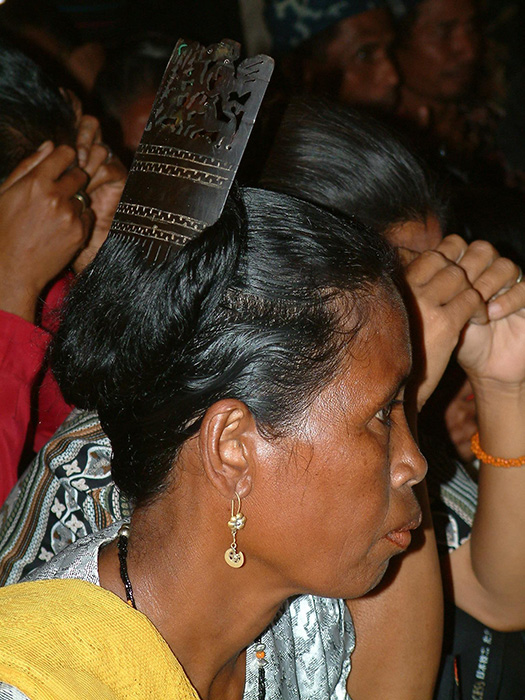 East Sumba Lady wearing a Comb.
There is an example in Art of Island Southeast Asia, The Fred and Rita Richman Collection in The Metropolitan Museum of Art, Metropolitan Museum of Art (New York, N.Y.), Florina H. Capistrano-Baker, 1994, page 102.
19th – 20th century.
Please ask for the price (or make an offer).