Product Description
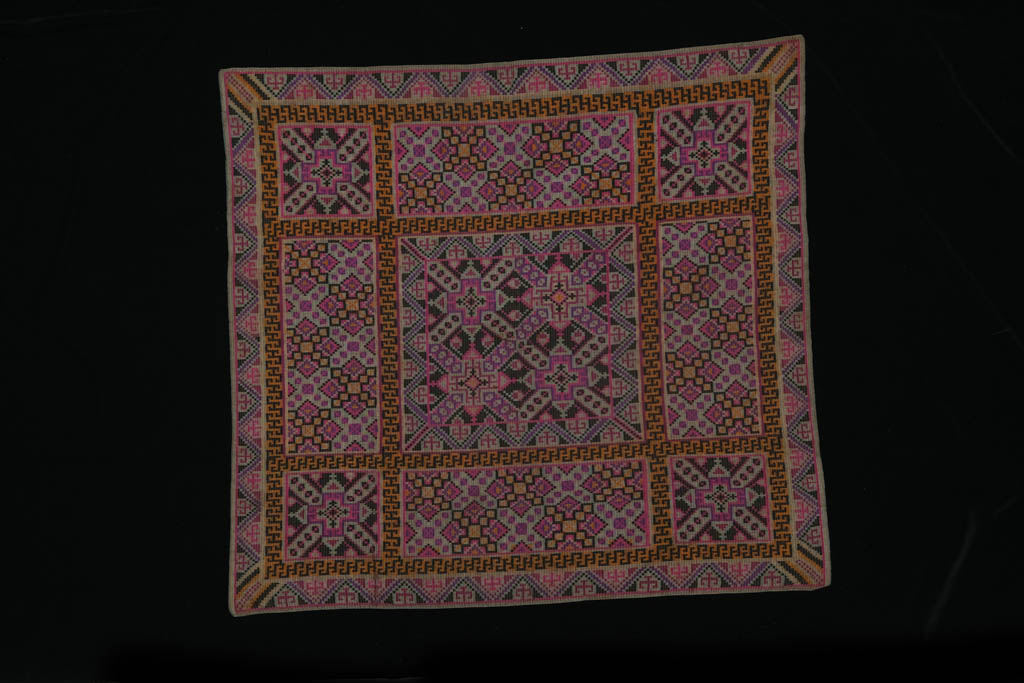
Antique Southern Philippines Headdress
Material: Silk
Style: Southern Philippines
Size: Length 91 cm, Width 85 cm
Order Number: MHSASPH1
West Mindanao and the neighbouring Sulu Archipelago are the main Muslim communities of the Philippines and the Tausug are one of the most important Muslim weaving groups.
Islam spread rapidly throughout Southeast Asia in the 13th to 15th centuries. Its furthest expansion was in the Philippines. The earliest Islamic communities were established in the Sulu Achipelago in the last quarter of the 13th century.
Islamic states preceded Magellan in the Philippines in 1521. Miguel Lopez de Legazpi established Manila as the Spanish capital in 1571. There were three centuries of warfare between the Spaniards and the Muslims. The states of Sulu and Maguindanao became trading states with contacts in the outside world. This introduced them to new weaving techniques and new styles for clothes, which were reworked to create unique Muslim Philippino textiles.
The Tausug people are the culturally dominant group in the Sulu Archipelago and Sultanate of Jolo. Jolo traded with the Chinese, Arabs and other Asians, who also lived there, which led to diverse forms of dress. Silk came from China. Jolo eventually traded with the Europeans.
Tausug women are among the most accomplished weavers in the country and are renowned for their coloured silk tapestry weave headcloths (pis) and men’s waist sashes (kandit). They used imported Chinese silk. In recent decades they tend to use cotton or polyester yarns.
Kandit and pis are woven using a tapestry technique, which was probably introduced as a result of the Chinese textile trade. The patterns are rigidly geometric, perhaps derived from Indian mandalas. The colours are rainbow-hued.
This Tausug tapestry-woven silk headcloth was an essential part of the ceremonial costume of a Tausug man. A waist-sash of the same technique was used to hold a dagger. The central design is a mandala and the geometric design (siyabit) is intended as eye-catching decoration.
There is an example in Textiles of Southease Asia, Tradition, Trade and Transformation, Robyn Maxwell, Periplus Editions, 2003, page 203.
Early 20th century.
Please ask for the price (or make an offer).