Product Description
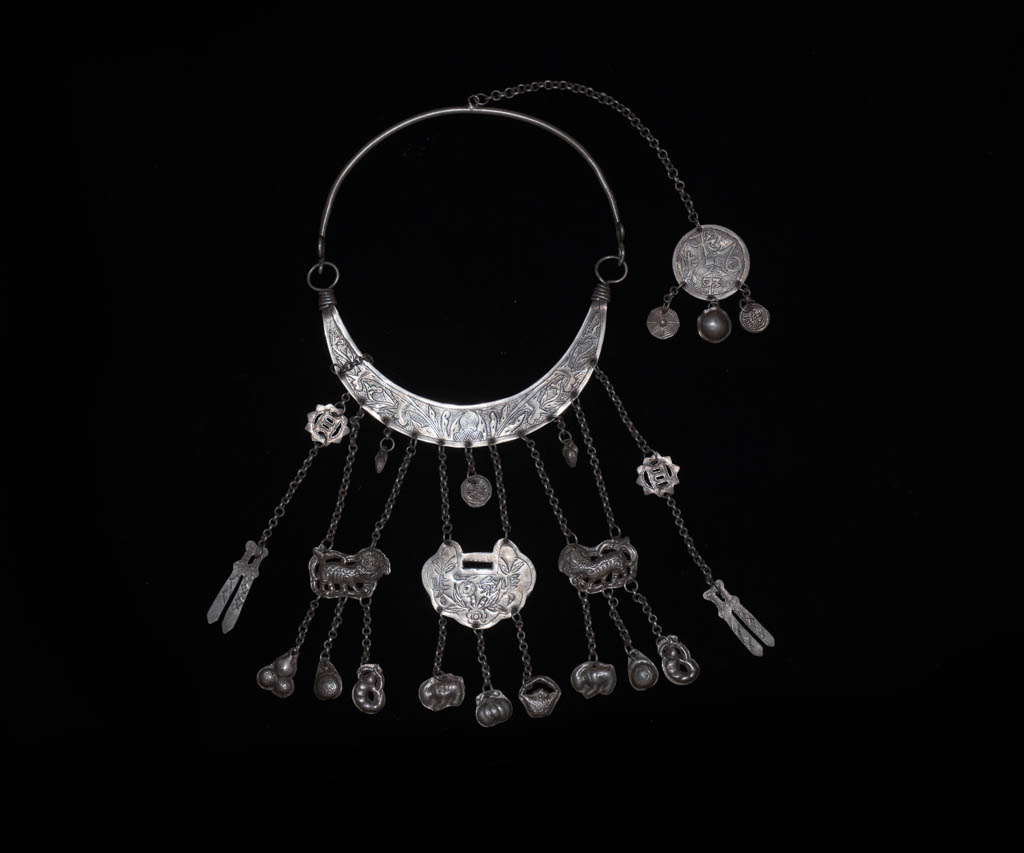
Miao Hilltribe Torque
Material: Silver
Style: Miao
Size: Height 29 cm, Diameter 16 cm (top)
Order Number: MHSHNR2
The Miao people live in southern China mostly in Guizhou province. Miao sub-groups such as the Hmong live in northern Thailand and eastern Burma. The Hmong have 2 major branches, the White Hmong and the Green Hmong.
Many migrated to Laos. By 1850 they were established in the mountains around Luang Prabang. By the end of the 19th century there were several Hmong villages in Thailand. In 1984 there were 245 villages.
During World War II the Chinese tried to stop them speaking their own language or wearing their distinctive dress, but they failed.
The Maio keep much of their wealth in silver jewelry.
The wearing of silver jewellery among women is very important. It is a sign of femininity and wealth. Families begin saving to buy silver jewellery when a daughter is born, so that she can get married with a substantial amount of silver jewellery which belongs to her.
Large amounts of silver jewellery are worn at weddings, funerals and springtime celebrations. At New Year all the family silver is worn.
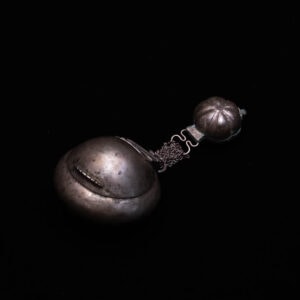
This is a very nice Miao torque with chatelaine pendants is particularly and unusually elaborate. The centre piece with 2 dangles is a symbolic silver lock with foliage designs in a scallop shape.
The weight and size of these locks varies a lot. The dangles are as varied as the locks themselves and may be pomegranates, lotus blossoms, monkeys, fish or pigs. Shapes may be scallop, butterfly, kidney, cylinder, rectangular, hexagonal, or multi-edged. The repoussé images may be floral, good luck symbols, dragons, mythological, folk-story or opera scenes. Chinese deities, calligraphy and Buddhist symbols, such as the lotus, peony and plum, were also popular.
During baby ceremonies throughout China during the Qing dynasty (1644 – 1912) the father or priest would drape a symbolic lock and chain over the baby’s neck to symbolically lock the child to the earth and safeguard it against evil spirits, who might snatch the baby away.
Teenage boys wore locks. Women also wore symbolic locks at their weddings.
There are some examples in Four Centuries of Silver, Personal Adornment in the Qing Dynasty and After, Margaret Duda, Times Editions, 2002, pages 32-41.
Please ask for the price (or make an offer).