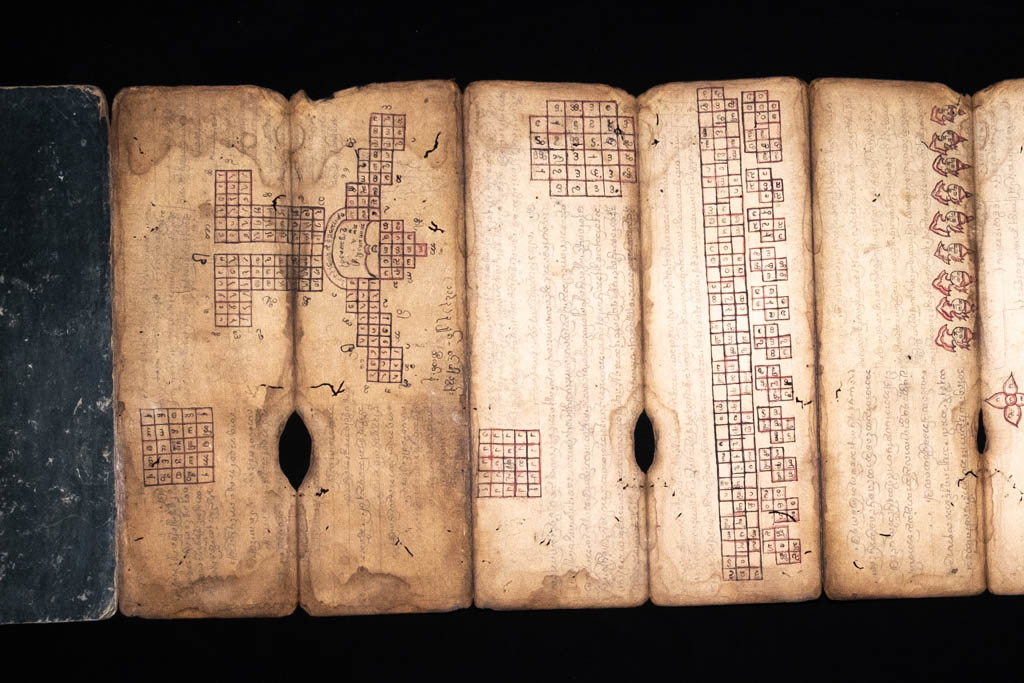
Product Description
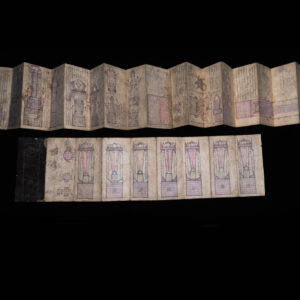
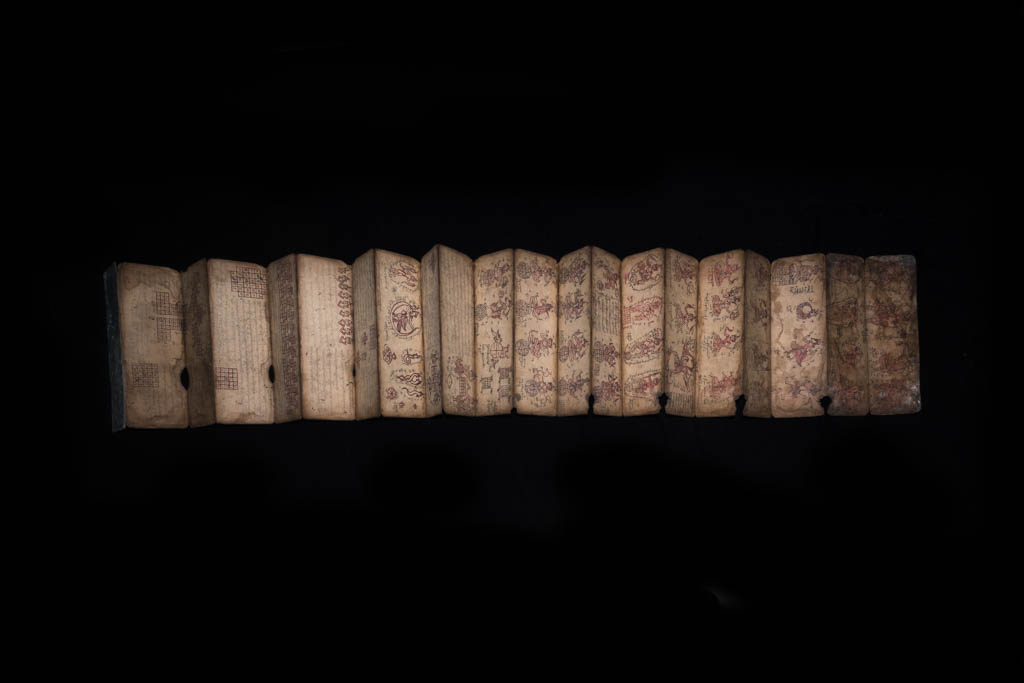
Antique Burmese Book 1
Material: Inner bark of the mulberry tree
Style: Burma
Size: Length 191 cm, Width 38.5 cm
Order Number: MHSTABB1
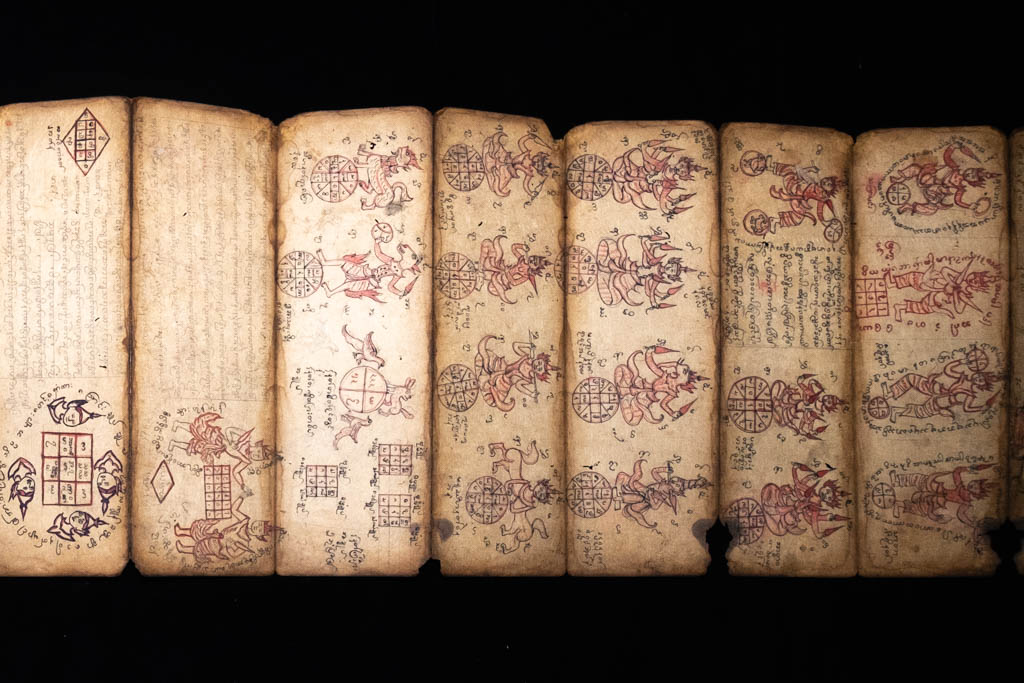
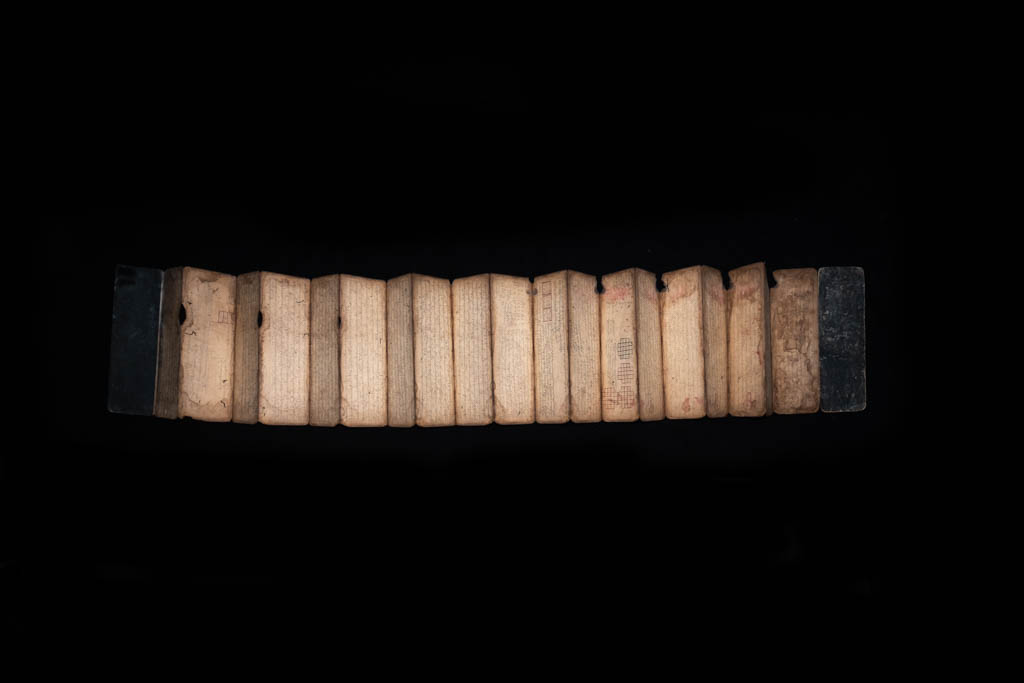
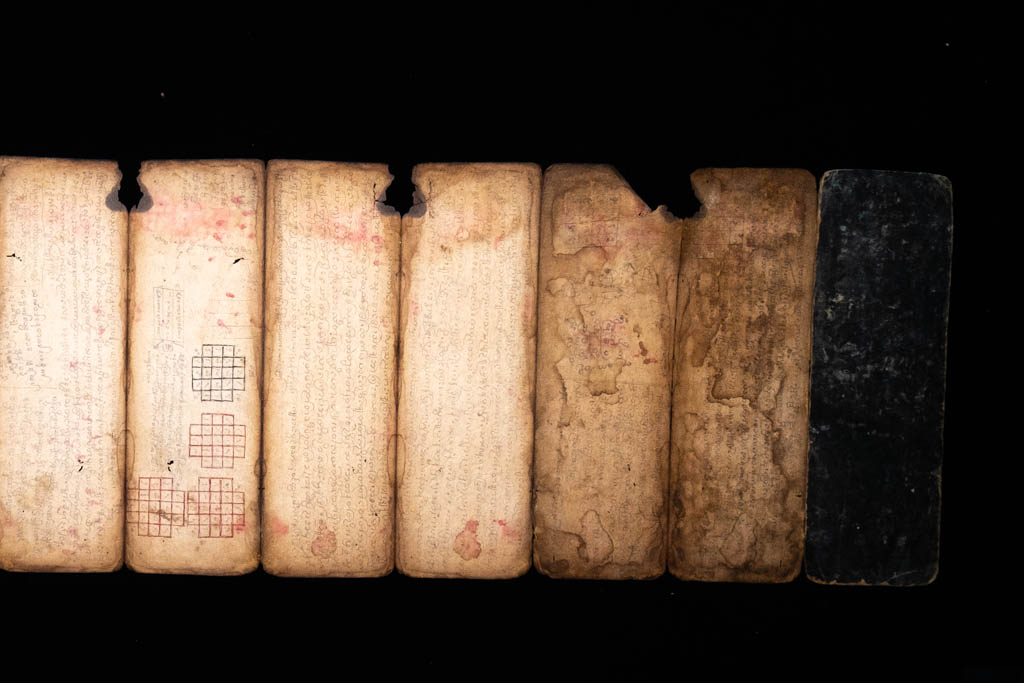
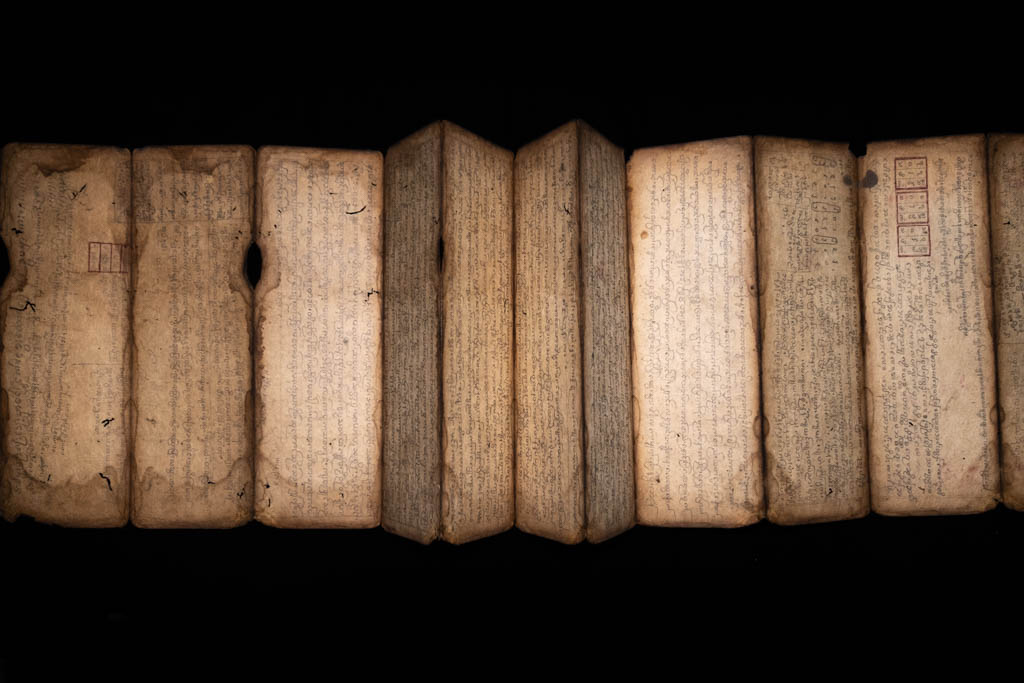
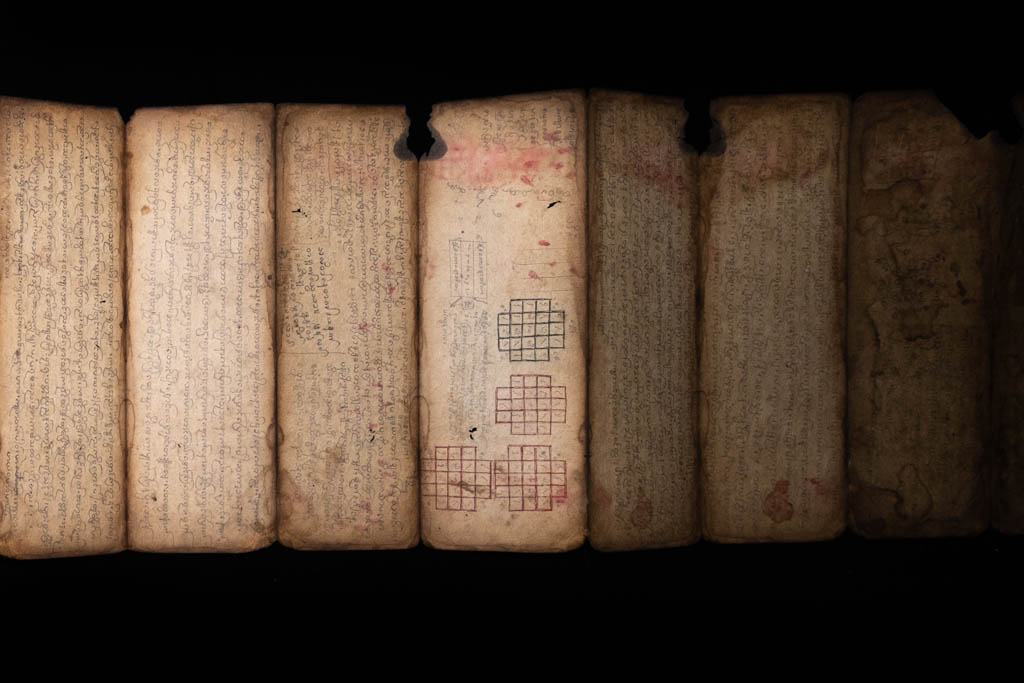
There are drawings and text on both sides. There are black covers and on one side there is a drawing on the other side of the cover. 19 pages.
Burmese folding books date back to the 11th century. They are called parabaik. They are strips of paper, made from the inner bark of the mulberry tree (Morus indica), up to 12 metres in length, folded like a concertina or accordion. The paper was made in the Shan States and is soft and fibrous and does not tear easily.
Front and back covers are made of 2 or 3 sheets of parabaik paper, sometimes thickened and hardened with black lacquer. There are black parabaik and white parabaik. The black ones are coated with charcoal powder and the white ones with chalk powder, black ink and gum. Black ink is made from soot and animal or fish bile. The white ones are finer. Writing is usually on both sides of the paper.
Red is from cinnabar. In Buddhism, red symbolises wisdom, dignity, fortune and virtue.
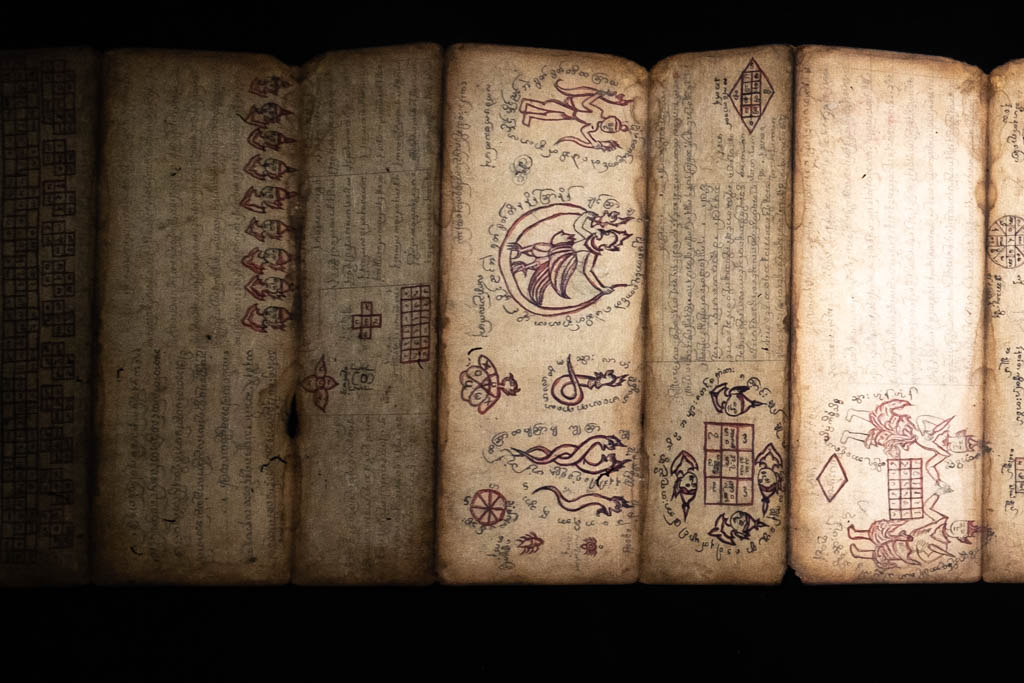
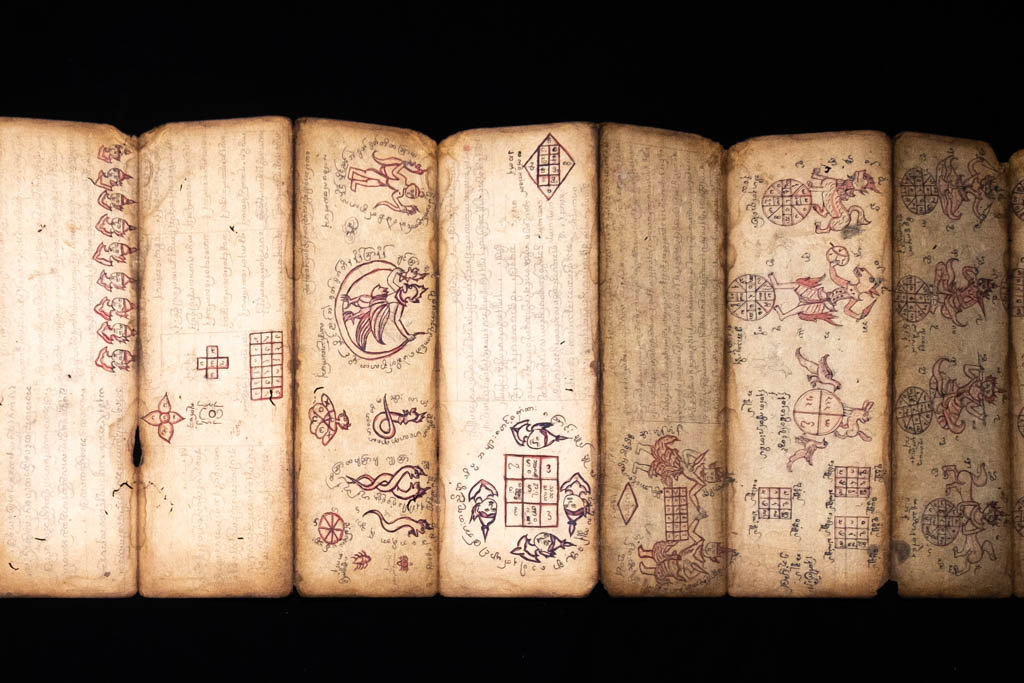
They are concerned with the magical religious systems of the Tai people of the Shan States of Burma and Lan Na (northern Thailand) and give information about Tai cosmology and cosmic power in drawings, diagrams and text. There are illustrations of spirits, spells in secret codes and syllables. Similar designs are found on clothes and tattoos. Some of the meanings are no longer known. Temple murals inspire some of the drawings.
The Shan and Lan Na people are Theravada Buddhists and include aspects of Hinduism and spirit religion. People visit experts called sala and some Buddhist monks, who can interpret them and perform rituals. They need to know the birth date of the client. There is faith in the power of nature. China influenced the Tai astrological system, especially the 12 year animal cycle of Rat, Ox, Tiger, Hare, Dragon, Snake, Horse, Goat, Monkey, Cockerel, Dog and Pig. Positive power is strongest at full moon. The moon is portrayed as a hare.
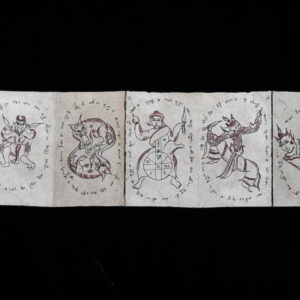
The books deal with spells, practices and incantations to create harmony in personal relations, protection and good luck. There are rudimentary drawings of magical animals, whose bodies are drawn with letters and numbers, Hindu gods, men and women. There are magic letters and numbers. Many numbers have meanings and supernatural powers, such as 3, 4, 8, 9, 38, 40, 56, 99 and 108.
Formulas to cure physical or mental illness, caused by evil spirits or an imbalance of the elements of earth, fire, water and wind, may be copied to a piece of mulberry paper for a candle ritual which takes place while Pali incantations are chanted. The ash from the burnt paper is mixed with water and drunk by the sick person. Drawings of ugly distorted creatures and deformed human heads are copied on to mulberry paper and rolled up in beeswax with a wick and a photograph of a sick person to form a candle and burnt to drive away evil spirits. Wild hogs, monkeys, lizards, tigers, cats and other animals are drawn so that their physical and mental characteristics may be transferred to humans.
Thick skins of wild hogs give protection against bullets, spears and swords, so a drawing on mulberry paper, burnt and drunk or rubbed into the skin is popular with soldiers and policemen.
Lizards bring good luck and protection, so a drawing on mulberry paper may be kept and touched in times of danger.
Cows give courage, so soldiers swallow a drawing on a thin piece of mulberry paper or it is rubbed into the skin with oil or burnt with a candle and the ash drunk.
Letters also form drawings of humans with various qualities. Actors, singers and teachers would pick one with good speaking attributes.
Women having sex with horses is quite common, the woman hanging on to the horse’s underbelly. It is a love talisman given to those seeking a permanent relationship.
Monkeys and cats are agile, intelligent and fast and their drawings are favoured by soldiers and criminals.
Diagrams in the shape of a candle, filled with letters and numbers, indicate a candle ritual and an accompanying intonation. Tiered diagrams in squares represent the planes of existence of Buddhist cosmology, which may be copied on to mulberry paper or cotton the height of the sponsor, tied to a wick, rolled in beeswax to make a candle, and lit.
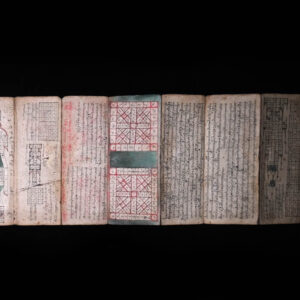
Horoscopes were written on cotton and on books made of mulberry paper. People consulted an expert sala to ascertain an auspicious day for a project. The day of a person’s birth is linked to a planet, a life force number and an animal. It’s a system of eight as Wednesday is counted as 2 – before noon and after noon. There is a box of 8 squares or 9 squares with the middle one blank. The sala fills in the boxes with the number for the birth day – Sunday is 1, Monday is 2, etc – and the corresponding life force number. He then counts clockwise for a man and anti-clockwise for a woman, adding them up until he reaches the person’s age. The sala compares the starting square number and final number and can tell if the person is in an auspicious time period for the project. It can be used to see if potential marriage partners are compatible.
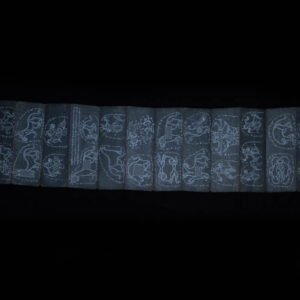
There are other divination systems involving numbers. Eight animals may be matched to the eight time periods. The animal at the starting point is compared to the animal at the stopping point and good or bad luck depends on their comparability. Animals such as naga, garuda, tiger, cow, cat, mouse, elephant, monkey, guinea pig, goat and lion.
Lucky numbers help in choosing lottery tickets, how much to give to a temple and how many offerings to present at a ceremony. Also when to travel, hold an event, build a house or even a city.
Before the early 20th century most people could not read or write unless they went to a monastic school and that was only for males. Buddhist monks and expert laymen made the manuscripts. The text is in a variety of Tai scripts, but Burmese, Khmer and central Thai script may also be used. Two or more scripts are often present. Shorthand is used. Words and phrases are sometimes placed inside diagrams.
There were no erasers. In case of a mistake, they applied a white lime paste to the surface.
Many magical parabaik books have not survived because they have deteriorated with humidity and age, were burned as part of a ritual, or have been eaten by white ants or other paper-eating insects. The ones that survive are bequeathed to a male ritual expert in the next generation. If there is no one, they are burnt at the last owner’s cremation or given to a local temple where they are ritually cleansed and placed in the library.
There are still some temples following the same procedures but modernised, for example, they use photocopies of the drawings and diagrams, rather than original drawings on mulberry paper.
19th – early 20th century.
Please ask for the price (or make an offer).