Product Description
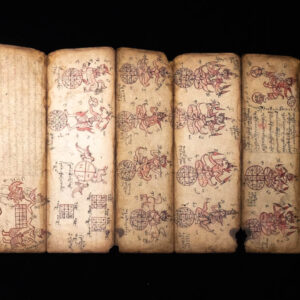
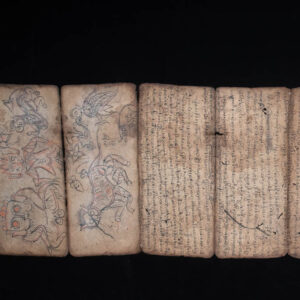
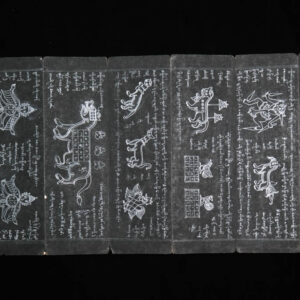
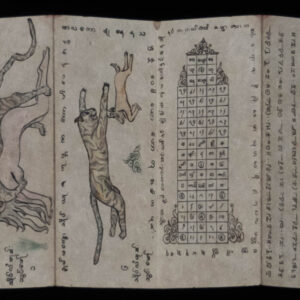
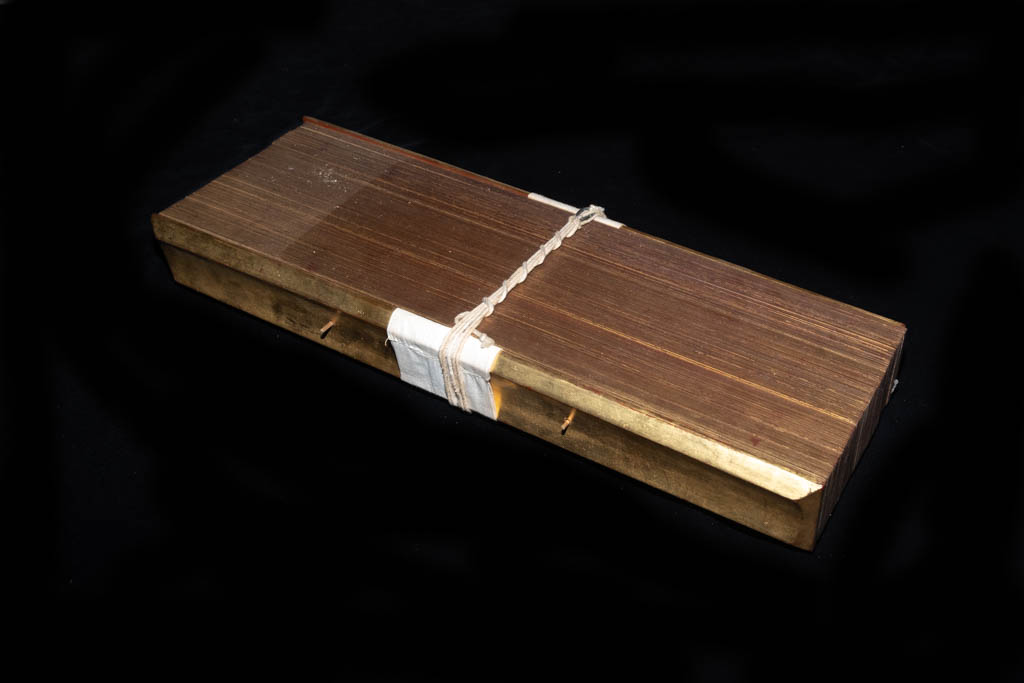
Antique Burmese Palm Leaf Manuscript
Material: Palm-leaf, lacquer, bamboo
Style: Burma
Size: Length 50 cm, Width 16 cm, Depth 5.5 cm
Order Number: MHSTABPM1
A religious palm-leaf manuscript bound between lacquered wooden boards. The edges of the leaves have been lacquered.
Palm-leaf manuscripts came to Burma from India together with Buddhism. The earliest book found in Burma dates to the 5th century AD. Monks made copies of Buddhist texts by writing on the leaves of the palmyra palm with a stylus. They were fragile.
The letters were engraved from left to right with a sharp iron stylus held perpendicularly by the first two fingers and thumb of the right hand, steadied by the thumbnail of the left hand. Both sides were inscribed. Writing was made visible by rubbing the surface with a cloth soaked in oil or a paste of ground charcoal mixed with gum. The number of leaves depended on the length of the text. It was a time consuming process and only a few pages could be written in a day.
The introduction of the printing press to Burma by missionaries in 1776 gradually led to the end of the palm-leaf book, and paper replaced them in the mid 19th century, although there are reports of monks using them in Upper Burma in the mid 1980s.
For binding the leaves were stacked in order and put between two wooden lacquered boards called kyan. The number of leaves depended on the length of the text. Two holes were bored through the folios and bamboo pins were passed through to secure the pages.
When read they were placed on stands and handled with care and respect. Women were forbidden to hold them on their laps. two hands were required to hold the palm leaves which were turned away from the reader after they were read.
Scribes were usually laymen hired by monks or religious lay people. While working the scribes lived in a monastery. Only a few pages could be transcribed in a day. 3,000 men were listed as scribes in the 1891 census. Sponsoring a manuscript gave the donor merit. One of the first duties of a newly crowned king was to commission a set of Tripitaka and present it to a monastery.
19th – early 20th century.
There is a similar one in Burmese Crafts Past and Present, Sylvia Fraser-Lu, Oxford University Press, 1994, page 281.
Please ask for the price (or make an offer).