Product Description
Antique Yantra Cloth 10
Material: Cotton
Style: Tak Province, Thailand, Lanna script
Size: Height 36 cm, Width 36 cm
Order Number: MHSAYC10
Cotton thread is used in Buddhist and spirit ceremonies. Spinning and plyng, that is twisting together a number of filaments, is carried out by village women after childbearing age. Cotton was produced locally and also imported from India. When woven, they have a slightly rough texture.
They made small talismanic cloths for protection and good luck, dress items, such as shirts, turbans, loincloths, skullcaps and hats, and large wall hangings, illustrated with text and diagrams using a stylus with black ink. If the yarn is loosely spun the illustrations will be irregular and if it is finely spun they will be smooth. The black ink is made from soot and animal bile. The artist may use a charcoal pencil to sketch the preliminary design.
Colours were obtained by using local plants, insects and soil extracts and painted on with a brush made of animal hairs. Indigo and cinnabar were the most popular and sometimes the colour seeps into others as a result of being sprayed with holy water. Later, commercial dyes were used.
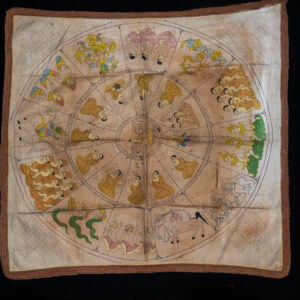
Some people commissioned Buddhist monks and expert sala to make mandala textiles to aid meditation in their homes. Work was carried out only on auspicious years and could take a year or even longer. Mandala textiles were also used as canopies and temple hangings and to protect the house and its inhabitants . Buddha, or more than one Buddha, is in the centre, representing moral discipline, surrounded by concentric circles of monks and guardian spirits displaying obedience, cosmological symbols, mythical animals and humans. Text in Pali surrounds them. The four guardians of the cardinal directions, or diagrams containing protective incantations, are in the corners outside the mandala. The sun and moon may be represented as a peacock and rabbit.
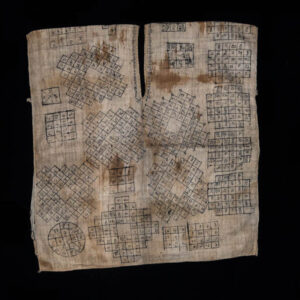
Horoscopes were written on cotton and on books made of mulberry paper. People consulted an expert sala to ascertain an auspicious day for a project. The day of a person’s birth is linked to a planet, a life force number and an animal. It’s a system of eight as Wednesday is counted as 2 – before noon and after noon. There is a box of 8 squares or 9 squares with the middle one blank. The sala fills in the boxes with the number for the birth day – Sunday is 1, Monday is 2, etc – and the corresponding life force number. He then counts clockwise for a man and anti-clockwise for a woman, adding them up until he reaches the person’s age. The sala compares the starting square number and final number and can tell if the person is in an auspicious time period for the project. It can be used to see if potential marriage partners are compatible.
There are other divination systems involving numbers. Eight animals may be matched to the eight time periods. The animal at the starting point is compared to the animal at the stopping point and good or bad luck depends on their comparability. Animals such as naga, garuda, tiger, cow, cat, mouse, elephant, monkey, guinea pig, goat and lion.
Lucky numbers help in choosing lottery tickets, how much to give to a temple and how many offerings to present at a ceremony. Also when to travel, hold an event, build a house or even a city.
Circular diagrams on the cloth, usually between three and twelve, record the placement of buildings, their direction and when built. The cardinal directions are in cruciform shape. They contained invocations to Buddha and the guardian spirits and the names of monks who had blessed the building. The cloth is kept in the rafters for protection.
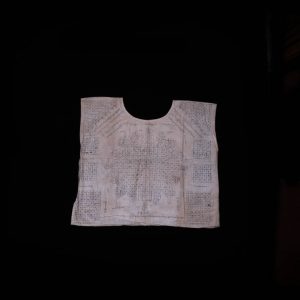
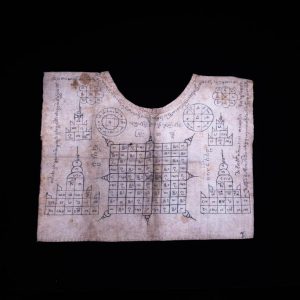
The cloth can be made into turbans, vests, jackets , headbands and armbands or maybe just a square, the size of a handkerchief, concealed in clothing. Drawings, diagrams of magic letters and numbers, incantations and magic spells gives clothes protective powers. The physical and mental characteristics of animals can be transferred from drawings to the person wearing the garment. A tiger can make a person ferocious, fast and stealthy. A wild hog is fierce and fearless and its thick skin resists bullets, swords and spears.
Clothes can also be charged with protective powers by covering the face or body of a corpse at a funeral. Printed formulas ward off bullets and stop guns firing or make the person invisible when magic words are chanted.
These protective cloths are unsophisticated and charming and unique works of art. They give protection in the same way that tattoos do. Many of the images and text are in the style of mulberry paper books. They are family heirlooms.
Buddhist monks or shamans write the yantra on the cloth. Meditating first until they are in trance, they write and chant simultaneously. Meditation and chanting increase the power of the drawings.
The number of yantra masters has severely declined in recent decades.
19th – early 20th century.
Please ask the price (or make an offer).