Product Description
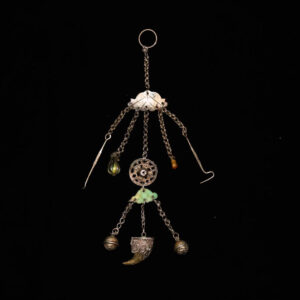
Antique Chinese Fingernail Guard
Material: Enamel
Style: China
Size: Length 9 cm
Order Number: MHSACFNG1
Finger guards are hollow metal sheaths which protect the long fingernails of aristocratic women. They are the most famous symbol of the Qing dynasty. They were usually made of luxurious materials such as jade, silver, gold or tortoiseshell, then inlaid with precious gems to show off the wealth of the wearer.
They are called 指甲套 zhijiatao (literally: fingernail covering) or 護指 huzhi (finger protection) in Chinese. They became popular in the Qing dynasty (1644 – 1911 AD) and proclaimed social status. They showed the wearer did not have to do manual labour.
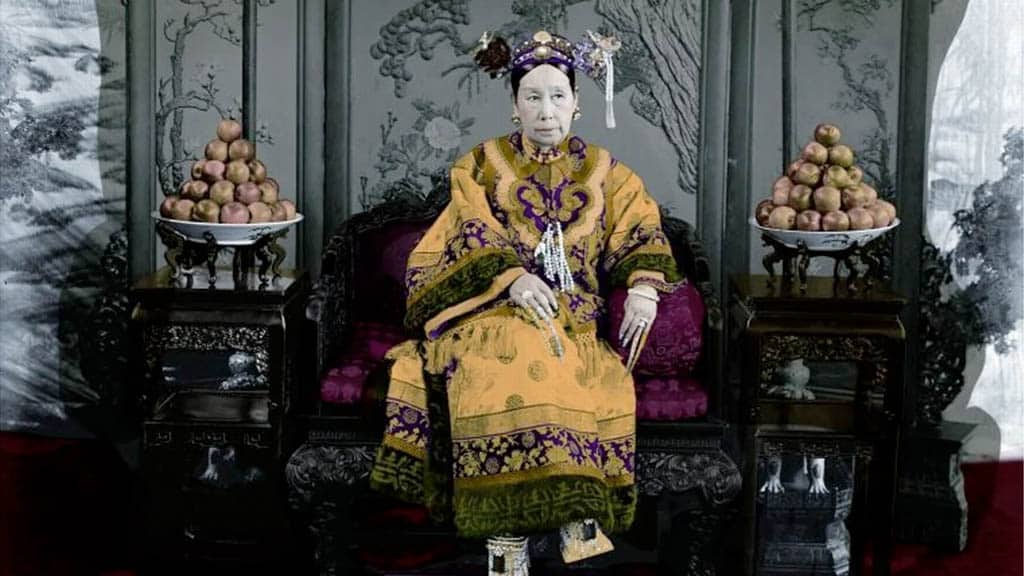
Empress Dowager Cixi (1835-1908) (above) wore fingernail guards on a regular basis. She loved sitting for elaborately staged photographs and many of these show her wearing long fingernail guards but only two or three on each hand.
Women usually had longer nails than men, which may be the reason we tend to see fingernail guards being worn by women in pictures and paintings.
They predate the Qing dynasty.
In 1979 a gold pair were found in a tomb from the Warring States Period (475 – 221 BC).
A pair of gold fingernail guards from the Han dynasty (206 BC – 220 AD) is on display in the Jilin Provincial Museum.
Ten matching cast silver guards were found in a Xian tomb from the Sui dynasty (581 – 618 AD).
Nails could only be cut on auspicious days. A member of the nobility kept his fingernail clippings so that he could be buried with them. When warlord Sun Dianying and his army pillaged the tomb of the Dowager Empress Cixi in 1928 they found a bag of her fingernails.
Everything of the body should be kept intact, because it signifies respect towards one’s parents, who give us our bodies, by not damaging one’s own body. A fingernail guard helps do this.
They range from 3 to 15 centimetres and usually come in pairs, worn over the ring finger and little finger. They can be worn on one hand only or on both hands.
The pin was added later to make it into an attractive brooch.
Early 20th century.
Please ask for the price (or make an offer).