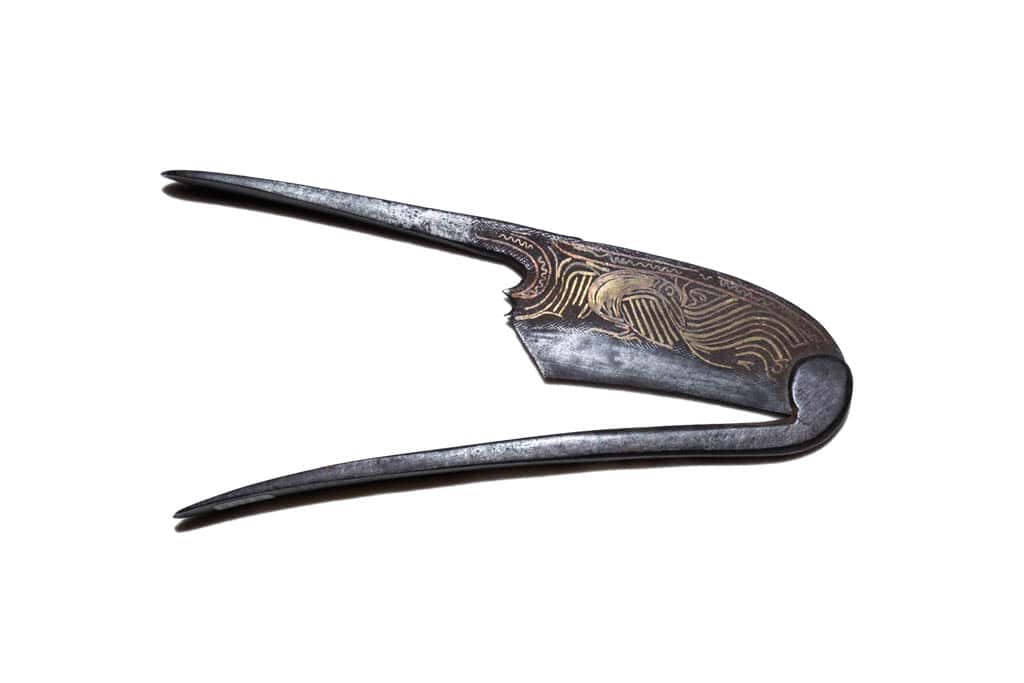
Product Description
Antique Burmese Betel Cutter 2
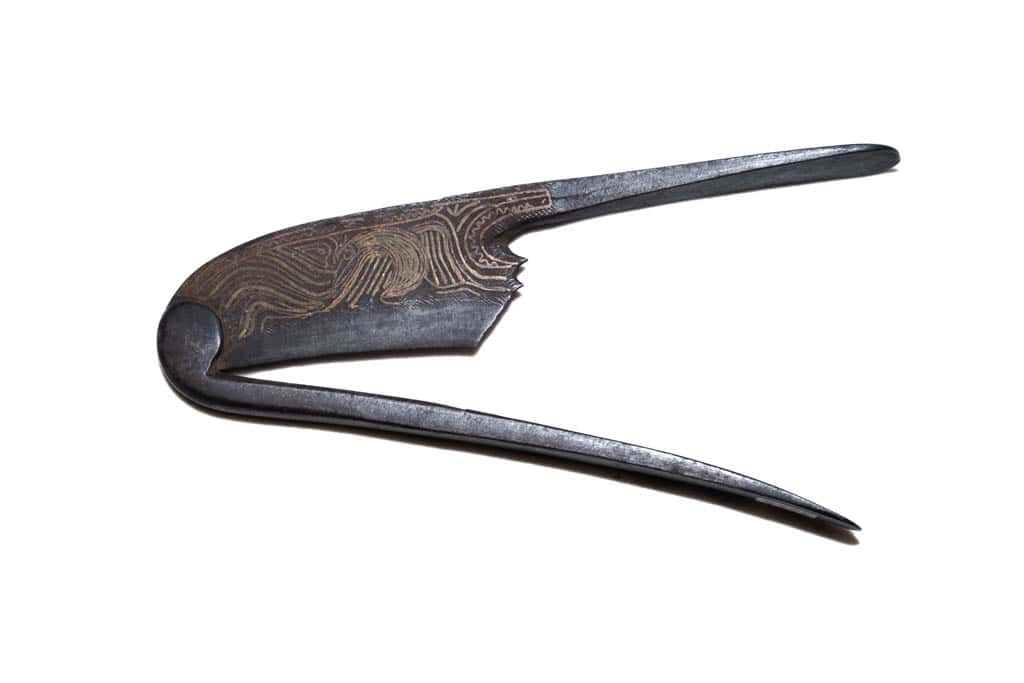
Material: Iron, inlaid with silver and brass wire
Style: Upper Burma
Size: Height 4 cm (closed), Length 16 cm
Order Number: MHSABBC2
The areca nut is one of the ingredients of the betel quid. The basic ingredients are betel leaf, areca nut and lime powder. Gambir and tobacco may be added to make it more fragrant. The hard nut is sliced into small pieces with a hinged cutter (caket). It is used like a small guillotine or a single bladed pair of scissors – with a vertical movement. There are 2 arms, one with an iron blade, and the other with a flat surface against which the blade falls. The rest may be brass or another kind of metal.
They were prestige implements, like the rest of the betel set, and commissioned by aristocrats and rich merchants. There are a multiplicity of designs. Brass and iron require different techniques and craftsmen. Being small, they travelled all over the region. Most are very elegant.
This cutter is inlaid with both silver and brass wire, on both sides of the body. According to Fraser-Lu (1994), Min-dan village in Yamethin district, just south of Mandalay in Upper Burma, specialised in decorating betel nut cutters with inlaid silver designs.
The blades were first forged from rod iron bought nearby Pyaw-bwe, and the area to be decorated was then scored with marks made y a chisel.
Using tweezers, strands of silver wire were carefully placed in position before being hammered into the iron. The cutter was gently heated and lightly hammered to bond the silver into the iron.
Further working with a cold chisel removed any roughness and brought the fine details into relief.
The origin of this kind of work may be about the middle of the 18th century.
Such cutters were exported to India via Madras and were often wrongly thought to have been made in Madras and became known as Madras cutters.
Min-dan village was visited by E. N. Bell in 1907, who wrote:
“Another artistic development has its home in Minden Village, Yamethin District, where every household depends more or less on its smithy, though there are only a few professors of the particular art to be described, which consists of an inlay of silver wire upon an iron surface.
The usual articles produced are ornamental dalwes or da-hmyaungs, scissors. katkyi, betel-cutters, kun-hnyat, hair-tweezers, hmwe-hnyat specimens of which are figured.
This industry is said to have had its origin five generations before Saya, whose son Saya Pyo, the chief local artist, turned out the articles shown in the illustrations.”
E.N. Bell I.C.S.; A Monograph on Iron and Steel Work in Burma.
Rangoon, Superintendent, Government Printing Burma, 1907.
The design is a fanciful bird with spread wings and an extended tail.
Early 20th century.
Min-dan cutters are described in Burmese Crafts: Past and Present, Sylvia Fraser-Lu, Oxford University Press, 1994, p. 148. There is a similar example in Betel Cutters, From the Samuel Eilenberg Collection, Henry Brownrigg, Thames and Hudson, 1992 on page 94.
Please ask for the price (or make an offer).