Product Description
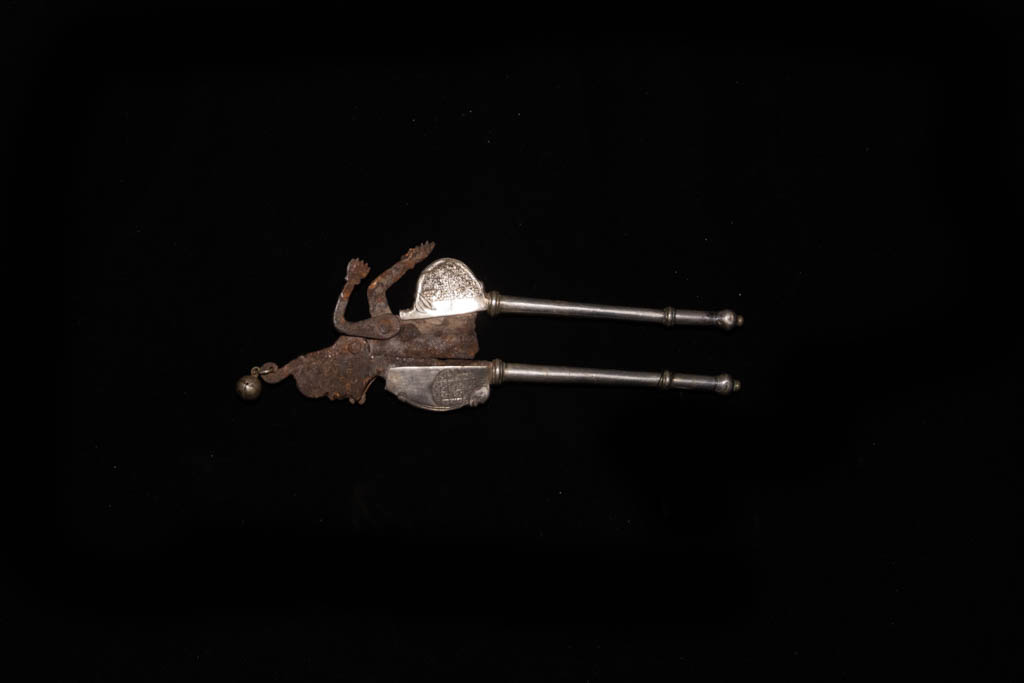
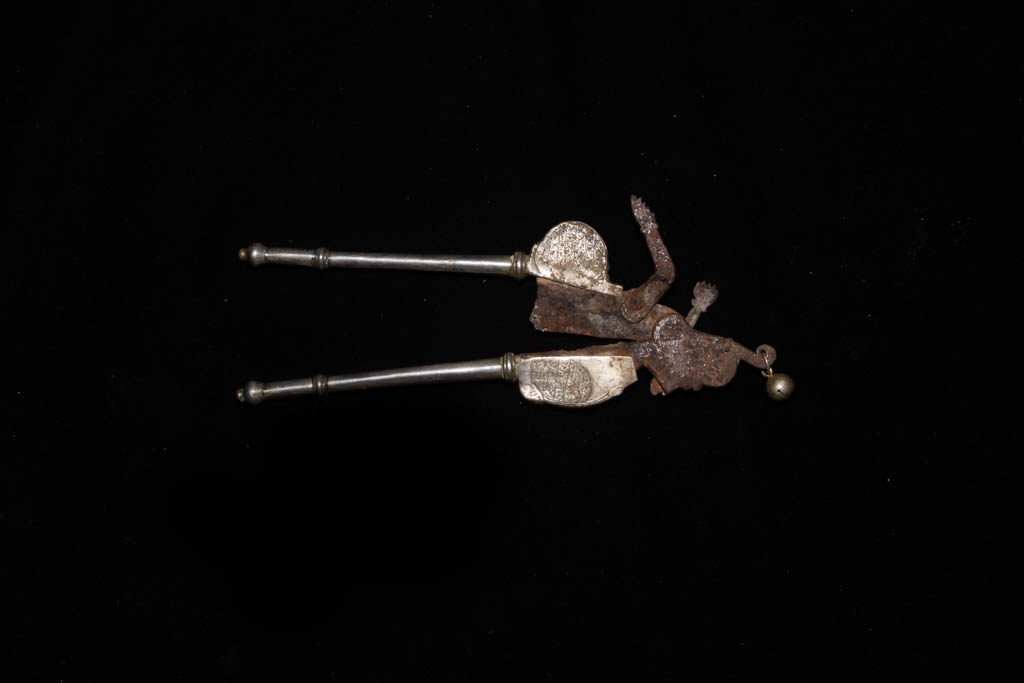
Antique Javanese Betel Cutter 1 SOLD
Material: Iron, silver
Style: Java, Indonesia
Size: Height 5 cm (closed), Length 16 cm
Order Number: MHSAJBC1
The areca nut is one of the ingredients of the betel quid. The basic ingredients are betel leaf, areca nut and lime powder. Gambir and tobacco may be added to make it more fragrant. The hard nut is sliced into small pieces with a hinged cutter (caket). It is used like a small guillotine or a single bladed pair of scissors – with a vertical movement. There are 2 arms, one with an iron blade, and the other with a flat surface against which the blade falls. The rest may be brass or another kind of metal.
There are 2 examples of cutters in Anuradhapura, the old capital of Sri Lanka, which was destroyed in 993 AD by the Cholas. The earliest written reference is in the Indian Basayapurana of Bhima-Khavi of 1369.
They were prestige implements, like the rest of the betel set, and commissioned by aristocrats and rich merchants. There are a multiplicity of designs. Brass and iron require different techniques and craftsmen. Being small, they travelled all over the region. Most are very elegant.
By the 12th century Indian metalworkers were in Bali and Java and impressive craftsmanship was applied to the cutters. In Indonesia, Thailand and Malaysia cutters are made of iron, which may be decorated with other metals.
There are animal motifs – usually horses, peacocks and dragons in iron, with incised mounts, sometimes in gold and silver. They typically have fins and crests with incised designs, inlaid with silver, gold or brass. The horse was probably introduced by Chinese metalworkers during the Bronze Age. The arched heads are similar to T’ang horses.
There are also stags and mythological animals. Mythical dragon birds are peculiar to Thailand. In Southeast Asia there are wayang figures from the puppet theatre, such as Arjuna and the comic Wak Long. Bali has birds and realistic roosters. In India and Sri Lanka there are parrot heads with gold mounts set with rubies. Some are abstract designs.
Many cutters from Bali and Java are silver plated, sometimes only on parts, such as manes and crests. Some parts may be left undecorated as a contrast. Eyes may be of glass, iron or brass. Some are minimalist and may just be suggested in the joint – often as a bird.
In Indonesia, Thailand and Malaysia the handles are made of iron, plain and usually sheathed in finely worked gold, silver or white metal. The end of the handles is usually a single knob, often slightly pointed and incised with a foliage design.
Indian cutters are often D-shaped of brass and steel, punched and pierced, and beaded. Those from Mughal-influenced areas of north India are frequently embellished by surface decoration. Apart from the odd parrot, north Indian cutters are mainly non-figurative, reflecting the Moslem prohibition on human forms, while those in southern India are highly figurative and sculptural.
Indonesian cutters come mainly from Bali, Lombok, Java, Madura, and Sumatra.
Sumatran ones from the Batak people have a snout shape or a horse with a flared mouth and arched neck and openwork mane, the hinge being an eye with a copper rim. Those from Palembang in south Sumatra are rectangular with the profile of a human face on in the inner side. There are humorous silhouettes of birds’ heads, elephants and wayang figures from Lampung.
Madurese ones have mythical monsters and birds and horses with openwork crests and manes.
In Java around the old capitals of Yogyakarta and Surakarta the blades are small and the handles are long and they have birds and nagas. The north coast have horses, stags and wayang figures, such as Arjuna or his servant Semar with articulated arms. In East Java they have small horses’ heads and elaborate manes.
Bali and Lombok have similar cutters, often robust and solidly made, and three-dimensional, including elephants, horses, birds, lions, wayang clowns, such as Twalen, the Balinese version of Semar, and his son Merdah, and Sangut and his older brother Dalem. The animals often have wings and a tail near the handle.
Silver and gold wire inlay is a Balinese speciality. The resulting pattern is often a swastika.
This Javanese betel cutter is in the wayang form, engraved with articulated arms, probably Gareng. his nose has a ball on it.
Gareng is a clown, son of Semar, who introduces light relief and social and political satire. He is a wicked, insubordinate, bawdy wit, with puns and double-entendres. He is expert at mimicing the high-blown speech of the aristocrats. Short, fat, with huge round eyes, he has a bulbous nose.
19th century – early 20th century.
Please ask for the price (or make an offer).