Product Description
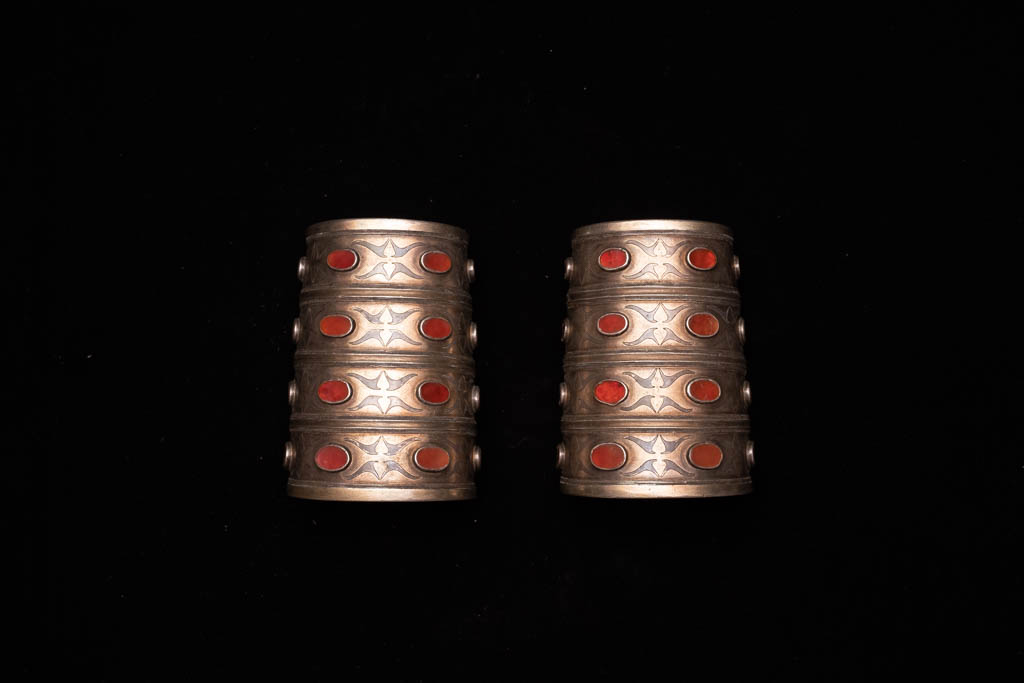
Antique Turkmen Bracelets
Material: Silver gilt, carnelians (4 rows of 4 carnelains)
Style: Turkmenistan, Central Asia
Size: Length 10.5 cm, Width 7 cm (top), 6 cm (bottom)
Order Number: MHSATB
Turkmens are a Central Asian Turkic nomadic ethnic group of about 3 million living mainly in Turkmenistan, northern and northeastern Iran and Afghanistan, Uzbekistan, Kazakhstan, and North Caucasus. About 1.9 million live in Turkmenistan.
The Turkmen are made up of more than two dozen major tribal groups, who were living in Central Asia from the 9th century. With the arrival of Islam in Central Asia, the Turkmen people converted, combining Sunni Islam with elements of their pre-Islamic faith, known as shamanism.
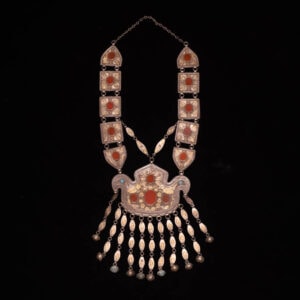
The most important Turkmen tribes, as far as jewelry is concerned, are the Tekke, the Yomud, the Ersari and the Sarik. The Tekke are the largest and most powerful. Turkmen artists are known for weaving carpets—largely the work of women artists—and making silver jewelry, which was the work of male artists.
Turkmen jewelry is now sought after by museums and collectors. It was worn mainly at weddings and for the first few years of marriage. Marriage was extremely important. Jewelry was part of the bride’s dowry, which included carpets and costumes. The textiles were made by the bride and the female family members. Quality gave the family prestige. The bride was given to the groom’s family laden with treasures to demonstrate her family’s wealth and importance.
The question arises how did these agricultural and herding nomads pay for this magnificent jewelry? It’s thought that it was by the slave trade. The Tekke tribe were particularly active in raiding for slaves in northeast Iran. In the 19th century about a million slaves were captured and sold in Bukhara and the city of Khiva. The money was then invested in silver jewelry, bracelets, collar buttons, necklaces and headdress decorations, for the women. Their way of life was pastoral nomadism – they moved where their flocks could graze as the seasons changed. For nomadic groups like this silver and gold were easy to carry.
Some pieces were protective amulets and talismans. Blue beads gave protection against the evil eye. Orange-red semi-precious carnelians were associated with fertility, blood and life. Shape also was important – triangles in the Middle East gave protection.
Tekke jewelry was symmetrical. A thin layer of gold was applied by heating gold dust and quicksilver. The quicksilver evaporates and the gold sticks to the jewelry. They liked carnelians more than the other Turkmen tribes.
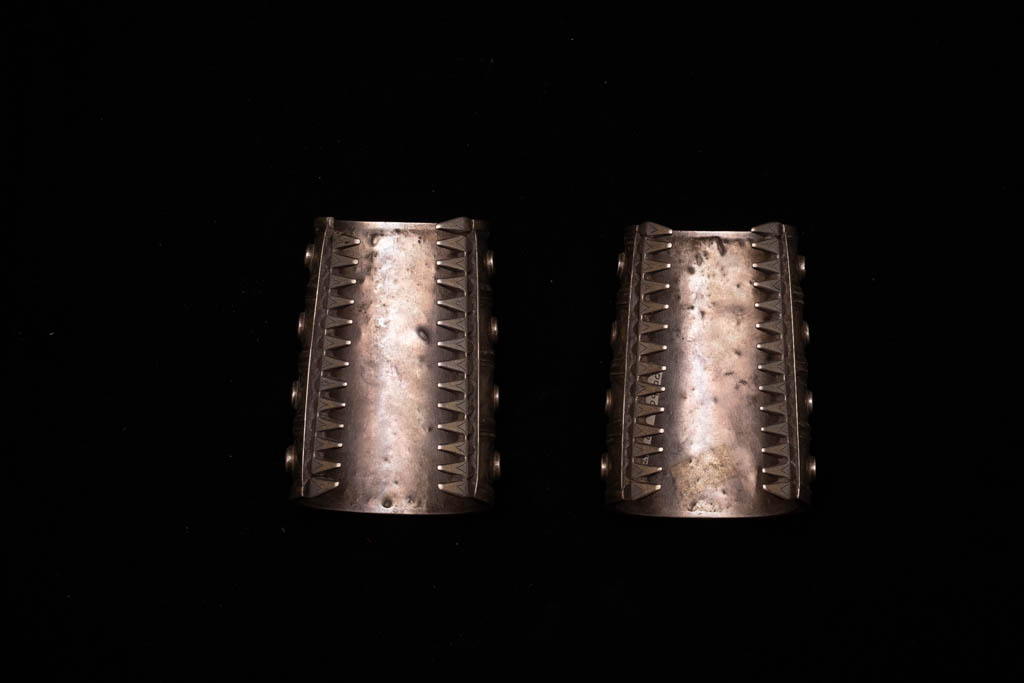
Turkmen double-walled gauntlet-like bracelets (bilezik) were typically parallel, horizontal bands, separated by narrow silver strips. Regularity was enhanced by rows of carnelians placed in the segments. The narrowest were 3 segments but 5 segments also existed. Most, as in this case, were narrower at the wrists.
At the back the bracelets had oval or sharp points with just enough space to slip it on the arm.
There are similar examples in Ethnic Jewellry from Africa, Asia and Pacific Islands, The Rene van der Star Collection, The Pepin Press, 2008, page 102.
19th century – early 20th century.
Please ask for the price (or make an offer).