Product Description
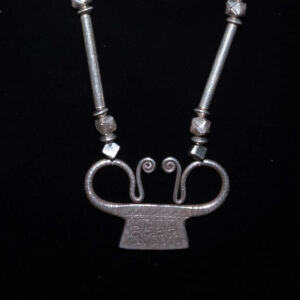
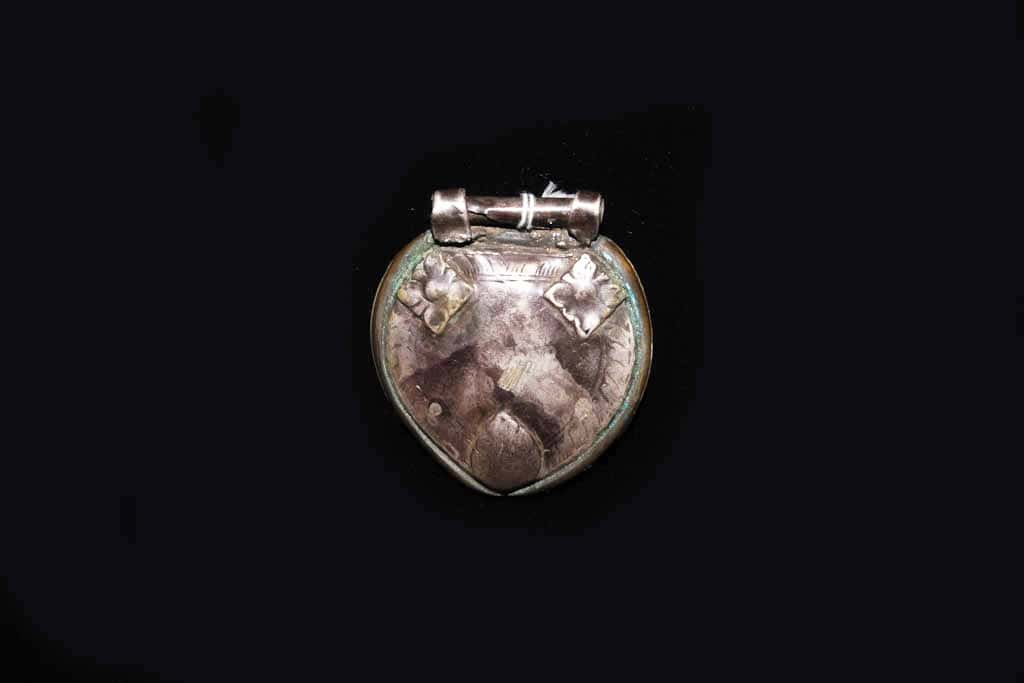
Antique Sulawesi Modesty Plate
Material: Silver
Style: South Sulawesi, Indonesia
Size: Height 6 cm, Width 5.5 cm
Order Number: MHSASMP1
Worn by pre-pubescent children, often with little else, heart-shaped modesty plates (caping) were believed to protect the young, who were particularly susceptible to sorcery and wandering spirits.
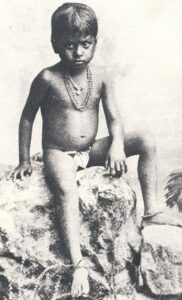 They were worn from the time that the child could stand on his or her own, that is about 12 to 16 months, until they were fully dressed, but. some still wore them beneath their clothes.
The caping was normally made of gold or a combination of gold and silver if the child was royal.
A wealthy, high-born family would have silver or gilded silver or copper.
An ordinary family, such as a fisherman, would make their own caping out of hard coconut shell, a flat piece of wood, seashell or brass.
Silver would have been made from silver ingots or silver trade coins melted and hammered or flattened.
They were tied around the waist by chains or strings in a tube or rings on the upper edge. Originally the colours of yellow, white, green, red or purple were reserved to royals . Commoners could only use green, white or red. Wealthy people wore silver wire cords.
They weighed about 30 – 40 grams. The shape was probably influenced by a betel leaf, which is associated with fertility and prosperity, as well as virginity and purity.
The first wearing would be accompanied by an important ceremony.
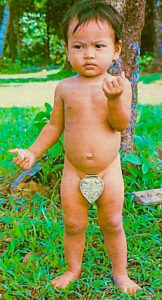 It is thought that they originated in India, where they were known as araimudi, and were brought to the Malay world during the Srivijaya period (7th – 12th century). Indian ones are more curved with more elongated lower parts.
Regional styles developed but they are all different. Some are decorated with a cross dividing the caping into 4 parts, some with floral designs. A common one is two embossed mangosteen calyxes at the top and a pointed oval bamboo shoot at the tip. They represent female breasts and vulva. Others look like shields.
They stopped being worn in the early 20th century.
There are examples in Gold Jewellery of the Indonesian Archipelago, Anne Richter and Bruce Carpenter, Editions Didier Millet 2011, page 250 and Malay Silver and Gold, Courtly Splendour from Indonesia, Malayasia, Singapore, Brunei and Thailand, Michael Backman, River Books, 2024, pages 243-246 and in the Asian Civilisations Museum, Singapore..
19th century or early 20th century.
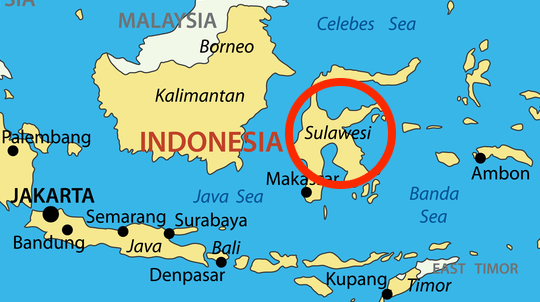 Map of Sulawesi.
Please ask for the price (or make an offer).