Product Description
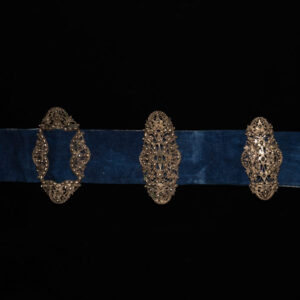
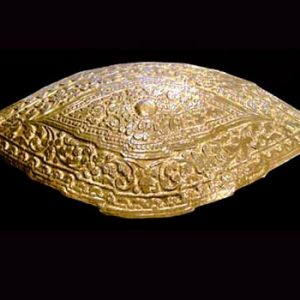
Antique Sumatran Belt Buckle 6
Material: Silver
Style: Minangkabau, West Sumatra, Indonesia.
Size: Length 22 cm, Width 13.5 cm
Order Number: MHSTACD0
The waist buckle (pending) was a part of Malay ceremonial dress and displayed the wearer’s social status, worn mostly by men, but occasionally by women, above the navel, with a cloth sash and belt to hold up the sarong, at ceremonial events, especially weddings. The back had a clasp attached to the belt and it was shaped like a lozenge, usually with pointed ends.
The buckle was made of brass, silver or gold. Royalty wore gold buckles decorated with precious stones. Rich, but non-royal people, wore silver. The rest wore brass.
The idea probably came from the Ottoman Empire, which traded with the Sultan of Aceh and other sultans in the area.
Typically the pattern is a central circle, with surrounding foliate motifs, all within an outer border at the edge of the buckle. The central eye may be a talisman to ward off the evil eye, the very central part resembling the pupil.
The Mingangkabau people live in the inland mountainous regions and hills and plains around Padang on the west coast of Sumatra. They claim descent from Alexander the Great. They are one of the world’s few matrilinear societies. Women inherit titles of nobility, houses and rice fields. It is also deeply Islamic.
Ceremonies are important and frequent, and magnificent ceremonial dress is worn. Islam began to spread into Sumatra in the late 13th century and the influence is seen in the arabesques and foliage.
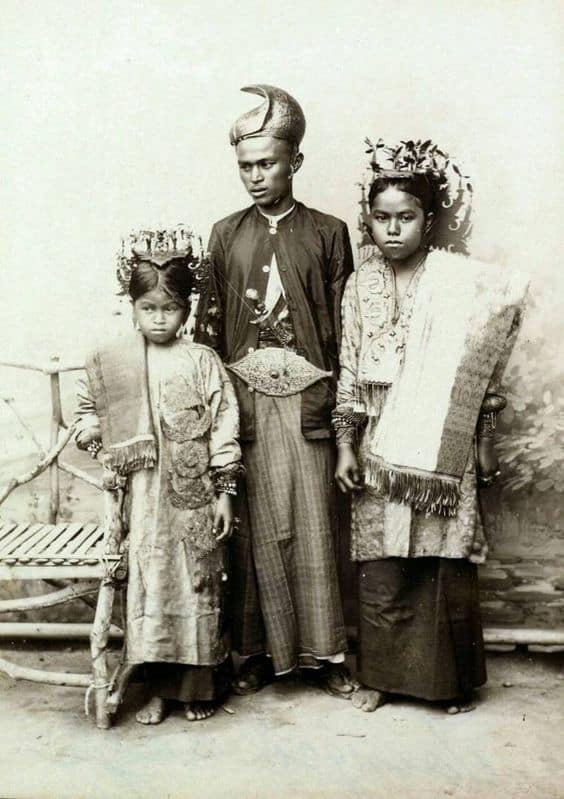
There are many examples in Malay Silver and Gold, Courtly Splendour from Indonesia, Malayasia, Singapore, Brunei and Thailand, Michael Backman, River Books, 2024, pages 214-223.
The chapter entitled Malay Waist Buckles, Allegories of Paradise, says at page 216, ‘Almost all are chased and engraved with motifs which can be interpreted as a stylised version of Paradise. This is a new way of looking at the iconography of the Malay buckle, but it is entirely plausible. Vegetation and gardens are all redolent of light, and for many Muslims, light is an extension of God, while vegetation and gardens – so dependent on light – are by implication an extension.’
Early 20th century.
Please ask for the price (or make an offer).