
Product Description
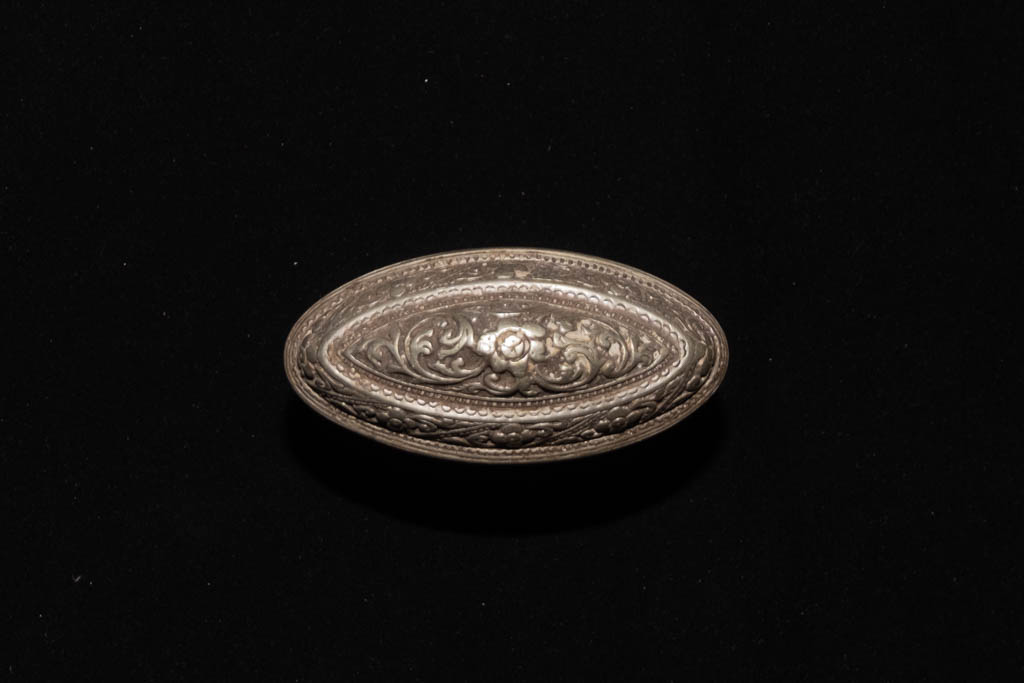
Antique Burmese Lime Container 7
Material: Silver
Style: Burma
Size: Height 6 cm, Length 6.5 cm, Width 3 cm
Order Number: MHSABLC7
The basic ingredients of a betel quid are betel leaf, areca nut and lime powder. Gambir and tobacco may be added to make it more fragrant.
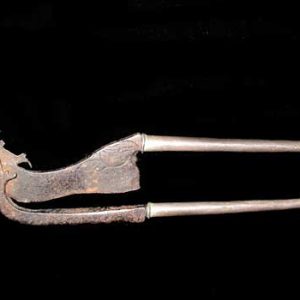
The containers and implements included boxes of various shapes and sizes to store the betel nuts, betel leaf holders for the already prepared betel quid, lime containers, hinged cutters, similar to scissors, to cut the hard areca nut, knives to cut the softer nuts, pounders to crush the nut, salve boxes to hold beeswax for the lips, spittoons, tobacco pouches and trays on which they all were displayed.
The Shan State in Burma (Myanmar) once made up a large number of traditional monarchies or fiefdoms. Betel boxes, flower bowls, and vases used in the palace were made of silver, rather than gold. Silversmiths hammered discs of silver into shape. Baw silver, at least 95% pure, was mined at Baw-dwin in the Northern Shan States. It produced light and flexible objects.
The silversmiths excelled in repoussé and chasing techniques, which involved hammering a sheet or disc of silver from the reverse side into a container and then covering it with lively figures and floral patterns in high relief. The work continued for affluent merchants and administrators after the fall of the palace and the start of the colonial period in 1885.
Distinctive boldly conceived, well-finished repoussé decoration is characteristic of Shan craftsmanship.
This solid silver oval lime container held powdered lime for the betel quid. The domed lid is repousséd.
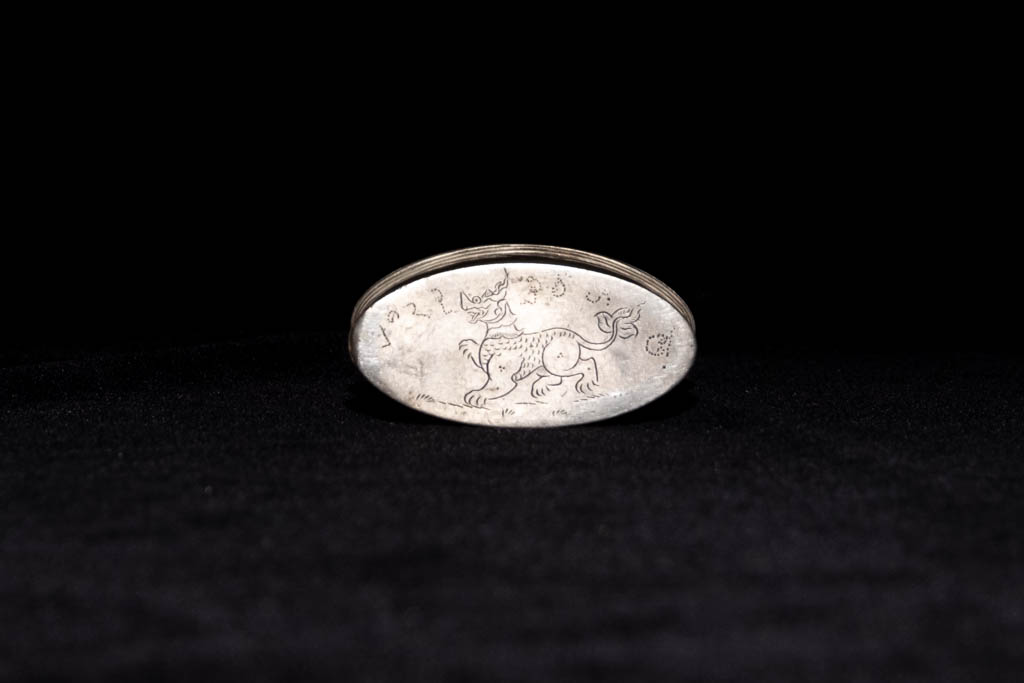
There is an inscription of a Burmese mythological animal on the base called a Pancarupa. It is a mythical winged chimera that acts as Guardian Protector. The name comes from the Pali word pancarupa, literally meaning ‘five forms’, being a combination of different animals: an elephant, bullock, horse, carp and toe (which is a fabulous horned animal). They are said to be the masters of water, land and air.
The inscription on the base also has Burmese writing. 283 – the full date must be 1283 of the Myanmar Era , that’s 1921.
There is a similar example in Betel and Miang, Vanishing Thai Habits, P.A. Reichart and H.P. Philipsen, White Lotus, 1996, page 77.
Please ask for the price (or make an offer).