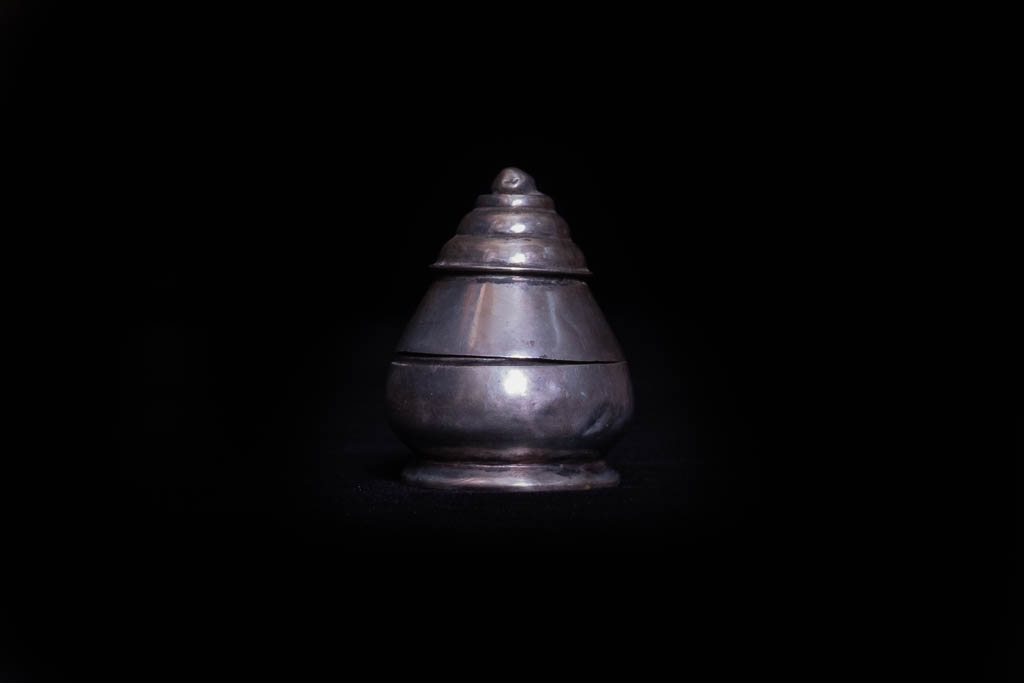
Product Description
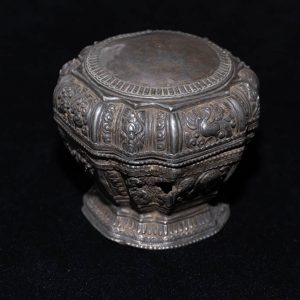
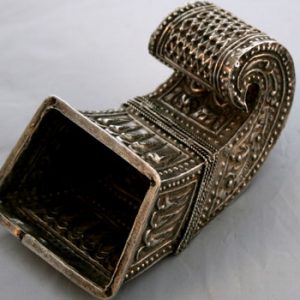
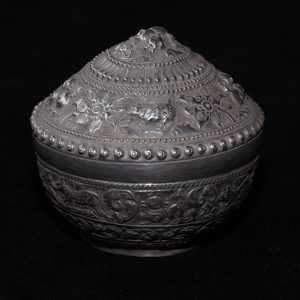
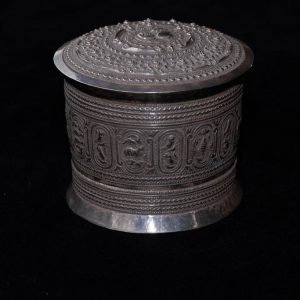
Antique Cambodian Lime Container 2
Material: Silver
Style: Cambodia
Size: Height 6 cm, Diameter 5 cm
Order Number: MHSACLC2
Silver objects have been found in Cambodia dating back 500 years. The Royal capital was in Udong from the 15th to the 19th century. In 1866 King Norodom moved the capital to Phnom Penh. Some master gold and silversmiths moved from Udong with the court and occupied quarters not far from the Royal Palace. In the early 20th century there were also skilled silversmiths in Battambang.
There were early foreign accounts of silver in Cambodia. Chinese records of Kaing T’ai and Chu Ying (3 AD) said ‘gold and silver were used for making utensils and decorated… .’
In the 13th century, Zhou Daguan, a Chinese emissary who lived almost a year in Angkor between 1296 and 1297, says ‘Cambodian silversmiths are experts in relief work.’ He went on to say, ‘Every person dining in the houses of nobles or rich people is given silver plates, and sometimes even gold ones … Then came other girls carrying gold and silver vessels from the palace and a whole galaxy of ornaments, of very special design, the uses of which were strange to me.’
Bas-reliefs of Angkor Wat, Bayon and Banteay Chhmar temples (12th century) depict people carrying richly decorated objects which look similar to silver pedestal-dishes produced by silversmiths in Koh Chen, Udong.
Zhou Daguan wrote, ‘No gold or silver is found in this country, to my knowledge, most in demand are Chinese gold and silver.’ In the 16th and 17th centuries, there were European traders and Portuguese advisers to the court. Portugal and Spanish traders imported silver from Mexico via the Philippines to Cambodia. In 1604 the Spanish priest Gabriel Quiroga de San Antonio mentioned the abundance of gold, silver and precious gems. A considerable amount of silver was imported to Southeast Asia from China and Japan.
There was surface silver mining in Bo Sup Trup in Cambodia since at least 1877 and underground mining from 1905 until 1911.
Thomas Wallace Knox, an Englishman who traveled throughout Southeast Asian countries in the late 19th century, mentioned precious objects that he saw in the house of the Siem Reap governor in 1871 after being entertained to dinner, ‘The Governor exhibited his gold betel boxes and other paraphernalia. He told us that all were made by a Cambodian goldsmith in Siemrap (sic) from the gold and silver coins of Hue, the capital of Annam, of entirely pure metal, and they certainly were very elegant in design and finish. We most admired the cigar case. The other articles were a large dish which contained the ‘kit’, a gold betel-leaf and lime holder; a small gold tobacco-box; a silver cup, with cigars and little silver box, made in the form of a fish, containing a perfumed ointment, used by the native noblemen to anoint their lips and nostrils.’
Silver repoussé boxes were made to contain lime and cosmetics. They usually have animal and plant motifs. The animals, usually crouching, are often astrological and mythological creatures and birds, such as kneeling elephants with upturned trunks, reclining deer, chickens, turtles, quails, geese, tigers, rabbits and lions. There are also fruits, such as mangosteens, pumpkins, and clam shells. Uniquely Cambodian is the lime container in the shape of a gourd decorated with flowers.
Some have characters from the Hindu epic Ramayana, often Hanuman, the monkey general, and his mermaid consort Supanamacha. Their monkey-fish child Michanu was also popular from the 19th century.
The boxes are made in two parts with the cover being the top of the animal. The join is hardly visible and it looks like one piece. The average length is about 10 centimetres. They are experts in relief work, delicate designs and careful workmanship, giving depth and texture.
Silver is expensive, so only rich and elites could afford a complete of silver betel utensils. Gold sets were reserved for the King and the Royal Palace. Commoners used boxes of brass and copper.
When tobacco was introduced to Cambodia, people, especially city dwellers, abandoned betel-chewing and turned to cigarettes. In the early decades of the 20th century, the silver betel set as symbol of prestige was replaced by tobacco and cigar boxes.
Small lime container in the shape of a funerary urn placed in a temple or home with a pagoda-like lid having three steps, a voluminous body, and stylised lotus bud-like tip. Flat socle and smooth undecorated surface.
There is a similar piece in The Musée de l’Homme in Paris, featured in the Catalogue: Le Bétel by Solange Thierry on page 238.
70-80 years old.
Please ask for the price (or make an offer).