Product Description
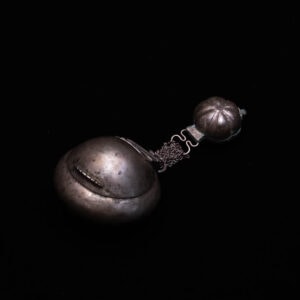
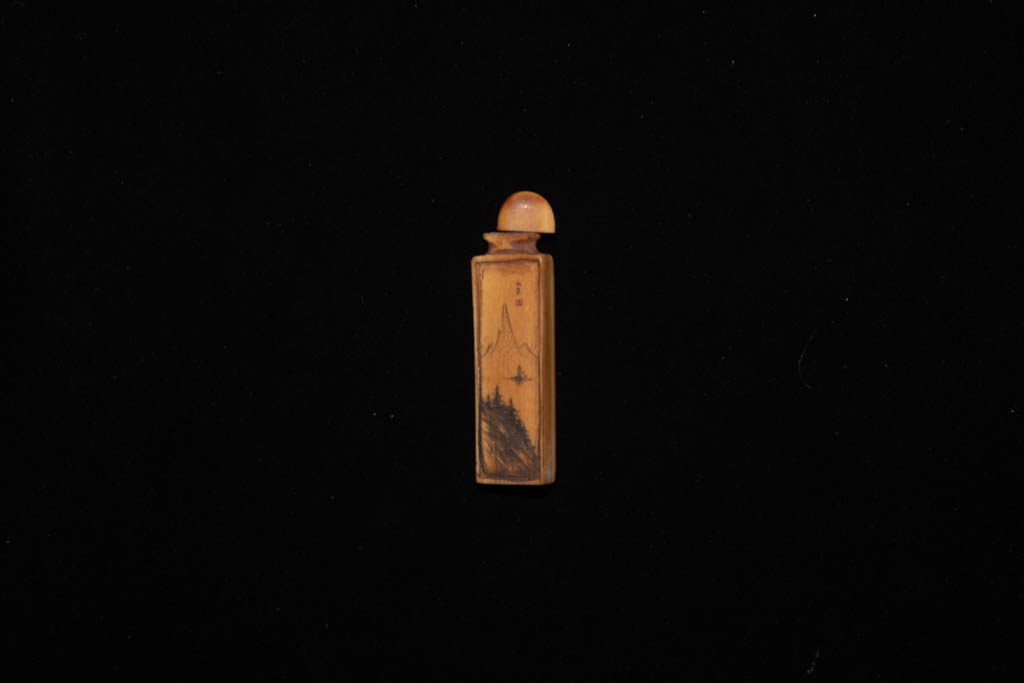
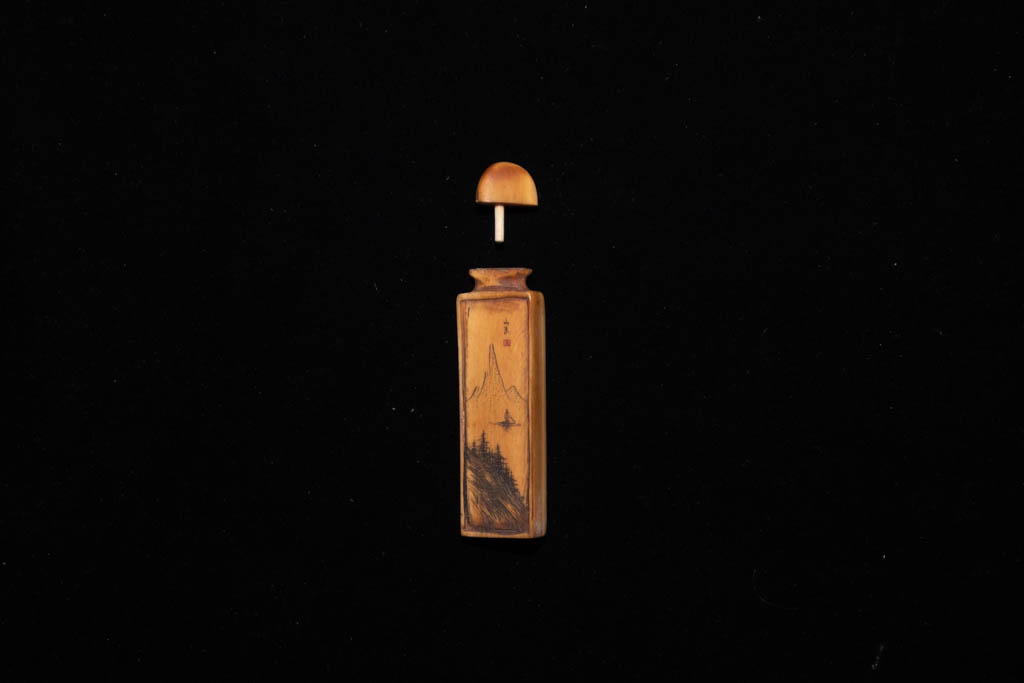
Antique Chinese Snuff and Perfume Bottle 1 SOLD
Material: Ivory or horn
Style: China
Size: Height 6 cm, Width 1.75 cm
Order Number: MHSACSB1
Snuff is powdered tobacco leaves mixed with aromatic spices.
Christopher Columbus saw the American Indians sniffing tobacco during his second voyage in 1494 and brought it back to Europe. It became fashionable in Spain and France, but was not popular in England until Charles II returned from exile in France – he was a fan.
It was popular in high society Europe and was taken by Queen Anne, Queen Charlotte, the consort of George III of England, George IV, Charles Darwin, Duke of Wellington. Lord Nelson, Napoleon, Alexander Pope, the actress Sarah Siddons and Mozart. Abraham Lincoln was also a connoisseur.
The Portuguese introduced it to China in the mid-16th century and gave it as a present to Emperor Kangxi (1654-1722 AD) in the 17th century.
It was originally used by members of the Chinese Imperial court for medicinal purposes, believed to ease headaches and digestive problems, and it then spread to all levels of Chinese society,
It was mass produced in the late 18th and 19th centuries. Domestic snuff came from the provinces of Shandong, Sichuan, Guangdong, Zhejiang and Jiangsu, and imported snuff came from Spain, France, and Scotland. The most highly prized was from Brazil.
The original small boxes were incompatible with the humidity of Asia, so the Chinese designed small bottles with narrow necks and added stoppers to keep the powder dry and maintain the aroma. Small bottles could be carried easily and fit comfortably in the hand. They were made from many materials, such as porcelain, lacquer, jade, ivory, metal, glass, horn (rhinoceros, buffalo), mother-of-pearl, tortoise shell, bamboo, and gemstones.
In the early 18th century, influenced by the Jesuit missionaries who were skilled in glass making and enamelling, there was a increase in making glass snuff bottles. After the end of the Qing dynasty in 1911, the use of snuff declined dramatically in China.
19th – early 20th century.
Please ask for the price (or make an offer).