

Product Description
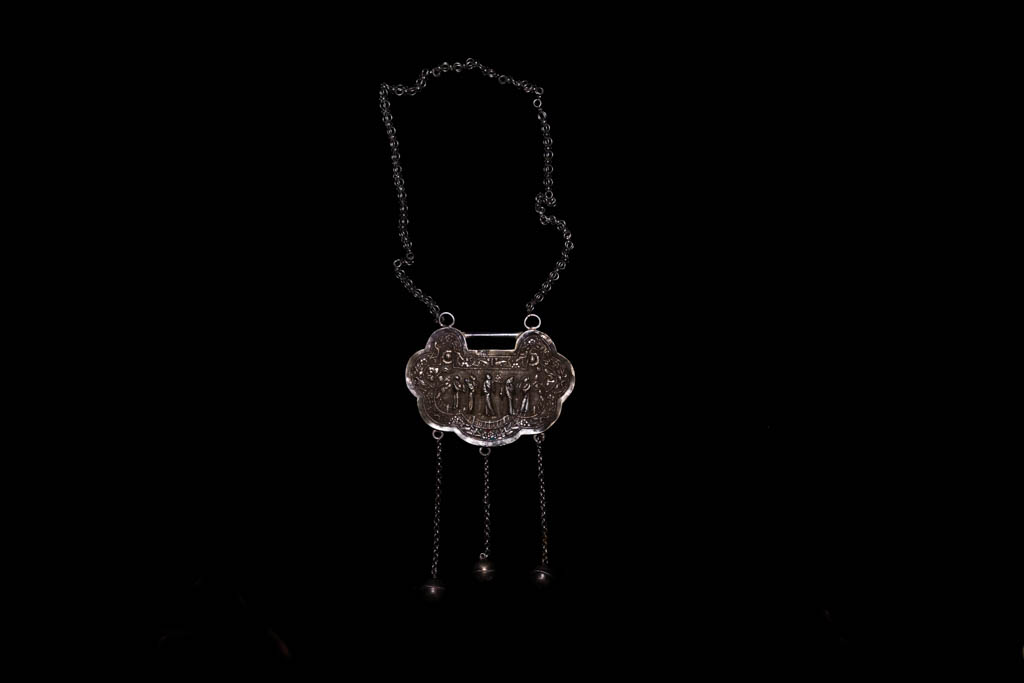
Chinese Symbolic Lock
Material: Silver
Style: Chinese
Size: Height chain 11 cm, Height lock 12 cm, Width lock 8 cm
Order Number: MHSCSL1
During baby ceremonies throughout China during the Qing dynasty (1644 – 1912) the father or priest would drape a symbolic lock and chain over the baby’s neck to symbolically lock the child to the earth and safeguard it against evil spirits, who might snatch the baby away.
Teenage boys wore locks. Women also wore symbolic locks at their weddings.
The weight and size of these locks varies a lot. The dangles are as varied as the locks themselves and may be pomegranates, lotus blossoms, monkeys, fish or pigs. Shapes may be scallop, butterfly, kidney, cylinder, rectangular, hexagonal, or multi-edged. The repoussé images may be floral, good luck symbols, dragons, mythological, folk-story or opera scenes. Chinese deities, calligraphy and Buddhist symbols, such as the lotus, peony and plum, were also popular.
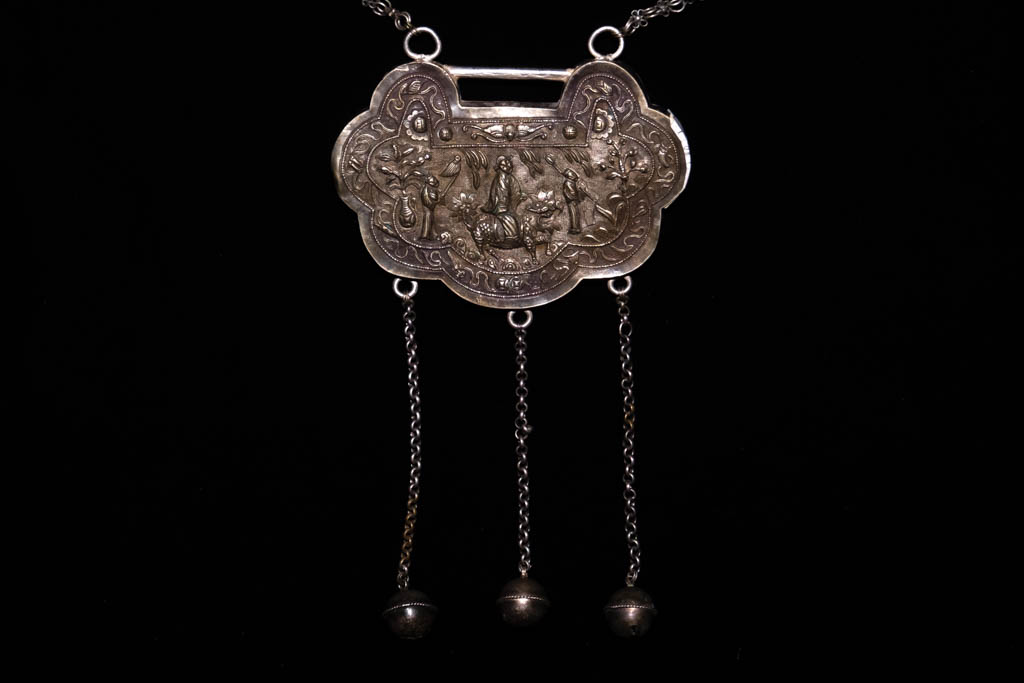
One side of the lock has a scene of five people, with floral designs, and on the other side there is a young man riding the mystical qilin, which shows the wish for a son to became an important official.
Qilin is pronounced ‘cheelin’. During the Qing dynasty every qilin hung on a detachable chain.
The young man is wearing the robes of a successful civil servant examination candidate. He appears to be smiling with joy. The qilin is sometimes called a unicorn in Chinese literature. It has a dragon’s head with one to three fleshy horns tipped with hair, a scaly body shaped like a deer, horse’s hooves, and a lion’s mane and tail. Qilin ate grass, never meat, moved regally and had a musical voice. Fluffy clouds surround the animal.
Qilin are one of the Four Mythical Creatures, along with the dragon, tortoise and phoenix, which together bring order to the universe. Qilin rule the west, facilitate autumn, time of maturity and fulfillment. Dragons reign over the east, influence spring by determining rainfall levels, The tortoise controls the north, initiates harsh winters and is a symbol of longevity, The phoenix controls the south and summer, represents happiness and warmth and appears only during times of peace.
Boys started to prepare for the exams at the age of 8 or 9 and continued into their late teens. When the young man went to the capital to take his civil service exams, the walls around the room were decorated with paper qilins. Embroidered qilins hung on the walls of many houses to bless the family with a distinguished son.
In this one the young man wears the long official gown of a candidate coming first in his exams. The qilin is in motion. Bells are on the end of the dangles to frighten away evil spirits.
There are examples in Four Centuries of Silver, Personal Adornment in the Qing Dynasty and After, Margaret Duda, Times Editions, 2002, pages 32-41 and 59-65.
Please ask for the price (or make an offer).