Product Description
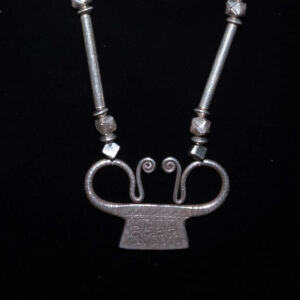
Yao Neck Rings
Material: Silver
Style: Yao
Size: Height 26 cm, Length 26 cm
Order Number: MHSHNR1
Many visitors to Northern Thailand will have seen Yao people. The women wear turbans and a flowing gown with a red woolly collar and hand embroidered trousers. They carry their youngest child on their backs in a decorated cloth babycarrier. The men wear indigo jackets with silver buttons.
They are scattered in many parts of South China, Vietnam, Thailand and Laos and practise slash and burn agriculture, producing mainly rice for themselves and maize for their poultry and pigs. They also grow opium.
The Yao are a very ancient minority. During the last 1,000 years they have migrated slowly from central China to the southern provinces and from there to north Vietnam, northern Thailand and northern Laos.
Reference to Yao was made first in a T’ang dynasty (618-906 AD) document – mo yao – meaning ‘not subject to compulsory service’. It probably indicates a settlement following a Yao rebellion. The mo was dropped during the Sung dynasty (960-1279 AD).
They broke up into several groups and sub-groups. They speak four main languages. The largest segment, about two-thirds of the Yao population, are the Mien and Mun language speakers.
The Yao have a close affinity with silver and it unifies all the Yao groups. They wear it every day and believe it keeps their souls within their bodies. A good part of their savings was invested in silver and passed down the generations. They did not use gold.
Old Yao silver displays excellent workmanship. Yao silversmiths are often priests, who use basic tools. They get their silver by buying it and melting down silver ingots, old silver chains and silver coins. Symbols, such as multi-pointed stars, are deployed, whose meanings have been forgotten.
Hollow neck rings or chokers are worn close to the body. The Hmong have adopted the style.
The White Hmong and the Green Hmong are two sub-groups of the Miao people. The majority live in South China. During World War II the Chinese tried to stop them speaking their own language or wearing their distinctive dress, but they failed.
Many migrated to Laos. By 1850 they were established in the mountains around Luang Prabang. By the end of the 19th century there were several Hmong villages in Thailand. In 1984 there were 245 villages.
The Hmong keep much of their wealth in silver jewelry. All Hmong – men, women and children – wear silver neck rings on special occasion, such as on New Year, when all their family silver is worn. It announces their wealth and indicates the likely size of a girl’s dowry. One woman might wear 50 silver pieces weighing 6 to 9 kilograms.
At a child’s naming ceremony the baby is given a silver neck ring to keep the soul and to show that the baby belongs to the human world.
Neck rings, solid or hollow, are worn either singly or in sets up to six tiers, five being the standard number.
This one is unusual as there are seven tiers. It is hollow. It is not believed to be very old.
There are examples in The Yao, The Mien and Mun Yao in China, Vietnam, Laos and Thailand, Jess G. Pourret, River Books, 2002, pages 146 and 147.
There are also similar examples in Peoples of the Golden Triangle, Six Tribes in Thailand, Paul and Elaine Lewis, Thames and Hudson, 1998, page 53.
Please ask for the price (or make an offer).