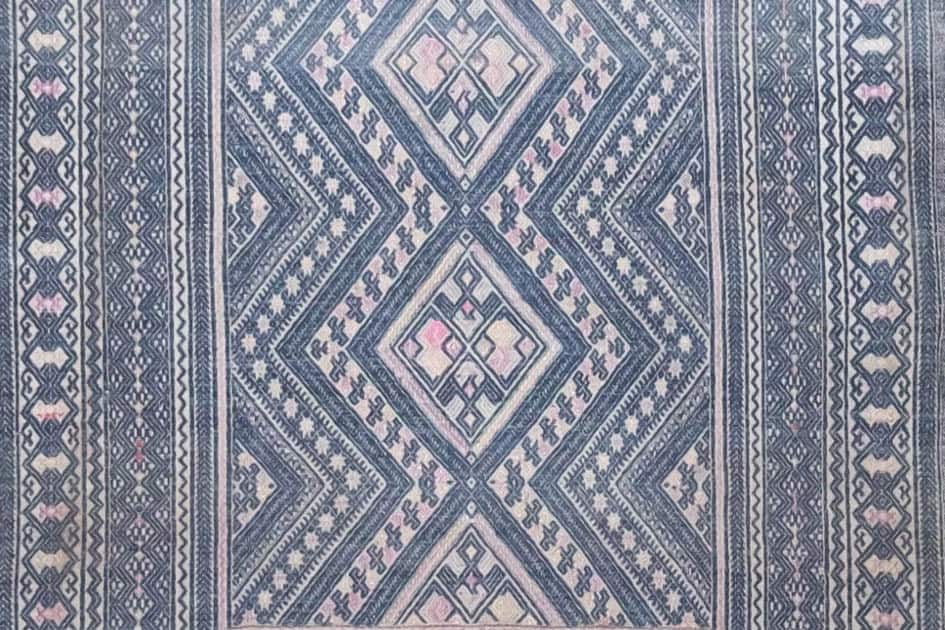
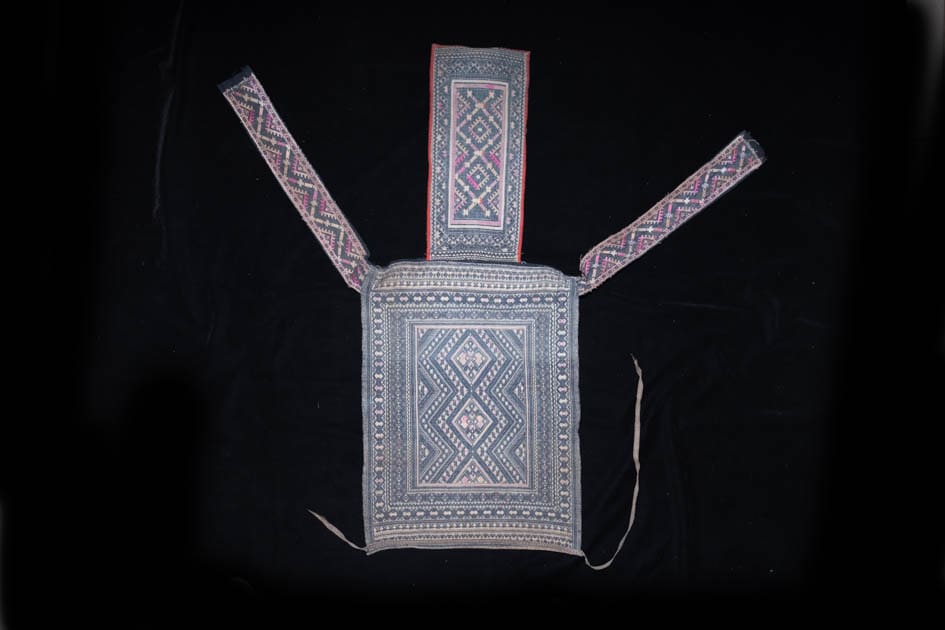
Product Description
Hmong Baby Carrier
Material: Cotton
Style: Hmong, South China
Size: Height 82 cm, Width 36 cm
Order Number: MHSHBC1
The Miao people are one of China’s major ethnic groups. They live in southern China mostly in Guizhou province. Miao sub-groups such as the Hmong live in northern Thailand and eastern Burma. The Hmong first started to migrate out of China and into Southeast Asia around 1800.
The Hmong have 2 major branches, the White Hmong and the Green Hmong. The Blue Hmong are also called Green Hmong. The names come from the colours of the Hmong style clothing worn by each group.
Many migrated to Laos. By 1850 they were established in the mountains around Luang Prabang. By the end of the 19th century there were several Hmong villages in Thailand. In 1984 there were 245 villages.
During World War II the Chinese tried to stop them speaking their own language or wearing their distinctive dress, but they failed.
Costumes and ornaments are considered by the Miao not only to satisfy the basic needs of life but also as precious works of art that represent the thoughts and efforts of the Maio people. They have mastered the arts of embroidery and batik.
Miao embroidery employs bold colours – green, red, bright blue, orange, yellow and white, often on a black or blue background.
They also used geometric patterns. The designs are delicate and clear cut. The geometric patterns are similar to those of the Yao people and they may have had a common ancestor.
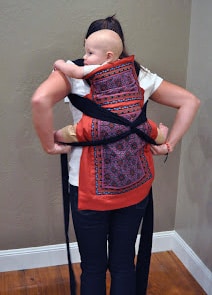
Hmong mothers devote their finest skills in making baby carrying cloths and caps. A carrying cloth resembles a bibbed apron. It is made of 2 rectangular pieces of cloth, the smaller at the top, joined together at the borders.
Straps attached to the outer corners tie around the mother’s body to secure the baby on to her back freeing her hands for other tasks.
Textiles and clothing are prized by the Hmong as family treasures, as examples of women’s needlework skills and symbols of collective ethnic identity.
There are two Hmong dialects: Blue and White. In Blue Hmong, a baby carrier is spelled hla nyia. In White Hmong, it is spelled daim nyias.
Women receive a baby carrier from their mother and/or mother-in-law when they marry or give birth to their first child for its use, but also to show desire for the couple to have many children. Hmong men and women are not considered to be adults until they have children.
When a baby is born, its paternal grandmother will make a baby carrier or a hat. Both of these objects provide physical as well as
spiritual functions, because the decoration will attract and help keep the baby’s soul in the body as well as draw protective spirits.
Baby carriers are used to carry and care for babies and small children and protect them from physical and spiritual harm. In Laos, mothers carry their infants or small child in a baby carrier to the family fields to work. Keeping the child in the carrier keeps them out of harm’s way which includes the child wandering off, hurting themselves, or being attacked by wild animals.
The spiritual protection comes from the surface embellishment which foils malevolent ‘wild’ spirits and prevents them from taking or enticing the child’s soul to leave the body. A person becomes ill when his soul leaves the body. The geometric patterns on the central panel keep the child’s soul from leaving the body and the bad spirits from getting close to the child.
During Miao holidays they wear their colourful costumes.
Early 20th century.
Please ask for the price (or make an offer).