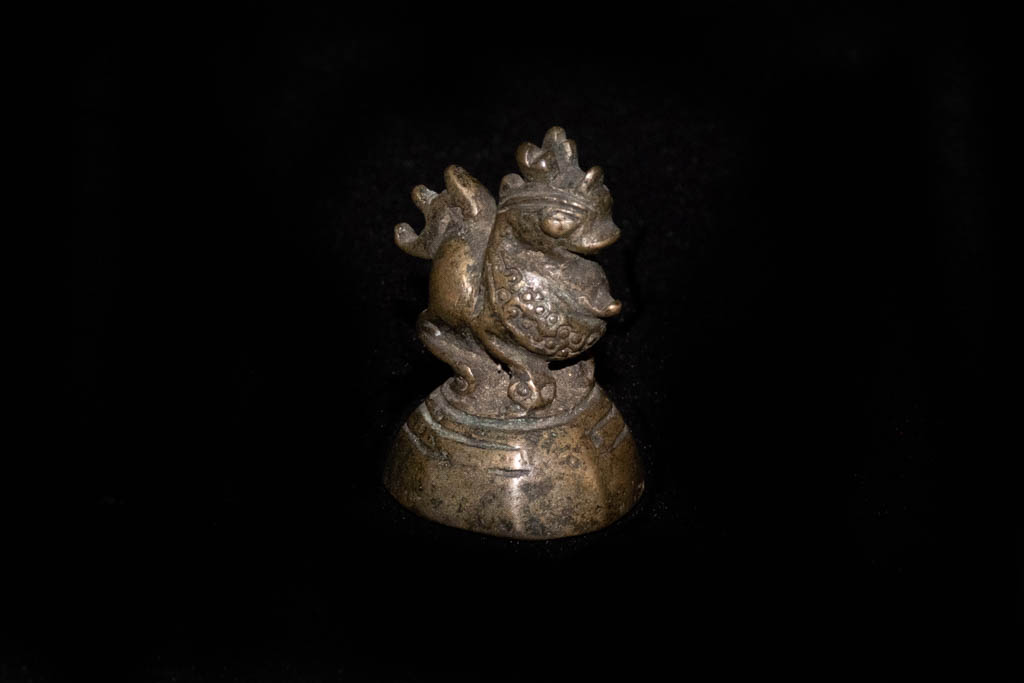
Product Description
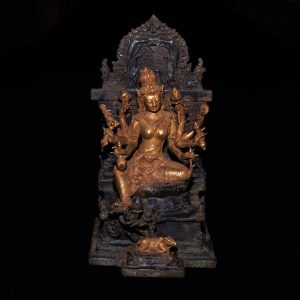
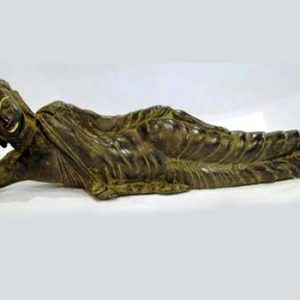
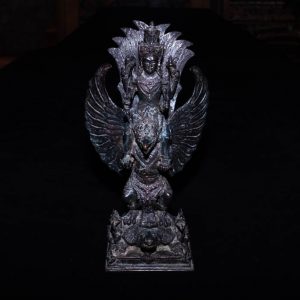
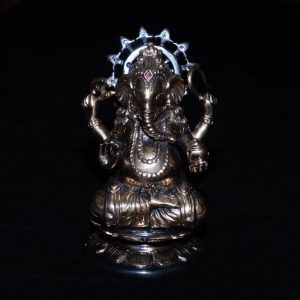
Antique Cambodian Opium Weight 4
Material: Bronze
Style: Cambodia
Size: Height 4 cm
Order Number: MHSACOW4
They are called ‘opium weights’ but this is not strictly correct. They were used in Burmese, Thai and Cambodian markets in the 16th-19th centuries to weigh food and everyday goods, as well as gold, silver and pearls. It is not known when they first came into existence.
The British associated these countries with opium, but is a myth that they were used to weigh opium. Goods were measured using two baskets or trays hanging from a beam. The weight was put in one basket and the goods were placed in the other basket.
Visitors to the court of Pegu in the 16th century mentioned that silver was weighed with ‘curious animal’ weights. In 1855 an emissary of Queen Victoria called Yule illustrated one in his book, A Narrative of the Mission Sent by the Governor General of India to the Court of Ava.
Boldly modelled opium weights were cast by the lost wax (cire perdue) method. They have two parts, an animal or bird and a base, which is about the same weight. The base may be hexagonal, rectangular, octagonal or circular. The bases are small platforms on which the animal or bird stands. In the 19th century they became steeper and feathers, manes and tails became more flamboyant. The larger ones may have had a separate mould. Many are incised with horizontal lines. Some are worn down through use.
Bronze was used, an alloy of copper, tin and zinc. 16th and 17th century weights are reddish because of a higher proportion of copper being used in the alloy. In the late 17th and 18th centuries they used more tin (10 to 40%), giving a slightly silvery-whitish colour. Late 18th and 19th centuries have a light yellowish colour. Late 19th and 20th century ones of brass have a deep yellowish colour. Bronze weights stopped being made shortly after the British defeated Burma in 1885. They were gradually replaced by round iron weights.
The units of measurement do not correspond to western scales of measurement, but there is a proportional relationship between the various sizes in a series. They came in a set of ten. They were checked and legalised by a stamp or seal (usually difficult to read through use) given by the king or his officials in each town.
Designs are birds or quadrupeds. The larger ones were usually made with greater attention to detail, but the larger and medium weights are more common than the smaller sizes.
The most common is a hintha bird or Brahmani duck, also called a hamsa. It was the emblem of the Mon kingdom, which once ruled Lower Burma. A duck’s beak and feet and a flamboyant, crested comb, with 3 to 4 layers of ruffles down the back of the neck is common. The beak is often holding foliage, worm or a pearl. The eye is usually outlined. The head is crowned by a two or three-point curling crest. The bird usually has a round, protruding breast and wings close to the body are often decorated with curved lines to indicate the main feathers. The wings and tail usually curl gracefully upwards. The tail may be short and stumpy. Back and tail feathers may have parallel curved lines. The feet may not be visible and the bird appears to be sitting on the base. Metal under the tail may add support. Head and feathers may be emphasised by incising.
Another popular animal is the to-aung, with the face of a lion and body of a bull, horns and the hooves and tail of a horse. It is often wrongly referred to as the chinthe or Burmese lion. The to-aung is a fabulous animal which inhabits the Himalayan forest. The earliest ones found date to the 17th and 18th centuries.
Other animals such as the elephant, chicken, horse, tortoise, spider and fish are extremely rare.
Please ask for the price (or make an offer).