Product Description
Antique Indian Palampore
Material: Cotton
Style: Coromandel Coast, India
Size: Height 203 cm, Length 113 cm
Order Number: MHSAIP1
India has been famous from earliest times as a centre for high quality, colourful, fine cotton weaving, as well as a major centre of international trade, especially spices and other luxuries. The two, textiles and trade, are inextricably linked. India’s textiles were in high demand from the Mediterranean to China, including Indonesia, especially Sumatra, Sulawesi, Buton, the Moluccas, and Timor, Thailand and Iran. They were famous for their colours and fastness of dyes.
There are records in 1508 of Indian textiles in Lisbon. They dominated the textile markets of Asia, where they were used as a medium of exchange to barter for cloves, pepper and other spices, even after the introduction of money. In Indonesia, for example, textiles were worn as indicators of rank, prestige and status and were central in religious ceremonies, especially rites of passage, birth, marriage and death. They were exchanged at weddings to bind families together. Some had healing properties. Royalty presented them as gifts to important visitors.
Those kept were prized family heirlooms, stored in the rafters of ancestral houses in rattan baskets, and only used on special occasions, thereby preserving them somewhat. When Indian textiles became scarce or too expensive, their designs were incorporated into local textiles, using ikat or batik.
By the late 17th century Indian textiles were the leading commodities at Persian Gulf ports. Textiles came from the west coast, in particular, Surat, but from the 17th century also the Coromandel Coast on the east coast. There was a steady trade in Persian market palampores from the port of Masulipatam, the main port of the kingdom of Golconda.
This textile is a palampore (from palang-posh bed cover), a hand-painted ceremonial hanging or bed cover that was made in India for the Iranian export market during the 18th century and very early 19th century. Only the wealthiest classes could afford to buy them. The few examples that have survived are very valuable.
A palampore was made using the kalamkari technique. The artist drew designs with a kalam pen on cotton containing mordant and then dipped the textile in dye. The dye only attached to the cloth where the mordant had been applied. The process was repeated for every color. Small details were painted by hand on the cloth after the dying process was finished. It has similarities to Indonesian batik.
Palampore patterns were usually elaborate and complex, depicting a tree, flowers, plants, animals, peacocks, tigers, elephants, deer and horses. Many are seen in this example. The flowering tree is a cypress. It is less exuberant than the trees for the Indonesian market and more in keeping with Persian taste. There is Arabic writing at the top: Khadem Mohammed Hussain, the name of the owner of the textile.
The tree is the Tree of Life, a universal symbol, with roots in the underworld and branches in heaven. It features among the most ancient cultures on earth. Indian trade textiles depicting the Tree of Life were immediately recognisable by their trading partners.
Palampore were primarily exported to Iran, but also in considerable quantities in the more flamboyant style to the Dutch in Indonesia, Ceylon and Europe. The Toraja people of central Sulawesi used Indian textiles in their rituals and ceremonies and adopted the flowering tree into their own designs.
The most comprehensive Indian textile collection in the world is in the Victoria and Albert Museum in London.
There is an example from the Victoria and Albert Museum in Woven Cargoes, Indian Textiles in the East, John Guy, Thames and Hudson, 1998, page 50.
18th – early 19th century.
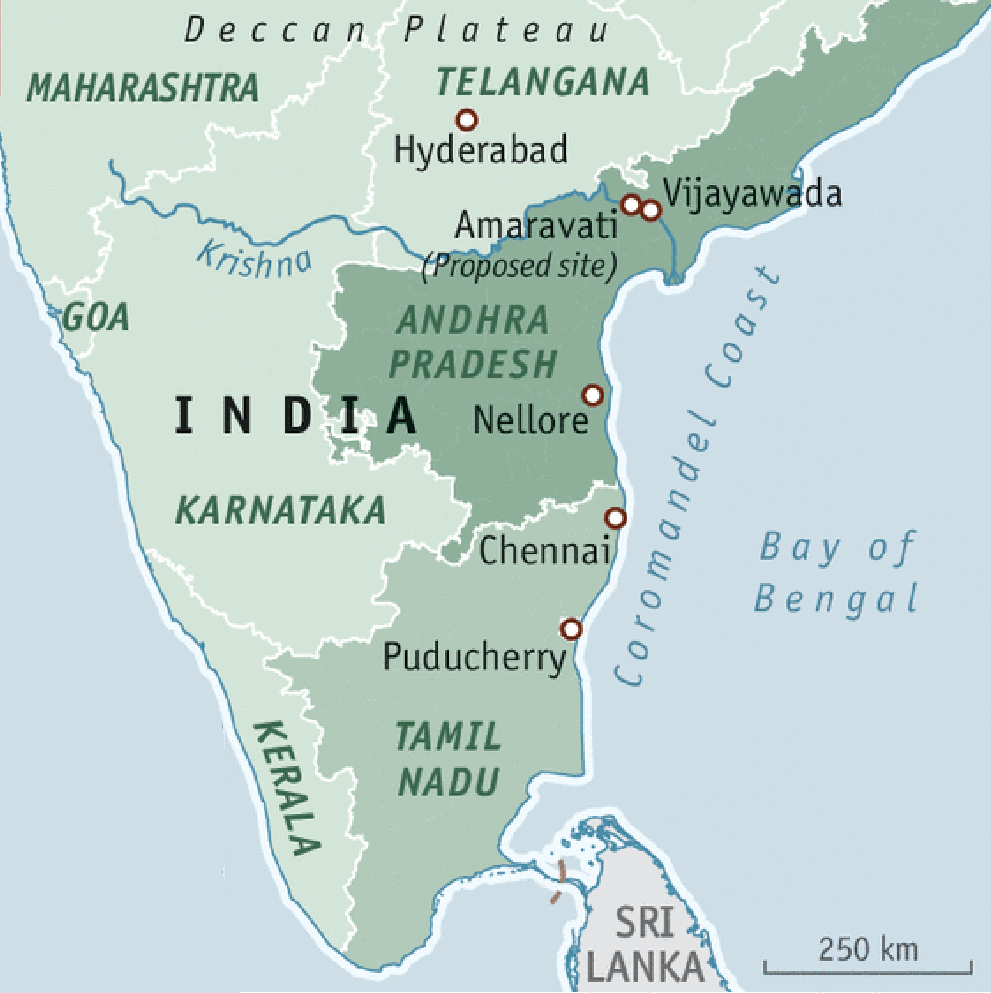 Map of Coromandel Coast.
Please ask for the price (or make an offer).