Product Description
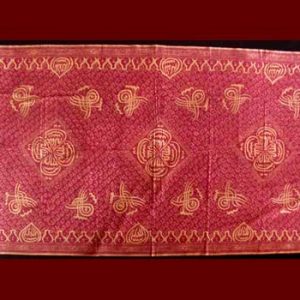
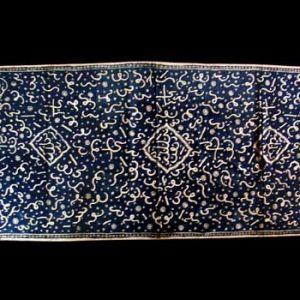
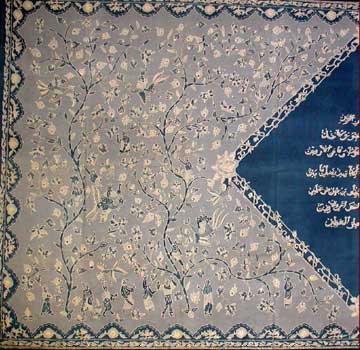
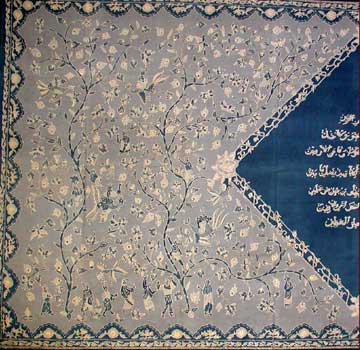
Calligraphy Batik 2
Material: Cotton; holes in the very outer plain fringe and one small hole in the body, very small tear in the fringe and body
Style: Sumatra, but woven in Java, where Chinese influence is seen in the motifs of birds and people; there are depicted trees of life
Size: Length 215 cm, Width 90.5 cm
Order Number: TC2
Ni Wayan Murni
Appreciating Calligraphy Batik
August – September 2007
“Calligraphy batiks do not get much press. The beautiful books on batik and the exhibitions abroad concentrate on Javanese batik, especially from the north coast of Java and the courts of Yogyakarta and Solo in central Java. The batiks from these areas are indeed magnificent and their history and evolution fascinating, but the calligraphy batiks, mostly associated with Sumatra, also have a wonderful story to tell.
I have been collecting textiles for over thirty years and have bought, traded and sold thousands of batiks. Recently I have been appreciating these mysterious and powerful textiles more and more and I think I am beginning to understand them. The most common are men’s headcloths about a metre square and rectangular cloths about a metre by two metres. They tend to be blue or less commonly red. I have examples of both in my collection.
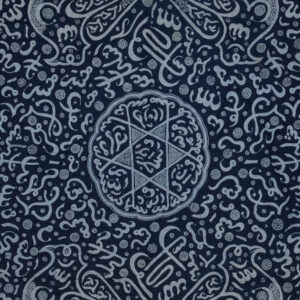
They all have Arabic script; hence they are called calligraphic batiks. The Arabic writing is usually the basmallah or the shahadah. The basmallah is said before any big project: In the name of Allah, the Beneficent, the Merciful. The shahadah is the main tenet of Islam: There is no God but Allah, and Mohammad is His prophet.” The cloths are sacred and worn at rites of passage ceremonies. They are also powerful protection against harm.
Soldiers wear them. The red cloths symbolise courage and deflect bullets. Dead soldiers killed in battle were covered in the red batik shrouds on their way to the graveyard. Adam Malik, Indonesia’s first Vice-President after Independence, was covered with such a cloth during his lying in state before burial.
It is likely that these textiles were inspired by textiles from Islamic countries. Arabic calligraphy goes back at least a thousand years in Egypt and the Middle East, and Arab trade with Jambi in Sumatra had started by at least the 13th century. Indonesians on the haj pilgrimage to Mecca would have seen the basmallah and shahadah.
Ottoman Turkey had close links with Aceh and Jambi and Turkish influence is particularly evident in these batiks. The motif called tughra shows this most clearly: it is the formal signature of the Ottoman ruler as used on official documents formed by three central lines with two loops which appear like a rooster. It had supernatural power.
The dominating impression is of perfect symmetry and balance and reminds me of Mughal and Moorish architecture. Typically there are three borders, the middle band containing diamonds. An outer border of white lines provides an artificial fringe. The centre field is the main part, normally full of geometric designs and Arabic calligraphy. Sometimes birds, lions and horses in stylized calligraphic designs appear.
In Islam the Koran is the actual Word of God. Mohammad was not divine; he was the messenger. The Words of God are important and revered. The writing itself has immense significance even if it is not understood. The most pious act a Moslem can do is to read or write the Koran. Beautiful and skilful calligraphy allows those who cannot read or write and those of us who are not even Moslems to appreciate the perfection, presence and power of God.”
Mid 20th century.
Please ask for the price (or make an offer).