
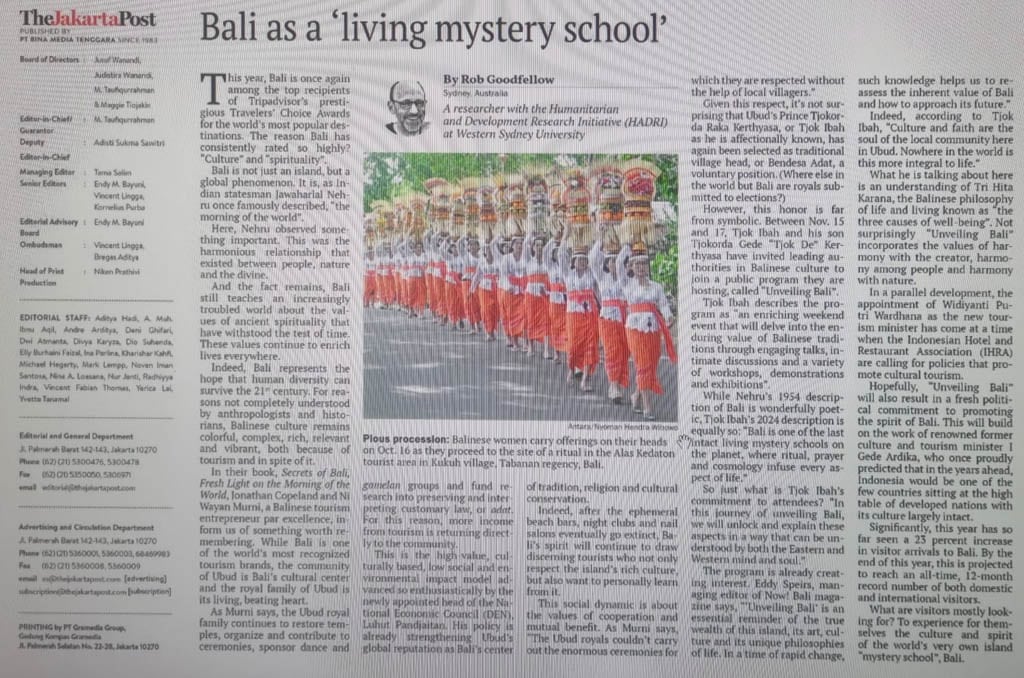
The spirit of Bali, which intertwines traditional values and customary laws within a universal framework of harmony, will continue to draw visitors long seeking enlightenment in this troubled world.
Rob Goodfellow
15 November 2024
This year, Bali is once again among the top recipients of Tripadvisor’s prestigious Travelers’ Choice Awards for the world’s most popular destinations. The reason Bali has consistently rated so highly? “Culture” and “spirituality”.
Bali is not just an island, but a global phenomenon. It is, as Indian statesman Jawaharlal Nehru once famously described, “the morning of the world”.
Here, Nehru observed something important. This was the harmonious relationship that existed between people, nature and the divine.
And the fact remains, Bali still teaches an increasingly troubled world about the values of ancient spirituality that have withstood the test of time. These values continue to enrich lives everywhere.
Indeed, Bali represents the hope that human diversity can survive the 21st century. For reasons not completely understood by anthropologists and historians, Balinese culture remains colorful, complex, rich, relevant and vibrant, both because of tourism and in spite of it.
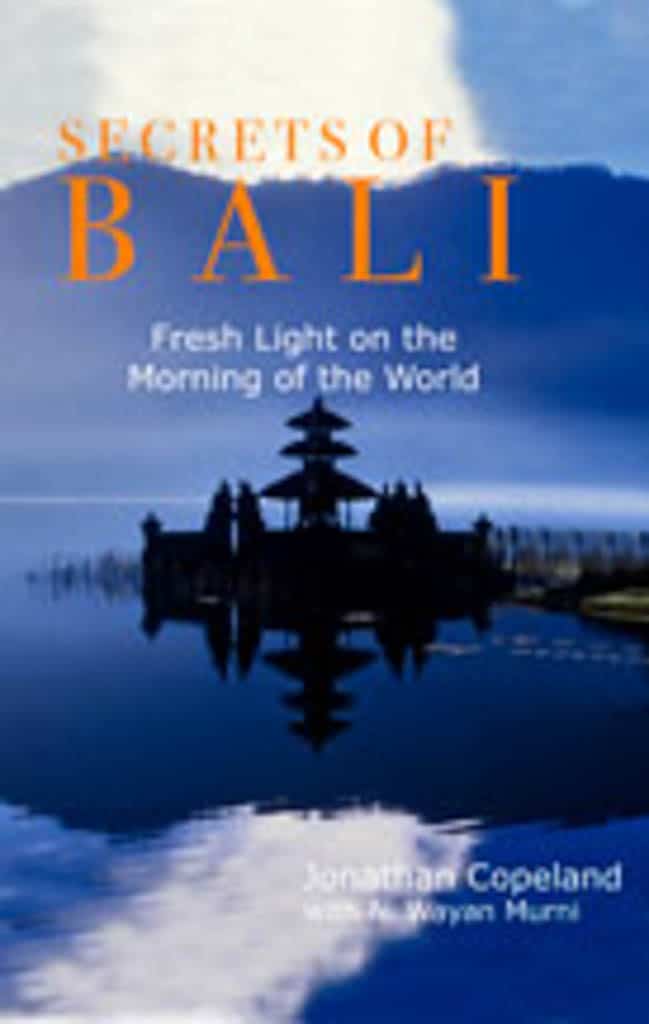 In their book, Secrets of Bali, Fresh Light on the Morning of the World, Jonathan Copeland and Ni Wayan Murni, a Balinese tourism entrepreneur par excellence, inform us of something worth remembering. While Bali is one of the world’s most recognized tourism brands, the community of Ubud is Bali’s cultural center and the royal family of Ubud is its living, beating heart.
As Murni says, the Ubud royal family continues to restore temples, organize and contribute to ceremonies, sponsor dance and gamelan groups and fund research into preserving and interpreting customary law, or adat. For this reason, more income from tourism is returning directly to the community.
This is the high-value, culturally based, low social and environmental impact model advanced so enthusiastically by the newly appointed head of the National Economic Council (DEN), Luhut Panjaitan. His policy is already strengthening Ubud’s global reputation as Bali’s center of tradition, religion and cultural conservation.
Indeed, after the ephemeral beach bars, night clubs and nail salons eventually go extinct, Bali’s spirit will continue to draw discerning tourists who not only respect the island’s rich culture, but also want to personally learn from it.
This social dynamic is about the values of cooperation and mutual benefit. As Murni says, “The Ubud royals couldn’t carry out the enormous ceremonies for which they are respected without the help of local villagers.” Given this respect, it’s not surprising that Ubud’s Prince Tjokorda Raka Kerthyasa, or Tjok Ibah as he is affectionally known, has again been selected as traditional village head, or Bendesa Adat, a voluntary position. (Where else in the world but Bali are royals submitted to elections?)
However, this honor is far from symbolic. Between Nov. 15 and 17, Tjok Ibah and his son Tjokorda Gede “Tjok De” Kerthyasa have invited leading authorities in Balinese culture to join a public program they are hosting, called “Unveiling Bali”.
Tjok Ibah describes the program as “An enriching weekend event that will delve into the enduring value of Balinese traditions through engaging talks, intimate discussions and a variety of workshops, demonstrations and exhibitions.”
While Nehru’s 1954 description of Bali is wonderfully poetic, Tjok Ibah’s 2024 description is equally so: “Bali is one of the last intact living mystery schools on the planet, where ritual, prayer and cosmology infuse every aspect of life.”
So just what is Tjok Ibah’s commitment to attendees? “In this journey of unveiling Bali, we will unlock and explain these aspects in a way that can be understood by both the Eastern and Western mind and soul.”
The program is already creating interest. Eddy Speirs, managing editor of Now! Bali magazine says, “‘Unveiling Bali’ is an essential reminder of the true wealth of this island, its art, culture and its unique philosophies of life. In a time of rapid change, such knowledge helps us to reassess the inherent value of Bali and how to approach its future.”
Indeed, according to Tjok Ibah, “Culture and faith are the soul of the local community here in Ubud. Nowhere in the world is this more integral to life.”
What he is talking about here is an understanding of Tri Hita Karana, the Balinese philosophy of life and living known as “the three causes of well-being”. Not surprisingly “Unveiling Bali” incorporates the values of harmony with the creator, harmony among people and harmony with nature.
In a parallel development, the appointment of Widiyanti Putri Wardhana as the new tourism minister has come at a time when the Indonesian Hotel and Restaurant Association (IHRA) are calling for policies that promote cultural tourism.
Hopefully, “Unveiling Bali” will also result in a fresh political commitment to promoting the spirit of Bali. This will build on the work of renowned former culture and tourism minister I Gede Ardika, who once proudly predicted that in the years ahead, Indonesia would be one of the few countries sitting at the high table of developed nations with its culture largely intact.
Significantly, this year has so far seen a 23 percent increase in visitor arrivals to Bali. By the end of this year, this is projected to reach an all-time, 12-month record number of both domestic and international visitors.
What are visitors mostly looking for? To experience for themselves the culture and spirit of the world’s very own island “mystery school”, Bali.
The writer is a researcher with the Humanitarian and Development Research Initiative (HADRI) at Western Sydney University.