Product Description
Antique Hmong Silver Neck Ring and Spirit Locks
Material: Silver
Style: Hmong
Size: Height 41 cm, Width 21 cm
Order Number: MHSAHSSLN1
The Miao people live in southern China mostly in Guizhou province. Miao sub-groups such as the Hmong live in northern Thailand and eastern Burma. The Hmong have 2 major branches, the White Hmong and the Green Hmong.
Many migrated to Laos. By 1850 they were established in the mountains around Luang Prabang. By the end of the 19th century there were several Hmong villages in Thailand. In 1984 there were 245 villages.
During World War II the Chinese tried to stop them speaking their own language or wearing their distinctive dress, but they failed.
The Maio keep much of their wealth in silver jewelry.
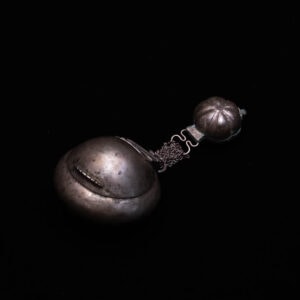
The Hmong wear silver spirit locks, which are are padlocks or hook shaped pendants, around the neck or on the body. They function as protective amulets to ‘lock’ the soul of a person into his or her body in the case of spiritual malaise, illness, or accident.
The Hmong are animists, who believe that everything has one or more souls, containing spirits, which are good or bad. The spirits of deceased ancestors can affect the welfare and health of the family and have to be appeased with offerings and prayers.
Shamans can communicate with the spirits. Every house has an altar where spirits are worshiped.
Humans have three souls, which can be in disarray and might leave the body if a person is frightened or stressed. A foreign spirit might enter a person’s body, causing illness. These beliefs explain sickness and mental illness.
To cure people, the elders led by the shaman performed a Soul Calling ceremony, casting out bad spirits or inviting good spirits into the person’s body. The spirit lock prevented the person’s soul from escaping and stopped outside spirits entering. The size of the amulet indicated the severity of the illness or problem.
There is an important ceremony for a newborn baby, called the
soul calling ceremony, hu plig. The Hmong believe that a newborn baby has 3 souls. The first soul enters the baby on conception, and the second soul when the baby takes its first breath. The third soul has to be called on the third morning after birth.
When all 3 souls are safely in the infant’s body, it will be healthy. If not, the baby may become ill and die. The ceremony starts before sunrise and continues until noon. There is a feast for the guests.
A shaman usually performs the ceremony. The baby is given a name.
The name represents its soul. If a wrong name is given, the soul of the child is not called and the right name has to be chosen. Naming is essential for well being and growth. If a wrong name is given, the child will cry and become ill. The chant includes words that instruct the soul about its home, siblings and family, and a promise that it will be looked after by the family.
The babies wear the spirit locks for life, often on their backs. They may wear 3 or 4 spirit locks at a time. They are usually fastened by chains to neck rings, which may be solid or hollow and worn either singly or in sets of up to 6 tiers.
Silver jewellery is valued highly by the Hmong and spirit locks are usually made from very high grade silver (95% or above). They are decorated with traditional tribal motifs, which may originally have related to the illness to be cured.
They are in many sizes and shapes, rectangular, triangular, half round and square.
They can be dated to at least the turn of the 19th century. Old locks are rare and are very collectable.
Early 20th century.
There are similar examples in Peoples of the Golden Triangle, Six Tribes in Thailand, Paul and Elaine Lewis, Thames and Hudson, 1998, pages 52, 54, 55 and 56.
Please ask for the price (or make an offer).