Product Description
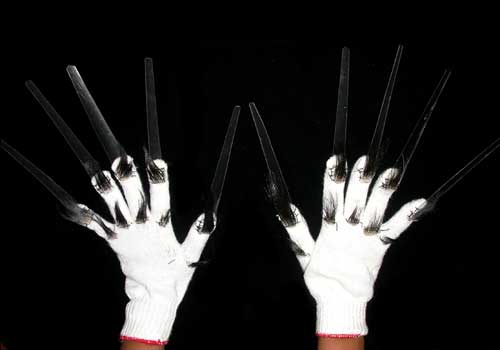
Rangda Gloves
Material: plastic fingernails
Style: Bali, Indonesia
Size: Length 37 cm, Width 13 cm
Order Number: DC11
From our book Secrets of Bali:
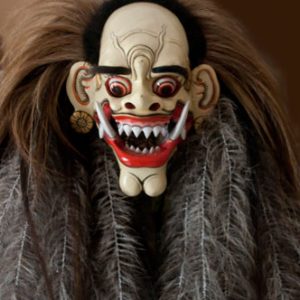
Rangda
A British politician, Ann Widdecome, once described her boss, Michael Howard (who later became party leader), as having ‘something of the night’ about him. Rangda has the same quality. Uniquely Balinese, she is the Barong’s counterpart, described by Miguel Covarrubias in his book Island of Bali (1937) as ‘undoubtedly the most interesting character on the island’. She is the formidable
Queen of Black Magic, head of witches, who sports a long, flaming tongue, pendulous breasts, long, trembling fingernails and human entrails around her neck, flicking a magic white cloth as she goes. Rangda is tall and has tusks. Some temples have two Rangda masks, one red and the other white. The red one represents the more dangerous Rangda. The white one stresses her royal birth—some say Rangda is based on the 11th century Princess Mahendradatta.
Rangda is the formidable Queen of Black Magic, head of witches, who sports a long, flaming tongue, pendulous breasts, long, trembling fingernails and human entrails around her neck, flicking a magic white cloth.
Men dance Rangda; they do not have to be professional dancers because Rangda does not keep time to the music. She is powerful and threatening but she is not all evil, just as the Barong is not all good. Her powers can be turned to protect the village against harm. She wears magical Balinese textiles: the black and white chequered poleng, which symbolises the duality of her naure, and a protective cepuk. There are no extremes in Bali. Tourist literature, neatly packaging Balinese culture, usually describes her as totally evil and is misleading in this respect. Jane Belo, the anthropologist, likened Rangda to Santa Claus, the Tax Collector, and the Angel of Death all rolled into one.
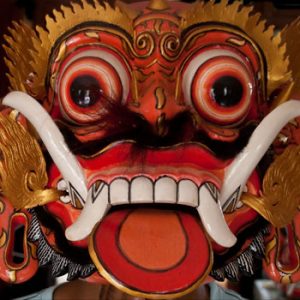
The purpose of the Barong-Rangda dance is to restore balance. There is a battle. The Barong’s followers try to attack Rangda. Through her magic they turn their krises, daggers, against themselves but through the Barong’s magic, they fall into trance and do not stab themselves to death. The dance-drama often ends at this point, where neither good nor evil triumphs, which is the balance that the Balinese strive for. The controlled anger of the dancers is a cathartic release in a society where displaying such emotions is frowned upon. At one time kris dancers were male and female but in the 1950s women stopped performing this role and as a result they have no such outlet.
The Barong is Siwa transformed and Rangda is his wife Uma transformed. The confrontation culminates in Siwa, the male principle, bringing her, the female principle, under control. She has been prevented from destroying the world and becomes a positive and creative force again. There is no question of her being killed. It is not a matter of good over evil. The drama lies in the tension between good and bad. The fact that they are husband and wife adds another dimension. Both are necessary components of the natural order.
Rangda is also the goddess of death. She was so depicted on post office posters in the 1990s. The aim was to stop drug trafficking. The Barong represents creation and Rangda destruction.