Balinese Origins – Volcanoes – Civilisation
Creation of the Universe
It is thought that the universe was created by the Big Bang about 13 billion years ago. Two studies using different methods have arrived at broadly the same age. In 2002 Harvey Richter of the University of British Columbia presented evidence of fading star clusters called white dwarfs 7,000 light years away. They are burnt out coals of stars, which were once eight times the size of the sun. After they exhausted their fuel, they collapsed into balls of cooling embers. They will eventually turn cold and wink out of sight. By looking at the faintest and oldest white dwarfs, thought to be the first group of stars that formed in the Milky Way galaxy, the home galaxy for the sun, early in the history of the universe, astronomers can use their known cooling rate to estimate the age of the universe. Richter said that star formation did not begin until about a billion years after the Big Bang.
In 1998 another method was used by the Carnegie Observatories in California arriving at an age of 13 to 14 billion years. They measured the rate at which galaxies are moving apart, an expansion which started with the Big Bang.
It is believed that the age of the earth is about 4.5 billion years old. Matter was created from the energy released by the Big Bang.
Oneness
The alternative Hindu view is that the world began with Divine Oneness or perhaps Divine Nothingness. However, unlike Western religions, there is no certainty about the matter. The Brahman poets in the Rig-Veda wrote courageously of their doubts in the Hymn of Creation. Read the poem and details in Secrets of Bali.
Early Man
Back to the modern Western world of science: there is a debate as to whether early humans evolved in Africa and then moved to the rest of the world, or whether they evolved separately in Africa, Europe and Asia. Genetic research shows that early humans evolved in Africa.
Man-like creatures, that is to say a creature and species separate from animals, but not yet human, archaic human or hominid, originated in Africa about 7 million years ago, when a population of African apes broke up into several groups. One of these groups, an unknown common ancestor, evolved into modern gorillas, a second group into the two modern chimps and a third group into humans.
In 2001 fossil remains were found in Africa, which were older than previous finds by several million years. Read about these in Secrets of Bali.
Fossils indicate that the human-like creatures became substantially upright about 4 million years ago. Body size, relative to brain size, increased later about 2.5 million years ago. From this time these proto-humans are known as Australopithecus africanus, Homo habilis and Homo erectus, and they evolved into each other in that order – probably. It is difficult to be certain whether they are in a direct line or they are branches along the way.
The first confirmed direct ancestor of modern man is Homo erectus, who emerged in Africa about 1.7 million years ago. His brain was barely half the size of ours. In early humans the human brain occupied about 500 cubic centimeters. In Homo erectus it occupied about 900 cubic centimeters. The brain increased again between 500,000 and 200,000 years ago.
Homo erectus was the first species to leave Africa and spread throughout the world. The other creatures stayed in Africa. Read about Homo erectus in Secrets of Bali.
A recent excavation in Flores, which is east of Bali, has disclosed remains of human habitation dating back more than 800,000 years. His ancestor probably reached China first and then moved down to Southeast Asia. That was during a time when the seas rose and fell many times and Africa, Asia, Europe and America were one big landmass. At that time it was theoretically possible to walk from the south coast of England to Bali. Java and Sumatra were joined to the Asian mainland. The Flores discovery shows that man had learned, by that time, to build watercraft and paddle them out to sea. The nearest island was at least 19 kilometers away, even when sea levels were at their lowest.
In October 2004 it was reported that the fossilized remains of prehistoric hominids, only one meter high, have been found in Western Flores in a cave. They have been given the name Homo Floresiensis. They had dark, scaly skin, making them a breakthrough in evolutionary studies.
Australia and New Guinea
Sea and the lack of sailing ability blocked off Australia and New Guinea from human penetration for a long time – until about 60,000 years ago. The Aboriginees probably came from Southeast Asia and a fair guess is that they travelled from Bali and Lombok. Bali had been inhabited for a million years. Someone must have crossed to Lombok and found that there was food, and that there were no tigers and that it was safe. They then probably moved on to Sumba when the food in Lombok was exhausted.
Europe
The earliest evidence of humans in Europe dates to about half a million years ago, about the time that that Flores sea trip was taking place. African and European skulls of this period are similar to ours. A new species had been born, our own, called by our own name, Homo sapiens. Read about Homo sapiens in Secrets of Bali.
Between 100,000 and 200,000 years ago anatomically similar people to us were in Africa, but not in Europe yet. In Europe there were the Neanderthals, Homo neanderthaensis, cave-men, whose remains have been discovered in Europe and West Asia. Read about Homo neanderthaensis in Secrets of Bali.
About 50,000 years ago there was another Great Leap Forward, probably caused by a large build up of population and environmental factors. The first modern humans appeared in Europe, the Cro-Magnons, named after the cave site in France where their bones were first found in 1868. They invented representational art, which is found in over 200 caves in France and northern Spain. They had advanced stone technology. The Cro-Magnons totally replaced the Neanderthals and all modern Europeans trace their ancestry to them.
Evidence
Archaeology, fossils and recently DNA are all providing evidence of man’s remote past. In 1953 two young scientists working in Cambridge, James Watson and Francis Crick, solved the molecular structure of DNA, deoxyribonucleic acid, which paved the way. Until then DNA was thought of as unimportant, but it holds the key to the chemical mechanism of heredity. Read about DNA and mitochondrial DNA in Secrets of Bali.
Bryan Sykes has described his genetic research in The Seven Daughters of Eve. Read the details in Secrets of Bali.
Saraswati
An alternative Hindu view of the creation of Man is that Saraswati, the goddess of poetry, brought humans into existence by the use of writing.
It is interesting the main Western religions of Judaism, Christianity, and Islam, which post-date Hinduism, also saw creation through the medium of the Word. Genesis says, “In the beginning was the Word, and the Word was with God, and the Word was God.”
Ice Age
Bali emerged from the seas in a series of volcanic explosions two to three million years ago.
Over the last 2 million years there have been 17 ice ages. Read the details in Secrets of Bali.
Sumatra, Borneo, Java and Bali had been connected by dry land during the Ice Ages, which enabled men and animals to migrate. After the Ice Age shallow seas formed between the islands and separated them all. Many of those on coastal plains would have drowned or seen their livelihood destroyed. Flood myths permeate many mythologies. It may be that the end of the Ice Age gave rise to these stories.
About 11,000 years ago agriculture was invented in the Middle East and changed human life for ever. Read the details in Secrets of Bali..
Continental Drift
A young German meteorologist, Alfred Wegener, devised the theory of continental drift or plate tectonics in 1912. Read the details in Secrets of Bali.
Bali sits on a turtle
The alternative explanation for the cause of earthquakes is the Balinese belief that Bali sits on the back of a turtle, the world-turtle, Bedawang Nala, who occasionally stirs and sets off earthquakes. Read the details in Secrets of Bali.
Balinese Volcanoes
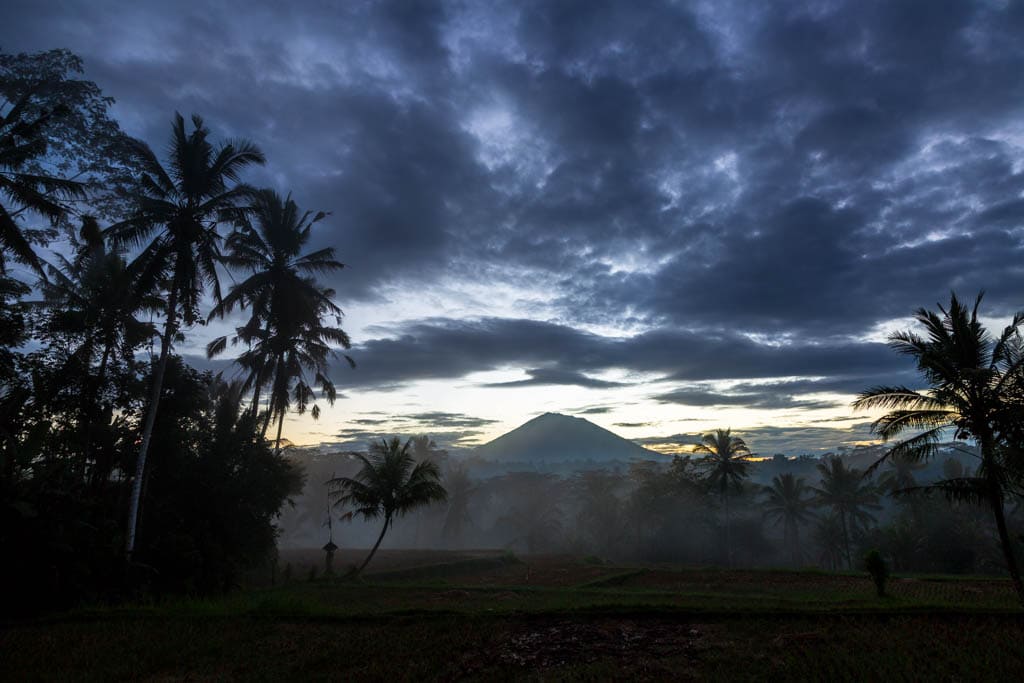 Mount Agung.
The collision of two plates produces continuous seismic activity (earthquakes) and heat. When earthquakes are large, volcanism results, often with the formation of magma or molten rock and gases. The magma or molten rock is under great pressure. Chains of volcanoes form if it is pushed up towards the surface through weak parts.
There is an arc of volcanoes, called the Ring of Fire, encompassing Indonesia, including Java and Bali. The vents of the volcanoes, through which the magma reaches the surface, are plugged by solidified magma. This increases the pressure until there is a series of violent explosions.
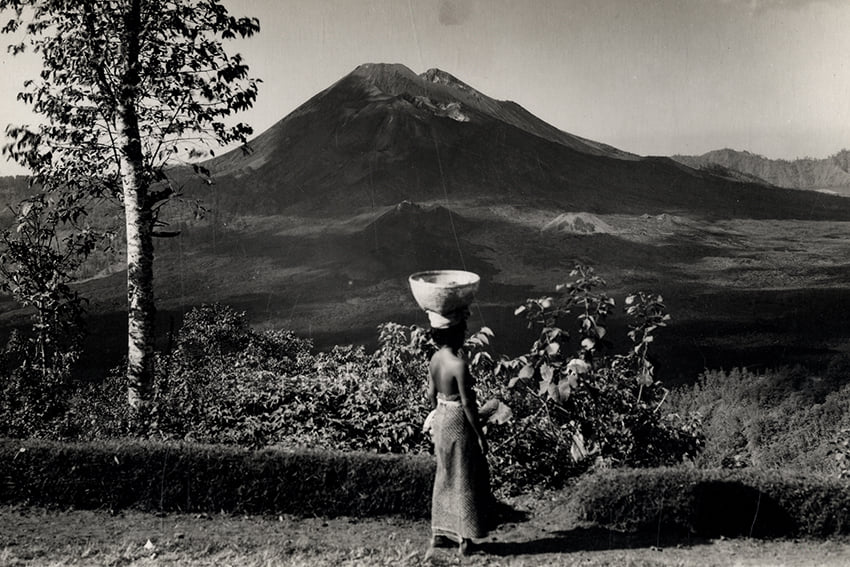 Mount Batur, about 1930.
Periods between eruptions are unpredictable. Mount Batur, 1,717 meters (5,633 feet), is live and can often be seen smoking and rumbling. It erupted twice in the 20th century and as recently as the 1990s. Mount Agung, the highest mountain in Bali, at 3,142 meters (10,309 feet), exploded dramatically in 1963 and killed over 2,000 people.
Volcanic ash enriches the soil. It also helps that water is plentiful. The Balinese traditionally turn a blind eye to the risk of volcanoes, perhaps blaming themselves for causing the gods to be angry. After an explosion they normally go back and try to continue farming. Life goes on.
Some large volcanoes plug themselves so well that huge magma chambers form. When they do eventually explode, huge vacant holes, like lakes, are the result. These are called calderas after the Spanish word for “kettle”. Mount Batur is an example of a double caldera and is one of the biggest in the world. It has been partly filled by a beautiful lake called Lake Batur, the biggest in Bali, and another volcanic cone.
Lake Batur is the source of an underground network of water channels, which feed into sacred springs on the slopes of Mount Batur. There is a tunnel running through the property, below Murni’s Villa, on the slope to the stream, which forms the western boundary to the property. We believe this comes from Lake Batur and feeds Ubud.
1917 Earthquake
There was a very, very bad earthquake in 1917. Ubud was flattened and the whole of Ubud palace was destroyed. No houses were left standing. Luckily it took place early in the morning when most people were already up and working in the rice fields. This saved a lot of lives.
Indonesian Volcanoes
There are five active volcanoes in Bali, including Batukau, 2,276 meters (7,467 feet) and Abang, 2,152 meters (7,060 feet). According to an expert from the local Department of Meteorology and Geophysics, Bali recorded 52 earthquakes in June 2002, recording an impressive 516 tectonic events in the first six months of 2002.
Indonesia has more active volcanoes than any other country in the world. During the last 10,000 years, at least 132 have been active and 76 eruptions have been recorded (that is to say 17 per cent. of the world’s recorded eruptions).
Tambora, on the island of Sumbawa, to the east of Bali, blew its top in 1815, killing more than 90,000 people. It is said to have created the loudest noise ever heard. It vented so much material into the atmosphere that Europe lost its summer growing season.

Krakatau, which is between Java and Sumatra (not east of Java as the movie said), erupted four times on 27 August 1883 and killed 36,000 people. Read the details in Secrets of Bali.
Indian Ocean Tsunami
Worse than any of the above was the Indian Ocean tsunami. On 26 December 2004 at 0058 hours GMT, 7.58 am local time, a strong earthquake, which had a magnitude of 8.9 on the Richter Scale, occurred off the west coast of Northern Sumatra.
A subsequent tsunami hit South, Southeast Asia, and East Africa causing a large number of deaths and serious, widespread damage to buildings, roads, and power lines.
Read the details in Secrets of Bali.
Civilisation
Despite the terrible effects, Bali can thank the volcanoes for her civilisation. Tropical soils tend to be poor because heavy rains wash away the nutrients. Bali, however, has been spared this disadvantage. Continuous eruptions throw fertile ash over the island.
Mountains also cause rainfall. Moisture-laden air rises, cools and then rains. Rain falls on the south of the island. The northern third is in the rain shadow and so is rather arid. So, thanks to the mountains, Bali has fertile soil and good irrigation.
Sacred mountains
Sacred mountains date back to India. Mount Meru was the center of the world, where heaven and hell met. Gods, demons, and men travelled back and forth on Mount Meru.
The islands of Java, Bali and Lombok were not stable according to legend. To stop their wobbling Mount Meru was transferred to Java where it became known as Mount Semeru. It is the highest mountain in Java. Part of the mountain was carried to Bali where it became Mount Agung and part to Lombok where it became Mount Rinjani. The god of Mount Semeru, Pasupati, is the father of the god of Mount Agung and that of Mount Rinjani.
Mountain symbolism appears worldwide. They are reflected in the Egyptian pyramids, the Babylonian ziggurat, and the Tower of Babel. There are sacred mountains in China and Japan.
Mountains are represented in many forms in Bali. Read the details in Secrets of Bali.
Balinese orientation
It is no surprise therefore that mountains have acquired a very deep religious significance for the Balinese. Read the details in Secrets of Bali.
Balinese Origins – Volcanoes – Civilisation