Balinese Rice
Introduction
Rice is the stable food of half the world’s population and is the world’s most important crop. Rice cultivation in Bali goes back at least 2,000 years. The current method of irrigation goes back at least 1,000 years. Sir Stamford Raffles was impressed by the rice cultivation when, as the British Lieutenant-Governor of Java and its dependencies, he visited the ruler of Buleleng in North Bali in 1815.
Words for rice
Rice is the staple diet of the Balinese. The word nasi (rice) also means “meal”. The Balinese cannot really conceive of a meal without rice and the number of words for rice indicates its importance:
Padi
Rice growing in the field or rice that has been cut but not threshed, or cut and threshed, but not husked (the husk and bran are removed at the mill, or in the old days by pounding with a mortar and pestle); the English word “paddy” comes from padi.
Gabah
Unmilled rice that has been separated from the stems.
Beras
Milled, uncooked rice.
Nasi
Cooked rice.
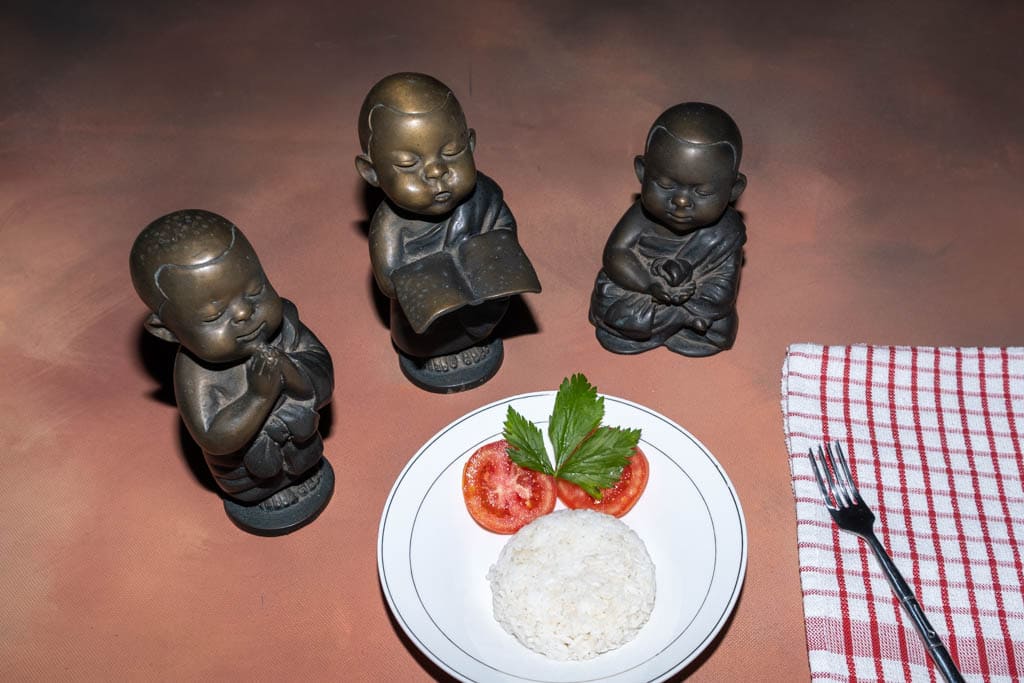 Nasi – Cooked Rice.
Types of rice
There are three different types of rice:
Barak
Red rice.
Injin
Black rice, which is in fact a dark, blackberry purple.
Ketan
White sticky, glutinous rice.
 Balinese Black Rice.
Available to eat at Murni’s Warung.
There are four sacred directions, each of which has a sacred colour, red, black, white and yellow. God intended to give the Balinese rice of all these colours, but there was a problem in transmission. Siwa sent a bird to bring the rice to the Balinese but the bird ate the yellow rice – except for a little bit which it planted under the eaves of its house. From the seeds grew turmeric, kunyit. Yellow rice does not grow in Bali, but mixing white rice with turmeric can make it. This is the fourth type of rice. Offerings of yellow rice are needed for certain offerings, and especially during Kuningan: see the chapter entitled Balinese Ceremonies in Secrets of Bali for an explanation of Kuningan.
New or miracle rice
Rice grows very well in Bali and the quality is excellent. Padi Bali is the old traditional Balinese rice, grown from time immemorial, but now largely replaced by “new” or “miracle” rice. Padi Bali takes 210 days to grow, the length of the Balinese year.
During the 1950s Indonesia was forced to import nearly one million tons of rice every year. After 1965, Suharto made self-sufficiency a major goal. Oil revenues in the late 1960s were invested in setting up bureaucracies and Bali was one of the first targets for the Green Revolution.
See Secrets of Bali for details of the so-called Green Revolution.
In the well irrigated south of Bali, rice is wet rice, while in the dryer areas to the north, dry rice is grown. Dry rice produces only one rain-fed crop a year.
World market
Indonesia does not figure in the leading world rice exporters. They are Thailand, Vietnam, China, the United States, Pakistan, India and Burma – in that order. According to the year 2000 figures, annual exports by them totalled 18 million tons. Apart from the United States, they account for 70 per cent. of the world’s rice exports.
Rice cycle
Just before planting, the fields are flooded and ploughed by cows. Tractors are used in Bali, but not in these parts. The fields look like reflecting mirrors. Then they are fertilized. After planting – by hand over several days – the yellow-green shoots of young rice sprout up. The little seedlings are reflected in the silvery water. This is a dangerous time. Scarecrows, wind chimes, bamboo bird-scarers and pulleys of cloth are put up to frighten the birds. People keep watch and yell at them.
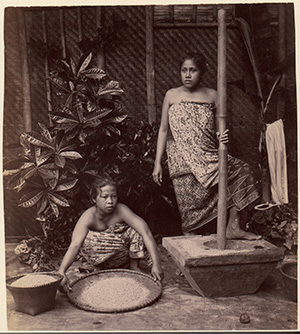 Women Preparing Rice 1860s – 70s.
Two months later the rice will have grown taller and green. When they turn, the plants are mature and ready to harvest. It takes about five months in all. After harvesting, the stubble in the fields is burnt or alternatively flooded, so that the old rice stalks slowly decompose under the water.
Ceremonies
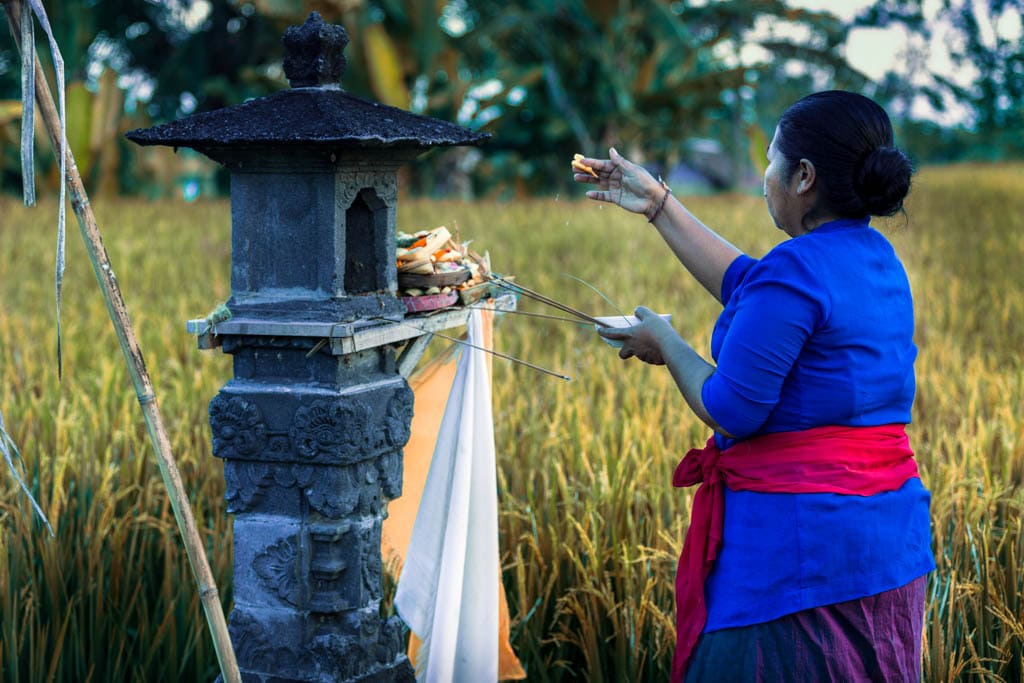 Balinese Offerings for the Rice Goddess, Dewi Sri.
The divine rice plant is considered an animated female being and is treated with particular respect. Each stage is carried out on an auspicious day, accompanied by appropriate offerings. Rites of passage, just like for a human being, are conducted.
Some of the rituals are carried out by the farmer at a small temporary shrine in the upstream corner of the field, others at the water temples. The rites include water opening, field preparations, transplanting, growth, panicle appearance, flowering and harvesting.
The upstream corner of the rice field is sacred. Here offerings are made to Dewi Sri. At harvest time a sacred image of Dewi Sri herself is made from rice that grows closest to this spot. It is not eaten but carried to the rice barn and given offerings.
Subaks
Control of irrigation, which is water coming from a higher source and directed into the many terraced rice paddies, is very important to the life of the population. It requires the rice farmers to co-operate with each other in social units, as mentioned in the chapter entitled Balinese Organisations in Secrets of Bali.
Water temples
The powers of the water temples, and the Temple of the Crater Lake, Batur as the supreme water temple, are therefore considerable and considerably important. The Dutch didn’t understand this. They didn’t have to. They were religious matters as far as they were concerned and posed no threat to their interests. The Dutch were more concerned about collecting tax.
The Indonesian Government also didn’t understand the water temples or even know about them. They passed laws demanding constant cropping of the new rice and farmers were forced to abandon traditional cropping patterns. Soon there was chaos in water scheduling and terrible outbreaks of pests.
It was not until well into the 1980s that the role of the water temples was appreciated, thanks largely to anthropologist Stephen Lansing, who has written a lucid account of his research in a book called Priests and Programmers. See Secrets of Bali for the details.
For more details on the Temple of the Lake see the chapter entitled Famous Balinese Temples in Secrets of Bali.
Dewi Sri
The Rice goddess, Dewi Sri, is the favourite manifestation of God amongst the Balinese. She is male and female, as indeed are all the gods, people and things in the cosmos. At important times in the rice cycle, images of Dewi Sri, made of rice stalks, are set up in the rice fields, in the shape of two triangles, with a pinched waist. This is called a Cili.
There is a nice story of Dewi Sri’s origin in Secrets of Bali.
Dewi Sri, as befits her importance, is a symbol of Bali and appears everywhere in many guises. Anthropomorphic deities, like Dewi Sri, evoke and remind us of the human presence in engineered landscapes.
Paddy fields
Rice paddies do not just produce rice. They produce a lot of protein. There are eels, frogs and fish in the paddies. There are also dragonflies. Little kids hunt the dragonflies with long, sticky rods, pull off their wings, pierce them alive on a stick, roast and eat them.
 Rice Paddies.
The rice paddies also provide a living for Balinese ducks, which, by the way, cannot fly. Read their contribution and how they inspired numerous paintings in Secrets of Bali.
Genetic Code of Rice
In April 2002 the genetic code of rice was published and it was discovered that rice has 15,000 more genes than humans. See more in Secrets of Bali.
Balinese Rice