Balinese History – the Europeans
Introduction
Spices launched the Age of Exploration and drove the European explorers to the Spice Islands of Eastern Indonesia in the 16th century. This led to the great Portuguese, Spanish, Dutch and British Empires of the East. Which spices and why were they so important?
The Spices
The spices were nutmeg, cloves, mace, pepper and cinnamon. The reason: their fragrance. For centuries they had been used to mask and disguise the smell of decomposing food in an age when there were no fridges. Nutmeg slowed down the process of rotting. Spices were also useful in adding flavour to food – and drink – they were added to beer. Nutmeg was also a perfume, a cure for bad breath, an embalming ingredient, a relief for sore teeth and an aphrodisiac.
But it was the physicians of Elizabethan London that provided the economic impetus to make it worthwhile risking lives and fortunes. Always expensive, the price of nutmeg rocketed overnight when they claimed it cured the plague, which was sweeping London’s streets.
For centuries numerous middlemen had sewn up the trade. Read more about it in Secrets of Bali.
The Spice Race
It took another 200 years from Marco Polo’s times before a European reached the Spice Islands. Read more about it in Secrets of Bali.
Portugal, Spain, England and later Holland competed to get to the source of spices, silks and gems. Read more about it in Secrets of Bali.
Key dates and details in the European spice race are set out in Secrets of Bali.
1492: Christopher Colombus.
1498: Vasco da Gama.
1501: the Treaty of Tordesillas.
1511: Alfonso de Albuquerque.
1511: Portuguese Antonio de Abreu.
1521: Magellan.
1529: King Charles of Spain.
1577: English explorer Sir Francis Drake.
1580: the Portuguese tried to establish a trading station in Bali but gave up after their ship was wrecked near Bukit in the south.
1595: the Dutch despatched their first fleet under the unruly Cornelis de Houtman.
1600: the charter setting up the English East India Company was signed by Queen Elizabeth giving it massive powers and the exclusive right to trade in the East Indies – a vague term including all Southeast Asia – without any Crown interference.
 Dutch East India Company.
1602: the Dutch East India Company (Vereenigde Oost-Indische Compagnie or VOC) was formed.
1606: by this point England had despatched 3 fleets comprising 10 vessels and lost one in three, 1,200 men had sailed, 800 had died of scurvy, typhoid or dysentery, only one ship reached the Banda Islands; the Dutch had despatched 14 fleets comprising 65 ships and had ousted the Portuguese from nearly all their “spiceries”.
1609: the Dutch acquired their first territory in the East Indies.
1619: the Dutch seized Yacatra, on the northeast coast of Java, renaming it Batavia.
1622: the Dutch massacre nearly everyone on the island of Banda.
1657: the English East India Company was finally bankrupt and gave up all hope of a presence in the East.
1667: the Treaty of Bredf.
1699: the Dutch had gained total control of the spice trade, which lasted for the next 200 years.
1750: by this date the Dutch controlled all the Indies except Bali and Lombok.
1799: the VOC’s charter expired.
Nathaniel’s Nutmeg by Giles Milton is an excellent book on the European rivalries to gain control of the spice trade.
During this time Europeans visited Bali but it did not greatly interest them.
The Dutch
Cornelis de Houtnan from Holland visited Bali in 1597 and from that moment Bali was on the map. He was so impressed by the beauty of the island that he wanted to call it Jonck Hollandt – Young Holland.
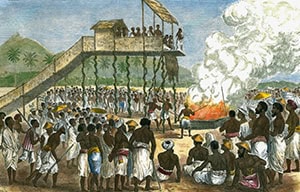 Widow burning in Bali 1860.
His reports and engravings captivated the public (although the one that most caught the popular imagination was of widow-burning of Indian origin!). Read more about it in Secrets of Bali.
Initially the main interest was the slaves. Read more about it in Secrets of Bali.
Commercial isolation
One reason the Dutch left Bali alone for so much of their 300 years of colonisation of the Dutch East Indies was that Bali had no good, natural, protected harbours and the coral reefs around the coasts caused shipwrecks. The seas were rough too. Bali also lacked useful resources.
As a result there was commercial isolation. A good indication of this is the number of Chinese residents in Bali as compared to the rest of Indonesia. Even in 1920, after the Dutch were in control of the whole island, there were only 7,000 Chinese (4 per cent. of Bali’s population), whereas there were 1.65 per cent. over all Indonesia.
The British had long regarded Bali as a possible base, but did not pursue their designs for the same reasons as the Dutch.
Slave trade
 Balinese and Papuan Slaves of the Rajah of Buleleng, 1865.
Bali’s chief export was slaves. In the 17th century about 2,000 were exported each year. Read more about it in Secrets of Bali.
The English Interregnum, 1811 – 16
The Napoleonic wars led to a renewal of British interest in Bali. When the French occupied Holland, the British took control of Java on behalf of the Dutch government in exile in London. From 1811 to 1816 Sir (1781-1826) administered the Dutch possessions as the Lieutenant Governor-General in Batavia. He was one of the founders of Britain’s empire in East Asia. Beginning his career in 1795 as a clerk in the British East India Company, he was sent to Penang in Malaya in 1805 as assistant secretary. He had a good knowledge of the Malay language and customs. Read more about it in Secrets of Bali.
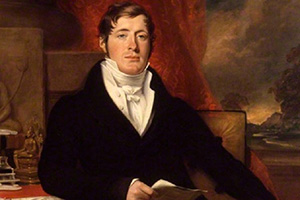 Thomas Stamford Raffles.
Raffles studied and admired Bali’s civilisation, including Balinese Hinduism. In his History of Java, which was published in 1817, after he returned to England, he wrote:
“On Java we find Hinduism only amid the ruins of temples, images and inscriptions; on Bali, in the laws, ideas, and worship of the people. On Java this singular and interesting system of religion is classed among the antiquities of the island. Here it is a living source of action, and a universal rule of conduct. The present state of Bali may be considered, therefore, as a kind of commentary on the ancient condition of the natives of Java.”
Read more about it in Secrets of Bali.
He was knighted in 1817. In 1819 Raffles secured the transfer of Singapore to the East India Company and initiated policies that contributed greatly to Singapore’s vital role in the lucrative China trade. He had a great zeal in collecting historical and scientific information, including a number of unique Balinese artifacts, which are now at the British Museum. On his return to England, he played the chief role in founding the Zoological Society of London and was its first president.
The Dutch are back
After the fall of Napoleon, and the end of the French occupation of Holland the British and Dutch signed a convention in London on 13 August 1814, in which it was agreed that Dutch colonial possessions dating from 1803 onwards should be returned to the Dutch Administration in Batavia.
The Dutch saw things very differently from Raffles. Read more about it in Secrets of Bali.
Missionaries arrived at this time but they did not make much headway. Read more about it in Secrets of Bali.
 The Submission of Prince Dipo Negoro to General De Kock, 1830.
After trade in slaves ended, the traders turned their attention to exporting rice, tobacco, coffee and sugar. Most profitable, however, was opium, imported from Calcutta and Singapore.
Mads Lange and Kuta
Mads Johansen Lange, a Dane, known locally as the White Rajah of Bali, was a very influential figure in the history of Kuta and Bali. He was born in Ruboking on Langeland Island on 16 September 1806. Lange and his two younger brothers left Denmark in 1833 for Hong Kong. Later they joined Captain Burd and established a company called Burd & Burd.
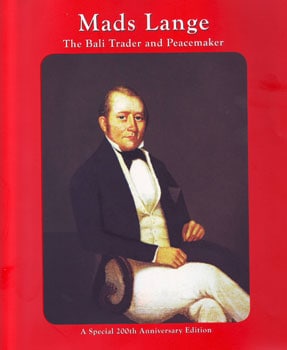 Mads Lange, The Bali Trader and Peacemaker: order here
Read more about it in Secrets of Bali.
Trade increases
The spirit of trade, however, had been engendered in south Bali and by the end of the century many people, including local Balinese, were selling opium and cloth, weaving and growing cotton.
British trade with Bali increased rapidly in the 1820s and 1830s. England, Holland and France all came to see the strategic importance of Bali’s location on one of the world’s most important shipping routes. The Dutch were concerned that the British would possibly annex Bali. They convinced themselves that they had to make a pre-emptive strike and conquer the island.
North Bali
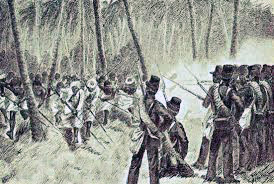 Surprise attack by Balinese warriors on Kasumba, 24 May 1849.
It took the Dutch three invasions before they could beat the Balinese and then it was only in the north of the island. Read more about it in Secrets of Bali.
South Bali
In 1891 the kingdoms of Tabanan and Badung, who had allied against him, defeated the king of Mengwi. The seven main kingdoms of South Bali, Tabanan, Gianyar, Klungkung, Karangasem, Bangli and Mengwi, were now six.
The Dutch conquered neighbouring Lombok in 1894. The kingdom of Karangasem in East Bali had conquered Lombok in the 18th century. When Lombok was invaded by the Dutch and the princes of Karangasem fell, the kingdom of Karangasem passed into Dutch control. Then they turned their attention to the rest of Bali.
The king of Gianyar turned to the Dutch in 1900 as a protective measure against his Balinese rivals. The king of Bangli did the same. They both signed treaties acknowledging Dutch sovereignty. That left three kingdoms: Badung, Tabanan and Klungkung.
The Dutch had an opportunity to confront the king of Badung in 1906 – in fact kings of Badung, as there were two. Read more about it in Secrets of Bali.
This was a mass ritual suicide. Puputan means “ending” and was the traditional sign of the end of a kingdom. There were war correspondents from the major Dutch papers on the scene and the tragedy attracted worldwide attention. Vicki Baum, author of Grand Hotel, who came to Bali in the 1930s, wrote a novel about the 1906 puputan, A Tale from Bali, the finest novel inspired by Bali so far.
A few weeks later the Dutch marched on the king of Tabanan in the west. Read more about it in Secrets of Bali..
The Theatre State
Ceremonial ritual suicide is rather hard for us to understand, but ceremonial rituals were what 19th century state politics in Bali was all about. It was what the state was for. According to the pioneering anthropologist, Clifford Geertz, in his book Negara it should reflect the supernatural order, the world of the gods. The royal court was the exemplary centre. The king was a divine object. Men should strive to pattern their lives on divine order. The closer they were to divinity, the greater the obligation to put on a good show.
Read more about it in Secrets of Bali.
The theatre state is not dead. On 3 October 1977 a royal wedding in Gianyar lasted four days. More than 15,000 people attended and it cost several hundred thousand dollars. In 1979 a royal cremation in Ubud drew 100,000 people. 3,000 were tourists, who paid US $25 each for good seats. The cremation tower was 63 feet high.
Direct and indirect colonial rule
So, the position was that five of Bali’s kingdoms came under Dutch control only after military resistance. These were Buleleng, Jembrana, Badung, Tabanan and Klungkung. Many of the rajas died in the process. The families were exiled to Lombok, Java, Madura and Sumatra. Their lands were confiscated. Their territories and people were brought under direct colonial control.
Three kingdoms came under indirect Dutch control at the turn of the century. These were Bangli, Gianyar and Karangasem. The royal families kept their wealth and much of their royal status and their kingdoms were in practice governed as indirect-ruled territories.
Read more about it in Secrets of Bali.
Ethical policy
Following the exposé of Dutch oppression, brutality and disenfranchisement, the Dutch suffered a nationwide crisis of conscience. The government of Holland imposed on the colonial administration a new policy known as the “ethical policy” in the early years of the 20th century. A number of the local elite were educated in Dutch high schools and hundreds of para-medics were trained.
Education introduced a significant number of locals to Western political philosophy, and anti-colonial and revolutionary literature, which were in Dutch. This led to Indonesia’s first anti-colonial movement. Their aim was nationhood. In 1928 youth groups swore an oath to uphold “One Nation, One People, One Language”.
Read more about it in Secrets of Bali.
Immediate benefits of Dutch rule
There were some good things. Read more about it in Secrets of Bali.
Immediate hardships of Dutch rule
Cash taxation increased. Land tax was the largest single source of revenue after opium. Read more about it in Secrets of Bali.
Rice and opium under the Dutch
The Dutch headquarters were in Singaraja in North Bali. By 1914 the Dutch were firmly in control, operating through the Balinese kings, who learned Dutch from the colonial service and who were encouraged to send their children to school in Java or Holland.
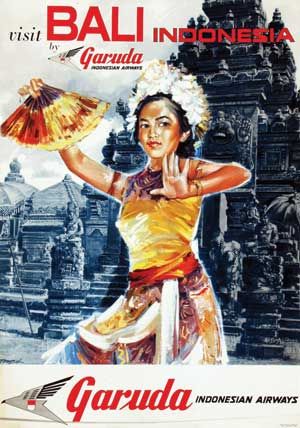 Garuda Airline Advertisement.
The most profitable aspect of that control was the revenue earned from rice and opium. Read more about it in Secrets of Bali.
Caste system under the Dutch
The pre-colonial caste system was fairly fluid, but under the Dutch it became rigid. Dutch policy had a strong high caste bias. Read more about it in Secrets of Bali.
Education under the Dutch
Western education was introduced initially to provide fodder for the civil service. The first school in Bali was established in 1875.
The gentry initially avoided schools, as they were concerned about the level of Balinese language and the status arrangements. Read more about it in Secrets of Bali.
Schools were racially segregated. Read more about it in Secrets of Bali.
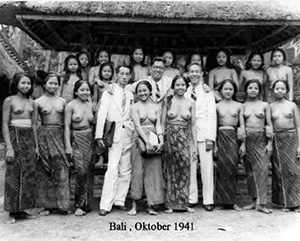 Girl’s School in Bali, October 1941.
As mentioned above the Dutch recruited the higher castes into the senior positions in the bureaucracy. Read more about it in Secrets of Bali.
It was, however, small scale and rudimentary. In Bali and Lombok, in 1920, 6.7 per cent. of boys and 0.25 per cent. of girls aged five to fifteen years were attending school and only 8.01 per cent. of males and 0.35 per cent. of females over fifteen years were literate.
In 1926 there were only 98 schools in all of Bali, all at primary level and 70 per cent. of them provided just three years’ education. By 1929 the number of primary schools, which is still all that there was, had increased to 128, attended by 14,372 students. Girls comprised 10.45 per cent.
By 1929, 73 Balinese students were attending secondary schools outside Bali, mainly in Java. It was not until the Japanese Occupation that education was greatly improved.
Balinese History – the Europeans