Balinese Dress and Balinese Textiles
Introduction
Balinese temple dress, which is called adat dress, is not a matter of choice, nor is it a fashion statement. It is a symbolic gesture with a function. It is compulsory attire for everyone for the temple.
Divine origin
As with nearly everything in Bali, dress has a divine origin. According to manuscripts, Brahma created the world and then he created people. They were naked. Read more about it in Secrets of Bali.
Chakras
Chakras are energy centres in our bodies. It is believed that certain emotions and desires are associated with each chakra. The purpose of adat dress is to control some of these desires and to focus attention on a higher purpose. Adat dress therefore symbolically and functionally harnesses the lower instincts.
Formal Dress
The Balinese wear their finest traditional clothes for the temple. They consist of lengths of cloth draped, wrapped or tied around the body. Read more about it in Secrets of Bali.
Relationship between chakras and formal dress
There are six chakras of the body that are controlled by Balinese formal dress. They are:
“The third eye” (ajna)
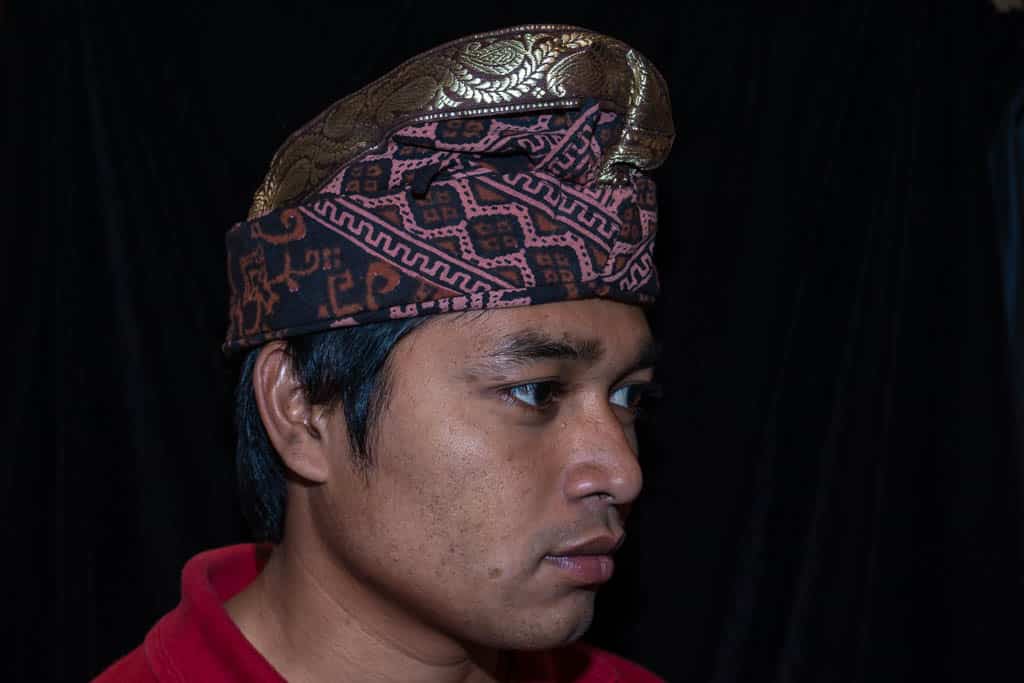 Balinese Udeng Headdress.
located in the pineal plexus, connected to pure energy or spirit, is associated with enlightenment. The purpose of a man’s udeng is to tie and focus his consciousness to this point of utter purity and distinguish it from all other personal desires, which hold a person down. Many women wear a white headband for a similar purpose. Balinese Udeng Headdress are available to buy in Murni’s Online Shop here.
The throat (vishuddha)
located in the crotid plexus, connected to the ether, is associated with knowledge, wisdom and understanding. This area remains open and flows freely.
The heart (anahata)
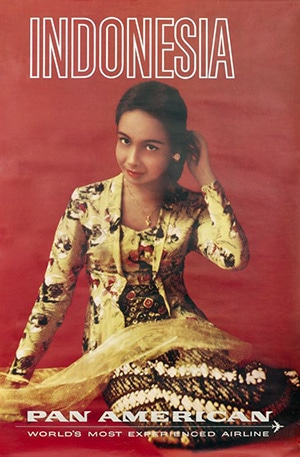 Kebaya.
The heart is located in the cardiac plexus, connected to the air, is associated with sharing, love, devotion, selfless service and compassion. It is above the boundary created by the selendang and although it is covered by a shirt or kebaya is open and flows freely.
The navel (manipura)
located in the solar plexus, connected to fire, is associated with immortality, longevity, fame, power, authority and wealth. These desires are harnessed by the selendang.
The genitals (svadhisthana)
located in the hypogastric plexus, connected to water, is associated with family, procreation, sexual urges and fantasy. These instincts are harnessed by the saput and sabuk.
The perineum (mulhadhara)
located in the pelvis plexus, connected to earth, is associated with being grounded, security, physical comforts, basic biological needs and shelter. These instincts are harnessed by the kamben.
Uniforms
The Balinese have become enthusiastic wearers of uniforms. Read more about it in Secrets of Bali.
Textiles
You can’t miss textiles in Bali. People wear them all the time. Read more about it in Secrets of Bali.
Textiles would probably also have been used as offerings to the gods. These sacred origins still resonate in Indonesia. Arabs and other traders would have used textiles as a primary medium of exchange. There is a report that in 1603 the price of imported cloth was worth 40 pounds of nutmeg on the island of Banda.
Silk
Silk was exported from China two thousand years ago and for a long time China was the only exporter. Read more about it in Secrets of Bali.
Endek
The most common traditional textile in Bali is endek. Endek is Balinese weft ikat. Read more about it in Secrets of Bali.
If you imagine a traditional backstrap loom, called cagcag, and the rectangular shape, with the weaver sitting on the floor at one end, shifting her weight backwards and forwards, the warp threads are the long ones facing her and the weft ones are the horizontal ones.
In Bali there is weft ikat, known as endek, and double ikat, known as geringsing. Read more about it in Secrets of Bali.
Originally only the courts wove endeks and only the princely families were allowed to wear them. Read more about it in Secrets of Bali.
The patterns started off being mostly geometric shapes, but later other motifs were employed, like animals, flowers, stars and wayang figures. Early endeks were red and then yellow and later green. Until the beginning of the 20th century traditional vegetable dyes were employed.
Read more about it in Secrets of Bali.
Songket
Not only in Bali, but the whole of western Indonesia, uses the word songket to describe a technique in which additional patterns are woven into a material with supplementary weft threads. Gold and silver threads are used in these textiles, the earliest ones being made of silk. Originally they would have been brought by Indian traders.
Songkets were restricted until the last 20 or 30 years to use by the princely castes. Now, anyone can wear them, but they are expensive.
Read more about it in Secrets of Bali.
Perada
Like silk cultivation, red dyeing, and songket weaving, Indian and Chinese merchants and travellers brought perada and its patterns to Java and Bali. The origin of perada lies probably in China.
Read more about it in Secrets of Bali.
Bebali
Various cloths are used in ceremonies, particularly during rites of passage. They form part of the offerings. These sacred textiles are given the generic name of bebali – like the dances, which can only be performed in the inner part of the temple. Read more about it in Secrets of Bali.
Poleng
Every visitor to Bali notices very quickly the black and white checked cloths, wrapped around guardian statues, pavilions, people, kulkul drums in temples and even trees and stones wherein a spirit dwells. It is dazzling and powerful and has a special meaning for the Balinese: it represents the cosmic duality.
Read more about it in Secrets of Bali.
Cepuk
These beautiful, but rare, sacred textiles have a uniform design. There is always a red background, although varying shades of red appear, a patterned frame of fine black, white, blue and yellow lines, a centre field and border, both of which contain endek patterns. Read more about it in Secrets of Bali.
Geringsing
The most spectacular textiles ever produced in Southeast Asia are the geringsings made only in the small attractive village of Tenganan in east Bali. The only other places in the world where similar textiles are weaved are Japan and India. Read more about it in Secrets of Bali.