Balinese Ceremonies
Introduction
 Sidha Karya, lord of innocence and childhood, is a comic and a demon. He chases children in the audience, who run away from him. One is always caught, but quickly given sweets or a coin. This sacred mask is also worn at the climax of a temple ceremony. It is danced to ensure the effectiveness of the ceremony.
There are numerous ceremonies in Bali, some of which are private, some public. Some are described throughout the book. To attend you must wear Balinese dress: see the chapter entitled Balinese Dress and Textiles in Secrets of Bali. It is unnecessary for tourists to be formally dressed: a sarong, sash and covered arms are sufficient.
Categories
There are five different categories of ceremonies, the panca yadnya. There are rituals for:
The gods (dewa yadnya)
An example would be a temple anniversary, odalan.
The higher spirits (pitra yadnya)
This includes the ancestors before they have been deified, such as cremation or Ngaben.
The consecration of priests and priestesses (rsi yadnya)
Humans (manusa yadnya)
These are rites of passage ceremonies from conception to just before death, such as pre-natal rites, birth ceremonies, the 12 day, 42 day and three months’ old baby ceremonies, tooth-filing, and marriage,
Evil spirits (bhuta yadnya)
Bhuta means element; kala, another word for demon, means time or energy. Demons are personifications of forces derived from the five elements and bring misfortune to man. The purpose of these ceremonies is to placate the demons and bring harmony to the world. One such purification sacrifice, taur kasanga, takes place on the last day of the lunar year at Besakih and elsewhere on the island.
Private ceremonies
All Balinese rituals are preceded by a purification ceremony to banish the evil spirits before the divine powers are addressed. This is done by offerings, holy water and hand gestures.
There follows brief details of some of the private family ceremonies.
During pregnancy
This is performed for the welfare of mother and child to anchor the embryo firmly in the womb.
Immediately after birth
The father collects the baby’s placenta, the ari-ari, which is the most important element of the Kanda Empat (for an explanation see the chapter entitled Balinese Religion Read in Secrets of Bali), takes it home, washes it, places it in a coconut with flowers and money, wraps it in a white cloth and buries it outside the door of his home. As you look out, girls’ placentas are buried on the left and boys’ on the right. The grave is covered with a black stone and spiky pandanus leaves to protect it. Finally a symbolic cremation fire is lit on the grave.
12 days
The baby can now be given a name. In some parts a grandparent may visit a clairvoyant priest, balian tenung, or he may be called to carry out a purification ceremony. The priest has the ability to communicate with the ancestors to identify whom the baby is a reincarnation of.
42 days
Mother and child are impure for 42 days after the birth. She cannot enter sacred places like temples and the child must be protected from witches. For the first three months the child is very vulnerable to witches and sorcerers. At the end of the period the mother and child cease to be impure and a small purification ceremony is held.
105 days or 3 months (tigang odalan)
This is the first big ceremony and takes place in the family compound. It is the day that a child attains a normal state and may enter temples. The baby ceases to be a divine creature.
It is the day that the baby first touches the ground – described as a return to the earth. Read more about it in Secrets of Bali.
210 days or First Oton
This is the baby’s first Balinese birthday, which takes place one Balinese year (six months) after birth.
The baby has its first haircut, a symbolic release of energies. The hair is cut from the five cardinal directions symbolically to remove impurities and is either buried or thrown in the river. There is a further exorcism ceremony to expel the 108 helpers.
All these rites of passage ceremonies are intended to remove impurities caused by the birth and the sins of previous lives.
Menstruation
A small ceremony is carried out at a girl’s first menstruation. From this age young people come under the influence of Semara and Ratih, the gods of love.
Tooth-filing
The shape of teeth separates the gods and humans from animals, birds and ogres. The former have flat teeth and the latter have pointed ones.
As mentioned in the chapter entitled Balinese Symbolism in Secrets of Bali. the purpose of a tooth-filing or matatah is to remove impurity by eliminating or reducing the Sad Ripu, the Balinese six deadly sins, lust, greed, anger, intoxication (through drink or passion), sadness, arrogance and jealousy. Raffles in his History of Java noted that the Balinese are “strangers to the vices of drunkenness, libertinism and conjugal infidelity…”
Read more about it in Secrets of Bali.
Sometimes there is a mass village-wide tooth-filing. This occurred in Ubud in July 2000. At that time over 100 men and women had their teeth filed in public.
Marriages
Unmarried motherhood is not an acceptable concept in Balinese culture, although premarital pregnancy is common and probably the norm. Pregnancy usually provokes the wedding. Read more about it in Secrets of Bali.
There is a preference for marriage to a patrilineal cousin (one’s father’s brother’s son or daughter). See the section Kinship in the chapter entitled Names, Titles and Castes in Secrets of Bali for an explanation.
Forms of marriage
There are three traditional forms of marriage:
Kidnapping a girl
This is now against the law.
Pre-arranged “kidnapping”
Everyone goes along with it but pretends not to know about it, is common and the least expensive.
Arranged marriage
This is a wedding agreed upon by the families. Right up to the 1950s arranged marriages were common. Conservative communities and social elites favoured it.
Wedding Ceremony
The ceremony takes place in the boy’s family compound and can be as elaborate as the family wish. The girl leaves her family temple and, unless she already is a relation, joins the boy’s family and ancestral group and will thereafter tend his ancestors. Read more about it in Secrets of Bali.
The wedding ceremony is fun; the couple wear their best clothes, gold thread and headdresses. Both wear make-up. Read more about it in Secrets of Bali.
Marriage allows the husband to join the banjar. At marriage he becomes an adult. See the chapter entitled Balinese Organisations in Secrets of Bali for details of the banjar.
Honorary male
As mentioned above, the bride joins her husband’s family temple and leaves her own. If it happens that a couple have only daughters, they will be left with no women in the family. Such a situation cannot be allowed to happen, as it would mean that ceremonies could not be carried out properly. There would be no one to look after the family temple and the cycle of reincarnation would be broken.
Read more about it in Secrets of Bali.
Polygamy
It is possible for a man to have more than one wife, but only a few do nowadays. It is usually only among the higher castes and the wealthy. Men do not usually take more than three wives.
Women
Although women are regarded honourably in the ancient Hindu scriptures, like the Manawa Drama Castro, which implies that when a woman is respected, the gods are delighted, they tend to be second class citizens. They do not have a vote at village banjar meetings, especially on matters of customary law. The village chiefs are invariably men. Many aristocratic women are expected to take care of domestic chores, such as preparing offerings, which prevents them from being able to pursue higher education.
Children
All Balinese have a duty to marry. It is vital to have children, as only they can perform the rituals for the dead and purification of souls, which are indispensable for reincarnation. Childlessness and impotence are grounds for divorce and in myths, ogres in the afterlife punish those without children. Often they are hung upside down from a tree and beaten. Being upside down is particularly degrading for a Balinese, as the head would be in touch with the ground: see the chapter entitled Balinese Symbolism in Secrets of Bali.
Twins
The birth of twins of the opposite sex to a Sudra family is regarded as a form of incest. The village is regarded as spiritually impure for 42 days after their birth. Read more about it in Secrets of Bali.
Even today twins born to a commoner result in postponement of major ceremonies. In the days of the Balinese kings the twins were taken as slaves by the king.
This does, not, however apply to twins born of a high-caste mother. Quite the reverse. It is auspicious. Read more about it in Secrets of Bali.
The idea that twins bring bad luck may date from pre-history. In the days of hunter-gatherers a woman could never nurse and carry two children. Statistically every 100 or so births are twins.
Divorce
Traditionally divorce is living apart. Read more about it in Secrets of Bali.
It is regarded so badly amongst aristocratic women that if she returns to her family compound, she will be treated like a servant and has to speak in the highest form of Balinese to her parents, brothers and sisters.
Caste
A high-caste woman should not marry a commoner. In the days of the Balinese kings both could be killed. These days the existence of the rule is rather controversial.
Inheritance
Marriage is largely about inheritance and responsibility for the family temple. Customarily daughters do not inherit. Male offspring take over responsibilities and authority, both within the family and the community. Read more about it in Secrets of Bali.
Death
Marriage denotes a break in the life cycle. Up to and including marriage, parents are responsible for their children’s purification and ritual protection; once married, the younger generation becomes responsible for their parents’ protection, primarily to carry out the death rites properly.
As soon as someone dies the hollow slit drum, the kulkul, is beaten to summon help from the banjar, which comprises men from the neighbourhood. They come to the deceased’s house and wash the body.
Read more about it in Secrets of Bali.
The body has now been prepared for burial or cremation. Bodies are frequently prepared and buried within hours of death. If they are not buried the same say, the family will stay up all night to guard the body against bad spirits. This is a time when gamblers play cards all night.
Cremation
It is not known when cremation was introduced to Bali. A Balinese cremation is very different from a Western one. It is the grandest and the most important of all Balinese ceremonies. The most important ceremony as its success, that is to say the correct carrying out of the ceremony, determines whether or not the deceased will be reincarnated.
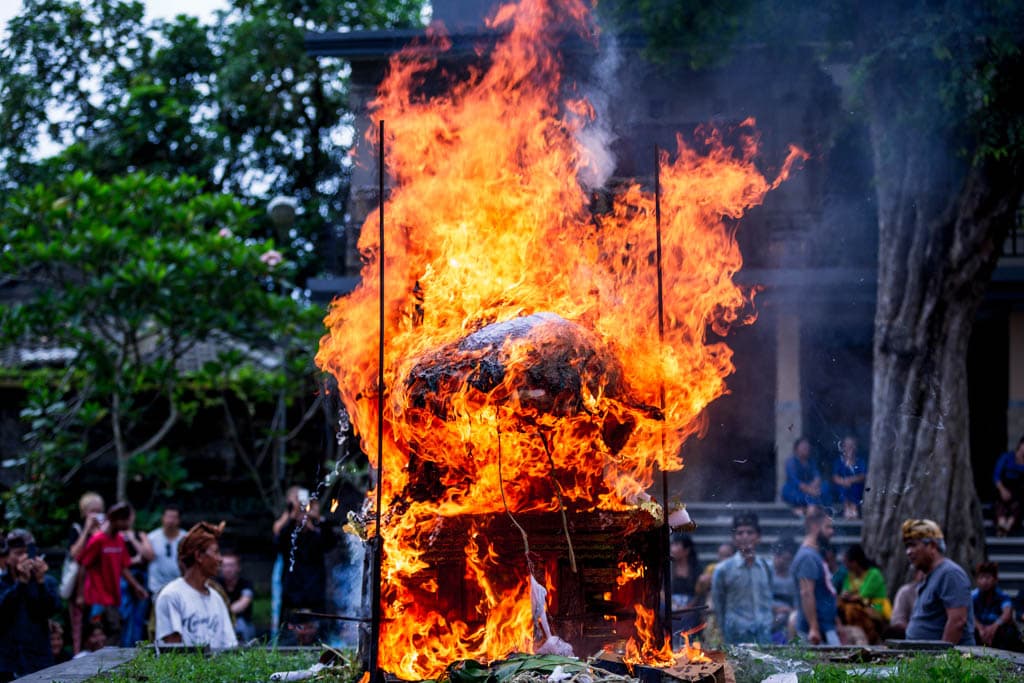 Cremation in Ubud.
Cremations are exceedingly expensive, so it is not uncommon for families to share the expense. Sometimes collective cremations are organized, like the one in Ubud in July 2000, when all 72 bodies in the village graveyard were cremated in one day or in December 2001 when 830 remains from 37 villages joined in the cremation of Ida Tjokorda Mengwi, a descendant from the 13th generation of the King of Mengwi, who reigned in the 17th and beginning of the 18th centuries. Unless the family is rich or a priest or a member of a royal family is the deceased, they are first buried to allow the family time to save up.
It should not be put off too long as uncremated spirits are restless and can cause the family and the village trouble. Read more about it in Secrets of Bali.
The ceremony takes place on an auspicious day. Read more about it in Secrets of Bali.
Chickens and ducks will be sacrificed. For a medium sized cremation two or three dozen women are required to make the offerings. It takes several weeks and they will be fed throughout. This adds to the cost. High caste priests, pedandas, carry out several of the preliminary ceremonies and officiate at the cremation.
Women make the offerings. Men from the banjar make the sarcophagus. It is in the shape of an animal. Status determines what kind. Read more about it in Secrets of Bali.
Having said this, it is not as rigid as it used to be and it is becoming a matter of choice which kind of sarcophagus is used. Either way there are always four feet to symbolise the four invisible brothers or sisters – see the chapter entitled Balinese Religion in Secrets of Bali for details of the Kanda Empat.
The men also build the cremation tower, the bade, which symbolises the universe. At the base is the world-turtle, Bedawang Nala, surrounded by snakes; in the middle, the world of man is shown by leafy forests and mountains, where the corpse is placed and at the top, there are meru roofs, like those of a pagoda, always an uneven number.
The meru roofs represent the tier of heaven to which the deceased aspires. Read more about it in Secrets of Bali.
The tower can be 60 or 70 feet high. The height indicates status. Nowadays telegraph poles have to be lowered to let the tower pass. Men who are of lesser rank than the deceased carry the tower.
On the main day guests and men from the banjar arrive at the house. If the body is in the house, it will have been prepared, with a Brahman priest in attendance, and will be placed in the cremation tower and tied to the shelf and covered by a white cloth.
There are three main phases. In the case of a large royal cremation, these would take place on separate days. Read more about it in Secrets of Bali.
If the deceased is a king, a Naga or dragon may be carried in a procession and placed to the west side of the remains. The Naga is a symbol of life. Two high priests will shoot arrows at it, which are intended to release the deceased’s soul from the world.
The procession to the cemetery will then start. The empty sarcophagus, tied to bamboo poles, will be carried by the banjar men, who intentionally turn it round roughly to confuse the deceased’s spirit, so that it will not return home. Read more about it in Secrets of Bali.
At the cemetery the sarcophagus is opened and the body – or the effigy – put inside and covered with offerings and pieces of cloth. The pedanda will pour in lots of holy water. Then the sarcophagus will be closed and firewood underneath set ablaze. Read more about it in Secrets of Bali.
Family members will pray and throw the ashes in the sea or a river, which leads to the sea. In Ubud, River Campuan is used. Thereby the body’s elements will be purified and returned to the universe.
The grandness of a cremation does not guarantee a good afterlife. It is karma, good deeds, that does that.
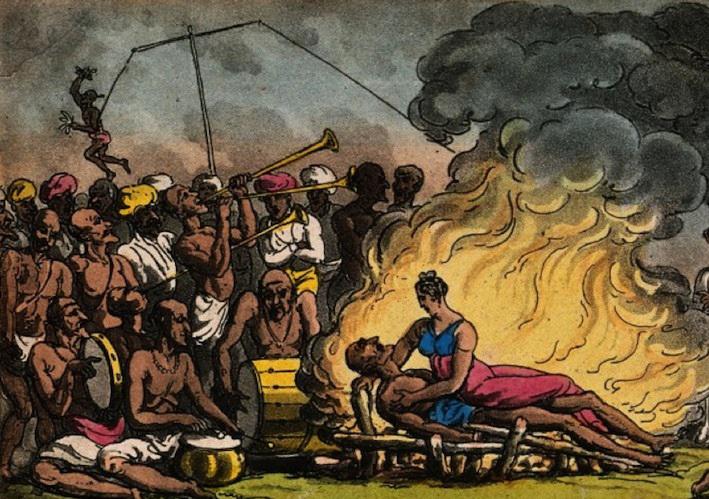 Suttee.
Suttee, the practice dating from at least the 1400s, whereby wives of Balinese rajas sacrificed themselves by jumping into the flames, sometimes stabbing themselves at the same time, was outlawed by the Dutch in 1895. Read more about it in Secrets of Bali.
The Bali Aga people – see the chapter entitled Balinese History – Pre-history to the Europeans in Secrets of Bali. for their origins – carry out death rites differently. The Trunyan people expose the corpse to the elements and the Tenganan people bury their dead.
Nyekah
A number of hours, days or weeks later, a second ceremony, sometimes called the second “cremation”, takes place to complete the matter. It is called Nyekah and it releases the soul, which still has some links to the body, from earth to heaven.
Read more about it in Secrets of Bali.
At this point the cremated dead are no longer individuals. They are good-natured ancestor gods.
Public ceremonies
Anniversaries: Odalans
All temples, public and private, have an odalan, usually every Balinese year of 210 days, which is the anniversary of their founding and dedication.
Two of the three main village temples have odalans every Balinese year. Pura Desa has one every lunar year of 355 days. Read more about it in Secrets of Bali.
New Year’s Eve, Ngerupuk
For weeks before New Year’s Eve a great din is made, banging tins and letting off firecrackers to frighten away the evil spirits from Bali. The purpose is to cast them out totally. It is an exorcism to purify the villages and towns. Large-scale cockfights are held.
On New Year’s Eve the Balinese carry out a ritual called Tawur, the aim of which is to give something back to nature. Read more about it in Secrets of Bali.
In the evening there are great processions around the villages of huge statues in grotesque shapes accompanied by loud gamelan music. They are symbols of demonic spirits, called Ogoh-Ogoh. Read more about it in Secrets of Bali.
A ceremony to cleanse the Ogoh-Ogoh is held before the parade takes place and after the parade they are usually burned at the village crossroads, but recently some have been kept and sold.
New Year’s Day: Nyepi
New Year’s Day usually takes place in March or April. It is calculated according to the Saka calendar.
On New Year’s Day total silence prevails. Read more about it in Secrets of Bali.
The idea is that Bali looks deserted and the evil spirits will leave the island. Men from the banjar, the traditional village guards, the pecalang, wearing black or red shirts with chequered black and white poleng sarongs, patrol the streets to ensure compliance and levy fines on transgressors.
On a personal level the silence, serenity and emptiness should lead to a revitalization of inner creative energy and enlightenment.
Galungan
Often described as the Balinese Christmas, this is the most important day of the 210 day Balinese year, the start of the period during which the deified ancestors descend to the family temple and are entertained and presented with offerings and prayers. Actually, strictly, they come down five days before Galungan. Those still in the cemetery will be given offerings as well. The villages are beautifully decorated with penjors. Read more about it in Secrets of Bali.
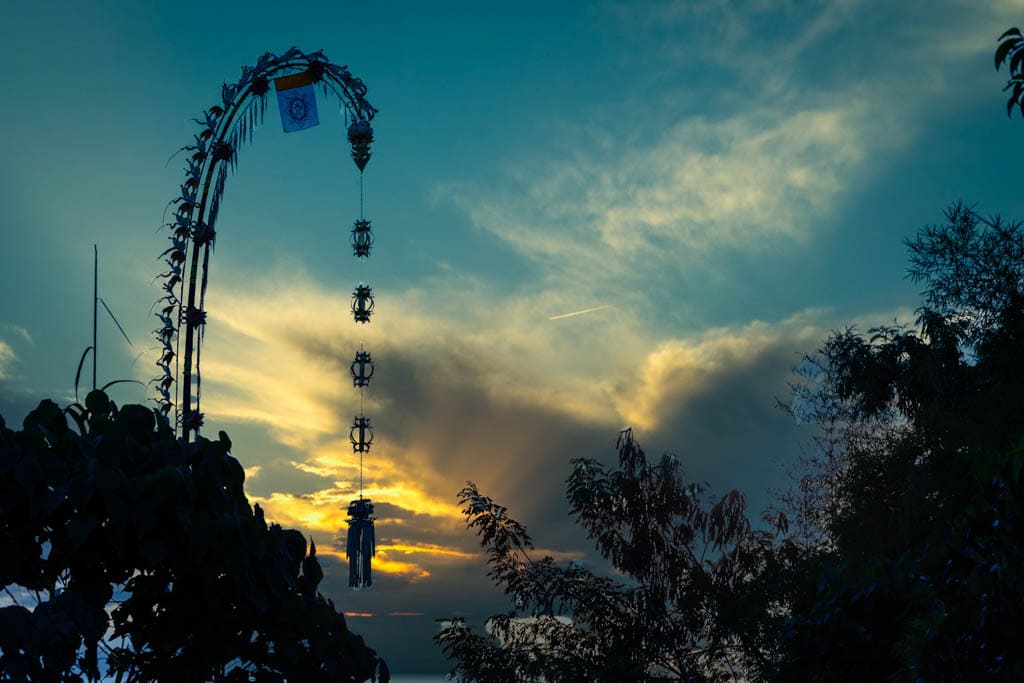 Penjor.
For the three days before, preparations are at their most intensive and disruptive spirits abound. It is a time to guard against arguments. On the first of these days bananas are bought or picked so that they will be ripe for Galungan. Tapé, a mildly alcoholic fermented rice pudding, is also prepared. Read more about it in Secrets of Bali.
On the day itself, always a Wednesday, in the eleventh week of the 210 day Balinese calendar, prayers are said, offerings made and families visited. There are barongs on the street, with crashing cymbals and gongs. Read more about it in Secrets of Bali. The holiday ends ten days later on the day called Kuningan.
Galungan also commemorates an historic battle, which symbolises good over evil. In 8 AD a bad giant king called Sang Mayadenawa forbade the Bali Aga Balinese people from carrying out their religious ceremonies. With the help of many Aryas from East Bali, a fierce battle took place and the king was killed. Peace was restored.
The Galungan kind of offerings are only made three times a year: Galungan, Kuningan and for family temple ceremonies.
Kuningan
Kuningan is also a day of prayers and visiting. Special offerings are made of yellow rice, rice made yellow by turmeric. Read more about it in Secrets of Bali.
It commemorates the spirits of the heroes who were killed during the battle against Sang Mayadenawa.
In Klungkung in the temple Paksa Bali, a Perang Dewa ceremony takes place – a symbolic fight between deified ancestors. It is very sensational. Many of the participants go into trance.
Saraswati
Saraswati Day takes place on the last day of the Pawukon calendar and is devoted to the goddess of learning, Saraswati, the wife of Brahma, the god of creation. She lives on the tip of the human tongue, and in written letters inscribed in poems on lontars and on the petals of lotus blossoms.
Her day is a public holiday in Bali. Read more about it in Secrets of Bali.
According to a religious text, Purwagama, our ancestors used to live like animals. Brahma sent Saraswati to change them into humans. She created poetry by attaching letters to the inner and outer worlds. Read more about it in Secrets of Bali.
Banyu Pinaruh
The day after Saraswati Day the Balinese clean themselves with water that has been blessed. Many people go to the beach in the morning to pray and bathe themselves with sea water (melukat). In the evening they eat a smoked duck feast.
Coma Ribek or Somaribek
The following day the Balinese pray to Dewi Sri, the rice Goddess, for wealth. No money is supposed to pass hands on this day.
Siwa Ratri
The same evening the Balinese fast and stay awake and meditate for 36 hours. On this day Siwa carried out his most important meditation. Those who do the same will be blessed and rewarded.
Pagerwesi
The following day offerings are made to Pramesti Guru for his blessing. This is to achieve balance in the world and its creatures.
Major ceremonies
There are many, but two stand out in importance:
Panca Wali Krama
This is a large purification ceremony, which takes place once a decade. The Balinese call it a year that ends in a zero.
Eka Dasa Rudra
This is the greatest of all Balinese festivals, an enormous purification ceremony, which takes place once a century. The Balinese call it a year that ends in two zeros. Read more about it in Secrets of Bali.
Eka Dasa Rudra means the eleven Rudras. Rudra is a god associated with wildness and danger, the Vedic antecedent of Siwa, with whom he later became linked. Eleven expresses the idea that he is everywhere in all directions.
It was planned to have the ceremony in 1963, but that was Saka year 1984, which did not end in two zeros. Read more about it in Secrets of Bali.
During the ceremony the Balinese were asked not to cremate their dead and not even to announce publicly, by beating the slit-drum kulkul that a death had occurred. Bodies were carried quietly to the graveyard and buried. Post-cremation rites that purify the soul of a body already cremated were, however, allowed.
The offerings were mind-boggling – more than 50 buffaloes, scores of other animals, thousands of ducks and chickens, tens of thousands of bananas, eggs and coconuts, tons of rice.
In February, during the preparations, Mount Agung began to erupt: see the chapter entitled Balinese History – the 20th century in Secrets of Bali..
Level of ceremony
Ceremonies may be carried out in three different levels:
Utama or elaborate.
Madia or average.
Mista or simple. sanggar cucuk.
These are sometimes sub-divided. They are all equally valid. Read more about it in Secrets of Bali.
Bhuta yadnya rituals with the generic name of caru begin with the offering of one fowl (eka sata) of multi-coloured plumage places at the foot of a little bamboo shrine. The next level is five fowl (panca sata) and five shrines, the colour of each fowl’s plumage corresponding to its direction. Larger bhuta yadnya ceremonies, called taur, require sacrifices of four-footed animals as well as fowls, a greater number of other offerings, the tall elaborate sanggar tawang shrine and the presence of a high priest.
There are several graded divisions of taur sacrifices, increasing in size from taur agung to taur gentuh to Panca Wali Krama and finally Eka Dasa Rudra.