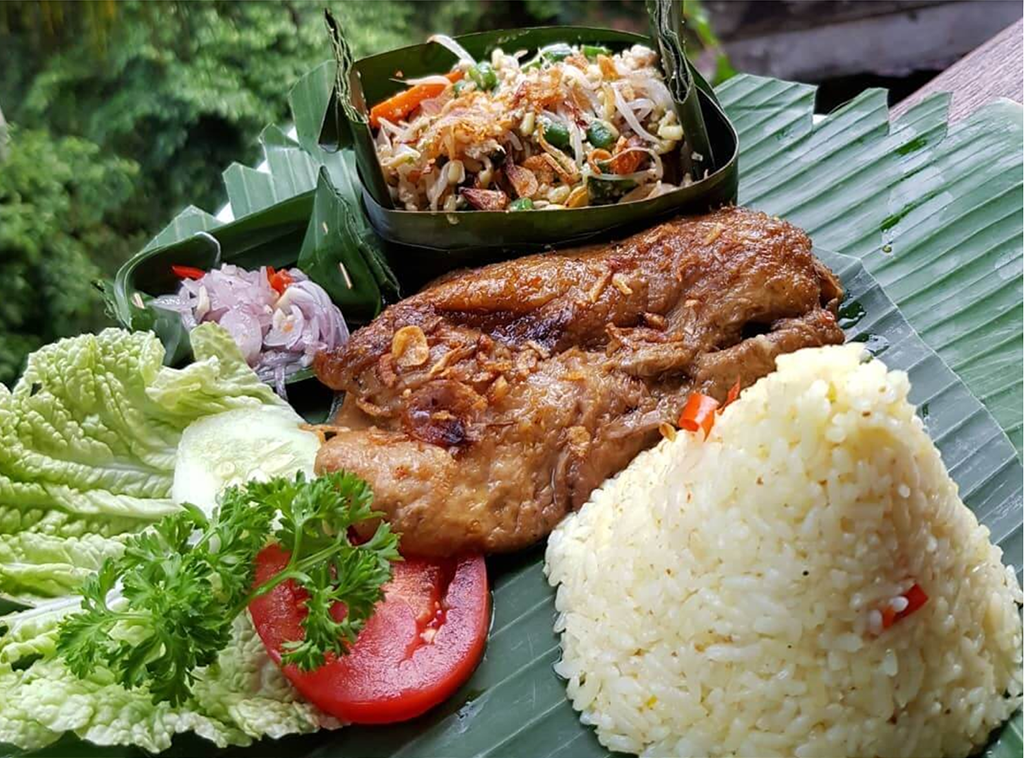
Located next to the old Campuhan Bridge, a five-minute ride from Ubud Central, Murni’s Warung sits peacefully on a river’s hillside, boasting the view of River Wos flowing water. Built from the ground up, the restaurant first opened in 1974 and has been serving food and hospitality for 47 years now.
Owned and run by a Balinese woman, Ni Wayan Murni, the warung has expanded to four open-air levels, complete with shop and lounge bar. However the atmosphere remains the same. Each guest will be immersed in its traditional interior design carefully decorated with exquisite antiques and artworks.
Similarly, the menu has also been expanded to cater to both local and international tastes where guests can find pasta, steak and a hot dog, for example. But you cannot miss the time tested signature dishes, such as Bebek Betutu (Balinese Duck), Murni’s Tutu Ayam, and Nasi Campur.
Traditional dish is so good that food critics struggle to describe it
Ian Lloyd Neubauer
Nikkei Asian Review, 28 February 2020
It’s what’s on the inside that counts: A duck is stuffed with the special mix of spices necessary to create the Indonesian delicacy bebek betutu.
UBUD, Indonesia — “No question about it, this is the best pig I have ever had. Absolutely the best. You think even the finest French chef could ever come up with anything as delicious or as beautiful as this?”
When the TV chef Anthony Bourdain uttered these words while filming in Indonesia in 2006, he turned babi guling — Balinese pig roasted on a spit — from a local favorite into a global delicacy.
There is, however, another Balinese dish that rivals or even exceeds babi guling: bebek betutu — roasted leaf-wrapped duck. Richly seasoned with chili, ginger, candlenuts and garlic, this melt-in-your-mouth masterpiece upstages the flavor profiles of China’s Peking duck, France’s confit de canard and every duck dish ever conceived, according to many prominent food judges.
“The duck meat was black and moist and so tender that it fell from the bone with a touch. It was so delicious and entirely unlike anything I had ever eaten,” wrote Sri Owen, the Indonesian food writer credited with introducing her country’s cuisine to the world, after she sampled bebek betutu for the first time in 1962.
Nicholas Jordan, a Sydney-based food writer, voiced similar sentiments after recently discovering the dish in Bali: “It’s one of the few things I’ve eaten in my life that’s so good it’s taken up a mythical status in my mind … something so beyond regular deliciousness it shouldn’t exist without some sort of paranormal ingredient.”
To learn more about bebek betutu I traveled to Ubud, the Balinese spiritual hub made famous by Elizabeth Gilbert’s bestselling memoir “Eat, Pray, Love” and the 2010 film based on the book. Now a booming tourist town with a cosmopolitan dining scene, Ubud has several restaurants that list bebek betutu as a signature dish. Among them is Murni’s, where duck legs are plated with pyramids of yellow rice and a spicy green bean and shredded coconut salad called lawar. With a lightly sweet and herbal finish, the recipe has not been altered since Murni’s opened in 1974.
Indus, a restaurant overlooking a coconut tree-fringed river valley owned by Australian-Indonesian culinary icon Janet DeNeefe, is also known for its bebek betutu, though it must be ordered as a whole bird for two or three people to share.
Aperitif, an extravagant 1920s-style restaurant that cost $2 million to build at the luxury Viceroy Bali resort, offers an East-West interpretation of the dish: duck magret (the boned breast of a duck reared for foie gras) injected with bebek betutu spice mix in place of orange sauce.
But according to Astrid Maharani Prajogo of Good Indonesian Food, a culinary tour company, the best bebek betutu is not found in any restaurant. It is made by specialists who work from home and supply locals with ducks for Hindu ceremonies, celebrations and Sunday roasts.
“There are lots of these duck specialists in Bali,” Prajogo says. “But the one I always take my clients to is Pak Rimpin near the Royal Palace in the center of Ubud. I went there because someone told me his duck was the freshest.”
“They’re all very good at what they do … but with Pak Rimpin, it was his idealism that struck me … his desire to preserve the culinary tradition. He was very keen to open up his kitchen and share his recipe and stories with tourists.” She adds: “It’s also where the royal family of Ubud get their bebek betutu.”
The labyrinthine streets and alleys of Ubud are still semi-deserted at 8 a.m. when I arrive at Rimpin’s home, a traditional Balinese compound with intricately decorated stone gates and Hindu shrines. There I find the specialist at work in a central courtyard kitchen filled with cooking aromas and shards of bouncing light.
Rimpin’s bebek betutu must be ordered at least two days in advance. Normally he cooks between 15 and 20 a day, but today it is relatively quiet; he is making only four, plus an order of duck satay sticks. When I ask his age, he consults quickly with his daughter-in-law Junek, who tells me he is “about 60.” He has been cooking duck “since the 1980s” and learned the craft from an older brother. “I asked him to stop working because he’s getting old and the work is exhausting,” Junek says. “But he won’t listen.”
Rimpin sighs and turns his attention to the four ducks soaking in a pail of water. He chooses one, rinses it dry and starts massaging it with a marinade of coconut oil, fermented shrimp paste, soy sauce and salt. He also adds tamarind paste to the blend to neutralize the naturally unpleasant odor of duck meat.
He then stuffs the bird’s cavity with a handful of bay leaves and bumbu — Balinese for “spice mix” — which in this case also contains sesame seeds, galangal and pepper. “There’s no secret recipe. If people think my bebek betutu tastes good it’s because of the attention to detail. I make them one at a time,” he says, wrapping the bird like a birthday present in betel-nut bark, which contains natural oils to further enhance the flavor.
Next, he takes the package to a room blackened by decades of soot with a series of raised mounds for cooking on the floor. He places the package in a steel wok, covers it with a second wok, rests it on one of the mounds and then covers it with a 30-cm-tall pyramid of rice husks. Finally, he tops the pyramid with a few coconut husks, adds a few squirts of kerosene and sets it alight.
The term “betutu” refers not to the recipe but to the use of rice husks — a time-consuming cooking process that gives the ducks cooked by specialists a robust flavor. The ducks are baked in these medieval-style ovens for a minimum of five hours, although Rimpin cooks his for 12 hours.
“You get this dry roasting effect similar with steaming and braising that commercial kitchens designed 1,000 years later still can’t replicate,” says Will Meyrick, an expatriate chef from Scotland who teaches tourists how to make chicken betutu, a popular variant, at the Canggu Cooking Retreat on the coast. “All the spices and ingredients get broken down into this rich juice and the flavor is amazing.”
Rimpin’s customers normally eat his bebek betutu at home. But I want to taste it straight out of the oven and unwrap my parcel in the middle of his kitchen. As the bark curls open I am struck by an aroma so complex it seems to possess texture.
The meat at the top is golden-yellow from the turmeric and black on the inside from the spice mix. I collect some on a fork, mop up some of the golden juice, and take my first bite. The flavor is so remarkable it speeds my heartbeat for a few moments. As much as I try, I can’t find the words to describe what I am tasting.
“What words would you use to describe the emotion of hearing ‘I love you’ for the first time, or the sensation of the sun on your face after a month of winter rain?” says Jordan. “How do you describe one of the best things you’ve ever eaten?”
Bali scores gastro-points with ‘indescribable’ roast duck
“Murni’s Warung: Beside a small ravine just outside Ubud, this multi-level restaurant is spacious yet intimate. The street level dining room has terrific views (particularly of a nearby waterfall), as does the downstairs bar. Throughout the shadowy wood interior is complemented by simple bamboo furniture and Indonesian art, creating a rustic and very Balinese feel. Both Indonesian and Western dishes are served, and special buffets are available on Western holidays. The Balinese duck – stuffed with spices and baked so thoroughly that the meat falls off the bones – is tried and true. The friendly, cheerful staff are ready to offer advice on local activities or simply rock babies while parents eat. A shop on the upper floor is a veritable gallery of Balinese items. Murni’s also has some accommodation, including two rooms, a bungalow and a house – all moderately priced.”
“As you approach through the highly-carved Balinese doors, you know you are in a place dedicated to the finer things of life…”
One evening recently, I decided to meet up with my old friend, Renée, and dine in Ubud’s oldest restaurant; Murni’s Warung. It’s above the sacred Campuhan River, just beside the old Dutch suspension bridge, facing a spot-lit wall of tropical trees. There is a real Murni and old Asian hands know her well. I was hoping she would be there.
As you approach through the highly-carved Balinese doors, you know you are in a place dedicated to the finer things of life. We resisted the almost irresistible temptation to go into her shops, which are on either side of the doors and which house her treasures. Murni is a well-travelled collector, who brings back amazing things.
Walking past the famous cakes, and making a mental note for later, we made our way to the little-known, comfortable Lounge Bar for cocktails: a Mojitos for me (tall, minty, thirst-quenching) and a Melon Colada for Renee. This is a great place to unwind, listen to great music, perhaps meet an old friend passing through and take in some amazing art. I particularly admired the primitive stone statues from East Sumba.
We both like gardens, ponds and shrines, and the sound of running water, so, after the drinks, we made our way down to the bottom level, through the third floor, which is often used for banquets and which we’ve named The Elephant Room, because it has so many Ganeshas, the God much loved by the Balinese. I would really like to get the new bronze one, commissioned by Murni five years ago and which has just been finished. It’s almost 6 feet tall and a whopping 500 kilos. I’m saving up for the deposit.
We sat down and spotted a few famous people. I think they recognized me too!. The menu is extensive and has not only the Indonesian favourites, but also a very good selection of Western dishes. There are also a number of Thai-inspired dishes, which tend to be specials, and change daily.
I decided to go Indonesian, opting for the mini-lumpia (delicious, crisp spring rolls served with sweet and sour and peanut sauces); an excellent choice – light and tasty. Renee ordered a creamy pumpkin soup, which was nutty and full of flavour. Murni was in the restaurant, presiding lovingly over her creation. She came over, smiling, to our table and explained that the pumpkins were organically grown on her property, Murni’s Villas, in the foot-hills of Mount Batur.
For the main course, I ordered the Bebek Betutu, traditional Balinese smoked duck and Renee chose Western fare, the Chicken Dijon. This proved to be a tender, juicy chicken breast, sautéed in white wine and finished with a cream and Dijon mustard sauce, steamed green beans and honey-glazed carrots on the side. My duck was perfect – meat falling off the bone, not at all fatty like ducks in the West, steamed saffron rice, vegetable lawar and a tasty duck consommé.
I’ve forgotten to mention the small but perfectly sufficient wine list. I chose an Australian Chardonnay, which was very reasonably priced and perfect with the duck. Renee wanted to try a local tipple and went for the Brem Merah, home-made Balinese rice wine, served with a squeeze of lime. The brem was hailed as “delicious!”
A quick look at the menu confirmed that deserts were a must. Murni has always been well-known for her baked on the premises cakes and pies, but I couldn’t get past the cheese cake with fresh strawberry coulis. Tangy lime and strawberries made this the perfect finish for an already memorable meal. Renée chose the Balinese Black Rice Pudding, creamy rice cooked in coconut milk, pandanus leaf and topped with grated palm sugar. Renee loved it. And the rice really is black!
What else? Well, we returned to the Lounge Bar to complete the night with espressos, served with sweet spice and vanilla biscuits. Settled back on the sofas, who could resist a liqueur? Not us! Two Benedictines please.
Oh yes, the bill. The three-course food bill for both of us came to Rp. 201,500 before tax and service, which was very reasonable. I’ll not mention the drinks bill as we had some I haven’t told you about!
After all that feasting, we really appreciated the free transport back to our hotels and a great night’s sleep.