Learn the tradition of making and playing the rindik, a traditional bamboo gamelan musical instrument, under the guidance of a Rindik master. The course takes place in the Green Village on the sacred Ayung River surrounded by lush Balinese forest.
Weekdays – 3 hours.
Includes:
Lunch
One Rindik instrument
Not including transport – ask Reception for that.
It takes about 45 minutes from Murni’s Houses & Spa.
Book as much in advance as possible – they get booked up.
Ubud is world famous for dance performances – legong (virgins), kecak (monkeys), jegog (girl and boy), barong (lion) – gamelan music – and shadow puppets.
Balinese Dance Performances.
Some of the best dance performances are in the magnificent Pura Dalem temple just a minute’s walk from Murni’s Houses. We can arrange tickets for guests.
SUN
Legong Dance
Ubud Palace
7.30
Kecak and Fire Dance
Padang Tegal
7.00
Wayang Kulit Shadow Play
Oka Kartini, Ubud
8.00
Pendet, Legong Lasem, Oleg, Cockfighting and Baris Dances*
No place on earth has as much music as Bali, or as many kinds. The reason for the plethora of musical forms is attributable to the limited interaction between the many villages. It is therefore due to geographical reasons. Not to mention the talents of the Balinese themselves.
The Balinese orchestra is called a gamelan. Strictly the word refers to the instruments, not the players. The Bali-Hindu religion requires the gamelan for the success of the thousands of ceremonies performed every year. There are more than two dozen distinct types of gamelan, each with their own traditions, repertoire and social or religious functions. The music is full of insistent rhythms and elegant patterns. There is hardly any improvisation.
The primary function of gamelan music, as with everything else in Bali, is to entertain the gods and deified ancestors at various ceremonies. There is music at temple ceremonies, weddings, cremations, family temple ceremonies and processions. The players rehearse frequently and memorize the music. There are also secular performances, and of course, many tourist performances too. Often the musicians have other jobs during the day and meet in the evening to practise or perform.
Instruments
The mainly percussion instruments are played in unison:
Gangsas
These comprise a number of different sized instruments, metallophones that look like xylophones, called gangsas, which have bronze keys that are hit with little wooden hammers which causes bamboo resonators below the keys to vibrate. They may have four to 14 keys and are grouped in pairs. After the keys have been hit by the hammer in the right hand, the left hand immediately grasps the key to stop the sound merging in the next note.
Gongs
There are a number of single fine bronze gongs, which are hit at intervals with a cloth-covered mallet, to divide up the composition.
Ceng-ceng
These are small bronze cymbals, which add colour and excitement.
Reyong
This is a long framed instrument holding about a dozen inverted bronze pots, having small knobs on top, bosses, which are hit with sticks by four players sitting alongside, each player being responsible for his own section.
Trompong
Sometimes there is a second similar instrument, called a trompong, which is played by only one person, whose arms need to be long; this, along with the suling and rebab, are the only instruments which improvise.
Kendang
These are two sets of double-ended drums, held across the lap, lead the orchestra; in each pair, there is a higher pitched one, designated male and a lower-pitched one, female. The kendang is considered the most difficult instrument in the gamelan.
Suling
High pitched flutes, suling, are often part of the gamelan.
Rebab
The rebab is an ancient two-stringed instrument like a violin.
Scale
Usually only five tones are used – a pentatonic scale. All the instruments have unchangeable pitches – except for the rebab. They are tuned when the instruments are made, which means they don’t tune up before a performance. Read more about it in Secrets of Bali.
Lead
The drums lead but they are not visible to all members of the orchestra, so the lead gangsa player often flourishes his hammer to guide the others. The compositions always end with a big gong beat.
Melody
The tuned instruments play the melody or a variation of it, while the large gong and smaller gongs, cymbals and drums keep time and furnish a framework for the melody. The higher the pitch of the instrument, the more complicated the music it has to play.
Much of the excitement of Balinese rhythms arises out of kotekan, interlocking pairs of gangsa at the upper registers. Two interlocking musical lines sound as one melody. They could not be played alone. They are often played at unimaginable speed. The two drummers also play in patterns that are similar to kotekan.
History
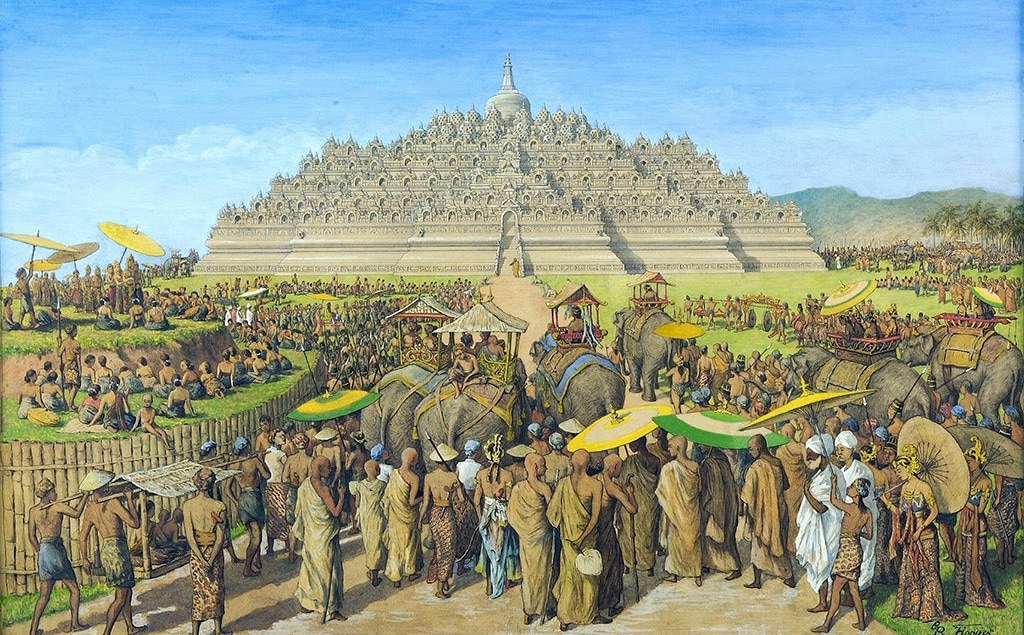
There are musical instruments on the friezes of Borobudur Temple, near Jogjakarta in central Java. The arrival of bronze from mainland Asia was the necessary breakthrough for music in Java and Bali. Smiths learned how to cast gongs and later forge keys. Then tuning evolved and ways of assembling instruments.
Borobudur Temple during a pilgrimage. The two figures in white robes on the right are the grandfather of the painter (with beard) D.A. Hooijer and his uncle Gijs Hooijer (about 1919).
One of the earliest gamelans is the Gamelan Gambuh, still played in a few villages, including Batuan, but more common is a gamelan called the Gamelan Gong Kebyar. Read more about it in Secrets of Bali.
The courts in Bali were patrons. Read more about it in Secrets of Bali.
Colin McPhee writes in his book Music in Bali that the Gong Kebyar was first introduced in Bungkulan village in 1914 and spread to almost every other village in Buleleng regency by the early 1930s, when it reached the height of its popularity. The word Kebyar derives from byar which means sudden intense sound or flash of light.
In the early 1960s a High School, KOKAR, and a College of Performing Arts, STSI, formerly ASTI, were established in Denpasar and have a high reputation for teaching, research and creating new works.
As with Balinese painting, tourism has provided a new kind of patronage, which has helped finance the purchase of gamelans, whilst civic pride has kept standards high. Ubud and Peliatan are particularly well regarded.
The Bali Arts Festival in Denpasar every June and July features performances from all over the island.
Influence on the West
The gamelan has influenced composers like Claude Debussy, Benjamin Britten and Philip Glass. It was introduced to the West at the end of the 19th century by some very successful music and dance tours. Read more about it in Secrets of Bali.
Colin McPhee
Colin McPhee was born in 1920 in Toronto of Scottish ancestry. At 24 years he showed promise of musical talent and went to New York and then Paris, where he met the young composers of the neo-classical style, including Aaron Copland. Read more about it in Secrets of Bali.
He wrote about his life and work in Bali in A House in Bali (in which he never mentions his wife) and a 600 page book called Music in Bali published 24 years after his return to the United States in 1941. He died in January 1964.
Ubud
There are active gamelans in each of Ubud’s 12 banjars and performances every night. There is also a respected women’s gamelan group in Peliatan.