Buffalo Racing, Dancing and Photography in West Bali
A rare chance to see Buffalo Racing in West Bali and other fascinating sights, and stay in a private house with a famous photographer, well off the beaten track.
The package is 3-days 2-nights.
It’s about 3 hours drive from Ubud to Tegalcangkring (depending on the traffic). There are some beautiful scenic landscapes on the way.
The house has 4 bedrooms (2 with single beds) accommodating up to 9 people.
Included:
Sunset at Delodbrawah beach (weather permitting).
Early morning sunrise at Perancak River Estuary (weather permitting).
Fishing port activities.
The beautifully carved and painted Bugis fishing boats.
Jagatnatha Botanic Gardens.
The magnificent Jagatnatha Temple.
Short presentation by Deniek G. Sukarya on practical photography tips and techniques.
Drive to Bunut Bolong, a massive, sacred tree with a hole through it which cars can drive through.
The ancient, important Rambut Siwi Temple.
The beach for sunset photography.
Private Jegog Dance Performance (15 musicians, 8 dancers), the unique bamboo orchestra of Jembrana, at Deniek’s home.
Early drive to Lanyah or Gintungan rice fields to photograph sunrise and rice farmers’ activities.
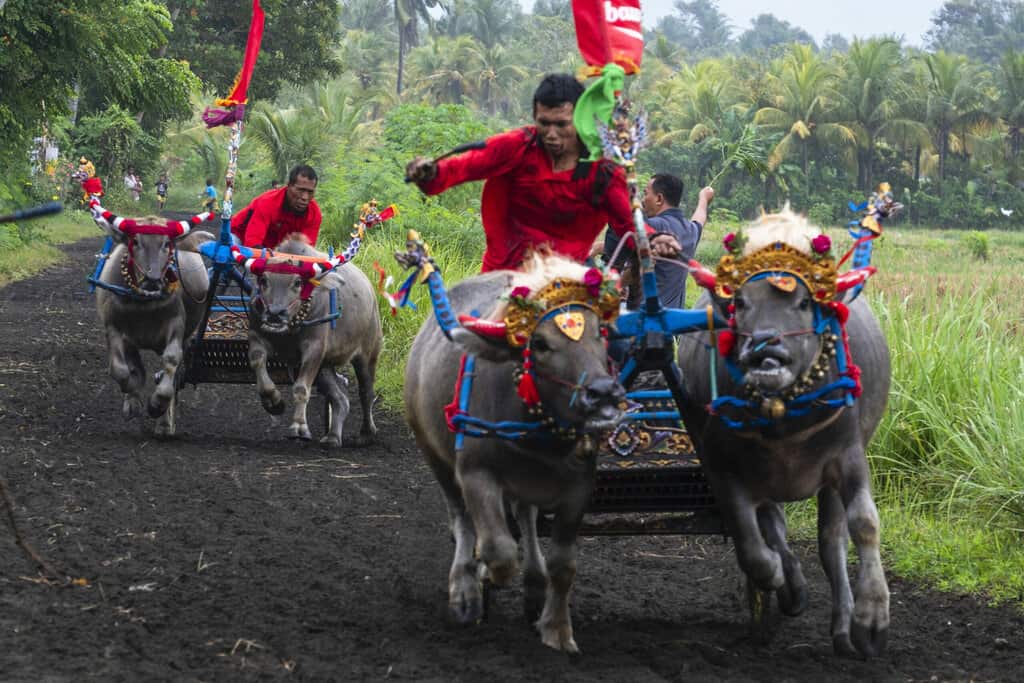
Makepung, the unique, incredibly exciting and colourful bull race of Jembrana from preparation to actual racing of the decorated chariots.
Accommodation
1 room for 1 or 2 people (twin sharing)
2 rooms for 3 people (twin sharing)
2 rooms for 4 people (twin sharing)
3 rooms for 5 people (twin sharing)
3 rooms for 6 people (twin sharing)
4 rooms for 8-9 people (twin sharing)
Breakfast, lunch and dinner included.
Please let us know if you have any dietary requirements.
Transport
Please let us know in good time if you need transport to and from Jembrana. It’s not included.
Pick up and Drop back to Murni’s Houses & Spa.
If you have your own transport, we’ll provide directions to the house in Tegalcangkring.
Your Host
Deniek G. Sukarya, a native of the region, is a great photographer, dance choreographer and musician, with more than 15 books, including the best seller Kiat Sukses Deniek G. Sukarya dalam Photography dan Stok Foto. His book, Indonesia – Harmony in Diversity was given as the Presidential Gift for visitors by President Susilo Bambang Yudhoyono.
Bring:
Your phone or camera. You don’t need to be an expert photographer.
Make sure it’s fully charged, with extra fully charged batteries and empty flash cards. If you have a tripod and filters, bring them.
Comfortable foot wear with non-slip soles, as the places can be wet and muddy, as well as a hat and sun block. A flashlight will be useful if you’re in the dark or low light.
Payment
Please note that full payment is required on booking and as everything has to be arranged and paid in advance for this private workshop, it’s non-refundable.
Book as much in advance as possible.
Note normally several weeks notice is required to arrange this special opportunity, but you may be lucky.
Today is Merchants’ Day is Bali. In fact it’s Merchants’ Day every 210 days. Merchants are mainly women, hence the queue of women with their offerings jostling to get into the small Melanting temple in Ubud market today.
The 3-day week determines the markets in Bali. The market shifts from one village to another on a 3-day cycle, so that there is a market in every village once every three days. Ubud forms part of a rotation with the markets at Payangan and Tegallalang. But in fact it’s very busy every day in Ubud.
Markets date back a long way in Bali. The first reference to markets and market weeks is in the 9th century. Some of these old inscriptions refer to markets that are still on schedule today. Markets start very early in the morning. They are usually situated outside the royal palace or a noble’s house. In Ubud, the royal palace is just across the road.
Ubud is world famous for dance performances – legong (virgins), kecak (monkeys), jegog (girl and boy), barong (lion) – gamelan music – and shadow puppets.
Balinese Dance Performances.
Some of the best dance performances are in the magnificent Pura Dalem temple just a minute’s walk from Murni’s Houses. We can arrange tickets for guests.
SUN
Legong Dance
Ubud Palace
7.30
Kecak and Fire Dance
Padang Tegal
7.00
Wayang Kulit Shadow Play
Oka Kartini, Ubud
8.00
Pendet, Legong Lasem, Oleg, Cockfighting and Baris Dances*
Offerings are called banten in Balinese. It is possible that the word comes from the Sanskrit word bali, which means tribute, obligation or gift. Or it may be derived from the word enten, which means to wake up or be conscious. It is a consciousness of the gods.
If you stay at Murni’s Houses you can learn how to make them .
Purpose
Offerings are gifts. They are a means of giving something back. But, of course, gifts obligate the recipient and so the system creates mutual obligations and favours, even between humans and spirits. With offerings to the demons, however, the offeror does not expect a gift in return, just the favour that the demons will go away.
There is another indirect purpose. The chapter entitled Balinese Religion in Secrets of Bali describes their function.
Preparation
One of the most striking things about Bali is the daily profusion of offerings. Offerings are important: they are to give pleasure to the gods (and the demons). They provide good karma to those involved in their preparation. Nearly every village has its own unique forms of offerings.
Some Balinese spend all their lives making them. Women mostly, but not exclusively: it depends on type of offering. Men prepare certain offerings as described in Secrets of Bali. Some can only be made by Brahman women. The work in preparing an offering, itself is an element of worship, and is regarded as part of its content.
Bokor
An offering must have a container. Some offerings are placed in round containers carved of gold or silver. They are made in various sizes. Nobody knows when the Balinese started using bokor as ritual utensils. There are no recorded documents.
It is said that the Pande clan of silversmiths, who lived in the village of Nongan in Karangesem in East Bali, about 60 kilometers from Denpasar, made them first. Now there are only seven artisans in Bali, who do so.
During the Dutch colonial period, it was difficult to find the raw materials and the only way was to collect tin coins, called pis bolong, and melt them in a heated kiln at 200 degrees Celsius. Finding the coins was a risky business. The Dutch imposed a prison sentence for anyone found collecting, much less using them to make bokor.
Components
The tall offerings have a soft banana tree trunk in the centre to serve as a core for inserting bamboo skewers to which the fruits and other things are attached.
Every offering has at least three ingredients as described in Secrets of Bali.
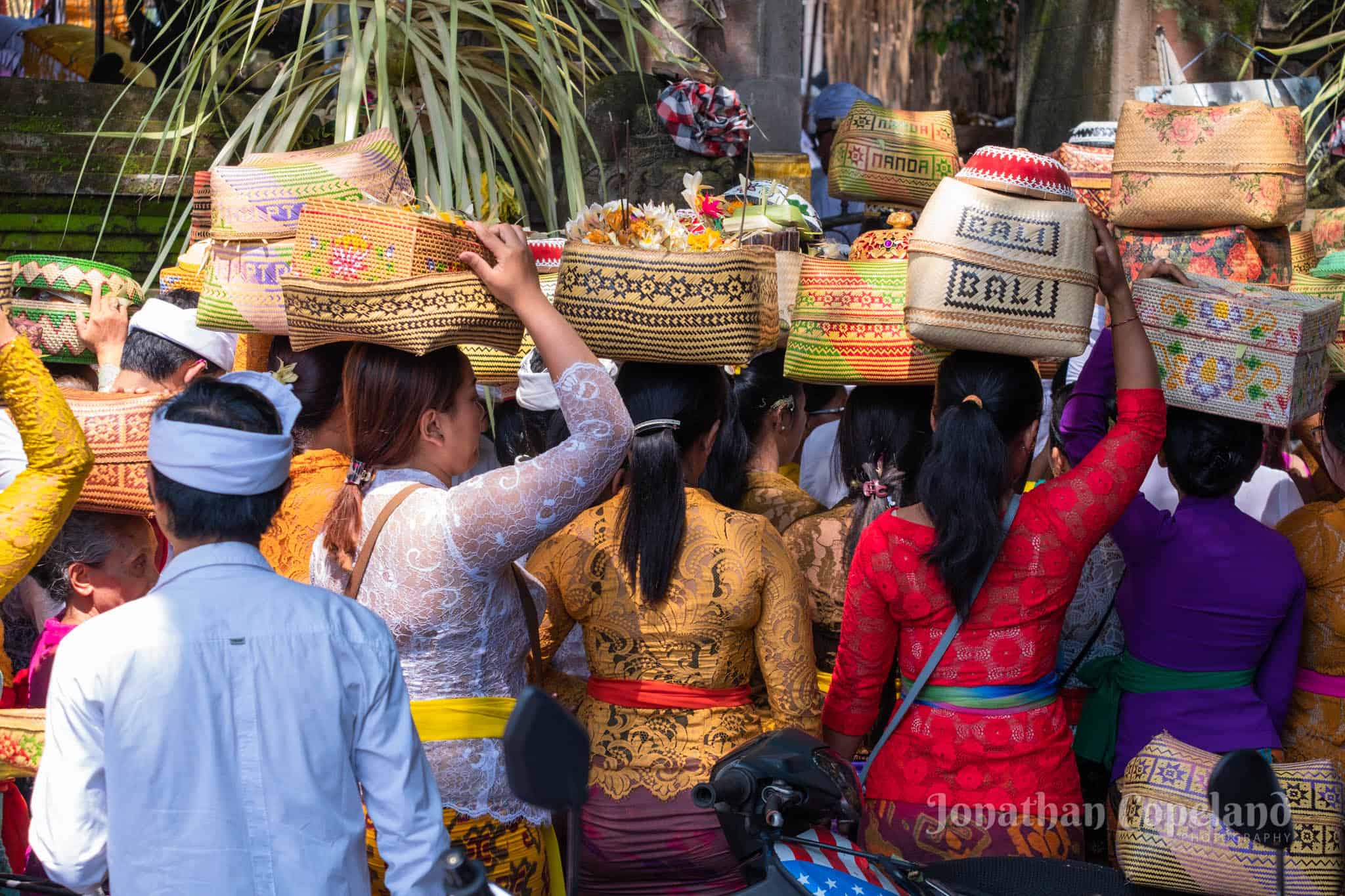
Offerings accompany ceremonies and prayers. They vary considerably in complexity. Some are very simple, some very tiny; others can be several meters high. If there is an important ceremony, such as a temple ceremony, enormous towers of flowers, fruit, cakes, meats and eggs are made at home and carried to the temple by women on their heads, often for long distances. Offerings are made of entirely natural things. They all have a very short life, but they contain the things that the gods like, the things that the Balinese like.
On very special occasions, like a wedding or a tooth-filing, figurines of coloured rice dough are made, fried and attached to a huge bamboo frame, several meters high, which represent the universe symbolically. There are ascending levels. They often have a gate, shaped like the kori agung gateway in a temple, the gateway to heaven. There are many flowers, fruits, leaves and other floral elements. Bhoma, with his large round face and bulging eyes, is above the gateway, symbol of the middle world and fertility, son of Mother Earth and Wisnu. The Cili, symbol of the Rice goddess and fertility, always has a place. The base is often Bedawang Nala, the turtle, on which the world rests, with the two snakes. These sarads take many people several days’ work. They last a week or so and are never eaten. They are accompanied by big meat offerings consisting of pig meat, intestines and fat, which are made by men.
Another kind of offering, much smaller, is made by pinning palm leaves from the coconut palm, sugar palm or lontar palm trees, and sewing them together with little pins of bamboo, or alternatively plaiting them into little containers. These are fashioned in numerous quantities.
Offerings for Durga and the demons always contain some pork or fish, onions, ginger and alcohol (palm wine or brem).
Temple offerings
You may stumble across a long procession of women, dressed in fine Balinese costumes, offerings on their beads, threading their way to the temple. It makes for a great photograph. It is, of course, appropriate for offerings to be carried on the head, as the head is the most sacred part of the body. Offerings are gifts to the gods and deified ancestors. When they are brought to the temple they are placed on special pavilions and sprinkled with holy water symbolically to remove any impurities. Then the priest offers the spiritual essence to the deities, after which the worshippers pray. Once the deities enjoy them and take their essence, their Sari, their function has been fulfilled. They are usually taken home and eaten and never re-used.
Family compound offerings
Family shrines are given daily offerings in the morning – after the meal has been prepared, but before it is eaten. On important days there are special offerings: days like Kajeng-Keliwon, Tilem, Purnama, the Tumpeks, Galunggan and other festivals. A female family member presents the offerings. She must be dressed in Balinese dress. The offerings are carried on a tray with a stick of burning incense. She wafts the essence of the offering towards the shrine.
The chapter in Secrets of Bali entitled Balinese Ceremonies explains the five different types of ceremony.
Very quickly dogs come and eat offerings on the ground, but that is alright, as the essence will already have been taken by the spirits by the time the dogs get there and in any case it is appropriate for dogs to take them. Dogs are not regarded highly by the Balinese. To call someone a dog is a monstrous insult.
Important offerings
All offerings are important, of course, but there are two that make an especially striking appearance on certain days:
Lamaks
These are runners, made usually of palm leaf, but they can also be made of cloth, whose main function is to decorate an altar or shrine. They also serve as a base for offerings. They are fairly narrow, but can vary in length from about 30 cm to more than 10 meters. The short ones have geometric patterns only, but the longer ones have representational and geometric patterns, often of a Cili, Dewi Sri, the Rice goddess.
The tree of life, sometimes on a little mountain, is the main motif, symbolizing the unity of all forms of life on earth. Pinning on contrasting dark green or dyed red leaves makes the patterns. The lamak is described as clothing for the altar or shrine.
Every Galungan festival, lamaks hang from the main shrines in every house temple and in front of people’s houses. The province of Gianyar, where Ubud is, is famous for very tall lamaks, five to eight meters long, erected outside houses where a wedding has taken place since the previous Galungan.
Penjors
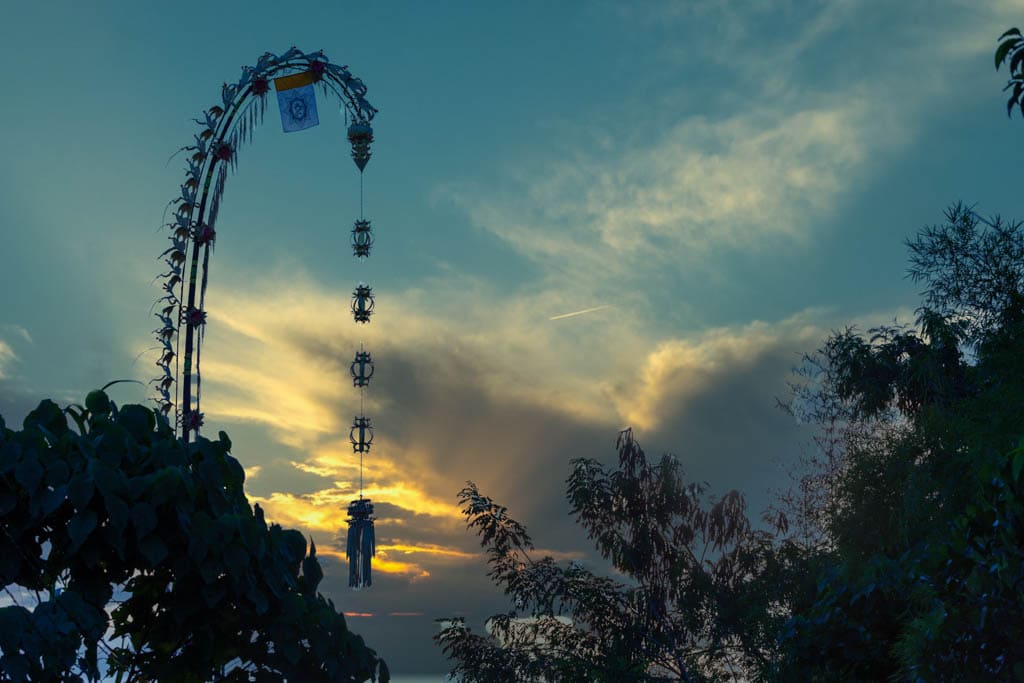
Penjors are tall, decorated bamboo poles, whose curved upper ends, on which are attached elaborate offerings, perhaps in the form of a Cili, dangle graciously over the middle of the road. The gods on Mount Agung and visiting ancestors will see them clearly. They are erected outside temples and family houses during certain ceremonies, and always at Galungan, beside a temporary altar dressed with a lamak.
In Gianyar, if there has been a wedding, two penjors are set up, a large one representing the man with a white cloth and a smaller one representing the woman with a yellow cloth. If Galungan falls on the same day as a full moon, additional decorations and strings of shells are attached, which emit a beautiful tinkling sound in the wind.
There are many theories about the symbolism of penjors. See Secrets of Bali for more information.
Cosmic Symbolism of Offerings
Mountains are represented in the shapes of offerings in many different ways. Rice is frequently moulded like a cone. The big offerings are mountain shaped. Mountains also often appear on lamaks. The bamboo pole of a penjor looks like a mountain. It represents Mount Agung.
Mount Agung, the highest mountain in Bali, is very sacred, as it is the abode of the gods, and represents Mount Mahameru, the sacred Hindu mountain, on earth. Mount Mahameru links the underworld, the middle world and the upper world. The constant stream of water down mountain slopes is a source of life.
Another holy mountain is Mount Mandara, which the epic Mahabarata describes being used as a paddle by the gods and demons to churn the Sea of Milk to obtain amerta, which is the elixir that gives everlasting life.
Colour and Directional Symbolism of Offerings
Secrets of Bali explains the numerous symbols operating in Bali. The compass points, colours, numbers and other attributes, called the Nawa Sanga system, have direct relevance in many aspects of offerings.
Cockfights
An offering is a gift. Many things can be viewed as offerings, like dances or cockfights. Even a cockfight is an offering. See the chapter in Secrets of Bali entitled Balinese Cockfights.