All posts by murni

Shop Smart Bali & Lombok

Book Review

Ni Wayan Murni
Hello Bali, November 2006

Shop Smart: Bali & Lombok,
edited by Jane Marsden, 2006


I often get asked by people writing books if I would be happy for my restaurant and shops to be reviewed. Of course I say I’d be delighted. Shortly after that I’m told that the cost is so many millions of rupiah per square inch. These so-called reviews turn out to be advertisements masquerading as independent critiques. That is very common. So, the first and most important thing to say about this new book, Shop Smart Bali & Lombok, is that it does not have any paid advertisements in it. There are over 1,000 contributed by just seven long term residents of Bali.

What about the content? Although it holds itself out as a shopping guide, which it primarily is, the book is actually much more than that. It contains useful introductory sections to life in Bali and Lombok with sections on history, geography, art, religion, festivals and celebrations. So for a very short visit to Bali or Lombok this maybe all you need. Throughout the book various hotels are mentioned and described, so it could also suffice as a guide as to where to stay.

Not every shop in Bali – or Lombok – is covered but all the main players and some lesser known, are profiled. Each area has a good introduction. It is then divided into smaller areas or streets with details of shops, hotels and restaurants, and maps showing where they are. This part of the book would be very useful if you were in one of those areas and wanted to walk around and have a view of what was available. As well as detailed profiles of places, it also cross-refers to the other section. The other section (482 pages) is the heart of the book, where shopping is classified according to the type of goods and services.

There are twenty seven categories and some are quite esoteric.They range from antiques and artifacts to stonecarvings, supermarkets and tailors and textiles.

Each category has an introduction and good tips on how to shop for that particular item. When shopping for antiques and artifacts: take frequent breaks to eat, drink and think. When buying pearls: a fake pearl can be detected by biting on it; an imitation pearl will glide across your teeth, while the layers of nacre on a real pearl will feel chalky and gritty. If you are looking at pictures, check out the hidden details – whether a canvas has been properly mounted, whether a drawing or pastel has been done on acid free paper so it won’t discolour with age. Shopping is a pretty exhausting business in Bali, which can be very hot, so the final section will be very welcome to most people. It’s the Après-Retail Details – a small selection of bars, clubs and restaurants, which are subject to the same standard of meticulous and independent reviews.

I know I will use this book myself and therefore have no hesitation in recommending it to others. It is the only one of its kind in Bali and Lombok.

Murni
Ubud, Bali

Shop Smart Bali & Lombok
Balians: Traditional Healers of Bali

Book Review

Ni Wayan Murni
Hello Bali, December 2006

Balians: Traditional Healers of Bali
Edited by Bradford Keeney, PhD
Ringing Rocks Press, 2004


Balians, dukuns, traditional healers, shamans or witch doctors, whichever name you like to use, are a subject that never fails to arouse interest. This new book looks at some of Bali’s better known healers.

Bradford Keeney begins the book by recounting an incredible story. He and his crew arrived in Bali in 2000 to interview and photograph a number of Bali’s balians. The first problem was that their photographic equipment and luggage did not show up at the airport, then when he turned in for the night he woke up to a huge explosion and the sound of rocks and sand sliding down the outside of his room and a thunderous stomping of feet on the roof. He was terrified and called for help but nobody heard him. Bradford Keeney wondered what he should do.

He remembered that balians make magical drawings, so he decided to change the nature of the project and publish a book about these magical drawings. His guide could collect them and he could leave Bali immediately. Instantly the terrible noises stopped. His guide then took him to Mangku Alit, Bali’s top balian, who went into a trance and contacted the god for all shamans, Jero Gede Macaling. Later the luggage turned up without explanation. It was a good omen.

They visited various balians, all of whom confirmed approval of the project. The book contains interviews with six balians, Mangku Alit, Jero Sekar Manik, Jero Tapakan, Jero Mangku Srikandi, Mangku I. Made Pogog and I Gusti Gede Raka Antara. They are not terribly revealing. There is no analysis or explanation such as undertaken by Angela Hobart in Healing Performances of Bali, reviewed in July 2006. The interviews are short and reveal little beyond explaining that the Balinese visit them when they want protection. The balians go into trance and get the reasons for any misfortunes. Often they prescribe magical drawings. The vocation usually runs in the family.

The book’s strength and interest lies in fifty five magical drawings. There are also pages of wonderful black and white photographs, and although many do not appear to have anything to do with the subject matter, it’s not important. The drawings are in a unique Balinese style, probably influenced by Indian Hindu art. They are powerful and wildly surreal in appearance: deformed bodies, disembodied heads, multiple limbs, half human, half animal, snake like protuberances and tails, and flames emanating from heads, knees and feet.

Balians can be of the right or the left side – those on the right side use their powers for good. The drawings depicted in the book are all of the right. They are not frightening; they are just very strange. A page is devoted to each drawing and facing it is a brief description, how it is prepared and its purpose.

The magical drawings are usually drawn on white cloth with Chinese ink. They can also be engraved on gold, copper or tin plate, or even clay fragments. Some are worn in your pocket or belt for safety; some are attached to the entrance gate of a compound to stop evil forces or robbers from entering; and some are placed above the bedroom door to give long life or above the bed for protection. One is drawn on a betel leaf and spat at a person who needs protection from witches. Another is drawn on a turmeric root and swallowed to stop you being poisoned The most intriguing are those than can make you invisible or help you fly. Some protect animals; some prevent mice coming in; and some protect crops against disease.

The drawings are not art for art’s sake: they have a serious purpose and function. Indirectly they lay bare the innermost concerns of the Balinese. They remind me of the elegant, energetic, expressive drawings of the remarkable I Gusti Nyoman Lempad, who lived from 1862 to 1978. It would be good to know if he was influenced by them as he was known to be interested in sorcery.

The magical drawings of the balians were shrouded in secrecy. This book reveals a bit of that secret knowledge and provides us with a great opportunity to see them. Most people never get the chance.

Murni
Ubud, Bali

Balians: Traditional Healers of Bali

Revolt in Paradise

Book Review

Ni Wayan Murni
The Times, Lombok, July – August 2007

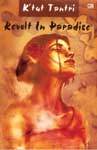
Revolt in Paradise
K’tut Tantri
Reprinted Gramedia, Jakarta, 2006

Revolt in Paradise is a classic and it is good to see it in print again after a long absence. It is rather hard to classify this book: maybe autobiography, perhaps historical novel, possibly adventure story. On the face of it, it purports to be autobiographical: the story of a British-born American woman’s fifteen years in Indonesia in the 1930s and 1940s. Doubt has been cast on its accuracy and indeed the author begins the book by saying, ‘It is always difficult to be completely honest about oneself’. This does not matter. It’s a great story.

The story is divided into three parts. The first part tells of her time in Bali. In 1932 in Hollywood she saw the film Bali,The Last Paradise and shortly after set sail from New York on a cargo ship. She was an artist and made for Bali immediately after arriving in Java. Like all visitors at that time she stayed in the Dutch owned Bali Hotel in Denpasar. She felt, however, that this was not Bali but Holland, part of the colonial masters’ country, and determined to leave as quickly as possible and live in a Balinese village. Such a thing was unheard of in those days but she hated the Dutch attitudes. She took off in her car, driving herself, and decided to stop when she ran out of petrol. The car happened to halt outside a Rajah’s palace and although she does not mention it, I have it on good authority that it was the palace of Bangli.

She was accepted as one of the family and given a Balinese name — K’tut Tantri. K’tut is the fourth-born child — the Rajah already had three. In this section she describes what it was like to live with a royal family. She describes the various ceremonies she attended and trips she took. She also tells of run-ins and arguments with the Dutch authorities. They did not approve and schemed to deport her, but never succeeded. Her analysis is not terribly profound — the Balinese are all wonderful and the Dutch are all terrible. She herself is heroic and brilliant at all things. She formed a very close relationship with the Rajah’s son Agung Nura. My informant tells me that she formed an even closer relationship with the Rajah himself. Agung Nura was active in the independence movement, which K’tut Tanri later joined.

She found palace life a bit restrictive and unrepresentative of real Bali life and moved out and as she put it, ‘bought practically the whole of Kuta beach’. Here she put up a hotel in partnership with some Americans. This is a delightful section of the book despite the fact that she fell out with the Americans. The accounts of her relationships with her staff are endearing and clearly affectionate. The first hotel in Kuta seems to have been very popular. It was not a financial success, however, and she ran into difficulties with the Dutch authorities. Europe was at war. Germany invaded Holland and Japan invaded Indonesia — they landed in Bali first. The Dutch did not fire a shot in defence and fled to Java. It was no longer safe. K’tut Tantri left for Surabaya in East Java. The hotel was demolished by looters permitted by the Japanese.

The second section of the book recounts her time in Japanese occupied Java. The Dutch quickly surrendered. She was able to negotiate travel passes with the Japanese and helped the underground resistance movement against the Japanese. She narrates stories of arms smuggling and tales of derring-do. K’tut Tanti always plays a starring role. Finally she was caught and imprisoned for more than two years until almost the end of the war. She was tortured and the descriptions are quite harrowing.

The third and final section of the book describes the long independence struggle and her part in it. After the war the Dutch wanted to come back to Indonesia as overlords. The English helped them and bombed Surabaya, which was unarmed and did not have air-raid shelters, for three consecutive days. The blood of hundreds was shed. Women and children died. It was a turning point for K’tut Tantri and she determined to help the Indonesians again. She broadcast twice nightly in English from secret radio stations run by the guerillas. By this means she brought the struggle to the attention of the World and became known herself as Surabaya Sue. She also helped spread the word in an English language magazine called The Voice of Free Indonesia. She met and wrote a speech for President Sukarno. There were more cloak and dagger escapades until she went to Australia and toured the main cities publicizing Indonesia’s case for freedom. Finally six years after the War ended world opinion forced the Dutch to grant Indonesia her independence.

The book ends there; K’tut Tanti drifts back to New York. After all the excitement it is rather an anti-climax and the reader is left dangling wanting to know more. Whether or not it is all true, it’s a jolly good read.

Murni
Ubud, Bali

Revolt in Paradise


Appreciating Calligraphy Batik

Ni Wayan Murni
Appreciating Calligraphy Batik

The Times, Lombok

August – September 2007

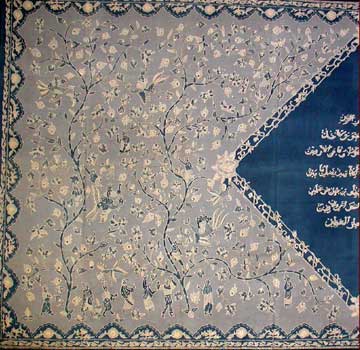
Calligraphy batiks do not get much press. The beautiful books on batik and the exhibitions abroad concentrate on Javanese batik, especially from the north coast of Java and the courts of Yogyakarta and Solo in central Java. The batiks from these areas are indeed magnificent and their history and evolution fascinating, but the calligraphy batiks, mostly associated with Sumatra, also have a wonderful story to tell.

Appreciating Calligraphy Batik

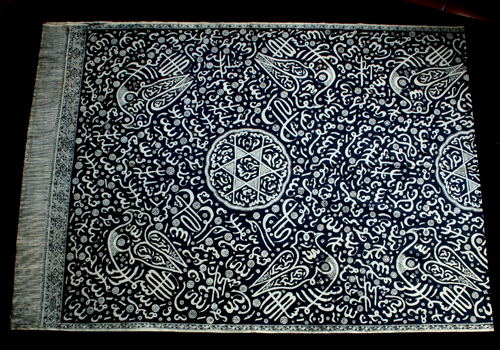
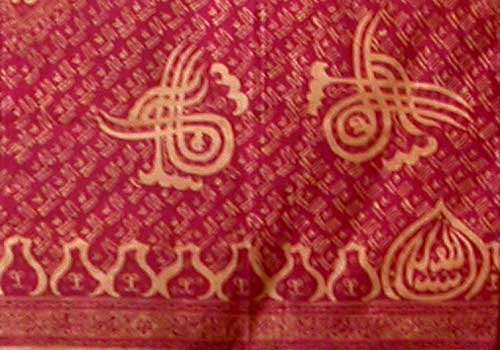
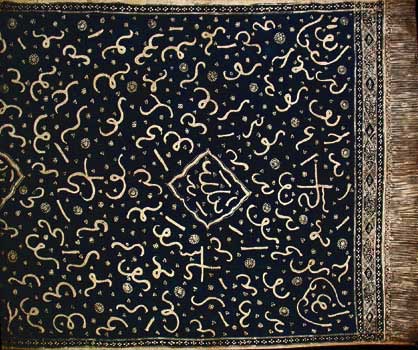
I have been collecting textiles for over thirty years and have bought, traded and sold thousands of batiks. Recently I have been appreciating these mysterious and powerful textiles more and more and I think I am beginning to understand them. The most common are men’s headcloths about a metre square and rectangular cloths about a metre by two metres. They tend to be blue or less commonly red. I have examples of both in my collection.

Appreciating Calligraphy Batik

They all have Arabic script; hence they are called calligraphic batiks. The Arabic writing is usually the basmallah or the shahadah. The basmallah is said before any big project: In the name of Allah, the Beneficent, the Merciful. The shahadah is the main tenet of Islam: There is no God but Allah, and Mohammad is His prophet.” The cloths are sacred and worn at rites of passage ceremonies. They are also powerful protection against harm.

Appreciating Calligraphy Batik

Soldiers wear them. The red cloths symbolise courage and deflect bullets. Dead soldiers killed in battle were covered in the red batik shrouds on their way to the graveyard. Adam Malik, Indonesia’s first Vice-President after Independence, was covered with such a cloth during his lying in state before burial.

It is likely that these textiles were inspired by textiles from Islamic countries. Arabic calligraphy goes back at least a thousand years in Egypt and the Middle East, and Arab trade with Jambi in Sumatra had started by at least the 13th century. Indonesians on the haj pilgrimage to Mecca would have seen the basmallah and shahadah.

Ottoman Turkey had close links with Aceh and Jambi and Turkish influence is particularly evident in these batiks. The motif called tughra shows this most clearly: it is the formal signature of the Ottoman ruler as used on official documents formed by three central lines with two loops which appear like a rooster. It had supernatural power.

Appreciating Calligraphy Batik

The dominating impression is of perfect symmetry and balance and reminds me of Mughal and Moorish architecture. Typically there are three borders, the middle band containing diamonds. An outer border of white lines provides an artificial fringe. The centre field is the main part, normally full of geometric designs and Arabic calligraphy. Sometimes birds, lions and horses in stylized calligraphic designs appear.

In Islam the Koran is the actual Word of God. Mohammad was not divine; he was the messenger. The Words of God are important and revered. The writing itself has immense significance even if it is not understood. The most pious act a Moslem can do is to read or write the Koran. Beautiful and skilful calligraphy allows those who cannot read or write and those of us who are not even Moslems to appreciate the perfection, presence and power of God.

Murni
Ubud, Bali

Appreciating Calligraphy Batik

How to make Batik

Ni Wayan Murni

How to make Batik

The Times, Lombok

September – October 2007


How is batik made?

I wrote in last month’s Murni’s Corner about Calligraphy Batik, which is an outstanding example of one of the many styles of beautiful batik made in Indonesia. I have been collecting batik for decades and selling it since I was a girl. I sell it from my shop, Murni’s Warung Shop in Ubud, and in recent years all over the world from my web site www.murnis.com, You see batik frequently as locals in most of the islands wear it on a daily basis and people love it. I am frequently asked How is batik made? I think that you may be surprised at the time and effort it takes. But, first, what is batik?


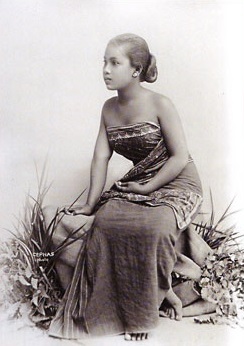
Girl wearing Batik breastcloth, Yogyakarta, 1880

What is batik?

Batik is a method of dying cloth by applying warm beeswax, mixed with paraffin, resins and fat, to it to repel the dye. The cloth is usually cotton but can be silk, The pattern is left unwaxed. When the cloth is put into the dye, the waxed parts aren’t dyed and are left uncoloured. The wax is then removed by gently washing it in warm water. The cloth is rewaxed and dipped into a different dye, so that there are more and more colours. If there are three colours, the cloth is dyed six times, three times on each side.

Generally lighter colours are dyed first to enable overdying with darker colours. Sometimes the dyes seep under the waxed borders and create interesting spider webs and attractive fuzzy outlines, which are so attractive.

One side or two?

Silk is only dyed on one side. It’s not necessary to dye cotton on both sides, but we like to dye both sides in Indonesia. It has to be done very carefully and takes more time. It is called two-sided batik. The pattern is then very clear on both sides.

The alternative is to wax the whole of the underside. That is called one-sided batik. The pattern is still visible but less clear and the textiles are not regarded as so good. So, how is it made?

Canting
Canting


Canting

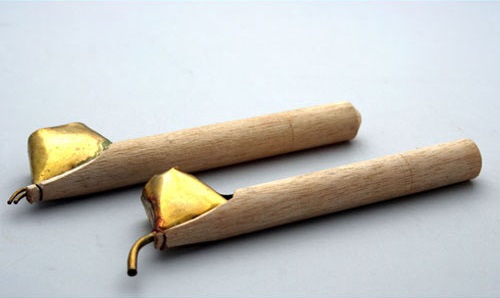
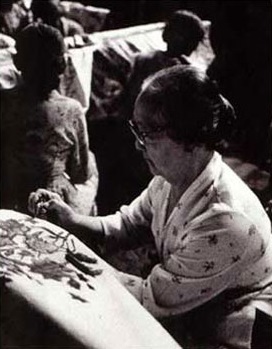
The finest, and still the most sought after, batik is hand-drawn batik, using a canting to apply the wax. A canting is a pen with a bamboo handle. It is a Javanese invention, probably in the 17th or 18th centuries. The wax painting is done by women, usually at home, often in bad light. The melted wax is poured into the pot at the end and carefully released out of the nozzle bit by bit on to the white cotton.

Lady using a canting

Slow work

It’s very slow and requires a calm state of mind and a lot of concentration. A complicated pattern could easily take six months or even longer. That was all very well in the18th century, but at the beginning of the 19th century the Europeans discovered batik and loved it very much. They didn’t want to wait. They wanted it and a lot of it, and they wanted it cheap and quick.

Problem: competition

The batik makers had another problem: competition. In the 1830s inexpensive machine-printed batiks were beginning to flood the market from Europe. It was cheap and quick. To meet the challenge the batik makers in Java experimented with stamps to apply the wax instead of the canting. Initially they tried stamps made from tubers, but they didn’t last long, then wood, but they weren’t fine enough.

Batik Stamp
Batik Stamp

Invention of the batik stamp

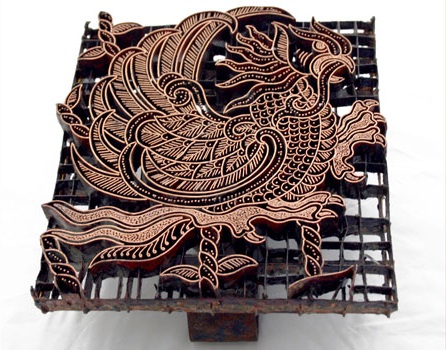
Finally, they invented the cap, made of red copper, which is still used today, and they are collected as works of art in their own right. In fact I sell a lot of them. The pattern is formed from thin metal bands, secured to a frame, to which a handle is attached. The structure was inspired by European wood-block printing stamps. The original caps were small and were first used around 1845. They are bigger now and tend to be about 20 cm by 20 cm.

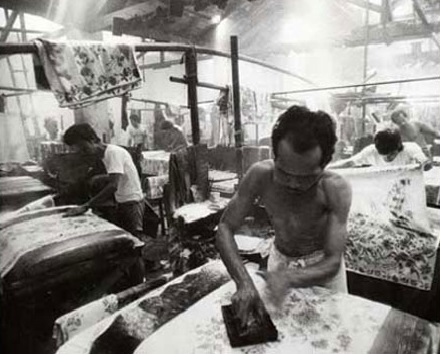
The cap process was revolutionary and enabled a batik maker to wax many cloths a day, maybe up to eight. Men saw the commercial possibilities and muscled in to do this new kind of work. Previously women made batik. Now, men make most batik cap textiles, whereas batik tulis, using a canting, is done mostly by women. The invention was a great success. The tide of imported foreign textiles to Indonesia was stemmed.

Man using a Batik Stamp

Using a batik stamp

It is hard and unhealthy work. The cap printer stands at a padded rectangular table on which the textile is stretched. Beside him stands a round, flat-bottomed basin containing warm wax on a small stove. The wax is filtered for impurities. The batik maker presses the cap on to a filter pad and absorbs the wax. He then applies the stamp on the cloth at exactly the right temperature. He places the edge of the cap on the cloth first to make sure that the position is correct. Then he presses it firmly on the textile to leave the wax imprint and repeats the process until all the cloth is covered. He may use several caps depending on the pattern.

One of the problems that took a long time to solve was how to overlap the wax so that patterns were regular. It was not until 1930 that the problem was solved: pins were soldered to the corners of the caps to ease the alignment. The batik maker just had to check that the location marks on the stamp matched the marks already on the cloth. Then the pattern would be perfect. Some batik makers use stamps for larger areas and the canting for fine details, so both techniques are applied to the same textile. They are called combinasi.

Affordability

Cap-printing has now made it possible for everyone to afford batik textiles. Interestingly there was a surge in demand for batik canting following the availability of cap batiks. Those who could afford it preferred it.

Which is better: canting or cap?

Customers often ask me which technique produces the better batik. I like both very much, but for me, batik cantingis more pleasing, more delicate, more charming and has more life than the batik cap.

In my opinion batik stamp patterns are too perfect. They don’t have those interruptions, small mistakes, variations and drips of colour that make the designs of a canting interesting, individual and alive. Hand-drawn batiks are unique works of art, which demonstrate great technical skill. Using a stamp removes the creative aspect from the process. Having said that it is sometimes difficult to tell which are tulis, that is hand-drawn, and which are cap. The hand-drawn batiks can be so perfect that they look as if they were done with a cap.

To me, the irregularities of batik canting give the piece feeling; they literally put you in touch with the lady who made a unique work of art; they are tactile signatures.


Murni
Ubud, Bali

What to Look for in Balinese Shadow Puppets


One of my earliest memories is of watching a shadow puppet performance in our village temple in Ubud at night. I must have been about five years old and was totally mesmerized. That was a long time ago but the art is still as strong as ever and I am still captivated by it. I collect the puppets and have an old set of over a hundred in a big wooden box. One of the challenges is identifying the characters, but there are clues, which I shall reveal. I sell old ones as well as new ones from my shop, Murni’s Warung Shop in Ubud and also from my web site www.murnis.com. They are very popular as unusual decorative items.

Hanuman
Hanuman


Shadow puppets are an old art form and were mentioned in a Balinese inscription dated 896 AD. A Balinese royal inscription of 1053 mentions a performance. They are instructive, entertaining and religious, and have had a profound effect on Balinese arts. They bring together dance, drama, literature, visual art and music. The puppeteer or dalang has to be an expert in all these arts: it is a one man (or woman) show, and very impressive.

The puppeteer sits cross-legged behind a large, white cloth. A flickering coconut-oil lamp casts shadows on the screen. The puppets are made of flat buffalo or cow hide and two assistants sit on either side of the puppeteer and hand him the puppets. I always like to go behind the screen and have a look. The stories concentrate on scenes from the epics, especially the Mahabarata and the Ramayana. We, the audience, know the stories well and can start watching a performance at any point.

The puppets are made of cowhide with a tapering buffalo horn or wooden handle. Each puppet is chiselled, coloured and has a conventional headdress, which provides instant recognition. The style has hardly changed in hundreds of years. They have long necks and arms, and toes that are not in the correct position. The eyes and headdress are the most important parts of the puppet, because the eyes reveal expression and the headdress indicates status.

Noble characters, like royalty, have light bodies, straight noses, flat teeth in slightly open, slightly smiling mouths and slit, almond-shaped eyes. Their legs are close together. Examples are Arjuna and Karna. They speak in high voices. Noble princesses are small and slim, large breasted, with flowing hair, narrow waists and slender hips.

Less refined males have neat moustaches. Further down the scale, there is more facial and body hair and eyes become round. They speak in louder, deeper voices. Examples are Bima and his son Gatotkaca, whose mother Arimbi was a demon. At the bottom of the scale are the coarse characters, like the ogres, who have hairy, muscular, red or brown bodies, thick hands, pointed teeth and bulbous, round eyes.

Body colours represent values in Balinese society, for example, white represents purity, green fertility and black evil. The gods have their own colours. Wisnu is green or black, Siwa is white and Brahma is red. Some attributes are restricted to certain characters. Bayu, the god of wind and his sons, Hanuman and Bima, have a large, lethal thumb-nail. Only these characters, and Tualen, wear a black and white chequered poleng sarong. All the monkeys in Rama’s monkey army are black, except Hanuman, who is white.

The Kayonan is the most important puppet, in the shape of the tree of life. It is also a palace. The dalang waves it to indicate the start of the story. It swoops, trembles and flutters and brings the puppets to life and indicates scene changes and the end of the performance. The dalang speaks in Kawi, which few understand. For the benefit of the audience, four clowns translate and comment in Balinese. The clowns are the most popular characters and can be very funny.

There are usually four gamelan instruments called Gender Wayang, which comprise the gender or xylophone, the rebab or two-stringed lute, the drum and the gong. The dalang directs the music and also sings songs. The music announces entrances, supports the dialogue, creates a benevolent atmosphere, and adds excitement to dramatic scenes.

If you can, I would recommend that you try and attend a performance in Bali. Even if you don’t understand much, you will certainly enjoy the atmosphere and marvel at the skill of the dalang.

Murni
Ubud, Bali

Ni Wayan Murni is the owner of Murni’s Warung, the first real restaurant in Ubud, Murni’s Warung Shop, Murni’s Villas and Murni’s Houses. Her web site www.murnis.com is Bali’s leading on-line resource centre. She has been the co-author to a new book ‘Secrets of Bali’ to be published later this year.

What to Look for in Balinese Shadow Puppets

The Art of Chewing Betel

Ni Wayan Murni

The Art of Chewing Betel

The Times, Lombok

November – December 2007


When I went to London I saw South Pacific. I loved Bali Hai but was really surprised when the men sang:
 
Bloody Mary is the girl I love.
Now ain’t that too damn bad!Her skin is tender as Dimaggio’s glove.
Her skin is tender as Dimaggio’s glove.
Now ain’t that too damn bad!Bloody Mary’s chewin’ betel nuts.
She is always chewin’ betel nuts.
Bloody Mary’s chewin’ betel nuts.
And she don’t use Pepsodent!
Now ain’t that too damn bad!My grandmother did it, my mother did it and my aunt did it. They were not alone. According to the Encyclopaedia Britannica a tenth of the World’s population did it. It goes back at least 2,000 years and in the old days everyone was at it, men and women, young and old, rich and poor, peasant and royalty. It’s not practised much or even known about much in the West. Now ain’t that too damn bad! But it’s very common, almost universal, here in Asia, or at least it was.

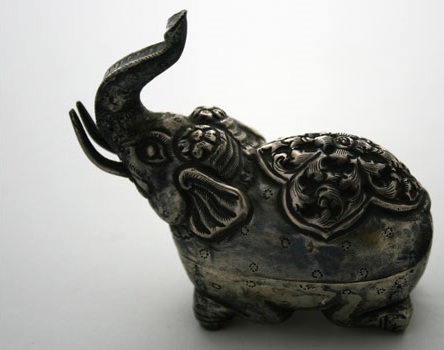
Betel container, Cambodia


Every morning my grandmother used to tear off a leaf from the betel pepper tree in her garden, smear it with lime paste and top it off with tasty thin slices of the areca nut. Those are the three basic ingredients. Some people, and it varies from country to country, add cardamom, cloves, nutmeg, black pepper, coriander or dry ginger to taste. Tobacco is a recent addition. Then you roll the whole thing up into a bite-size quid and place it in your mouth between teeth and cheek and start chewing. Very soon your saliva turns bright red and becomes copious. You can’t swallow it and that is why until recently the pavements in Asian countries used to be splattered with blotches of red spittle. Of course, it was undignified for members of royalty to spit and they had spittoons.

Lime container, Thailand


With the introduction of cigarettes men began to stop chewing betel, at least in Bali but also in other places. It was actually made illegal in Thailand in 1945 and now it tends to be older women who indulge. My generation don’t usually chew betel and it’s a habit that’s dying out. But I do love the equipment and collect betel sets. I have been collecting the sets and implements comprised in the sets for ages and from various countries. Each country has interesting variations. I have put some of them on my on line shop at www.murnis.com and also sell them from my shop in Ubud.

Betel container, Cambodia


We all call it betel nut chewing but that is strictly incorrect because it’s the areca nut from the palm family and not the betel nut which is chewed. We should call it betel chewing. Before describing the implements I should explain why people chew betel. There are several reasons. The main one is social: offering a quid of betel is a sign of hospitality. Another reason is that red lips are a sign of beauty.

Betel was especially useful before the introduction of lipstick. It was also thought to be a cure for bad breath and to make people strong. It lessens the appetite which is helpful when food is short and undoubtedly it produces a mild high and is addictive. Its central role in Balinese culture is evident in the use of the three main betel ingredients in almost all offerings and ceremonies, the colours symbolising the colours of the three main Hindu gods. The areca nut symbolises Brahma, the Creator, betel leaves symbolise Wisnu, the Preserver and lime symbolises Siwa, the Destroyer.

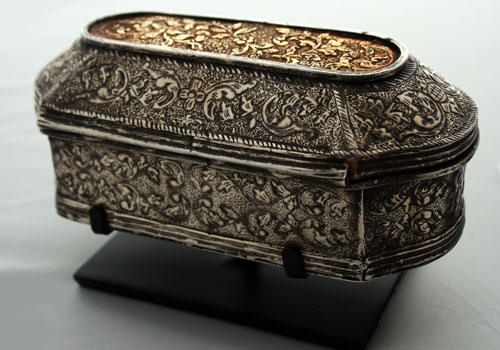
Betel container, Sumatra


The best betel equipment was owned by royalty, often made of gold, and was part of the standard royal regalia for rulers in South East Asia. Much time and effort was put into their creation and beautiful, artistic pieces were the result. A person’s standing was clear from the materials and decorations of his betel set. Betel sets were exchanged as gifts between foreign rulers and given to loyal retainers as rewards for services rendered.

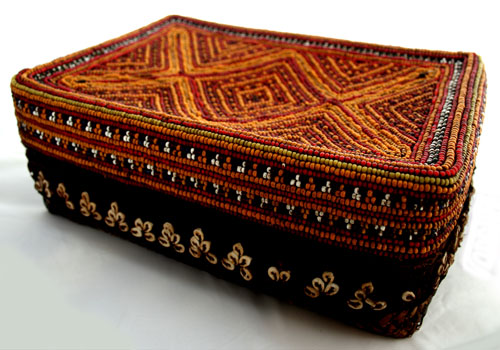
Betel basket, Sumatra


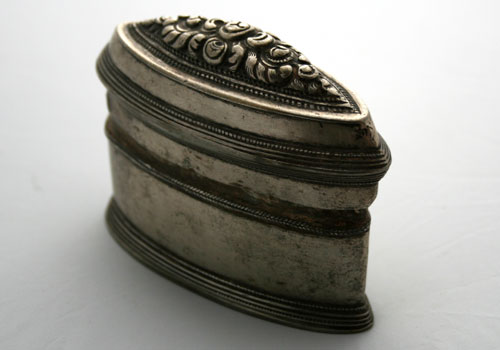
The most basic set would just be a geometric receptacle, such as a box, tray or basket, divided into compartments to hold the ingredients and equipment. It would be made of local materials, such as bamboo, rattan or wood, and would be elegant as well as functional.

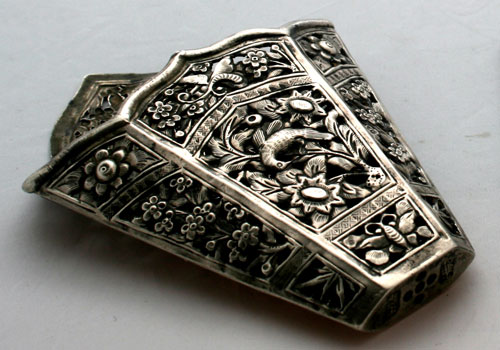
Betel leaf holder, Thailand


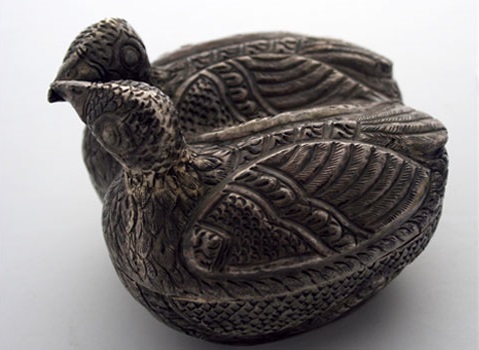
The most elaborate sets are hand-made containers for each individual ingredient. In Thailand there are gorgeous silver containers for betel leaves in the shape of a leaf. In Laos they are shaped as a horn of plenty. Local materials are used – silver in the Shan States and Thailand, lacquer in Burma, horn in Sumatra and beads in Timor. Perhaps the greatest variety in the region is in the lime containers – wonderful dark clay bird-shaped containers from Cambodia, pots with a hole in the top from Vietnam, and bronze stupa-shaped containers from Thailand. Where metals are used, they are often skilfully engraved, especially the small elephant, turtle and bird boxes from Cambodia.

Betel cutter, Bali
Betel cutter, Bali


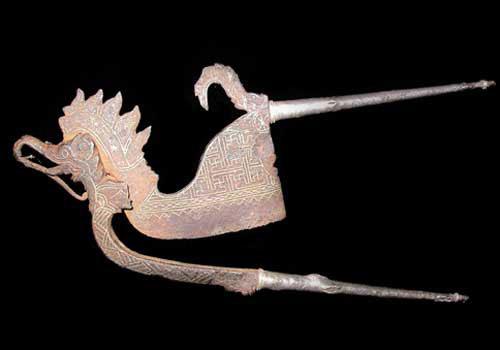
The implements are equally beautiful. The range of cutters for the nut is mind-boggling. There are iron and steel cutters with handles of gold, silver, bronze or brass in wild, fantastic shapes from India and in the shape of birds or horses from Bali. Sturdy brass mortar and pestles were made to pulverize the nut for toothless people like my grandmother. Spatulas with cute horn handles of seated figures from East New Guinea were fashioned to smear the lime on the leaf. Royal spittoons were made in gold and heavily decorated. It’s polite to spit in a spittoon. I used to live opposite the royal palace of Ubud and remember that a servant would bring up the rear of a royal procession carrying betel nut equipment in a bag. It ain’t too damn bad!

Murni
Ubud, Bali

Ni Wayan Murni is the owner of Murni’s Warung, the first real restaurant in Ubud, Bali. Murni’s Warung Shop, Murni’s Villas and Murni’s Houses. She has been dealing in antiques for over 30 years in Bali and exhibited part of her collection in the United States in February 2007. Her web site www.murnis.com is Bali’s leading on-line resource centre. She is co-author of a new book ‘Secrets of Bali, Fresh Light of the Morning of the World’ by Jonathan Copeland.

Mads Lange, the Bali Trader and Peacemaker

BOOK REVIEW: Mads Lange, the Bali Trader and Peacemaker


Order here.

A Danish expat living in Lombok and Bali in the 19th century has been almost completely forgotten, yet he was one of the most influential people in Balinese history. He is Mads Johansen Lange, a blue-eyed, blond haired Dane, who is buried in Kuta in a small Chinese graveyard on a road named after him, Jalan Tuan Langa, in a forgotten tomb guarded by a fine Dalmatian statue.

Lange was born on 18 September 1807, which gave the impetus for this book to be published on the 200th anniversary of his birth. It is amazing that it is the first book in English on Mad Lange’s life. Peter Bloch, who is Danish and living in Bali, produced it with the help of veteran Leonard Luras and Gustaaf Scouten.

At the age of 26, Lange, his three younger brothers and Captain John Burd, a friend, sailed for Hong Kong in 1833 and never returned to Denmark. Lange soon went to Bali and Lombok looking for opportunities. He picked Lombok as the base for his trading ventures, possibly because rice production was extremely high there and much greater than in Bali. It was high because of fertility from ash deposits from the huge Tambora eruption in 1815. The book has some wonderful old maps and many black and white photos of Lombok from Dutch archival sources.

There were two rival kingdoms: Mataram-Lombok to the north and the more powerful Karangasem-Lombok to the south. Karangasem-Lombok welcomed him and Lange became their trusted adviser and harbor chief and was granted a virtual monopoly of all trading in Lombok. He was there until 1839, so the subtitle of the book could have equally well referred to Lombok.

It did not take long for competition to arrive — in the shape of George Peacock King, born of English parents living in Bengal, who allied himself in 1835 to the rajah of Mataram-Lombok. There was enough business for both of them, but a succession of land and sea fights between the two rajahs culminated in defeat for Karangasem-Lombok in 1839 and Lange escaped to Bali with nothing but his life, a few personal items, his horse and ship. Gustaaf Scoutten is a talented painter and beautifully illustrates many of the dramatic episodes from Lange’s life.

In Bali the Rajah Kesiman gave him land on the beach in Kuta to build a house, factory and warehouses, from which he traded on a large scale and did very well from the start. In his flamboyant style Lange visited all the rajahs personally, arriving on his horse, which was twice the size of the local animals. They were impressed by his respect for local customs.

Lange, the ultimate ex-pat, lived in Bali style, with a well-stocked wine cellar, billiard table, chamber orchestra, two wives, concubines, children, servants and slaves. There were also Danish Dalmations.

Lange performed a useful role mediating between the Dutch and the South Balinese rajahs and was instrumental in getting two important — although fudged and misleading — treaties signed with the Rajah Kesiman in 1841 and 1842, under which the Rajah appeared to recognize Dutch sovereignty and give up Balinese customary rights to take possession of shipwrecked cargo.

The Dutch found him so useful that they offered him citizenship of the Dutch East Indies in 1844, which he accepted. There were contemporary accounts by visiting Europeans, who knew Lange, and extracts of these are contained in the book.

He was a broker in the lucrative slave trade and imported Chinese kepeng coins. Lange’s business grew. He owned or hired (it is not clear which) between nine and twelve ships in the 1840s. His ships gathered rice, coconut oil, animals, cotton, tobacco, coffee and other goods from neighboring islands, which he sold to visiting traders from his warehouse. There are many fine old Balinese photographs in the book.

Lange played a pivotal role as a shuttle diplomat between the Dutch and the Balinese in the wars of Dutch invasion of 1846, 1848 and 1849. The book contains lengthy details of the invasions. The Dutch navy blockaded the island between 1848 and 1849. Lange worked hard and brokered an historic truce, a treaty which was signed by the two sides in his house on 15 July 1849, and gave the Balinese freedom for many years to come. The Dutch were pleased and made him a “Knight of the Dutch Lion” in December 1849.

The good times came to an end. Lange’s business was badly hit by the blockade. The rice harvest suffered from the wars — which a plague of rats made worse — and exports practically ceased. A smallpox epidemic in 1850 disrupted life and some of his employees died. Then there was a water shortage. Meanwhile the Dutch were building up Singaraja in the north as the main port.

Lange was planning to leave Bali for good and sail to Denmark in 1856 when he was invited to a banquet at Denpasar Palace by the new rajah. Upon returning home he was violently sick, coughed up blood and his lips turned blue. He had been poisoned and died two days later on 13 May at home at the age of 48. He had been in Bali 18 years.

Christian Peter Lange, his nephew, came to Bali in 1847 to help his uncle and inherited the business, but failed to make a profit, sold up and returned to Denmark in 1863. Kuta declined after Lange’s death and did not revive for many years.

This book has been beautifully produced and can be enjoyed as a coffee-table book, leafing through the wonderful photographs and illustrations, or as a more scholarly work, usefully filling a gap in our knowledge of a remarkable man.

Mads Lange
The Bali Trader and Peacemaker
Produced by Peter Bloch
Bali Purnati Center, 2007
Hardback, 176 pages

Murni
Ubud, Bali

The Palaces of Bali

“A Secret Worth Sharing”

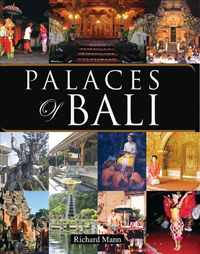
It is a big surprise to discover that the small island of Bali has so many kingdoms. The plethora of palaces encouraged an intense rivalry between them as they competed to produce the best buildings, decorated with the finest paintngs, stonework, textiles and woodcarvings. The kings staged the grandest ceremonies with hundreds of dancers and musicians in dazzling costumes. This glittering outpouring of artistic talent amazed the outside world when early visitors reported what they had seen. Clifford Geertz, one of the leading anthropologists of the 20th century, described the pre-colonial Balinese kingdoms as ‘theatre states’.

The royal palaces had neither military nor economic control over the villagers. The villagers, were, after all, the military. What control they did exercise was essentially based on consent and moral authority. There was an unwritten contract under which the kings organised huge, theatrical ceremonies and the villagers helped with the preparations and participated in them. These elaborate state rituals derived from the sacred texts. A court’s prestige was measured by and its power depended on its ability to carry out grand ceremonies. The palaces were out to impress.

When we researched the nature of royal power for our book Secrets of Bali, Fresh Light on the Morning of the World, we discovered that the relationship between the rulers and the villagers was one of mutual dependence. We also found out that the kingdoms were defined, not by borders, but by their centre, similar in concept to a mandala. Move closer to the centre, and you move closer to power and influence.

It is amazing that so much has been written about Bali yet so much remains to be written about this incredible little island. Search the internet and there’s barely a mention, yet, as Richard Mann reveals in this book, there are, in fact numerous palaces still belonging to the old royal families and they are inhabited by accessible people, who will welcome you into their homes. It is a secret worth sharng.

Ni Wayan Murni and Jonathan Copeland

Introduction to Palaces of Bali by Richard Mann, Gateway Books International, 2012

If you would like to buy the book, please email murni (at) murnis.com

The Palaces of Bali

Food of the Gods

Food of the GodsIn Bali, Religious festivals begin with elaborate culinary sculptures

by Ni Wayan Murni
Saveur, 13 March 2012


Like every girl in Bali, I was taught how to make banten, food offerings, at an early age. We make thousands of different offerings; it’s a key practice of Balinese Hinduism, which is influenced by veneration for the dead and the spiritual forces of nature.

We use offerings to please the gods and our ancestors and to placate malevolent spirits. We make offerings to certain animals, trees, and objects. The biggest are created for holidays, for weddings and other rites of passage, for full and dark moons. These are made mainly by professionals, Brahmin women who specialize in the constructions required for a cremation, say, or for a tooth-filing ceremony.

Some, called ajuman, are carried in baskets or bowls. Others, called gebogan, are formed around a banana tree trunk. Fruit, grilled chicken or duck, coconut, rice, palm leaves, and flowers are attached with bamboo skewers in rings of decreasing size to form a pyramid shape. The whole thing – which can stretch nearly five feet high and weigh more than 40 pounds – is carried on the head of a woman to a temple. It’s a spectacular sight, a procession of gebogan-carrying women. The offerings are presented to the deities, who partake of their essence. Afterward, worshippers can take them home to enjoy foods that have been touched by the gods.

More Info

When in Bali, Indonesia, stay at Murni’s Houses and Tamarind Spa (Jalan Raya, Ubud; 62/361/975-165), where you can obtain instruction on creating traditional Balinese food offerings.

Visit her restaurant, Murni’s Warung (at the bridge, Campuan, Ubud; 62/361/975-233), and her shop next-door called Murni’s Warung Shop (62/361/972-146).

Book Review: Looking for Borneo

Book Review Looking for Borneo

Book Review

Ni Wayan Murni
The Jakarta Globe, 13 October 2014


Explore the Sights and Sounds of Kalimantan in ‘Looking for Borneo’

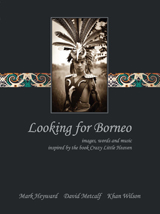
Mark Heyward, David Metcalf and Khan Wilson
Creatavision Publishing, 2014

“Looking for Borneo” by Mark Heyward, David Metcalf and Khan Wilson is not just a book; it’s an event, a multimedia extravaganza.

Tasmanian Mark Heyward wrote the text, New Zealander David Metcalf took the photographs and Khan Wilson, also a Tasmanian, contributed the drawings. Clare McAlaney, from Australia, designed and published the book. But that’s not all. There’s also a delightful CD full of songs and ballads penned by Mark Heyward, sung by Qisie, who was born in Kalimantan, and a group of musicians from Lombok and Bandung. The book is a unique experience that I highly recommend.

My introduction to Kalimantan was through collecting Indonesian ceremonial textiles, jewelry and tribal art, including wonderful beaded baby carriers, which I have been selling in my shop, Murni’s Warung Shop, in Ubud, Bali, for many years. Usually runners from Kalimantan, the third-largest island in the world, just show up, without any warning, with their treasures wrapped in a dirty blanket, and I choose what I want before they go on to other dealers and possible buyers.

Whenever I get a chance to read about the Dayaks of Kalimantan or see their photographs, I am enthralled. The words by Mark Heyward are, in fact, extracts from a previous book, “Crazy Little Heaven,” which describes his incredible 17-day journey 20 years ago traveling from one side of the island to the other by basic dugout canoe and on foot, accompanied by local guides and some adventurous friends. He describes, in evocative prose, challenges along the way and the extraordinary variety of flora and fauna. I particularly loved his encounters with orangutans.

The photographs by David Metcalf make the book, in my opinion. They are simply stunning, beautifully composed, masterful in atmosphere, and the colors are striking. The book includes several black and white ones, too. They complement the text and are a real page-turner in themselves. These captivating images are in no way distracting from the book, but give a tremendous flavor of what Kalimantan is and should remain.

Khan Wilson’s whimsical drawings are in complete contrast. The choice to insert fun, brightly colored drawings in the book is unusual, but it works. They are a welcome bit of light relief after reading through harrowing episodes in the jungle, such as the day the explorers discovered skulls halfway up a mountain, which might have been left by Dayak headhunters.

Unfortunately, much of Kalimantan is under a death sentence; destruction of its forests, which threatens humans and wildlife alike, and indeed the whole world. The final section of the book offers suggestion on what can be done to alter the situation and save the island’s natural reserves. One is to provide alternative economic opportunities, such as sustainable ecotourism. Another is to ban palm oil plantations.

“Looking for Borneo” does its part in the struggle to help preserve Kalimantan’s natural and cultural heritage by donating the profits from its sales to the Darung Tingang Dayak Dance Academy in Palangkaraya, Central Kalimantan.

The Best Spas in Bali for Your Money

The Best Spas in Bali for Your Money

Tamarind Spa ,Just LuxeJust Luxe
www.justluxe.com

By: Jon | Posted on May 24, 2012

The Best Spas in Bali for Your Money

For many travelers, a trip to the spa for some pampering is one of the highlights of any trip. A few hours spent in a tranquil environment, getting massaged, cleansed and relaxed can do wonders for any stressed out globetrotter.

In the tropical paradise of Bali, the spa experience goes to a new level. Nestled in lush gardens or along sandy shores, the spas in Bali are legendary and thousands of travelers book flights to this tiny nation every year for rest and rejuvenation. From full service spa resorts to simple day spas, these are some of the best bets for your money in this paradise. All prices are in Australian dollars.

Tamarind Spa at Murni’s Houses

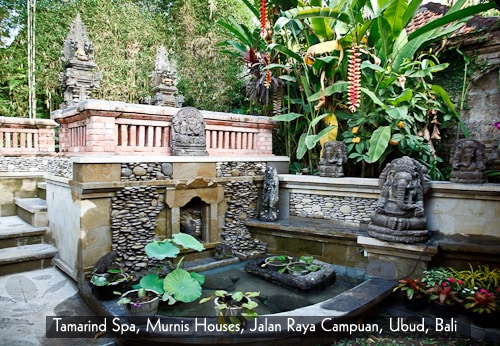
Located under the shade of a Tamarind tree in the tourist hotspot of Ubud, Tamarind Spa at Murni’s Houses is one of Bali’s most consistently top rated spas. With trademark Balinese hospitality, the spa is surrounded by tranquil gardens and fountains, and offers a full range of spa services from massages and rubs to manicures and pedicures. Tamarind Spa is also unique in that it is an artistic as well as relaxing experience. Murni, the owner of the spa and adjacent guest houses and villas, has a background in fine art and has filled the spa with Balinese and Indonesian art, offering a glimpse into the local heritage. Prices for such luxury are surprisingly reasonable, with full day packages average about $100.

The Best Spas in Bali for Your Money

The Ultimate Guide to the World’s Most Spectacular Tropical Island

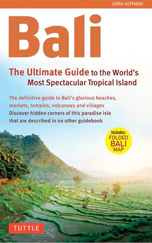
The Ultimate Guide to the World's Most Spectacular Tropical Island“Tamarind Spa at Murni’s Houses, Jalan Raya (up the ramp opposite Pura Dalem on the main street, left at the top, 2nd gate on the right). Murni’s extremely popular new spa shot to the top of Trip Advisor within weeks of its opening. Rave reviews. Many repeat guests, including masseurs, say it’s the best they’ve ever experienced. Well-kept gardens, fountains, sounds of running water, soothing music, healthy lunches, reasonably priced.”

Bali, The Ultimate Guide to the World’s Most Spectacular Tropical Island, Linda Hoffman, Tuttle Publishing, 2012

Tamarind Spa at Murni’s Houses

Art Museum-like Spa

Art Museum-like Spa

Art Museum-like Spa
Tamarind Spa

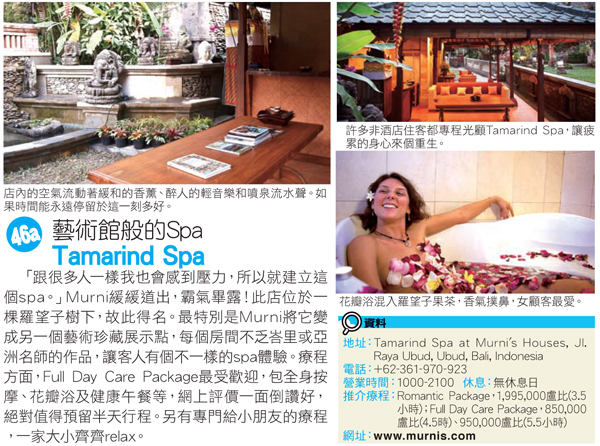
Just like a lot of people, the owner Murni sometimes feels stressed, so she built this spa! What makes Tamarind Spa different is the abundant amount of artworks placed inside every treatment room. The most popular treatment is the Full Day Care Package, which includes whole body massage, flower bath, healthy lunch and more. There are also treatments for children. Let’s come and enjoy with your family!

Sky Publishing Guide to Bali 2013-14
Hong Kong

Art Museum-like Spa

Tamarind Spa, Ubud, Bali

perfect spa in UbudTamarind Spa, Ubud, Bali


Stephanie Brookes

Author & Travelwriter
January 2014

It can take a lot of searching to find a perfect spa in Ubud.  There are plenty of five-star, high end establishments set in hanging gardens and on cliff tops, but they come at a price that is literally over the top and then, on the other hand, there are numerous low-grade spas which cater for the budget minded. So how do you find the perfect mid- range spa with value for money?

A couple of years ago a unique spa, right in the heart of Ubud was created under a Tamarind tree.  Tamarind Spa at Murni’s Houses is a delightful find.  Murni herself is a bit of a legend in Ubud.  She is well known for her famous restaurant Murni’s Warung, which was established 40 years ago in Campuhan, located at the bridge with its stunning views over the gorge.

Tamarind Spa is a small, intimate spa facility.  The tropical gardens and beautiful fountains create a relaxing, serene setting, as the sound of coursing water is your constant companion.  The care taken in the design detail is reflected in the fact that Murni got advice from spa experts around the world, which she blended with her Balinese heritage and artistic talents to create this beautiful spa.

“The best part of starting a new spa is the extensive research that must go into trying and testing the best of Bali’s masseurs and masseuses,” said Murni.  “ The challenge took one year.”  This quest has resulted in the spa treatments at Tamarind being performed by the most intuitive hands, and by people who understand the complexities of the human body, the balance between the pressure points and allows for a therapeutic experience of the highest standard.

So, what kind of choices of treatments do I get at Tamarind Spa? I would recommend the hot stone massage or the honey seed scrub and for something very engaging try the four-hand massage.

The whole family, including children are very welcome at Tamarind. Lunch is available in the beautiful, quiet garden setting of Murni’s Houses and there is a separate massage menu for children.  Because of the high level of expertise, massage training is also an additional feature of the Spa.

With the combination of very high standards and cleanliness, plus the beautiful Balinese ambience, it is no wonder within a couple of months Tamarind Spa was top of the list of all the spas in Ubud on Trip Advisor. As far as a quality spa experience is concerned, put it on the top of your list of things to do in Ubud and the good news is, you can book in by email or conveniently drop in – you just need to look for the Tamarind tree.

Tamarind Spa, Ubud, Bali

Tamarind Spa – Destination Bali

Tamarind Spa - Destination BaliTamarind Spa – Destination Bali

India Currents, The Complete Indian American Magazine, 12 July 2015

Vivienne Kruger

“A relaxing, rejuvenating day spa indulgence is another integral element in Ubud’s arsenal of healing, happiness, and wellness choices. I recommend the Tamarind Spa at Murni’s Houses in Ubud for the ultimate in luxurious, body-pampering bliss. It lives up to its beautiful name—a place for magical caretaking, delicious scents, and the ultimate in body and soul rejuvenation. Most spa products in Bali are natural and contain local Balinese herbs, plants, flowers, and spices grown in Ubud’s equatorial, tropical highland Garden of Eden. The native plants used in the Tamarind Spa all grow in rich, local volcanic soil. The village of Ubud (obad means “medicine” in Balinese) is the source of many of the Tamarind Spa’s superior concoctions—a naturally fertile area lush with emerald green leaves, roots, barks, and herbs.

In Bali, spiritual income is as important as physical income: the use of raw, organic spa ingredients benefits the local farmers. Honeycomb may come from area bee keepers, and seaweed is brought over from Bali’s pristine sister island, Nusa Lembongan. The high quality of the fragrant ingredients enhances the Spa’s body and bath treatments, scrubs, facials, massages, and exfoliants. You will stare—with love and longing, and anticipation—at your beautiful, fragrant bar of soap sitting on the treatment room ledge. It awaits your every pleasure. This is the type of soap that you bond with—that you build an intimate relationship with—an indulgent delight! You may find yourself lingering in the gorgeous hot shower in a fragrant haze. Your skin feels soft, silky, smooth, and relaxed—like everyone and everything else in Bali.

Tamarind Spa, Murni's Houses, Ubud, Bali

For the ultimate Balinese spa experience, you must take the famous, flower-filled, mandi lulur bathtub extravaganza—which originated in the sumptuous royal palaces of Java to preserve the beauty of the pampered royal princesses. You will luxuriate for an hour in a warm, gleaming tub filled with fresh flower petals, red hibiscus blossoms, and vivid marigold flowers and sip hot ginger tea from small, elegant, celadon-green stoneware cups. It does not get any better than this.”

Tamarind Spa – Destination Bali

Bali Gods Crying

Bali Gods CryingBali Gods Crying

Richard Mann
Gateway Books International, 2013

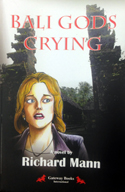
The novel is based on true events in which unscrupulous criminals are threatening Bali’s Hindu religion and civilization. The heroine lives in Ubud.

“Maybe something romantic will happen to you,” said Oz wickedly.

Celine was silent, looking around her.

They had a late lunch at Murni’s Warung next to an old Dutch suspension bridge across the two rivers of Rsi Markandya in a comfortable lounge decorated like a Balinese antique gallery and overlooking the gorge she had seen from the suspension bridge.

“Even your lunch venue has a special meaning,” smiled Oscar. “Murni’s was almost the very first tourist restaurant in Ubud. Sometimes Murni is here and loves to tell visitors about Bali’s culture.” On their way out of the restaurant the French language caught Celine’s eye from a selection of promotional materials on a low side table.

“Un Momento Oz,” she called pointing at the table. “I want to see what they have in French.” .

…

Celine remembered her way to Murni’s so she went there for a breakfast of eggs, fruit and coffee, much more than her normally frugal, diet conscious fare in France … Outside Murni’s she walked down a slight hill along an asphalt lane romantically overhung with long tendrils of trailing creepers, past the temple housing the statue of Maharesi Markandya that Oz had told her about, turned right and was almost immediately in the rice fields.”

Bali Gods Crying

Murni and Murni’s Warung in Literature

Murni and Murni's Warung in LiteratureGolton Island
Douglas Gellatly
Smashwords, 2013

The novel is the second of an ebook trilogy following the lives of two gay guys called Richard and Max, who live on Golton Island, Australia.


“Being much nearer to the equator than their own Golton Island, the sun set at about six o’clock and nighttime descended quickly. Max and Richard asked at the reception desk where they could go out for dinner, and were directed to Murni’s Warung, just over the river on the main road.

The restaurant is also set on the side of the same ravine and, in daylight, some tables have a view down to the flowing river below. That night, Richard and Max enjoyed an entree of Lumpia, a deep-fried spring roll served with peanut dipping sauce, followed by Cap Cay, a vegetable stir-fry with everything thrown in together, and then Black Rice Pudding. Bintang beer accompanied their meal. Having made an easy start that day in order to catch their flight, Max and Richard then walked along the dimly lit road and hotel pathways back to their room and slept soundly cuddled up to each other.

…

Back in the hotel, they rested and swam in the pool during the afternoon, then that night decided to go back to Murni’s Warung for dinner. As they were concluding their meal, Murni herself came to join them at their table, having introduced herself first. In her friendly way Murni chatted animatedly about her restaurant and her life, a smile often crossing her broad, dark face, her eyes twinkling.

“What were things like in Ubud when you were a child?” Richard asked.

Murni smiled and said, “Oh, very basic. We had no electricity, no running water, the roads were dirt tracks. No-one had any money and we had to make do with whatever came along.”

“What did you do for food?” Max asked.

“We ate whatever we could catch or collect. As a bare-footed child, I would catch capung dragon flies, with a sticky substance on the end of a long bamboo pole, and we would cook and eat them. Or I would catch eels in the rice paddies, or shrimps in the river, which we would also cook. And there was always fruit like pisang, bananas, or durians or coconuts.”

“And now you’ve got this restaurant,” Richard observed.

“Yes, and I hope that you have enjoyed coming here,” Murni said. “What else have you gentlemen being doing while you have been staying in Ubud?”

They told her of the various things they had done, including the cooking class, and Murni said, “Thank you for contributing to the economy of this town. We all need as much help as we can get.”

Murni and Murni’s Warung in Literature

Ubud is a Mood

Ubud is a Mood

James Murdoch, Sayan, Bali
Ubud is a Mood, 2004

“Murni’s Warung is justly famous. It was the first warung to cater for the tourist trade, and since then has maintained its standards and trade. Murni has an uncanny eye for beautiful and rare objects and she has established her own signature shop at the top of the hill from the Campuhan bridge (where her warung is located). The shop is a museum in itself, each object with a history and a provenance. Her textiles are first rate, as are the old Javanese gold ornaments, now rare indeed. Murni loves to travel, and has friends all over the world. Ask for her, but she may well be up the Nile, in Brazil, or at the opera in London.”

Ubud is a Mood

Murni, The Ibu of Ubud

Rob Goodfellow

The Jakarta Post, 11 January 2001
Rob Goodfellow


UBUD, Bali (JP): I was having dinner with an international businesswoman based in Singapore. I asked if she knew Murni’s Warung in Bali. Without blinking she said, “Know Murni? Of course I know Murni! Everyone knows Murni. She is a legend. Travelers to Bali call her the Ibu (mother) of Ubud”. In October this year I traveled to Ubud to meet this living legend.

Murni was born just after World War II in the village of Penestanan-Ubud. Her life reflects the history of Ubud itself. Her family has always been closely involved with international travelers. Her mother cooked for Walter Spies, the German aristocrat painter, who lived during the 1930s in a thatched cottage overlooking rice terraces in the neighboring village of Campuan.

At this time, (much like today), anyone who was anyone visited Ubud and they all at some time ate Murni’s mother’s food: Charlie Chaplin, Noel Coward, Barbara Hutton, the Woolworths’ heiress, Colin McPhee, the ethno-musicologist and his anthropologist wife, Jane Belo, Vicki Baum, the novelist, Margaret Mead and Gregory Bateson the pioneering anthropologists.

Some say Miguel Covarrubias, the Mexican painter and ethnologist, was so inspired by the food in Ubud that he decided to write the still widely read and influential book Island of Bali, published in 1937.

Colin McPhee likewise decided to stay and live in Ubud where he studied Balinese gamelan music. He wrote a marvelous book, A House in Bali, which has just been re-printed in paperback. Murni’s great aunt looked after him too. She is still alive and well and living in Ubud.

In the 1950s it was in Murni’s village of Penestanan that Arie Smit, a Dutch painter founded a school of art called “The Young Artists of Penestanan”, which has profoundly influenced the development of the avante garde art for which the area is now known. Again, Murni’s family was involved.

During the 1960s Ubud was not the bustling tourist center it is today. Murni would get up at 4 a.m. every morning and cycle downhill to Sanur on the south coast of Bali and sell her textiles to visiting cruise ship passengers.

If it was a bad day she had to put her goods back on her head, and cycle home up the hill to Ubud. However, before long she had four shops and counted the Rolling Stones’ Mick Jagger as one of her regular clients. He is still a customer of Ibu Murni shops today…and he’s still getting satisfaction.

By the mid-1970s Murni had returned to Ubud where she created the first real restaurant in the area – Murni’s Warung. Ever since it has been one of the places to go in Bali. Today Murni’s Warung employs over 60 staff and continues to serve patrons from all over the world. It has been called the most romantic restaurant in Ubud. You can hear the sound of rushing water in the narrow jungle gorge that has formed from the convergence of the River Wos and its tributary. Here locals and visitors, writers, artists and dancers, all enjoy the atmosphere, the exotic cuisine, and, most importantly, each other’s company.

Murni’s shops, Kunang-Kunang I and II and the Warung Shop are all in Ubud’s main street. They have been imitated but never surpassed for quality, authenticity and value. Her international clients think of Murni so highly that they call to check if she’s in Bali before they book their flights. It is little wonder that many of her friends are important people from the United States. The New York Times has in fact named Murni’s Houses as one of the best small hotels in the World.

Murni’s latest venture is the creation of Villa Kunang-Kunang. This is about 15 minutes outside Ubud, on the road up to the landmark Mount Batur. Kunang-Kunang means “firefly” in the Indonesian language. Here Ibu Murni has built two fabulous villas, which are said to have the best views in Bali. The Villas look out over the ancient rice fields and are set in 3 hectares of beautifully landscaped tropical gardens.

Hidden away is a curved swimming pool, which merges into breathtaking views of the emerald-green rice terraces. There are fishponds, water lily ponds, lotus ponds, and the sounds of running water everywhere.

In addition, there are 33 Buddha statues lovingly placed around the gardens. The Villas are furnished with a mix of contemporary and antique Balinese and Indonesian furniture in Murni’s inimitable style. There is even a book specially written for her guests on Balinese life and culture.

There are walks along the rice terraces and, if Ibu Murni has time, she takes her friends and guests along trails where tourists never go, explaining the tropical trees, flowers and plants. Along the way she stops to introduce her guests to local people they would never otherwise get an opportunity to meet.

What continues to inspire Ibu Murni is her strong faith in the importance of maintaining Balinese culture, as living and unique. This is combined with her genuine desire to extend friendship and hospitality to others and to show visitors to the Island a special piece of the real Bali.

Murni, the Ibu of Ubud