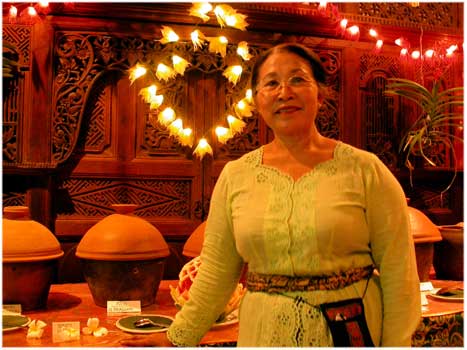
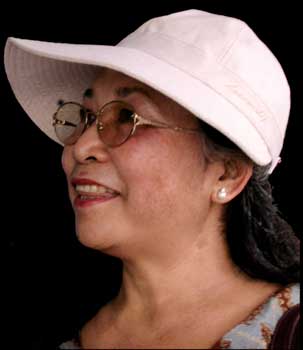
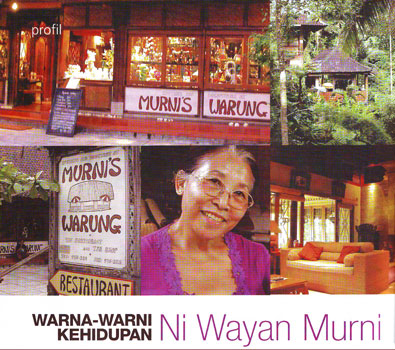
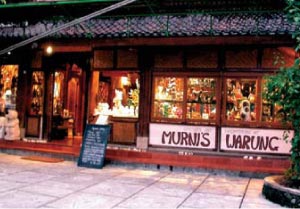
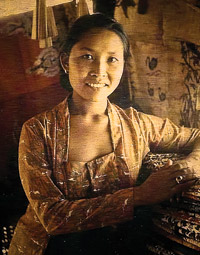
Ibu Murni is a well-known character in Ubud as owner of Murni’s Warung, Murni’s Villas and many other enterprises but it wasn’t always like this.
Murni
Back in the 1950s, life was hard. Murni’s parents split up and at the age of 6 or 7 years she was sent to live with an authoritarian aunt in Denpasar. She made her get up every morning at 2 am to prepare and sell food.
After she had sold everything, she was then allowed to go to school. Murni went back to Ubud when she finished elementary school, and lived with her mother in Ubud market. Life was still very hard; helping her mother eke out a living.
On the three days each week that the market was open, she carried a load of salt from Ubud to Penestanan and on the other days sold warm beer and sarungs to tourists and locals. When the market closed at 5 pm, she had to walk to Padang Tegal to help her mother’s sister pound rice.
Tourism increased after the opening of the international airport and, from1965 to 1974, she lived in Sanur where she opened several shops on the beach.
Her major break occurred in 1974 when she bought some land in Ubud and opened Murni’s Warung. Initially, she sold only clothes and paintings but after marrying her American husband, things started to improve when she realised that by selling Western food, she could attract more business.
Being married to a foreigner caused a lot of problems and for some time, the only member of her family who would speak to her was her father, but she persevered with the business.
From a very small enterprise with no electricity or refrigeration, Ibu Murni has moved on to become one of Ubud’s most successful entrepreneurs but it hasn’t changed her. She has never forgotten her origins and she is one of the kindest people I know.
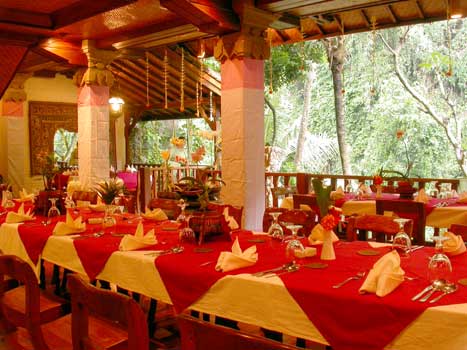
A visit to Murni’s Warung is a delightful experience as the food is excellent and inexpensive and you will also experience the stunning views over the river from any of the four levels on which the restaurant is built.
Many people in this country have achieved success after starting from humble beginnings but they have mostly become arrogant and egocentric. Murni is one of the rare exceptions and I feel proud to consider her as a friend.
Ni Wayan Murni: Ubud’s First Restaurateur. Ni Wayan Murni is a pioneer of tourism in Bali. She is the owner of Murni’s Warung, the Kunang-Kunang shops, Murni’s Villas and Murni’s Houses. Murni opened Ubud’s first restaurant in 1974 and it remains first in the hearts of many residents today. Murni is also an avid collector of antiques and beautiful objects, and many of the finest works of craftsmanship turn up at Murni’s shops in Ubud.
What is your background?
I come from a long line of hard-working Balinese ladies. I think I must be a reincarnation of one of them. I was born in the small village of Penestanan, just after the war. My mother was from Penestanan and my father was from Campuan, the neighbouring village. I lived in Penestanan until I was 5 years old and then we moved to Campuan. My restaurant and shops are in Campuan, so I haven’t really come very far!
What was your early childhood like?
Very hard, like it was for all Balinese in the Fifties and Sixties. Until I was 4 years old, my mother used to carry me on her hip as she went from house to house offering salt, dried fish and things like that. She wasn’t selling; she was bartering. In those days she used to offer her goods in return for rice. I think I learnt to bargain watching her at that young age. My parents split up when I was 7 and I went to live with my aunt in Denpasar. When I was 12, I returned to my mother in Ubud.
What was the first enterprise you started?
I made my first money when I was living with my auntie. I had to get up at 2 am to make cakes for morning coffee. Then I had to go to the houses of the Balinese and Chinese families in Denpasar and sell the cakes. The money went to my aunt, but if I sold all the cakes, she gave me 5 rupiah. I had to save 2 rupiah for my school books, which left me 3 rupiah for lollipops.
As I said, when I was 12, I went back to Ubud and lived with my mother. She was then a very successful business woman. I worked with her in the market for 2 or 3 years and started my first business in 1961, cycling down to Sanur to sell batik to the tourists. That started my love of textiles and beautiful things.
How did you discover which products or services appealed specifically to the tourist market?
I watched their eyes. If they opened their eyes wide, they liked the goods and I had a buyer. It was then just a matter of price. I always give very fair prices, so my customers come back. I still have customers from those days. I also discovered that quality is more important than anything. People remember quality. As regards to the restaurant, I think I just knew instinctively that cleanliness, friendly service and good lavatories are really important.
How many businesses do you own right now?
Far too many. I should be retired by now. Apart from the restaurant and shops, there’s Murni’s Villas and Murni’s Houses. We’ve also got into the wedding business. Weddings and honeymoons in Murni’s Villas are very popular. I really enjoy those. My web site, www.murnis.com, is also thriving. It’s probably the largest Bali web site and growing all the time.
Of all your different enterprises, which gives you the most satisfaction?
Hard to say. I like different aspects of all of them. I love meeting old and new friends in the restaurant. I enjoy the shops, showing people my collections and exchanging ideas about textiles and antiques. I also get a lot of pleasure travelling, not just abroad, but also in this country.
Which business is the most difficult to run?
Easy! The restaurant, but it’s a lot of fun.
What difficulties (or strokes of good luck) did you encounter in the early days starting Murni’s Warung?
It’s pretty difficult running a restaurant with no electricity or refrigeration. I did that for 6 years. It’s also difficult getting up at 4 in the morning to go down to Denpasar to get supplies and back in time to serve breakfast. Thank God those days are over.
I had many strokes of luck. I met really nice people in the restaurant who taught me fabulous recipes and we had great laughs trying them out. Many are still on the menu. Every day I meet interesting people from all over the world who teach me a lot about antiques and handicrafts.
What makes Murni’s Warung different from other similar restaurants in Ubud?
I built the first restaurant in Ubud, so I was able to choose the best spot. The location and atmosphere are very special. It sits on a gorge overlooking the Campuan river, which you can hear rushing below. It’s a sacred river. I don’t think any restaurant is quite so romantic. I also keep everything traditionally Balinese – from the food and décor to the costumes of the waiters and waitresses.
How do you relieve stress?
I play the gamelan really hard!
What is the most valuable antique object you own?
Myself!
What would you like to be doing now?
Having dinner with Walter Spies in Mrs Balbir’s Indian restaurant in Bangkok.
Note: Murni’s web site: www.murnis.com, is one of Bali’s leading online resource centres. She plays the gamelan in a ladies gamelan group in Ubud.
The Interview: An Ubud Original. Comprised of 4 levels and situated on a lush ravine overlooking the sacred Campuan River in Ubud, Murni’s Warung is an institution that has been serving the best in traditional Balinese cuisine for over 3 decades. Besides its food, décor, and locale, the Warung is also well known for its proprietor, Ni Wayan Murni, an Ubud local whose congeniality is known to all who have walked through the hand-carved doors of her restaurant over the years.
From the time she sold a sarong to Mick Jagger in 60’s Sanur to her current involvement with the Royal Pitamaha Gamelan in which she is a member, Ibu Murni’s life is a fascinating one. She took time out from her busy Warung duties to speak to Hello Bali about the good old days.
Ubud Origins
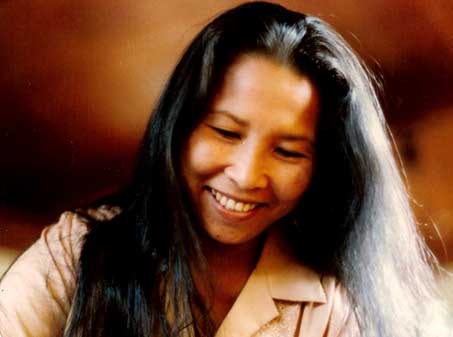
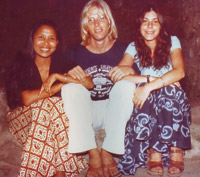
Murni, 1974
I am an Ubud original. I was born in Penestanan, about 5 minutes walk from Murni’s Warung and was raised in Campuan. My grandparents are from about 100 meters from Murni’s Warung and I’ve lived here all my life. Ubud at the time was, of course, very different, very rural. There was no expansion bridge across the river, all the roads were made of dirt, and there was no electricity.
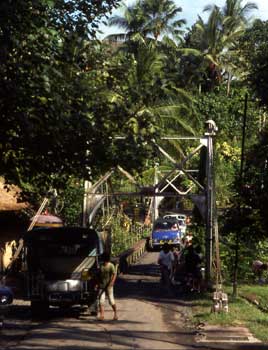
Dutch suspension bridge, 1977
Most Balinese from this area at the time, including my family, were very, very poor and didn’t have much to eat. Around 1952 or 53, when I was 6, I remember going to the river to collect rocks to sell on the road. We used to have to carry water in terra cotta pots from the big spring just below where my grandmother lived because there was no plumbing then.
Most of my family worked from this river, gathering whatever they could from rocks to sand and selling it on the road. Or they would work in the rice paddies where they would work during the harvest season that was only every 6 months and not like today where there are sometimes 3 harvests a year.
I would also go to the rice paddies to help my family: my grandparents, my father, to harvest the rice and afterwards we would sometimes catch rice paddy eels or snails to eat. All this work would keep us busy for about 2 months at a time. At other times I would go to the old Ubud market with my mother to sell different types of leaves, vegetables, rice, or anything else that was used or eaten every day.
The Warung
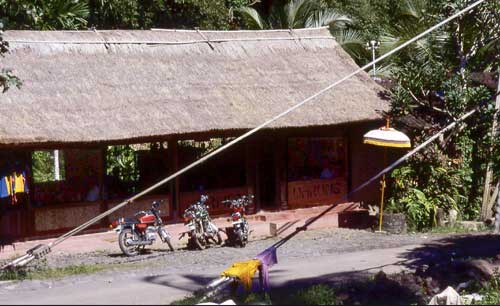
Murni’s Warung, 1978
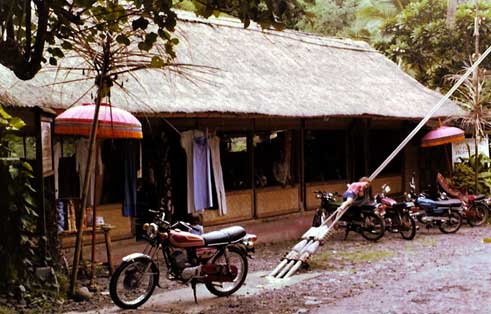
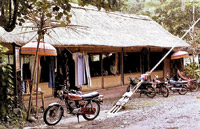
In 1974, I started Murni’s Warung and it was one of the very first restaurants in Ubud. There was no running water or electricity. We used oil lamps for light and cooking kerosene for the burners. There were still very, very few tourists in Ubud at the time and they usually stayed at the Campuan Hotel, which was one of the first hotels in Ubud.
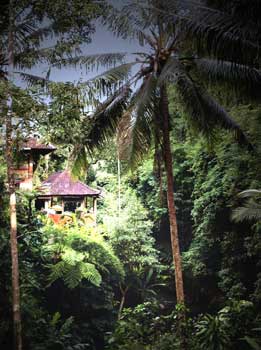
View from Murni’s Warung, 2006
At the time, I wasn’t really planning on opening a restaurant. My husband and I used to go to a warung near the center of Ubud where they cooked food with kerosene burners. That’s when I decided to open a warung in this area because it took so long to walk to central Ubud to get some food and was very inconvenient. So then I started to sell some very Balinese dishes at our warung. We only had one bamboo table and two chairs at the time, but people started to come and within one month I had expanded to 4 tables!
Murni’s Warung, 1984
There were many interesting things that passed in front of the warung that made it quite an attraction. People going to the rice paddies, ducks that crossed at 5 a.m. every morning and then cross again in the afternoon on their way back home, cows, pigs, people going to or returning from the market carrying produce on their heads. The tourists would come to my warung and just sit in front and watch the procession of happenings. It was like dinner and a show! We also had our regular customers who lived in the area and tourists, who if they stayed for only one week, would come to the warung once a day.
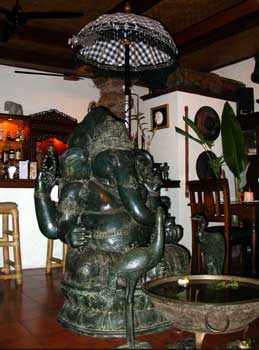
Lounge Bar, Murni’s Warung, 2006
At that time, I only knew about Indonesian and Balinese food. I would go shopping at the market every day because there was no refrigeration except for an icebox and I would do all the cooking myself, as well. Every month we would have more and more tourists coming and started to have more tables and chairs for the warung. In the 80’s we had our first big expansion during this good time when many tourists were coming after the new bridge was built and buses started arriving.
Traditional Smoked Duck in Murni’s Warung, 2006
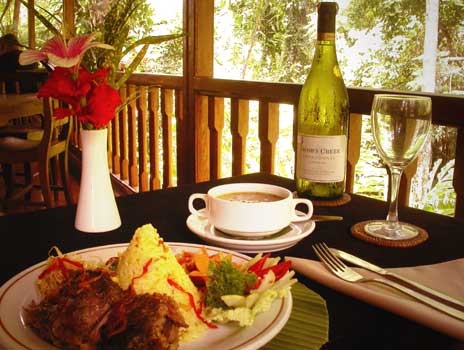
Most of the food we serve is very traditional Balinese cuisine. Smoked duck and smoked chicken, for example. I also created a dish called “Murni’s Fish” which is sautéed tengiri served with vegetables and a special sauce that won an award in a Nusa Dua school in the 80’s. This is still popular and is always on the menu. I also cook a few Western dishes whose family recipes were given to me by friends. We serve Indonesian and Balinese desserts as well, such as Black Rice Pudding that we make fresh from scratch every day.
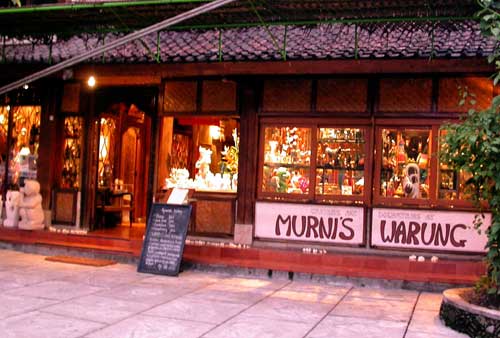
Murni’s Warung, 2006
I also have a shop here that I was running over 30 years ago, even before the warung, where we sell jewelry and antique and new textiles. And I have started a small beautiful villa called Villa Kunang-Kunang (Fireflies) that is in Ponggang, Ubud, about 12 km north of Campuan.
Tradition and Changes
Even until today, I would say that our cultural life in Ubud is still very strong and everyone here, including myself, is very involved with the community. But after the year 2000, I would say that Ubud really changed in terms of development. There were more buildings, more shops, more restaurants, more hotels, the roads are very busy and there is much more traffic here. I think that during the past few years, it has gotten out of control and I am hoping that we stop and really think about it so we don’t overbuild. It is not easy and I hope that the local government will maintain the traditional ways of building in Ubud.
Mortar and Pestle used in Murni’s Warung
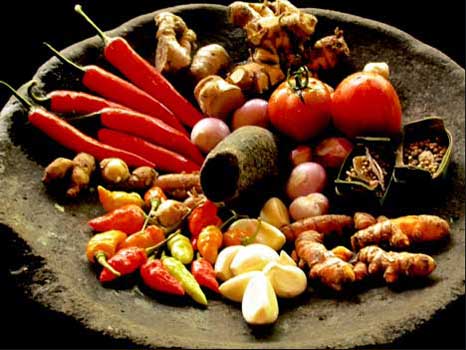
That is why I keep Murni’s Warung like it was in the old days. This is a difficult task these days, but I try to preserve these traditional methods with the workers and the way we cook here. For example, instead of using a blender or food processor, we use a mortar and pestle to prepare ingredients. This takes more time, but I prefer using this traditional Balinese way of cooking because I believe the food tastes better this way.
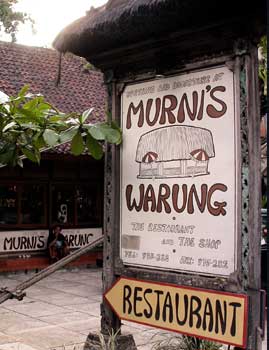
Murni’s Warung Sign
It is also the reason we use more people to work here. I think it’s very important to give people jobs. Two of the staff have been working with the restaurant since we opened for business! At the time they were about 9 years old and now they have grandchildren. They are like family. And a few of the original regular guests that I’ve known for 35 or 40 years still come here even though some are in their 80’s.
Murni’s Warung, Level 3, 2006
Within the family and the community of Ubud, we really try to retain the traditional ways of living. Like my grandchildren, for example, I try and show them how we care and how we are involved in what we do in the community. A member of the Ubud royal family passed away recently and all the members of this community really helped each other for the ceremony. We are very much tied together here and spend more than 30% of our time doing things for the people of Ubud, supporting each other and trying to make all the generations understand and stay strong. For the 32 years that Murni’s Warung has been open, we have always had strong ties here.
Ni Wayan Murni:
Balinese entrepreneur and travelerAndrew Charles
Jakarta Post
21 July 2006
Ni Wayan Murni is a revered character in Ubud as owner of Murni’s Warung, Murni’s Villas and many other enterprises, but it wasn’t always like this.
Back in the 1950s, life was hard. Murni’s parents split up and, at the age of six or seven, she was sent to live with an authoritarian aunt in Denpasar who made her get up every morning at 2 a.m. to prepare and sell food to the neighbors.
Difficult though it was for a very young girl, the hard work, discipline and selling skills were an important part of her education and set her in good stead for the future.
Murni’s mother was an excellent businesswoman, but strict. “She was the only person to sell soft drinks in the market”, Murni reminisced. “I remember one of the king of Ubud’s servants used to cross the road to my mother’s shop to buy drinks for the king’s friends.”
On the days the market was closed, Murni carried a load of salt from Ubud to Penestanan, a few kilometers away. She explained how her mother worked: “My mother insisted that I should not waste the journey back from Penestanan, so when I sold the salt, I had to find something to buy with the money and then I had to sell that when I got back to Ubud.”
Even at that young age she was interested in textiles and sold batik. She said, “When I heard that there were tourists in town, I used to go to where they were and display my batik; I even sold a piece to president Sukarno, who often visited Ubud.”
Tourism increased after the opening of the international airport and, from 1965 to 1974, Murni lived in Sanur where she opened several shops.
These were just outside the Tanjung Sari Hotel, where many people stayed, including Mick Jagger. It was at this point that Murni started becoming interested in antiques.
Her major break occurred in 1974 when, with the small amount of money she had been able to save, she bought some land in Ubud on the edge of a cliff overlooking trees and a river, where she opened Murni’s Warung. “I was so lucky to get this property,” she said. “It’s the best piece of land in Ubud.”
Initially, she sold only clothes and paintings but things started to improve when she realized that by selling Western food, she could attract more business, and was the first to do so in Ubud.
In 1978, electricity arrived so Murni was able to purchase a refrigerator and serve cold beers — a landmark occasion!
Diners at the restaurant used to give her their favorite recipes and they often spent hours practicing together. Murni had to modify the recipes as the ingredients available were hardly ever the same as in her friends’ countries; even when they were, the recipes came out differently.
For example, she couldn’t get pecans anywhere so she changed the pecan pie recipe to cashews; it’s still on the menu.
From a very small enterprise, Murni has moved on to become one of Ubud’s most successful entrepreneurs and the restaurant is one of the most famous on the island.
Murni has incredible stamina and energy. As well as running the restaurant, which was catering to an increasing number of visitors, she opened two more shops and bought for all of them.
It was hard to keep up with the business. She was the first woman driver in Ubud and drove all over the island in search of stock. She said, “I’d buy as many textiles, antiques and good-quality handicrafts as I could and they’d be sold the next day. Every day was like that in the 1980s. It was incredible.”
A visit to Murni’s is a delightful experience. The food is excellent and inexpensive with a wide range of dishes, Western to Asian, and a number of real Balinese dishes not found elsewhere.
As Murni’s Warung and Murni’s shops flourished, she decided to get into the accommodation business. The first venture was Murni’s Houses: residential accommodation for visitors in the center of the town.
As if all this were not enough, Murni got the travel bug. It is very rare for a Balinese to want to travel — and a Balinese woman at that. Undeterred, she took off and traveled all over Europe, Egypt, Tanzania and Turkey.
She still loves traveling and is frequently abroad, searching out rare treasures and testing new recipes for her restaurant.
These trips opened her eyes to luxury. About 12 years ago she acquired a stunning piece of land some 20 minutes drive north of Ubud and built Murni’s Villas.
Many people in this country have achieved success after starting from humble beginnings and then become arrogant and egocentric.
Murni is one of the rare exceptions. She has five children and nine grandchildren and is happy with what she has achieved, but shows no signs of wanting to retire.
She is a traditionalist but also a modernist. She has embraced the digital age and runs one of the best websites in Bali. With her commitment and energy, there is little doubt that she will be in the forefront of Ubud society for many years to come.
Ni Wayan Murni: Balinese entrepreneur and traveler
Meeting Ni Wayan Murni. I arrived early for my meeting with Ni Wayan Murni. Ni Wayan Murni tells us four things. ‘Ni’ that she is female, ‘Wayan’ that she is the first-born, ‘Murni’ that she has been given the name ‘pure’ and ‘Ni Wayan Murni’ that she is Balinese. (She is known as Murni to her friends.) That is quite a lot of information in a name. My name is John Braine, which doesn’t tell you anything. Sex: male. Status: single. Occupation: photo-journalist. Home: San Francisco.
It was in the Slanted Door in San Francisco that I almost met Murni. The Slanted Door is a great Asian restaurant frequented by lovers of beauty in all its forms, dealers and collectors, and foodies. I had been invited by friends for lunch and arrived late. Murni had just left. Another missed opportunity. I knew that Murni had had a very successful exhibition at the Arts of Pacific Asia Show at Fort Mason the previous month and was keen to meet her.
It was the first time that a real Balinese collector had exhibited at the show and it caused quite a stir. She’s been collecting all kinds of Asian arts for at least thirty years, many of which are no longer made, and are very rare. She brought textiles from all over the archipelago and interesting tribal jewelry and objects, which she has collected personally over the years on her travels around the region.
I was really annoyed to have let an opportunity like this slip through my fingers, but fate intervened when my cell phone rang a month later. ‘Can you go to Bali to photograph the ten day Galungan celebrations? Your ticket’s ready. You should base yourself in Ubud. We recommend you stay at Murni’s Villas.’
So it was with great anticipation that I went down the small flight of steps to the Lounge Bar of Murni’s restaurant in Ubud, in the cultural heart of Bali, to meet this famous lady. She was surrounded by beautiful muted textiles, red, reddish-brown, dark blue and black violet, explaining to a couple of Belgian tourists that these were the most spectacular textiles ever produced in Bali and arguably the whole of Southeast Asia. They were rare geringsing textiles from the small village of Tenganan in east Bali, which contained sacred energy.
The Belgian ladies got two each and left to have a look at Murni’s shop where other treasures from Bali and elsewhere tempted them. I was now able to chat to Murni alone over a couple of cocktails and take photographs of her in her landmark restaurant. She explained her pioneering career starting the first real restaurant in Ubud over thirty years ago, still a favourite, where she created dishes unheard of in Ubud and which nobody knew how to spell, all the while collecting Balinese and Asian antiques, which no-one was interested in, opening the first proper gallery of antiques and tribal art in the village, and then getting into the tourist accommodation business culminating in the spectacular Murni’s Villas and her latest venture of exhibiting abroad.
They say that if you want something done you should ask a busy person. If all that was not enough, she has acted as a consultant to a new 500-page book on Bali called Secrets of Bali by Jonathan Copeland and another book is on the stocks. Does she relax? Well, yes. She walks an hour every day, plays badminton three times a week, swims in a jaw-dropping, beautiful pool at Murni’s Villas and gives her two dogs, a dalmation called Toby and a golden labrador called Darling, a run for their money. And I haven’t even begun to mention the massive cultural obligations and duties of just being Balinese.
As I was finishing my second Pina Colada a runner from Sumbawa arrived fresh from the boat with local treasures for her perusal. I get the impression that this is a daily occurrence. Murni explains that she has to spend some time with him before he goes off to see other dealers. She likes to get the pick of the crop. She told me where the best shots were to be had for my photo assignment of the Galungan celebrations and we made arrangement to meet in the Slanted Door in February 2008. As she gracefully moved on to her next meeting I promised not be late and thanked her for giving me an insight into her life in Bali.
I can certainly recommend Murni’s Warung in Ubud for great food and great Pina Colodas in the Lounge Bar. You never know, you may be really lucky and meet Murni. Her shop, Murni’s Warung Shop, is a treasure trove and Murni’s Villas is the place to stay.
Kolektor barang seni dan pusaka serta perintis pariwisata di Ubud ini mengenang masa hidupnya yang susah sebagai pengalaman yang sangat berharga.
Rani R. Moediarta, Pesona, November 2007
Warna-Warni Pengalaman Hidup Ni Wayan Murni. Siapa pun yang berkunjung ke Ubud, Bali, tentu pernah melewati Murni’s Warung. Warung ini menempati lahan dengan lanskap alam khas Ubud – pas di lekukan sungai Campuhan bersisian dengan tebing yang di bawahnya mengalir sungai dengan -derasnya. Alam asli Ubud yang terpelihara ini menjadi bagian dari eksterior Murni’s Warung.
Sambil duduk menikmati hidangan di teras terbuka yang menghadap tebing, para tamu bisa menikmati udara sejuk pegunungan, dihibur suara aliran air. Berbagai koleksi barang seni dan antik melengkapi interior warung yang dibangun bertingkattingkat di bibir tebing ini. Paduan antara keasrian alam dan tradisi rumahan selalu menggugah keinginan orang untuk singgah dan mungkin kembali lagi. Pemiliknya, Ni Wayan Murni, berpenampilan sederhana,
bersuara lembut, bertutur kata halus, namun terasa tegas dan berwibawa.
Saat ditemui oleh PESONA, Murni sedang sibuk mempersiapkan keberangkatannya ke San Francisco guna mengikuti Arts of Pacific Asia Show, pameran internasional yang diikuti oleh para kolektor tingkat dunia.
NOSTALGIA UBUD
Sosok Murni memang lekat de-ngan Ubud. Boleh dibilang, perkembangan Ubud tak lepas dari usaha Murni dan kawan-kawannya. Dari ingatan yang di-sampaikannya, terkesan berbagai kenangan masa lalunya berkaitan dengan kondisi Ubud separuh abad yang lalu.
Perpisahan kedua orang tuanya membuat Murni menumpang hidup pada seorang bibinya yang tinggal di Denpasar. Ia mengenang masa itu sebagai masa yang amat berat. Ia baru berusia 6 tahun tapi harus bangun pukul 2 dini hari untuk membuat penganan yang dijajakannya pagi harinya sebelum ke sekolah. Pada usia 12 tahun, barulah ia bergabung dengan ibu kandungnya. Namun, kehidupan tidak bertambah ringan.
Di Ubud, ia tinggal bersama keluarga besar – lebih dari 20 orang. Selain nenek dan ibunya, di rumah itu ada paman, bibi, dan para sepupu. Sebagaimana rakyat kebanyakan, mereka selalu makan seada-nya dan setiap orang diberi tugas untuk mencari tambahan penghasilan. Maka sejak kecil, Murni sudah biasa menjunjung batu atau mengangkut pasir untuk dijual. “Semua orang melakukannya di zaman susah itu,” katanya.
Sungai Campuhan waktu itu adalah sumber penghidupan warga Ubud. Selain batu apung untuk dibuat paras (dekorasi bangunan) dan pasir, sungai itu juga memberikan pangan ikan dan udang. “Ikan ditangkap dengan bubu. Sedangkan udang, dapat ditangkap dengan tangan,” kenang Murni. Namun ‘makanan mewah’ seperti belut, ikan, udang, atau tiram dari sungai itu tidak pernah mereka nikmati. Perolehan itu harus disetorkan kepada sang Nenek.
“Dengan masih bertelanjang dada dan hanya mengenakan sarung yang sobek-sobek, Nenek membawa tangkapan kami untuk dipersembahkan di Puri Ubud. Pulangnya, Nenek mendapat sekitar 2-3 kilogram beras. Itulah jatah kami untuk sebulan. Ya, beras itu cukup untuk 20 orang dalam sebulan, karena yang ditanak setiap harinya hanya segenggam, dicampur dengan nangka muda atau jantung pisang yang dicincang halus. Bila ada ubi untuk mencampur beras, wah itu makanan -mewah!” Murni mengenang.
Hanya pada hari raya Galungan mereka bisa menikmati daging babi atau ayam. “Satu ekor ayam bisa untuk lauk kami 20 orang, selama tiga hari!” Kehidupan berat itulah yang dirasakannya memperkaya hidupnya.
OTODIDAK DAN PENDOBRAK
Tempat strategis itu awalnya hanya dipinjamkan dan disewakan kepadanya. Pelan-pelan, dengan menyisihkan penghasilan warung, Murni akhirnya bisa membelinya. Sejak membuka warung pertama kali di tahun 1974, Murni tidak sekadar menjamu para tamu, tapi juga menjalin persahabatan dengan mereka. Sebagian dari tamu datang dari mancanegara dan menjadi teman serta pelanggan tetap warungnya. Beberapa bahkan bekerja sama dengannya.
Pada tahun 1992 Murni merenovasi warungnya besar-besaran, tapi ia tetap mempertahankan cirinya sebagai warung rumahan dengan nuansa tradisio-nal. Dia tak ingin merombaknya menjadi restoran bernuansa modern.
Dari warung ini Murni memiliki jaringan teman-teman yang tersebar di Amerika dan Eropa. Mereka itu pula yang mendorongnya untuk melakukan perjalanan ke mancanegara. Sejak tahun ‘70-an Murni telah menjelajahi Amerika, Eropa Barat dan Timur, juga Afrika. “Saya hanya tamatan SD. Namun perjalanan ke luar negeri banyak memberi saya pendidikan. Sekolah saya adalah kegiatan perjalanan itu. Saya belajar dari soal disiplin, bergaul, bersosialisasi, dan menghargai pusaka leluhur. Pandangan hidup saya terbentuk dari perjalanan yang telah 30 tahun saya lakukan,“ kisahnya.
Murni dengan rendah hati menceritakan bahwa awalnya ia tidak tahu apa-apa tentang benda seni dan pusaka. Teman-temannyalah sumber pengetahuannya. “Misalnya soal barang-barang pusaka -kita, saya justru belajar dari orang Jerman dan Belanda yang banyak mengoleksi barang-barang leluhur kita. Saya termangu ketika mereka bercerita tentang keindahan kain dari Singaraja misalnya, yang sebelumnya sebagai orang Bali saya sendiri tidak terlalu peduli.”
Kini koleksi benda antik Murni tak terhitung banyaknya sehingga ketika ditanya koleksi apa yang paling bermakna buatnya ia hanya menggeleng. “Terlalu banyak! Yang lebih penting bagi saya adalah memberikan kepedulian dengan memberikan apresiasi.”
Untuk memuaskan kesenangannya pada benda-benda seni dan pusaka, Murni rajin mengunjungi pameran di mana-mana. “Boleh dibilang setiap tahun saya pergi untuk keperluan itu. Saya hanya datang untuk melihat-lihat. Bila ada yang saya suka dan mampu saya beli, ya saya beli.”
Selain itu, Murni juga seorang pendobrak. Sebagai remaja putri yang dituntut berbakti kepada orangtua, Murni tak bisa menolak ketika ia dijodoh-kan dengan seorang lelaki yang masih terhitung saudara, pada usia 16 tahun. Namun perkawinan yang memberinya empat anak – tiga putra dan satu putri itu tidak berjalan mulus. Ia mengenangnya sebagai pengalaman pahit. Karena, meski sudah bekerja keras menghidupi ke-tiga anak dan menjadi istri yang berbakti, toh ia merasa tidak diperlakukan dengan baik. Ia pun mengambil keputusan yang langka pada zamannya: meninggalkan suami dan berjuang mencari penghidupan sendiri.
Ia kembali mendobrak nilai lama dengan menjalin kasih dengan seorang kulit putih, Patrick Moore Scanland, salah seorang pelanggan warungnya, yang kemudian menjadi suaminya sampai sekarang. Pada zaman itu, menikah dengan orang luar Bali, terlebih seorang asing, masih dianggap melanggar adat dan secara sosial dipandang rendah. Tapi Murni menempuh risiko itu dan lebih menuruti kata hatinya. Mereka menikah di Singapura tahun 1975. Dari perkawinan kedua ini ia mendapatkan anak kelima, seorang putri.
JIWA WIRAUSAHA
“Entah apa yang membuat saya dan kawan-kawan berani mencoba,” kenang Murni tentang awal ide memperkenalkan barang seni Ubud keluar Ubud. Waktu itu Ubud belum terlalu dikenal dunia luar. Di Bali pun belum ada bandara internasional. Sesekali hanya ada kapal laut dari luar negeri bersandar di pelabuhan Padang Bai dan Benoa. Namun, kampung Murni, Penestanan, merupakan kediaman para seniman lukis terbaik di Bali, sejak dulu dan kini. Dengan mengayuh sepeda, -Murni dan beberapa kawan perempuannya nekat menemui para tamu dari luar negeri untuk menjajakan hasil seni dari Ubud.
“Di boncengan belakang, kami membawa patung, kain bali, dan lukisan-lukisan. Yang mendorong saya adalah tekad. Saya selalu menguatkan hati: saya harus berhasil! Mungkin pendorongnya tak lain adalah kehidupan waktu kecil dan sebagai anak tunggal, saya ingin berbakti kepada keluarga yang hidup susah.”
Ketika Ubud mulai dikenal dan turis mulai berdatangan, Murni banting setir dengan membuka warung. Pelan-pelan ia mulai melihat kebutuhan pasar: makanan bagi turis asing. Itulah awal berdi-rinya Murni’s Warung. Jembatan di depan warungnya menjadi saksi bagaimana dia dulu, dalam keadaan hamil besar, pukul 4 pagi menunggu bemo, satu-satunya kendaraan untuk berbelanja keperluan warung ke Denpasar – bahkan ia harus berganti kendaraan tiga kali. Pukul 8 pagi, ia kembali ke Ubud dengan menenteng belanjaan. Begitu setiap hari. Dan, karena saat itu belum ada listrik maupun air PAM, air untuk keperluannya memasak dan mencuci pun harus diangkut dari sungai.
Sejak kecil Murni memang terbiasa membuat penganan dan menjajakannya. Tetapi tahu apa Murni soal makanan yang disukai orang asing? “Modal saya adalah tidak malu bertanya dan senang belajar. Pelanggan yang mengajari saya memasak makanan yang mereka suka.“
Murni juga membuka dua toko cenderamata, bersebelahan dengan warungnya. Bisnisnya yang lain adalah properti. Namun menurutnya belum berkembang seperti yang diinginkannya karena wisata di Bali secara umum belum pulih. Warung dan tokonya hingga kini masih dikelola langsung olehnya.
Menjalankan tradisi sebagai wanita Bali memang diakuinya berat, karena wanita Bali dituntut untuk mengerjakan banyak hal. Mulai dari melayani keluarga, membereskan rumah, dan mengikuti ritual keagamaan yang menuntut ba-nyak waktu dan tenaga. Dan bagi Murni sewaktu muda, harus ditambah dengan banting tulang mencari nafkah. “Mungkin, bila saya hanya fokus mengelola warung, -saya bisa bosan atau lelah karena yang namanya pekerjaan, selalu ada stres. Nah, dalam hal ini, kegiatan seremoni dan tradisi menyeimbangkannya. Makin lama saya makin menikmati menjadi orang Bali dan menghayati tuntutan adat Bali.”
Bagaimanapun, ia sering merasa hidup di dua dunia. “Di satu sisi, saya menjalani dan menikmati semua se-remoni adat dan sosialisasi di komunitas saya sebagai orang Bali. Untuk itu saya harus berperan sebagai perempuan, ibu, dan nenek yang orang Bali. Di sisi lain saya bekerja mengelola warung dan menikmati pertemanan dan pergaulan internasional. Saya mesti memberi waktu
bagi teman-teman baru, seperti kolektor, tamu, wartawan, dan bepergian ke luar negeri.”
Kini, pada usia senja ditemani suaminya, hidupnya terbilang mapan. Usaha warungnya berkembang. Ia pun kerap melanglang buana. Teman dan rela-sinya tersebar di seluruh dunia. Ia juga memiliki peluang menyalurkan hobinya mengoleksi benda seni dan pusaka. Murni juga masih sempat menyalurkan bakat seninya dengan bermain gamelan. Anak-anaknya sudah mapan dan memberinya 10 cucu. Masih adakah yang ingin dilakukannya?
“Saya masih ingin terus bisa traveling!” jawabnya spontan. Dan matanya menerawang oleh hasrat yang tampaknya belum akan padam dalam waktu dekat.
Dallas Hall The World of Dalilambchop, 26 January 2009
The Matriarch of Ubud. 22 years ago this month I made my first trip to Asia. The first place that I landed was Bali. Frankly, I was a little skeptical and afraid but I got lucky and found the world of Murni.
The world of Murni is very special. Her home is located high off the main road in Ubud among the rice patties. She has lovely accomodations placed amongst the most beautiful gardens on earth. When you stayed with Murni you were truly family. And, you remained family for the rest of your life.
There have been changes and fancier places have evolved but the energy of Murni’s was beyond compare. To this day when I’m feeling sideways I close my eyes and travel to the veranda off the main house where I usually stayed.
I remember how every afternoon around 4:00 pm one of the young ladies that worked there would come around and offer you a cold drink. If there is heaven on earth Murni’s villa’s have to be one of the places.
I hadn’t seen Murni for about 8 years but this winter one of my best buddies and his love stayed with Murni and told her that I was in Bangkok. They gave her my number and two nights ago we met again as if it had only been a week. Great friendships are like that!
We reminisced and shared stories of how we were doing as well as our grown up kids that use to run around the grounds.
I think that this week would be a great week to contact old friends that you haven’t talked to for a while and catch up. It is really a good feeling to re-connect.
Finally, coming up in San Francisco on Feb. 6 to 8 will be the 13th annual San Francisco Arts of Pacific Asia Show. I think it will be a great show that is open to the public. Stop in and say hi to Murni.
Garuda, The Magazine of Garuda Indonesia, July 2009
“The story of my life is a long and complicated one” she said softly. And thus began my interview with the legendary Murni of Murni’s Warung in Ubud.
Many of my fondest memories of Ubud in the eighties are wrapped up in the walls of this multi-levelled eatery that is perched beside the Tjampuhan suspension bridge overlooking the Tjampuhan River. I remember spending oh-so-many lazy afternoons there when Ubud was a sleepy village, reclining in that tropical let-the-world-float-past way on creaky bamboo furniture. We’d sip on freshly squeezed lime drinks brimming with crushed ice eating Nasi Campur or Nasi Goreng. Lunchtimes drifted into dinner and it didn’t matter. There was nothing urgent to be done except chat about life, love and cosmic heroes – no mobile phones, internet, emails, reality TV, not even Facebook! Life was suspended between our daily routine and fairy tales.
The ground floor pavilion of Murni’s Warung was our preferred haven. Like the inner sanctum of a temple, this cosy space inspired discussions on all things sacred and profound. Ketut, my husband, any number of friends and I would gather at our favourite table and listen to never-ending tales of Ken Arok, one of the most powerful rulers of Indonesia in ancient times, the Mahabharata and the Ramayana. The tales would almost lull me to sleep as I listened to the ongoing treacheries, tragedies and majesty of Ken Arok, the extraordinary beauty of his wife Ken Dedes and Hindu epics of family betrayal and bravery.
The seething jungle around us and the surging sound of the Tjampuhan River below enhanced the dramas. Nature seemed to grow before my eyes. I absorbed all that I could in what became a crash-course in Indonesian history and Bali-Hinduism.
Sitting with Murni in the downstairs Lounge Bar at Murni’s Warung that has now replaced our favourite retreat. Murni chatted about her life, treading delicately through sad memories of her childhood that have laid deeply buried in her heart for so many years. But on this breezy day, they bobbed to the surface and floated around us as if we were in a time warp. In those days, life in Bali was often arduous, unforgiving and heartbreaking for many.
Murni touched on the tragedy of 1965: the communist coup that saw more people slaughtered in Bali than any other part of Indonesia. She spoke of the nightmares that continued to haunt her for such a long time and the many wounds that have been patched superficially but not healed. The tale of being taken from her mother at the age at seven left us silent.
After three hours of emotional chatter we dried our eyes and steered the conversation back to the incarnation of Murni’s Warung.
“I wanted my own business in Ubud so I rented this small Warung from Pak Munut. Victor Mason, who, believe it or not, is still alive and well in Ubud, gave it the name, The Black Stump. He said, just call it that and I did. But I had no idea what it meant!” she said.
“At first I had one bamboo table. I had started to sell sarongs, paintings and carvings. I didn’t plan to have a warung and I am not at all a chef. My future husband Pat would sit in the shop with me. He wanted to drink beer and eat sandwiches so I made these for him. Guests who came into the shop would ask if they could buy some too. “
“I eventually opened a little kitchen and began to sell beer and sandwiches. Every morning I caught the bemo to Denpasar to buy tomatoes, cheese, ham and bread and would come straight back home to run the business. I borrowed beer from my mother who had a shop in the market. We made ice boxes from cement and filled it with ice.”
The following year in 1975, Murni bought the property and changed the name to Murni’s Warung. Slowly the business expanded. Murni had clearly acquired the business acumen of her mother and years of a Cinderella-type childhood living with her father’s family in Denpasar (before the handsome Prince) had prepared her for an around-the-clock shop-keeping routine.
“My guests taught me how to make everything. They taught me how to make guacamole because I had an avocado tree. But when they made it I couldn’t eat it because it reminded me of a Balinese poultice they make here for pregnant women. We were the first in Ubud to make yoghurt. The culture was brought from Holland for us. I eventually bought a fridge and made jackfruit and white mango ice cream,” Murni reminisced.
But it was Murni’s cakes that I loved to the most. She was and still is famous for them. In the eighties you were lucky to find anything more than fried bananas on local menus. Murni’s Warung was one of the first to serve a selection of international sweet dishes to appease cake eating, chocolate-craving gluttons like me. Her chocolate brownies and home-made pies saved many a home-sick traveller.
Murni’s Warung quickly became an institution and remains so to this day. It is an Ubud icon. Back then, I remember that one of the greatest joys about visiting Murni’s Warung was simply Murni. She used to sit at the front desk and invariably wander up to your table and have a chat. When Murni wasn’t there holding the fort, Nyoman, the head cashier, was there taking her place. Now there was a girl with her own brand of dry humour but she’s another story!
There is so much about Murni to love. Whether it be her heart that’s as big as the moon, her gentle nature, grace or soft humour ….or the combination of these matched by her lovely soft round face…whatever it is, it’s infectious.
Murni’s moving tale of longing, separation and hardship stays with me. Her struggles and subsequent battles laid the foundations of her success. Here is a woman who has learnt to straddle two cultures, for better or for worse. She created an iconic business, single-handedly, that helped put Ubud on the map. And for all these reasons, and many more, she is and will always be one of my favourite mothers in town.
Back at my writing desk. It feels a little strange as I step into my pre-loved Jakarta Post dancing shoes once again. The buckles are rusty, the toes are tight and the leather lacks that seductive patina that speaks of action and verbal flirtation. But beat those Brazilian drums and let the party begin.
I am back on track with sharpened brain, if not a little wine-drenched, with a super-charged laptop and a song to sing. After all, it is approaching the time for the sixth Ubud Writers & Readers Festival and other festivities and there is so much to tell you.
“There are so many stories of Ubud waiting to be told.” I was sitting next to the legendary Ibu Murni of Murni’s Warung in Ubud.
We were at the compound of my favorite priest when she uttered these words. The occasion was for a Melukad, a Balinese cleansing ceremony in which we were both participating.
I have written about this priest before. He was the one who tied the proverbial marital knot or rather Balinese thread around the wrists of Ketut, my husband, and I, 20 years ago. He has blessed our children many times and I adore him.
He is tall and stately, and shines with the kind of grace and wisdom that holy folk tend to acquire. He is rather like a character from Lord of the Rings, one of the good guys, with cosmic rings to match.
It is no secret either that Murni is one of my favorite mothers in Ubud. We are members of the same banjar or community group and often meet at ceremonies. Sitting in the shade of the bale overlooking the cozy temple grounds and knotted scented trees, we chatted about our beloved town, Ubud.
“If you visit every family in Ubud,” Ibu Murni whispered, “you will find a different story, stories about generations of life here. There are so many tales to tell. They should be written down; otherwise they will be forgotten.
“Did you know about Jalan Bisma where you live now, before it even had a name? In the early days, it was just a tiny dirt track in the middle of the rice fields. When I was a young girl, I used to walk up there in the afternoons, around three o’clock when the sun was still warm. That was the best time to collect Balinese snails and the ones from Jalan Bisma were the finest.”
Opposite us on a slatted wooden bench sat two old weather-beaten Balinese men waiting to be blessed. The story of the snails struck a chord and they nodded like twins in agreement. I love it when the Balinese discuss their favorite foods.
“The sun was warm so the snails would rise to the top and I would scoop them up and take them home for dinner. They were so delicious,” Murni continued.
The old men smiled.
Have you ever seen Balinese talk about the old days in Ubud before the streets were paved and televisions, Internet cafes or Western-style restaurants were anywhere to be seen? I watched the faces of the people around me who were gathering by the minute.
A wistful distant look crept into their eyes: dark misty pools of memories reliving an age gone by, a lifestyle that no longer exists.
Here we were, assorted locals thinking about tasty snails fattened on the happy nutrients floating in the rice fields in the days before fertilizers and modern technology, a time when bullocks churned the fields, a time of clearer skies, quieter roads and more wholesome foods.
“The eels were more delicious then too,” Murni reminisced. The men smiled again and shook their heads in agreement. Balinese chatter followed. Other village folk started filing in, sitting beside us and listening to the conversation.
There is something so all-encompassing about a discussion of food, especially flavors of a bygone era. It digs up a whole host of memories that trigger all the senses, of happy times and sad, of places, people and events. Have you ever eaten something that has stopped you in your tracks because it reminded you of your childhood?
“I imagine the rice was even tastier then,” I added quietly, hoping it wasn’t too presumptuous of me to make this suggestion, as this was not my time or place. “Yes it was,” agreed Murni. More heads nodded and the chatter continued.
I left the conversation as it wandered off into the growing of rice and the virtues of organic soil in the region of Pupuan.
The ceremony had recharged and invigorated me in a strange sort of way. Holy water had been poured over my head, the freshest feeling imaginable, and the scent of yellow cempaka was orbiting around my entire being. But my thoughts were wrapped up in snails, eels, rice fields and Jalan Bisma.
I remember when I first strolled down Jalan Bisma with Ketut, some 25 years ago. “I want to show you my land,” he said proudly. “My father bought it for me a few years ago.”
We walked in the hot afternoon sun through a stretch of bright green rice fields and passed three small lonely compounds. After 500 meters, we arrived at a long piece of land on the east side of the track that was no different to any other rice field, except that it was Ketut’s. This was before Jalan Bisma had a name.
“Did your dad have to buy property so far from town?” I whimpered beneath my sweaty brow. It seemed so distant, miles in fact from the main road, but nowadays it’s almost the center of Ubud, a stone’s throw from the hub of restaurants and swanky shops. Beyond our place, the track wound all the way to the Monkey Forest and the silent rock pools hidden nearby.
Coconut trees framed the sides of this narrow path forming a deliciously shady canopy overhead. Years later, the trees were cut down to widen the road and make way for the machinery to harvest the fields. Such is the dilemma of progress.
Nowadays, Jalan Bisma is a cement-brick road of snug compounds and small businesses that blink seductively at tourists beneath the hooded lashes of Balinese village charm. The rice fields remain, albeit more sporadically, and coconut trees have been replaced by ornamental frangipani, wild gingers and feathery plants.
Bakso sellers appear in the afternoons and nasi campur and rujak are sold in the small warungs.
And while the snails might be fewer and the eels less than perfect, I still love my little neighborhood and happy bustling street. But Murni’s story lingers in my mind and I dream of Jalan Bisma’s char-grilled snails and eel pepes, circa 1970.
Back with a Song to Sing and so many Tales to Tell
Murni’s Story Ni Luh Dian Purniawati Bali & Beyond March 2010
Bali & Beyond recently sat down with the namesake owner of Murni’s Warung, one of the restaurants hailing from the early days of Ubud’s tourism growth that has endured and progressed until now, to talk about her recollections on Ubud’s development.
To the left and right of the warung there have been many changes, but one thing that hasn’t changed is the lush valley and sound of the rushing river that reminds many of the Ubud of yore.
Sitting on the lounge listening to the sound of Blues, it took me back to Ella Fitzgerald 1930s. But glancing to my left at the scenic high ledge of foliage and the rushing river down below me, plus the waitresses clad in Balinese attire, I was beamed back to reality – in Ubud. The place had just been hailed as “The Best City in Asia” by readers of the Conde Nest Traveller.
Murni’s Warung in the early 1970s.
I myself was at this time honored by the acquaintance of Murni, owner of Murni’s Warung, one of the restaurants dating back to the early days of Ubud’s tourism, which has endured and progressed until now.
“Forgive me, I just got back from ngayah,” Murni said. She seemed to be in a bit of a rush, catching up with her appointment with me. Just like any other Balinese woman, it was her obligation to go to the temple for ngayah, a communal activity among village members where they gather together to do things such as temple cleansings and ceremonial preparations. Ngayah could last for several days.
It’s no easy task being a Balinese woman. They not only readily go and serve for ngayah at temples but also take care of social and family activities such as weddings, ngaben cremations, and rites of passage for new family members, as well as other similar rituals in a banjar community.
Guests at Murni’s Warung in 1975.
Murni’s spirit and enthusiasm for life hasn’t diminished a bit. She has five children and eleven grandchildren, several businesses that must be looked after, including Murni’s Warung, a large antique collection and her help on a new book Secrets of Bali, Fresh Light on the Morning of the World.
“Back then there was only the Tjampuhan Hotel in Ubud,” said Murni. Murni’s business instinct only started when she bought a piece of land not far from the hotel that was owned by the Ubud royalty and started to sell paintings and some souvenirs.
More than a few guests came in to the warung to shop and look around. It came to be that they did not only pay attention to her wares but also her dining table, the only dining table in the space.
“They said, ‘I want this’. They were hungry and wanted to eat. I said, ‘but this is my lunch – not for sale,'” she recalls. This was what sparked her initial idea to start selling food. At the beginning she took a bit of her mother’s wares at the Ubud market and transferred them to her warung. Eventually she started to learn to make sandwiches. The western snacks she learned from her guests who later on became her close friends.
Murni was resilient. At 4 o’clock in the morning she would leave for Denpasar to get the freshest bread, tomatoes, and ingredients that at that time were not yet available in Ubud. At 9 she would be back in Ubud and prepare to open her warung. She repeated these similar chores every day. Back then she had her two cousins to help her out. Business was quite good. One month later she had added 3 more tables to her space.
“I learned a lot from my guests. I named my menu items with the names of my friends who taught me the recipes. Mary Sandwich for instance, was due to Mary teaching me to make sandwiches,” recalls Murni.
“I was lucky to have gotten this space,” she continued. “I bought it in 1974 and set up this warung. Starting with one level, I gradually expanded downwards. Some of it has been retained, such as the footpath that leads down to the river. Back then there was no such thing as channeled water or water companies; there was not even electricity in Ubud at that time!”
To the left and right of the warung there have been many changes in line with the rapid progress over the years together with the increasingly busy Ubud. But one thing that has not changed is the lush valley and the sound of the rushing river that reminds many of the Ubud of yore. Many guests are impressed with the warung. They somehow find constant déjá vu and live their memories there.
Many older tourists revisit and find a different and changed Ubud. Some of them are knowledgeable about the situation and the changes and understand that change is inevitable, but others are disappointed. They imagine the ‘village’ of Ubud, yet in reality find the ‘city’ of Ubud.
The street of Jalan Bisma for instance. Murni has vivid memories of the road as a once lonely footpath amongst a vast spread of rice paddies. That frequently muddy path during the rainy season has since changed into a hard paved road, and the rice fields have turned into an array of cafes, art shops, and hotels on both sides.
Many trees have been felled without replanting schemes to follow. Lots of garbage is scattered around the street with the lack of consciousness to keep a cleaner environment. A lot of understanding must be planted into the psyche of the locals.
“We are proud to have been called The Best City in Asia, but let’s not let us ‘sink’ underneath the pride,” solemnly advised Murni. “Overpride can lead to conceit. And when we reach this stage, we’ll forget that the true predicate given is a challenge for us in maintaining it.”
“We must keep on striving to become the best and remain the best,” Murni added with enthusiasm. Enthusiasm that should be in the hearts of us all. She remains energetic and engaged in all sorts of activities, despite her current health ups and downs.
This year she was supposed to head to San Francisco for an exhibition of her antique collection. Yet she had to cancel due to health. She has done several exhibitions before, meeting up with like-minded collectors from the world over.
“I want to have a museum to display my antiques,” said Murni. “Many of our youth do not understand the significance of their nation’s past. Then they’d be surprised when they go abroad and see their ancestral wealth on display there, as I was to see the Sembiran weavings (from North Bali) in the Netherlands. Not even the Sembiran people themselves know much about their own heritage.”
Her dream of building a museum is not easily made into reality in a flick of a wrist. It’s like she never imagined that Ubud would become what it is today, she also never thought that she would have become a collector and have the chance to travel to other regions.
Evening neared in, yet Ubud remained lively if not livelier. Several guests started to come and be seated at the dining tables. They seemed to enjoy the composed, comforting and hospitable Ubud nuance.
Charles and Mary Love Charleston Style & Design, October 2010
Planning a trip to Bali arouses expectations of achieving nirvana or, at least, of escaping from the mundane. And those who visit usually aren’t disappointed.
Consider the current movie based on the popular memoir, Eat, Pray, Love by American writer Elizabeth Gilbert. The author finds happiness and liberation on Bali – a journey the Balinese call “achieving balance” – after she travels the world following an unsettling divorce.
Some attain nirvana on Bali through the high-class pampering they receive at luxury resorts. Others find solace in the island’s slow rhythm and physical beauty – an exotic tapestry of mist-shrouded volcanoes, emerald rice terraces and palm-lined beaches. Everyone who comes here appreciates the island’s culture, an intoxicating blend of Hindu religious and artistic expression that permeates every aspect of daily life.
“I’ve traveled the world, but there’s no place like Bali,” says an Australian expatriate who has made the island his home for over 25 years.“ It’s as if all of life has been condensed on this one small island.” An American woman from the South, who spends six months each year on Bali, explains, “The life force here is strong … there’s something about Bali that brings out a person’s creativity.”
One of 17,000 Indonesian islands, Bali (population over 3 million) has nearly 20,000 Hindu temples and countless palaces, a legacy of the eight ancient kingdoms that once ruled the island.
Ubud, a small town (population around 7,000) near the middle of the island, is the acme of Balinese culture. As one American visitor recently confessed, “There’s no place I’ve ever visited where religion plays a greater role in daily life…virtually every corner and tree branch of Ubud is adorned daily with offerings of incense and banana-leaf parcels with rice and yellow ginger shavings set out for a dazzling array of gods.”
In fact, the Balinese believe that good and evil exist everywhere in the world and that only their constant prayers and offerings can keep bad spirits away. As one native explains, “In Bali, we live on many levels, but religion is the core. It balances three worlds: our relation to the spiritual world, with humans, and with the earth.”
Ubud and its rustic environs have been a mecca for western tourists since the young German artist, Walter Spies, settled here in the 1920s at the invitation of Ubud’s royal family. He was mesmerized by Bali’s culture, which soon became an inspiration for his art.
Eventually, intellectuals and celebrities beat a path to his door: musicologist Colin McPhee; Mexican artist and ethnologist, Miguel Covarrubias (whose 1946 book, Island of Bali, remains a definitive reference on Balinese culture); anthropologists Margaret Mead and Gregory Bateson (traveling on a “working” honeymoon); Noel Coward; Charlie Chaplin; and many others. Today, artists, jetsetters and celebrities continue to flock here.
Ubud is at once urbane, bohemian—and, of course, spiritual.
On the town’s main street, inexpensive curio shops stand across from high-end galleries while spacious, open-air restaurants look upon ancient temples. Weddings, cremations, full moon rites and other religious events occur day and night. During these various spectacles you’ll see dancers in bizarre masks, women balancing baskets of fruit offerings on their heads and ensembles performing rhythmic, often haunting, music.
Restaurants in town range from the sophisticated Mozaic, which offers American and French-inspired cuisine in a romantic garden setting, to Naughty Nuri’s, an al fresco roadside warung or restaurant known for its weekly tuna grills and “killer” martinis. Murni’s Warung, the oldest restaurant in Ubud, remains a favorite because of its delicious Indonesian and international cuisine and serene candlelit setting next to a murmuring river. There’s also a popular nightspot, the Jazz Café, which is one of the best places in the village to hear live music and enjoy a simple meal and drinks.
Traditional cultural events occur just about every night in Ubud. They range from elaborate dance-dramas based on Hindu legends to Bali’s famous wayang kulit, folklore plays in which the shadows of leather puppets are cast on a fabric screen. Gamelan orchestras – ensembles of drums, gongs and metallophones (shimmering and slightly dissonant) – accompany most performances.
Ubud’s shopping opportunities are many. Be sure to check out Murni’s Shops, which offer a large variety of Asian antiques, collectibles, textiles and gifts. Murni herself is an energetic entrepreneur, an expert in Asian antiques and textiles and one of Bali’s “living legends.”
Near Ubud, villages specialize in different crafts. Celuk, for example, is known for its goldsmiths and silversmiths; Mas, for mask makers; and Tegallalang for its wood carvers.
In and around town are wonderful accommodations. If you’re seeking an ultra-chic resort, the Four Seasons at Sayan, located just outside town, is hard to beat. Located along Bali’s sacred Ayung River, the resort features enormous suites and villas nestled in a jungle setting. Its fabulous terrace restaurant overlooks a tropical gorge and features Asian-inspired cuisine. The resort’s spa offers a menu of seductive facials, body massages and Ayurvedic treatments.
In town, Murni’s Houses, known primarily through word-ofmouth, is a unique, low-key option. The ambience and friendly staff make guests feel like they’re staying in a traditional island home. Situated inside a Balinese-style walled compound within three minutes of Ubud’s main street, this tranquil sanctuary offers a variety of suites and rooms. Meals are served either on a garden terrace or in the guestrooms.
In the countryside, just 20 minutes outside Ubud, Murni’s Villas offer upscale accommodations at a site that has become popular for weddings and honeymoons. Situated on six acres and overlooking ancient rice terraces, the villas are collectively named Kunang-Kunang after the fireflies that sparkle above the terraces at night. Matrimonial ceremonies are performed beneath temple umbrellas and feature a flower-strewn aisle lined with Balinese flags. Country walks, tours, courses in local culture and massages can easily be arranged either here or at Murni’s Houses.
If you’re based in Ubud, you’ll inevitably want to allow time for exploring central and eastern Bali – regions of expansive rice terraces, lava-strewn hillsides, coconut and banana groves, remote beaches and villages centered on Hindu temples.
Mount Agung, at over 10,000 feet, is Bali’s tallest volcano and, allegedly, the dwelling place of Bali’s most important god. Besakih, a complex of nearly two dozen temples on the slopes of Mount Agung, is considered Bali’s Mother Temple, in part because it houses the ancestral shrines of Hindu Balinese. Accordingly, villages position their temples, homes and even their beds, in relation to the volcano.
With Bali’s cultural traditions passionately sustained by her people, tourism is not likely to diminish the island’s magical culture. Whatever your means for seeking nirvana, the odds of achieving it are greater here than anywhere on the planet.
Island of Bali
by Miguel Covarrubias.
Alfred A. Knopf, Inc., 1946.
Secrets of Bali – Fresh Light on the Morning of the World
by Jonathan Copeland with Ni Wayan Murni.
Orchid Books, 2010.
Murni – A Tourism Pioneer Al Hickey Bali Advertiser, 28 December 2011
Ni Wayan Murni’s remarkable story began at the very dawn of the age of mass tourism in Bali at a time when Ubud was a sleepy backcountry village. Hers is the story of a woman’s drive to succeed in spite of humble origins, a one-parent family and only a grammar school education.
Murni1973
During the poverty-stricken early years of Indonesia’s post war independence in the 1950s, Murni slept with the pigs and the chickens, cut firewood, and climbed trees for coconuts, durians and mangos. She trapped rice paddy eels, river shrimps and catfish and collected snails along the tiny dirt track that was later to become Jalan Bisma. To help feed the family she helped her father sell a fruit-flavored ice drink (es lilin) from the back of his bicycle. There was also heavy labor – even for small girls – carrying sand and rocks on her head from the river to sell on the road to big trucks rumbling by. From these improbable beginnings, Murni has become one of Ubud’s most successful woman entrepreneurs. Her story of personal achievement parallels the island’s modern development. She owned four clothing shops in Sanur in 1960s, sold batik to Bali’s early cruise ships passengers, peddled sarongs to President Sukarno and Mick Jagger, opened Ubud’s first real restaurant in Campuan in 1974 and was the first woman in Ubud to drive a car – a blue Datsun which she still owns. She operated three antique and tribal art stores in Ubud, then got into hotel business for tourists and long-term travelers with the opening of Murni’s in the 1980s. Her latest enterprise is a newly opened spa.
Murni the Restaurateur
Located by the old Dutch iron suspension bridge over the cavernous Wos River, Murni’s Warung had its start as a rude grass and bamboo structure where she sold drinks and staples to locals and textiles to passersby. One of her first “customers” was a tall American tourist from Topeka, Kansas who later became her husband. Pat bought a sarong and a drink and was invited for a bite to eat. Within six months they were married. When Murni and Pat got tired of the long walk into central Ubud to eat, she made him a sandwich at the shop. The story goes that tourists from the Tjampuhan Inn (now Tjampuhan Hotel) would wander across the swaying iron bridge on their way up the green corridor of splashing waterfalls and fireflies to Ubud. They would spot Pat sitting at a table eating his sandwich and soup, and ask, “May I have what he’s having?” It didn’t take Murni long to realize that this was a business opportunity.
That’s how it all began. Murni prettied the place up, added more tables and chairs, built a tiny kitchen with kerosene burners. She borrowed an icebox and a truck from Gianyar brought blocks of ice every day. She put more Western dishes, sandwiches, bottled drinks and beer on the menu. Word got out that it was one of the best vantage points from which to view a whole panoply of village life, religious processions, people from the market carrying produce on their heads, cattle and herds of ducks passing by outside. It wasn’t so easy in those early days. Far from the beach resorts of southern Bali, there were no grocery stores in Ubud in the 1970s and only dry fish, salt, fruit and vegetables were sold in the market. During the first months of the small restaurant’s existence, Murni had to rise at 5 am to cycle the back roads all the way down to Denpasar’s Badung market to buy eggs, butter, bacon, ham, jam and bread to bring back in time to serve breakfast.
Murni operated the restaurant for four years without running water or electricity, using only oil lamps for light. Water was carried in terra cotta pots up from a spring in the river. Big concrete bins were used to keep the meat, vegetables, drinks and Bintang chilled for her Western guests until she bought a diesel generator in the early 1990s. Electricity didn’t come to Ubud until 1978, and then she got only 450 watts. Murni remembers the first time she made ice cream with her staff. After spending a whole day churning four flavors and putting the hardened ice cream in the freezer, the power shut off for 35 hours. Her warung expanded dramatically in the mid-1980s after the new bridge brought increased tourist arrivals.
The first mention of her legendary warung was in Indonesia Handbook published in 1975. This classic guidebook reports “Murni’s has No. 1 yoghurt, chili con carne, great French fries, ice cold beer and very jegeg (pretty) waitresses.” Much has remained the same – even the logo – and Murni is determined to keep it that way. The iron bridge is still there (only used by pedestrians), the kitchen still uses the traditional mortar and pestle to prepare ingredients, the yoghurt and the black rice pudding are still homemade and the waitresses are still jegeg. Two of the staff have been working at Murni’s since it first opened. At that time they were preteens. Now they have grandchildren. A few guests have been coming for 37 years and still come back even though they are in their 80’s. Anything Western on the menu with someone’s name before it – such as Daniel’s Italian Mother’s Minestrone, Mary’s Grandmother’s Apple Pie, etc. – means that the recipe was originally contributed by one of those early patrons. When a Californian woman prepared guacamole in the kitchen from a nearby avocado tree, Murni tasted it for the first time and stuck out her tongue in bitter disgust, “That’s a medicine we give to sick people!” Friends from the States would bring packages of Nestlé chocolate chips for chocolate chip cookies. Once in the 1970s Auntie Bronia from Melbourne tried to smuggle in a 10-kilo drum of Philadelphia Cream Cheese for Murni’s Lorrie’s Cheesecake and got caught at customs. She talked her way out of it by describing to the bemused official that her rare medical condition required a constant diet of soft cream cheese. To this day all these old standbys remain popular.
Murni the Art Collector
Cooking is not Murni’s whole life. She is also very active in the community, contributes to charities, plays in a woman’s gamelan and somehow even found time to co-author with Jonathan Copeland a best-selling book on Balinese culture called Secrets of Bali: Fresh Light on the Morning of the World published by Orchid Press in 2010 and is already on its second print run.
But her dominating passion is collecting one-of-a-kind artifacts from all over the archipelago. She was brought up in Ubud market where her mother had a shop and trading is in her genes. Her various art shops pre-date even the restaurant. Though Murni has a great eye for quality, her tastes are eclectic as is evidenced by the diversity of antiques, jewelry, new and old textiles, collectibles and gifts in her shop next to the warung. The majority of the items were hand-picked by Murni from a small silver reclining Buddha bought recently by Rebecca Owens from Wales to a huge Balinese Barong bought by the American Museum of Natural History in New York. Her special interest is textiles, a hobby that began when she dyed batik organically in the 1960s. She bought sarongs from Cap Cili in Gianyar to sell to aid workers and medical personnel who flooded into the island after the eruption of Gunung Agung in 1963. Ever since then she has been fascinated by fine cloths, not just from Bali or Indonesia, but as far afield as Turkmenistan, Afghanistan, China, Laos, Burma, Thailand and Cambodia.
It is through her expertise in textiles and Asian antiques that she is the only Balinese to be invited each year since 2007 to exhibit at the prestigious Arts of Pacific Asia and Tribal Arts & Textiles Show in San Francisco. While there she is often asked to give a talk on Balinese textiles to the Textile Arts Council of the de Young Museum in San Francisco.
Murni the Hotelier
One morning recently my wife and I checked into Murni’s Houses. Started in the 1980s, this complex of four units of accommodation, open-air pavilions, full service spa amid a garden full of flowers, shrubs and trees lying all by itself next to rice sawah and open fields is a wonderful introduction for first timers to Bali and a dependable refuge for her many guests who return each year.
Just 5 minutes walk from the traffic of the main road, accessed through a traditional roofed gate, you’d never know it is actually a working Balinese compound occupied by three families similar to the walled confines of a tiny hamlet deep in the countryside. The grounds and ponds are punctuated with comic stone carvings and playful water fountains – a place of tranquility amidst an ever-developing Ubud. We stayed in The House – literally a whole two-bedroom/two-bath house – and there is also The Room, The Suite and the very private The Bungalow, all with their own spacious configurations, private verandahs, antique furnishings, mini-bars, well-stocked libraries, comfortable sofas, vintage ceramic tile floors. The staff are friendly and helpful, the breakfasts are huge and the standards high. The perfect environment for doing nothing. When Murni wants to get even further away from it all, she escapes to her luxury villas 13 km up the road in Payangan. She lives in one villa and offers the other to guests. With its infinity pool and magnificent views over a magnificent river valley, the villas have been the site of numerous weddings and parties over the past decade.
That afternoon, we arranged for a massage in the newly opened Tamarind Spa on the grounds of the property with one of the most renowned masseuse teams in all of Ubud. We were greeted first with a cup of tamarind tea, our feet soaked in a flowered bath, then chose one of seven fragrant oils and led to the “couples” room. Pica and his wife Agung, who count pop-stars, fashion designers and British royalty among their clientele, employ a thoroughgoing combination of deep tissue, reflexology, Shiatsu and Javanese techniques. But you can’t give their specialty a name. Experiencing waves of shivering sensations, Pica and Agung found muscles in parts of our bodies that we never knew existed. We drifted into another world. The calm Feng Shui atmosphere of flowing water surrounding us made for the most conducive setting for reducing stress. After it was over, while sipping another cup of tamarind tea, I asked Pica why he began at the feet. “It opens up every organ in your body,” he said.
Later that night, still tingling, all we could hear were the sounds of frogs and tokay lizards and in the morning the distant crowing of roosters. No wonder a New York Times travel writer called this country hideaway “one of the world’s ten best small hotels.”
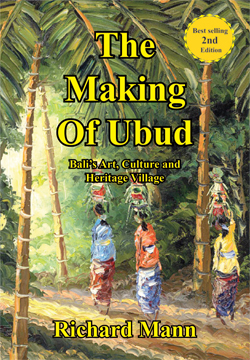
The Making of Ubud Bali’s Art, Culture, And Heritage Village Richard Mann, Gateway Books International, 2013
The Making of Ubud. Ni Wayan Murni is another example of what happened when new elements began to appear in Ubud.
Generations of Murni’s family had worked as farmers on land around Ubud, obedient to the seasons, fulfilling the heavy tasks under the tropical sun but always poor. “We hardly had enough food to eat – coconut, jack fruit, occasionally meat or grasshopper, rice paddy eels and snails, sometimes eggs.”
Even in a poor agrarian society such as Bali there were regular local markets for the buying and selling of produce, household items and farming tools. It was generally the women of the family who attended the market and for generations Murni’s family was no different – she cut her trading teeth at Ubud Market where her mother traded as had her mother before her. Not only that but the whole family lived at the market, sleeping on a grass mat with a small pillow and bathing in nearby streams which today have become obscured by urban development.
But at the time when Murni lived at the market there was a big difference – the times were changing and in addition to the custom of her friends, neighbours and local people, suddenly, miraculously, strange looking foreigners were appearing in Ubud with the money to buy things – tourists looking for souvenirs.
In 1960, Ubud Market was nothing like it is today (under renovation again in 2012). There was a big banyan tree at the front and all around farmers thronged in the early morning to sell their produce (they still do if you get up early enough) and buy essentials for their homes behind ubiquitous mud walls. At the back was a small school and then rice fields stretching unbroken to Monkey Forest.
At night kerosene lamps burned in the family compounds as well as little wooden warungs open ‘til late at the roadside. Murni remembers being taken to the many brilliantly lit and decorated temples where, after devotion, there was often (and still is) dancing and gamelan, wayang puppet shows and a pasar malam or night market (there still is).
In 1960, there was no traffic, not even a bicycle, and in the later afternoon, fresh from bathing in the river, the unsealed, dirt roads were lined with people in bright clothes, laughing together or in groups. Having said that, the little bridge in front of Murni’s was often jammed with ducks, cattle and people.
In the mornings, the women prepared offerings, cooked food over a wood fire and went to market.
Every day Murni helped her mother at the old Ubud Market selling vegetables, rice, sugar, coffee, textiles and sarongs from Gianyar and household goods such as kerosene and plates, which had to be fetched from Denpasar, then a major excursion. Her schooling was only until primary level at Ubud and later at Denpasar so she had plenty of time to learn from her mother. She also learned cooking from her mother’s aunt who had cooked for Walter Spies at Campuhan and later on this skill would stand her in surprising good stead.
As cruise ships began to arrive in the early 1960s, usually at Padang Bai, more foreigners made their way to Ubud by bus. According to Murni, the target was Puri Lukisan, the Palace of Paintings, opened in 1956 as a repository of paintings from the inter-war years which had helped make Ubud and Bali famous – a complete vindication, if one were needed, of the correctness of the strategy of Ubud Palace in giving Ubud its very own tourist object. At Puri Lukisan, visitors can see hanging on the walls the entire spectrum of Balinese life from myths of temple scenes, ceremonies, markets and everyday life. Sometimes the tourists visited the palace itself.
Between 1961 and 1964 when the visitors arrived, little slender Murni wearing a traditional sarong ran to the bamboo bridge leading across a riverine gorge to the Museum from the road and hung up a tempting array of textiles and sarongs supplied by her mother at Ubud market. Since she couldn’t yet speak English, using smiles and sign language she persuaded some of the visitors to buy.
By the mid 1960s a number of beach-side hotels had sprung up at Sanur, usually bungalows beneath the palm trees, and Murni started to cycle more often to the developing resort area to sell more of her mother’s goods, especially textiles and sarongs. She didn’t go every day, just whenever news went round Ubud that Sanur had tourists. The Bali Beach Hotel opened in 1966 attracting more tourists, usually ones with money because it was relatively expensive. As the number of tourists increased again after the opening of Kuta airport in 1969 Murni was able to open not one but three small ‘shops’ along the Sanur beach front.
Business was so good that she moved to Sanur with her husband in 1965 and lived there for a decade until 1974 by which time circumstances had begun to change in Ubud. More guests were making the journey northward and some started to stay there, often at new homestays that were beginning to appear and often, too, in the homes of members of the Ubud royal family, especially the Campuhan Hotel where Walter Spies had once lived.
The day trippers were interested in Puri Lukisan but those seeking to stay longer were interested in experiencing the landscape, the people and the culture of ‘real’ Bali. In the small area of Ubud they could experience the emerald green rice fields, stroll along the steep river valleys, watch farmers at work and feel themselves surrounded by the culture of Bali expressed in tinkling gamelan music, temple ceremonies and the throaty story telling of the Wayang puppet dalang at night in front of the kerosene lamp.
Sanur was comfortable but somehow it wasn’t Bali in the way Ubud seemed to be. At Ubud, too, in the 1970s, they found painters and carvers, alone or in groups, working in the compounds of their traditional homes re-creating a magical world. If ever there was a ‘secret’ Bali, it could be found at Ubud.
Many visitors also strolled west to look at the temple by the two rivers discovered by Maharisi Markandya and the Dutch built a wooden suspension bridge to cross the river. By 1976, Suteja Neka would build an art museum even further west at Sanggingan, attracting even more visitors,
These developments gave Murni her next lucky break. Guests stayed at the Ubud Palace’s Campuhan Hotel, on the other side of the bridge, the only real hotel in Ubud until 1982. They loved to walk into Ubud and on the way often asked Murni for drinks. Murni’s father owned land on the hill next to the bridge and overlooking the River Wos but not close to the river. Luckily Murni was able to lease land right next to the suspension bridge and within one year she bought it.
Separated from her Balinese husband at Sanur, she opened a small warung to provide first drinks and later food for the visitors. At first she learned about food from the tourists, about bread, guacamole, avocado. “strange foods.” She started with one bamboo table, two chairs, an ice box and an important acquisition, a new American husband, Pat, who taught her about soup, sandwiches and ice cold beer.
This was 1974 and the start of Ubud’s iconic Murni’s Warung, one of the first restaurants in Ubud. Murni also added fried rice and noodles to the menu setting up one extra table every week as more and more guests dropped by. By 1978, when electricity arrived at Campuhan, she could serve cold beer from a refrigerator.
Everyone moving east to west or vice versa had to pass Murni’s even the ducks and cows and local people with loads on their heads and even bare breasted girls (the painting shows it all). What more could the tourists ask!
But they did. Visitors asked for books about Bali and so when the Warung had become an enclosed restaurant Bali style, built from bamboo, Murni set up a glass book case in the centre – where I first foud many Bali classics such as Vicki Baum’s A Tale from Bali.
Murni’s was also used as a ‘post office’, at which travellers left and picked up messages, adding again to its usefulness and appeal.
Murni always loved antiques and handicrafts and after she became Ubud’s first woman driver in 1978, she drove everywhere looking for the best quality antiques, handicrafts and batik. During the 1980s whatever she bought she could sell in a single day. Times were good.
From selling at Puri Lukisan, at the beach at Sanur and then opening one of Ubud’s first restaurants, still today one of Ubud’s tourist attractions, Murni, the girl with little education and little money has become a successful restauranteur, a dealer in antiques with shops in Ubud and international sales via the internet and trade shows around the world, owner of holiday houses and villas for rent to tourists in and around Ubud and also a luxury spa close to the Warung. All this has been the gift of tourism.
Like everyone, Murni says tourism has its pluses and minuses, but that despite the loss of rice fields for development, on balance, she feels that with all its busy-ness and stress and pressure on time, life in Ubud is still good.
Murni’s success secrets Intan Tanjung The Jakarta Post 21 August 2013
She has hosted top celebrities from David Copperfield, Richard Gere to Richard Branson but Ni Wayan Murni finds comfort outside the spotlight simply by being herself.
Her hair is mostly grey now but it’s hard to miss the grace and spirit that sparkles in the woman’s eyes, now in her late 60s.
I used to cycle all the way from Ubud to Sanur and then Kuta to sell Balinese batik clothes, recalled the woman, fondly known as Murni, who arrived in her Balinese kebaya blouse.
It was a long way but at that time there wasn’t any traffic at all, she added, while sitting comfortably in her legendary restaurant, Murni’s Warung, in Ubud, Bali.
Just like Ubud, which has grown from a sleepy town to a bustling city, her business has expanded fast from when she started it in the 1970s. She is now known as one of Bali’s most successful businesswomen.
Apart from Murni’s Warung, which continues to attract high-profile clientele who cannot wait to taste her signature recipes such as Balinese Smoked Duck or Sweet Sour Shrimp, she has launched several other businesses, from a villa to a spa.
But the restaurant was not her first venture.
Ever since she was young, Murni has been working hard, selling sarongs to tourists at Sanur Beach.
After commuting on her bicycle for three years, she then settled in Sanur for 10 years, getting married and tending to her small shop on the beach from where she sold items to people including then president Sukarno and legendary frontman Mick Jagger, who she claimed she did not recognize at that time.
When her marriage ended, Murni returned to Ubud, opening a small shop where she sold Balinese clothing in early 1974, located near the old Campuhan suspension bridge.
It was in that shop where she met an American tourist who she would go on to marry. They were married for 36 years before he passed away three years ago.
The story of Murni’s Warung began when she made her husband soup and a sandwich for lunch at her shop. Tourists who visited her shop later asked if they could have what her husband was having giving her the idea of opening a restaurant in the town.
Eating at restaurants wasn’t part of our culture back then. There weren’t any restaurants around, people only sold Balinese food in Ubud market, Murni says.
Since many tourists from Tjampuhan Inn [now Tjampuhan Hotel] asked for the food, the idea to set up the restaurant came to mind.
Murni’s Warung was soon born. Within one year, she had six tables and expanded quickly.
But the sweet taste of success did not come easy. Murni had to go to another town to buy ice blocks for cold beer and coke for her customers and later cycled to Denpasar to buy groceries to keep the restaurant going.
Slowly but sure, she kept adding more western dishes to the menu, selecting customer favorites.
Her limited knowledge of western food did not stop her from trying to please her diners, although at that time, she could only make simple dishes since there was no electricity in town yet.
Fortunately, many of her customers, who became friends with her, were willing to share their secret recipes. To return the favors, she named the dishes after them.
By the time electricity reached the town in 1978, she had already learned how to prepare a variety of food and beverage items, including homemade ice cream.
Murni still remembers how her early ice cream creations were ruined when power outages lasted for 30 hours at a time. I was so disappointed because I had just learned to make it and it took so much work, she laughed.
Murni’s Warung has drawn the attention of both tourists and expats, such as artists Arie Smit and Antonio Blanco, who used the place as a meeting point.
Soon, people dropped postcards and mails to her warung to be picked up later by postmen since Ubud’s post office only operated for certain period of time.
Tourism in Ubud dramatically increased after the Campuhan bridge was built in the 1980s.
At the same time, Murni did business in antiques, jewelry, textiles and souvenirs.
She opened two antiques shops in Ubud in the 80s and 90s to accommodate her passion of collecting one-of-a-kind artifacts and fine textiles. Although she is no longer in control of those shops, Murni said that she still displays her best collections at Murni’s Warung Shop.
Her antiques drew extensive interest from customers.
A piece from her giant barong collection was bought by the American Museum of Natural History in New York. She had also exhibited her collection at the prestigious Arts of Pacific Asia and Tribal Arts and Textiles Shows in San Francisco. She has also discussed Balinese textiles at the de Young Museum in San Francisco.
Her restaurant, which was also given a new look in the 1980s and renovated in 1991, is still bustling with customers despite the presence of an increasing number of restaurants.
Murni also entered the property business with Murni’s Houses in downtown Ubud and the luxurious Murni’s Villas located on the road to Kintamani.
Three years ago she opened Tamarind Spa, which offers Balinese massages with a serene garden view and waterfall.
Her latest venture was co-authoring two books with Jonathan Copeland — the bestseller Secrets of Bali and Murni’s Very Personal Guide to Ubud.
Copeland and two other writers are currently putting together a book, entitled Forty Delicious Years, to celebrate 40 years of Murni’s Warung next year and have invited Murni’s friends to contribute memories about Murni on her website.
Despite her success, Murni is still the woman she used to be the mother of five and grandmother of 12 who loves to laugh and talk to people around her.
She also values the loyalty of her staff, retaining those who have been with her through the highs and lows since she first opened the restaurant.
My recipe for success is to just be myself. I like people, I like to talk. I made a business for myself but I share with people. It just happened like that.
Bali Soul Journals Clare McAlaney and Trish McNeill Creatavision Publishing, 2015
I imagine Murni in 1960, pigtails flying as she squeals with excitement dodging dogs and other bicycles on her travels through Bali. A farmer turns and smiles as she holds up a golden hand that stretches upwards to a cloudless, sapphire blue sky.
Back home, her mother stands before a temple in the shade of a banyan tree, as the gamelan echoes over the hills of Ubud. She has an offering in her hand and she bows her head towards it, gently wafting the smoke of the incense toward the temple.
Murni chats with the weavers who make a healthy living from the visits of a teenage girl. Later, the aroma of roasted pig brings people shuffling quickly in bare feet to her village. Amidst the chatter of women, she will help prepare the intricate baskets that carry offerings for the gods. The balance in Bali of mind, body and spirit is given a place in time and a reverence that is symbolised by the tok tok tok sound of the wooden kulkul coming from the temple.
I watch her with my mind’s eye as she grows into a beautiful young woman with the experience of a trader and the courage of an explorer.
Her village gratefully transforms to accommodate a growing number of visitors.
It opens its centre, and quietly, and with more speed, they come. As money flows from the hands of tourists to outstretched brown palms, life begins to change, needs begin to change. Education – maths, language, hospitality – becomes a priority.
And I see Murni today, a graceful lady with hair that has long since turned white, and smooth cheeks that ripple when she laughs. I see her painful image of an island being lost to gold, and sit down at my desk and begin to type.
Excerpt from Journal XIV: The Spirit of Bali, Bali Soul Journals
Bali Souls Journals is available for sale from Murni’s Waung Shop.
Murni’s Warung remains an Ubud icon 40 years since it was established, with fans crediting its founder as the heart of the place and even of Ubud.
She is often referred to as the “mother of Ubud,” and her restaurant has been a longtime favorite among both travelers and locals: Ni Wayan Murni, a Bali native who recently celebrated the 40th anniversary of Murni’s Warung with the launch of a book that includes personal memories and anecdotes of people who have accompanied her on her journey from the 1970s until today.
Author and photographer Jonathan Copeland, co-editor of “Forty Delicious Years,” as well as a good friend of Murni, said that it felt right to celebrate this milestone “in a more tangible way than simply a T-shirt and party.”
“We didn’t want a book blowing our own trumpet — there are enough of those vanity publications around — but instead a book focussing on the times and life of Murni’s Warung as seen through the eyes of its guests over 40 years,” he said. It is an approach that gives readers the chance to learn more about Murni and also about Ubud and Bali in general, and particularly how significantly it has changed over the years.
The first thing that needed to be done was to decide on the number of contributors; 40 contributor for 40 years was the logical solution.
“We then compiled a list of colorful, engaging and interesting characters whom we thought we could contact,” Copeland said. “We went through the time-consuming process of trying to track them down. Some were easy to locate but some were impossible to find. We were delighted with the final list as they comprised a wide range of nationalities, occupations and ages which cover the life of Murni’s Warung from day one until the present. They are all busy people with big jobs and we are very grateful for the time they spent on this.”
Murni, who was born in Penestanan, just a few minutes away from Ubud, began selling breakfast snacks before going to school in the 1950s. Less than 20 years later, Murni already owned four shops on Sanur Beach and established Murni’s Warung in Campuhan-Ubud.
Besides traveling the world and collecting Asian antiques and textiles, Murni built Murni’s Houses and Murni’s Villas catering to the growing number of tourists, and recently opened the Tamarind Spa at Murni’s Houses.
In the book, Murni writes that she still finds it incredible to look back at how she started Murni’s Warung — with no more than a bowl of soup and a sandwich.
“I wasn’t a cook and had no knowledge of what Western food was. I had no business plan, no mission statement, and no spreadsheets. I didn’t have electricity or a fridge or an electric oven. I didn’t have staff or suppliers or a car,” she said. “But I did have passion and drive and energy. And I had friends and customers and hard work. Luckily, Murni’s Warung grew and prospered and has been able to serve food and drinks to thousands of people these 40 years.”
Murni also has a very special connection to the restaurant’s location on a gorge above the river Wos, which is sacred to the Balinese people.
“It has been part of my life, going back more than 40 years,” she said. “When I was a very young child I played and bathed down there at the river and among the rocks. When I was older, I helped carry rocks up from the river bed to the road for construction use. Later still, after my parents split up, I secretly met my mother below the bridge. I never dreamed that I would be able to buy part of the gorge, live there and go to sleep to the sound of the sacred river crashing over the rocks.”
Copeland, who has worked with Murni on three previous publications, said that not many people can survive in the highly competitive F&B industry, especially these days, when new restaurants pop up everywhere in Bali.
“Restaurants often start out as flavor of the month and fizzle out,” he said. “It is not an easy business and diners are demanding and unforgiving customers who don’t give you a second chance.
“I think it’s easy, in retrospect, to see how Murni’s early success came about,” he added. “In the early days there simply wasn’t a place in Ubud to get good food. Murni’s Warung was a beacon for early travelers to hang out. They spread the word and they still do. But obviously there had to be substance to it. I think the substance is what has made Murni’s Warung remain a favorite for so long. Murni is a perfectionist. She is very concerned about the comfort and happiness of her guests. And she is a traditionalist concerned about the preservation of Balinese culture. Murni’s Warung is a Balinese building with Balinese food served by Balinese waitresses in Balinese dress.”
Dr. Lawrence Blair, an anthropologist, author and filmmaker who has been based in Bali for almost 40 years, was among the warung’s earliest customers and still vividly remembers a quiet Ubud.
“Instead of tourists, there were only a few ‘travelers’ and barely a handful of eccentric resident expats,” he writes in his section in the book. “And the place to meet them was Murni’s Warung. But the first real draw to Murni’s was the discovery that hers was the sole place in Ubud to have mastered that most rare and esoteric art of producing a sunny-side up properly fried egg. Further cause for enthusiasm was when she also became the first person in Ubud to provide natural yoghurt and wild honey with one’s tropical fruit.”
Blair was also witness to some of the illustrious figures who have visited Murni’s Warung over the years, including Richard Branson, Mick Jagger, Richard Gere and Diane Von Furstenberg.
“My only regret is that they weren’t all there at the same time,” Blair wrote.
Australian-born Janet de Neefe, founder of the Ubud Writers and Readers Festival, has also been a regular to Murni’s since the 1980s.
“Many of my fondest memories of Ubud in the Eighties are wrapped up in the walls of this multi-leveled eatery,” she writes in the book. “We’d sip on freshly squeezed lime drinks brimming with crushed ice while slowly eating nasi campur or nasi goreng . Lunchtimes drifted into dinner and it didn’t matter. There was nothing urgent to be done except chat about life, love and cosmic heroes — there were no mobile phones, Internet, e-mails, reality TV, not even Facebook.”
De Neefe, like the other contributors, have always enjoyed the peaceful surroundings as much as the delicious food. But they also all agree that Murni, the heart and the soul of the restaurant — some might even argue, of Ubud — has always been the real draw and the secret of the restaurant’s lasting success.
“Back then, I remember that one of the greatest joys about visiting Murni’s Warung was simply Murni,” de Neefe said. “She used to sit at the front desk and invariably wander up to your table and have a chat. There is so much to love about Murni. Whether it be her heart that’s as big as the moon, her gentle nature, grace or soft humor.”
Murni’s Bali Tours, Murni’s Very Personal Guide to Ubud, Forty Delicious Years, Secrets of Bali and From Tattoos to Textile
It’s not unusual that Ni Wayan Murni – hotelier, restaurateur, art collector, textile expert, blogger – has just published her 5th book. Everything about Murni and her wide range of interests is unusual.
All of this woman’s activities link together, each emerging out of one another. Her literary output is no exception. Murni has written and co-authored five books as well as numerous articles on Balinese art and culture. The majority of photographs in her books were contributed by the accomplished, well known Bali photographer Jonathan Copeland.
Ni Wayan Murni, born in Penestanan, is a well known and much loved personality on the Bali scene and a pioneer of Balinese tourism. During her extraordinary life Murni has lived in Sanur and Ubud and has travelled over the globe. By the early 1970s she owned four shops on Sanur beach and had opened Ubud’s first real restaurant, Murni’s Warung, overlooking the Campuan River. Many thousands of people have enjoyed her food and hospitality. Both amateurs and professionals have learned from her experience collecting and writing about the Southeast Asian arts. But far from letting all her notoriety go to her head, Murni has shown a longstanding dedication to her community, family and local temples. She actively participates in banjar activities, plays in a women’s gamelan group at important religious ceremonies and takes part in cultural events.
When guests asked Murni for advice on where to go or what to do in Ubud or on what to buy, those inquiries gave birth to Murni’s Very Personal Guide to Ubud. Written by a native Ubud resident – the village of her birth – this eBook selling for only around Rp25,000 is kept up to date more easily than a printed guidebook. Being digital, it can easily be carried around on your portable iPhone, iPad, Android or Kindle. In a sense, Murni has been researching this eGuide all her life, confiding with her guests what businesses she likes to patronize; what arts and crafts, courses, cultural sites and secret places she recommends and what galleries she supports.
This 120-page guide, with its detailed descriptions and insightful observations, is all you need to experience the very best of what Ubud has to offer.
Forty Delicious Years, Murni’s Warung 1974–2014: From Toasted Sandwiches to Balinese Smoked Duck, published in 2014, was a natural outcome of the 40th anniversary of Murni’s Warung when Murni presided over the book’s launch, spoke and signed copies. This book tells the story of one of Bali’s most enduring culinary landmarks from its beginnings as a humble roadside stall on the side of a river gorge to become an institution. Narrated by some of the warung’s eclectic and most intriguing patrons, with a preface by Murni herself, the collection of vignettes, anecdotes and testimonials makes easy and immensely enjoyable reading.
It applauds all that is worthwhile in life – good food, gracious hospitality, shared laughter and the warm company of friends. The reminisces are especially compelling from the perspective of its 40 famous contributing authors, artists, scholars, adventurers and notable long-time Bali expats. The book was edited by Jonathan Copeland, Rob Goodfellow and Peter O’Neill. Bring your copy to the restaurant, or get it there, and Murni will sign it.
Murni’s fine arts credentials are impeccable. During her adult life she has passionately dedicated herself to collecting Asian antiques and textiles. Munri was the first person in Ubud to establish a proper gallery of antiques, textiles, costumes, old beads, tribal jewelry, stone carvings, masks and other ethnic pieces. Many of these unique museum quality artifacts are to be found in Murni’s Warung Shop beside her restaurant. In the course of pursuing her hobby, she has become an acknowledged authority.
The idea for From Tattoos to Textiles, Murni’s Guide to Asian Textiles, All You Need to Know … And More, was conceived during the course of an exhibition of Murni’s collection of Asian antiques and textiles in San Francisco in 2007 at the prestigious Arts of Pacific Asia and Tribal Arts & Textiles shows. In 2009, the textile curator at the de Young Museum invited her to come back to San Francisco to lecture on Balinese textiles before the Textile Arts Council at the museum, which she did following her second exhibition in San Francisco. This gave rise to a much-expanded and more wide-ranging written version of the lecture that includes many additional photographs of selected pieces from Murni’s personal collection.
Her latest publication Murni’s Bali Tours, Where to go, What to Do and How to Do It is an eBook of seven tours written and designed for guests staying at Murni’s Houses. Tours of Bali routinely offered by travel agents and drivers haven’t really changed for decades, even though there are now numerous exciting new places to visit. Again, this book sprang out of a need to serve her many guests who expressed an interest in going to unusual off the beaten track places, more preferable than the run of the mill destinations that drivers often recommend. Guests also wanted clear, helpful and accurate information about both classic and untouristed places, which many drivers aren’t able to do. This new must-take eBook (Rp100,000 or free for guests staying at Murni’s Houses who book a tour) focuses on a whole set of fresh destinations away from the mainstream such as the Sukarno Center, Pura Gunung Raung and the rice terraces at Ceking that are less overrun than the ones at Tegalallang.
Each tour covers a range of interests, so whether you are a temple lover, an art aficionado or a history buff there is something for you. Some wonderful short walks, scenic treks, selected art galleries, chocolate and ceramic factories, a strawberry farm and a visit to Bali’s youngest priestess have also been included. Stunning slideshows and photographs of each tour, taken by Jonathan Copeland, are viewable on YouTube
Secrets of Bali, Fresh Light on the Morning of the World, co-authored with Jonathan Copeland, was published by Orchid Press in 2010. This comprehensive account of Bali’s history and culture arose from questions that guests staying at Murni’s Houses asked her to explain. The persistence of inquiries gave her the idea of researching specific subjects in more detail and putting it all down on paper so that it was available for everyone.
The book offers succinct and wide ranging information about Balinese life, religion, festivals and offerings, architecture, music, dance, textiles, dress, carvings and paintings, manuscripts and food. Secrets of Bali is not a guidebook per se, but a valuable and authoritative reference source as well as an entertaining read for the visitor, scholar and Bali aficionado. Encyclopedic in its coverage, the result of prodigious research, difficult subjects from the sublime to the arcane are simply explained in this well written and up to date work which will reveal a great number of facts and misconceptions that are little known to even long-term residents of Bali.
Bill Dalton, Toko Buku Bali Advertiser 17 February 2016- 2 March 2016
Ubud is world famous for dance performances – legong (virgins), kecak (monkeys), jegog (girl and boy), barong (lion) – gamelan music – and shadow puppets.
Balinese Dance Performances.
Some of the best dance performances are in the magnificent Pura Dalem temple just a minute’s walk from Murni’s Houses. We can arrange tickets for guests.
SUN
Legong Dance
Ubud Palace
7.30
Kecak and Fire Dance
Padang Tegal
7.00
Wayang Kulit Shadow Play
Oka Kartini, Ubud
8.00
Pendet, Legong Lasem, Oleg, Cockfighting and Baris Dances*