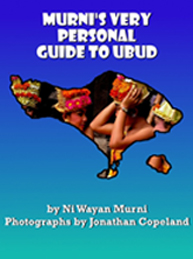
When guests asked Murni for advice on where to go or what to do in Ubud or on what to buy, those inquiries gave birth to Murni’s Very Personal Guide to Ubud.
Written by a native Ubud resident – the village of her birth – this eBook sells for only US$2.99 .
Being digital, it can easily be carried around on your portable iPhone, iPad, Android or Kindle.
In a sense, Murni has been researching this eGuide all her life, confiding with her guests what businesses she likes to patronize; what arts and crafts, courses, cultural sites and secret places she recommends and what galleries she supports.
This 120-page guide, with its detailed descriptions and insightful observations, is all you need to experience the very best of what Ubud has to offer. Start reading Murni’s Very Personal Guide to Ubud in under a minute
Island of Bali, Miguel Covarrubias, Oxford University Press, 1972
Kinship in Bali, Hildred Geertz and Clifford Geertz, University of Chicago Press, 1975
Negara, The Theatre State in Nineteenth-Century Bali, Clifford Geertz, Princeton University Press, 1980
The Balinese, Hugh Mabbett, January Books, 1985
The Interpretation of Cultures, Selected Essays, Clifford Geertz, Fontana Press, 1993
The Balinese, J. Stephen Lansing, Harcourt Brace College Publishers, 1995
The Peoples of Bali, Angela Hobart, Urs Ramseyer and Albert Leemann, Blackwell Publishers, 1996
To Change Bali, Essays in Honour of I Gusti Ngurah Bagus, edited by Adrian Vickers and I Nyoman Darma Putra with Michele Ford, Bali Post, Denpasar in association with the Institute of Social Change and Critical Inquiry University of Woollongong, 2000
Archaeology
Monumental Bali, Introduction to Balinese Archaeology and Guide to the Monuments, A.J. Bernet Kempers, Periplus Editions, 1991
Architecture
Architectural Conservation in Bali, Eko Budihardjo, Gadjah Mada University Press, 1986
The Traditional Architecture of Indonesia, Barry Dawson and John Gillow, Thames and Hudson, 1994
Arts
The Art and Culture of Bali, Urs Ramseyer, Oxford University Press, 1986
Bali Style, Rio Helmi and Barbara Walker, Times Editions, 1995
Autobiography
The Night of Purnama, Anna Mathews, Oxford University Press, 1965
Tjokorde Gede Agung Sukawati, Ubud, 1910 – 1978, Autobiography as dictated to Rosemary Hilbery, Mabhakti, Bali, 1983
Our Hotel in Bali, Louise G. Koke, January Books, 1987
The Birthmark: Memoirs of a Balinese Prince, A.A.M. Djelantik, Periplus Editions, 1997
A Little Bit One O’clock, Living with a Balinese Family, William Ingram, Ersania Books, 1998
Ceremonies
Seven Plus Seven: Mysterious Life-Rituals in Bali, Katharane Edson Mershon, Vantage Press, New York, Washington, Holywood, 1971
Ceremonies in Bali, R.M. Moerdowo, Bhratara Publishers, Jakarta, 1973
Once a Century, Pura Besakih and the Eka Dasa Rudra Festival, David J. Stuart Fox, Penerbit Citra Indonesia, 1982
Cookery
Indonesian Food and Cookery, Sri Owen, Prospect Books, 1986
The Rice Book, Sri Owen, Doubleday, 1993
The Food of Bali, Heinz von Holzen and Lother Arsana, Periplus Editions, 1993
Indonesian Regional Food & Cookery, Sri Owen, Doubleday, 1994
Classic Asian Cook Book, Sri Owen, Dorling Kindersley, 1998
Communities
Adat and Dinas, Balinese Communities in the Indonesian State, Oxford University Press, 1993
Dance
Dancing out of Bali, John Coast, Faber and Faber, 1954, reprinted, Periplus Classics, 2004
Gardens
Flowers of Bali, Fred and Margaret Eiseman, Periplus Editions, 1988
Fruits of Bali, Fred and Margaret Eiseman, Periplus Editions, 1988
Balinese Gardens, William Warren, Periplus Editions, 1995
Guide Books
Knopf Guide Bali, 1996
Bali Insight Guide, Garrett Kam and Debe Campbell, Apa Publications, 1988
Insight Pocket Guide, Bali, Hans Hoefer and Made Wijaya, Apa Publications, 1998
Bali & Lombok, Lonely Planet Publications, James Lyon, 2001
The Natural Guide to Bali, Equinox Publishing, Anne Gouyon, 2005
History
Bali Profile: People, Events, Circumstances (1001-1976), Willard A. Hanna, American Universities Field Staff, 1976
The History of Java, Thomas Stamford Raffles, AMS Press, 1983
In Praise of Kuta, Hugh Mabbett, January Books, 1987
The Indonesian Killings of 1965-1966, Studies from Java and Bali, Robert Cribb, Monash Papers on Southeast Asia, no. 21, Clayton Victoria, 1990
Bali at War: A History of the Dutch-Balinese Conflict of 1846-49, Alfons van der Kraan, Monash University, 1995
Nathaniel’s Nutmeg, Giles Milton, Sceptre, 1999
Southeast Asia, An Introductory History, Milton Osborne, Allen & Unwin, 8th Edition, 2000
A Short History of the World, Geoffrey Blainey, Penguin Books Australia, 2000
The Seven Daughters of Eve, Bryan Sykes, Bantam Press, 2001
Masks
Masks of Bali: Spirits of an Ancient Drama, Judy Slattum, Chronicle Books, 1992
Music
A House in Bali, Colin McPhee, Oxford in Asia, 1972
Balinese Music, Michael Tenzer, Periplus Editions, 1991
Novels
Twin Flower, A Story of Bali, G.E.P. Collins, Oxford University Press, 1934
A Tale from Bali, Vicki Baum, Oxford University Press, 1937
The Year of Living Dangerously, Christopher J. Koch, Michael Joseph, 1978
The Painted Alphabet, Diana Darling, Houghton Mufflin Company, 1992
The Butterflies of Bali, Victor Mason, Periplus Editions, 1992
Bali Behind The Seen, Recent Fiction from Bali, Vern Cork, Darma Printing, 1996
The King, the Witch and the Priest, A 12th century Javanese tale, Pramoedya Ananta Toer, Equinox Publishing, 2002
Offerings
Offerings, The Ritual Art of Bali, Francine Brinkgreve, Image Network Indonesia, 1992
Painting
Walter Spies and Balinese Art, Hans Rhodius and John Darling, Tropical Museum, Amsterdam, 1980
Balinese Paintings, A.A.M. Djelantik, Oxford University Press, 1986
Neka Museum, Guide to the Painting Collection, Yayasam Dharma Senii, Museum Neka, 1986
Perceptions of Paradise, Images of Bali in the Arts, Garrett Kam, Yayasan Dharma Seni, Museum Neka, 1993
Images of Power: Balinese Paintings made for Gregory Bateson and Margaret Mead, Hildred Geertz, University of Hawaii Press, 1995
Photographs
Bali 1912: Photographs and reports by Gregor Krause, Hugh Mabbett, January Books, 1988
Bali: The Imaginary Museum, The Photographs of Walter Spies and Beryl de Zoete, Michael Hitchcock and Lucy Norris, Oxford University Press, 1995
Poetry
The Morning After, Poems about Bali by Bali’s major poets, Venn Cork, Dharma Printing, 2000
Politics
The Dark Side of Paradise, Political Violence in Bali, Geoffrey Robinson, Cornell University Press, 1995
The Politics of Indonesia, Damien Kingsbury, Oxford University Press, 1998
Suharto, Indonesia’s Last Sultan, Keith Loveard, Horizon Books, Singapore, 1999
Indonesia, An Eyewitness Account, Michael Maher, Viking, 2000
Jakarta Jive, A Story of Survival in a City of Upheaval, Jeremy Allan, Metafor Publishing, 2001
Psychology
The Balinese People: A Reinvestigation of Character, Luh Ketut Suryani and Gordon D. Jensen, Oxford University Press, 1992
Trance and Possession in Bali, Luh Ketut Suryani and Gordon D. Jensen, Oxford University Press, 1993
A Psychiatrist in Paradise, Denny Thong, White Lotus, 1993
Religion
The Mango Tree Church, The Story of the Protestant Christian Church in Bali, Douglas G. McKenzie in association with Bishop I. Wayan Mastra, Boolarong Publications, 1988
Bali: Sekala and Niskala: Essays on Religion, Ritual and Art, Fred B. Eiseman, Periplus Editions, 1989
Priests and Programmers: Technologies of Power in the Engineered Landscape of Bali, J. Stephen Lansing, Princeton University Press, 1991
Guidebook for Balinese Prayer, Terry Satterthwaite and Ketut Rusni, Wholistic Creations, 1996
Temples
Balinese Temples, Julian Davison and Bruce Granquist, Periplus Editions, 1999
Textiles
Balinese Textiles, Brigitta Hauser-Schaublin, Marie-Louise Nabholz-Kartaschoff and Urs Ramseyer, British Museum Press, 1991
Tourism
Bali, A Paradise Created, Adrian Vickers, Periplus Editions, 1989
Bali, Cultural Tourism and Touristic Culture, Michel Picard, Archipelago Press, 1996
Travelling
Travelling to Bali, Four Hundred Years of Journeys, Adrian Vickers, Oxford University Press, 1994
Wayang Kulit: shadow puppets
Wayang: Its Significance in Indonesian Society, R.M. Moerdowo, Balai Pustaka, Jakarta, 1982
Dancing Shadows of Bali, Theatre and Myth, Angela Hobart, KPI, 1987
Woodcarving
Woodcarvings of Bali, Fred and Margaret Eiseman, Periplus Editions, 1988
Adat: customary law
Angklung: ancient bamboo percussion instrument, used in orchestra, having only 4 notes
Arak: strong spirit distilled from the sugar palm
Awig-awig: basic constitution of a group, usually written on lontar palm leaf manuscripts
Bade: cremation tower
Bale: open air pavilion
Balian: Balinese herb doctor
Banjar: hamlet
Banten: religious offering
Bebek betutu: smoked duck
Besakih: the chief mother temple on Mount Agung
Betel: nut of areca palm, pink inside, chewed with leaf of sireh vine, damar gum and lime paste
Brahman: the highest of the four castes
Brem: sweet white or pink rice wine
Cokorda: the title of the king or prince
Dadia: preferentially endogamous patrilineal kin group
Dalem: literally, “within” often used to refer to a paramount lord or “king,” his residence, court, or family
Desa: village
Desa Adat: a local community defining a sacred space and governed by one set of customary laws
Dewa: God
Dewi: Goddess
Dugul: small altar, usually of stone, for offerings to the gods
Gamelan: Indonesian generic term for orchestra
Gangsa: metallophone, ie metal keys strung like a xylophone over framed bamboo resonators
Gede: big, large, great, eg, Puri Gede, Jero Gede
Gelgel: 14th century Balinese kingdom, the primary exemplary state of Bali, founded by Javanese lords and priests, and the kingdom from which other major Balinese kingdoms broke off
Gong: literally means orchestra eg Gong Peliatan means the orchestra from Peliatan village; but also gong in the English sense
Gong Gede: full Kebiar orchestra, like a symphony orchestra
Griya: Brahman priest’s residence
Guru: teacher
Halus: refined, civilized, polite, graceful
Jaba: literally “outside”, used to indicate relatively lower status and greater distance from the centre, so a general term for the fourth caste, the Sudras
Jero: literally “inside” used often as a title to indicate a higher status and closeness to the centre and a general term for the three highest castes, for the world of the court and residences and households of lords
Jero Gede residence and household of a major lord; the major lord himself
Kahyangan: great temple
Kahyangan Tiga: the three main village temples: Pura Puseh, Pura Dalem and Pura Desa
Kain: batik cloth, worn by men and women, waist down
Kasar: unrefined, crude, impolite, ungraceful, rough
Kendang: Indonesian word for drum
Kepeng: bronze or lead Chinese coin with a hole in the middle used as a currency formerly and for offerings
Kulkul: wooden drum to summon villagers
Lalang: tall fibrous grass used for thatch
Lawar: Balinese dish of grated, spiced raw meats
Leyak: witch or spirit, generally a blood-sucking, flame-dripping female monster
Lingga: phallic image, symbol of Siwa
Lontar: palm leaf manuscript
Majapahit: 14th century Javanese kingdom considered by the Balinese to be the origin of their civilization and culture
Mecaru: religious cleansing ceremony
Meru: Holy Hindu mountain, the abode of the gods, also a temple pagoda-style roof
Metatah: tooth filing
Moksa: ascending to heaven after death without leaving the corpse
Mudra: sacred hand gesture used in rituals
Negara: state, realm, capital, court
Odalan: anniversary temple ceremony
Padi: rice growing in a field
Paras: sandstone, sold in slabs, used in building temples and for stone carving
Pedanda: Brahman high priest
Padmasana: lotus seat, the throne of the Supreme God
Pemakesan: a temple congregation, responsible for the temple’s upkeep, and worshipping the gods when they descend
Pemangku: a Sudra priest
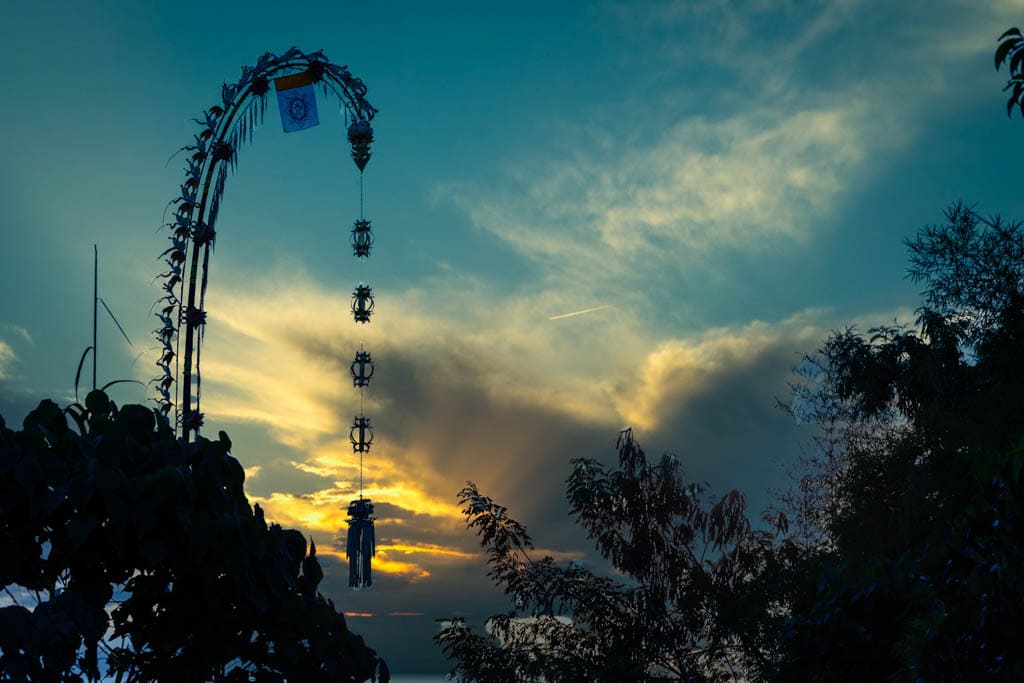
Penjor: a bamboo pole, highly decorated
Perada: gold paint, liquid or leaf
Punggawa: a lord
Puputan: literally an “ending”, the ritual suicide to mark the end of a dynasty
Pura: temple
Pura Bale Agung: great council templ, village temple dedicated to fertility of the land and people of a customary law community
Pura Dalem: village temple of the dead
Pura Penataran: courtyard temple dedicated to enhancing the unity and prosperity of the area
Pura Puseh: “Navel Temple”; village temple dedicated to founding ancestors
Pura Ulun Carik: “Head of the Ricefields Temple”; irrigation society temple
Puri: lord’s residence, palace, household
Puri Gede: the palace and household of a paramount lord
Rebab: 2-stringed violin
Sad Kahyangan: the six Great Temples; all Bali temples dedicated to the prosperity of the island and its people as a whole
Salak: astringent fruit with a snake-like skin
Sarong: non-batik cloth used for the same purposes as a kain, but the ends are sewn and the wearer steps into it
Satria: the second highest of the four castes
Sakti: spiritual energy, charisma; the dynamic aspect of a deity
Sawah: rice field
Sebel: unclean ritually
Siwa: one of the three most important of the Hindu gods in Bali identified with the Sun
Subak: irrigation society
Sudra: the lowest of the four Balinese castes
Suling: bamboo flute
Surya: the Sun identified with Siwa
Tirta: holy water prepared by Brahman priests
Triwanga: literally the three peoples, the three upper castes, considered as a group against the fourth
Tuak: palm toddy
Wargi: relationship between two kin groups of unequal status established by the giving of a wife from the lower status group to the higher
Wesia: the third ranking of the four castes
Wong: human being
In 1972, there was a change in the spelling of Indonesian words. The most important differences were c for tj (Campuan rather than Tjampuan), j for dj (banjar rather than bandjar) and y for j (Yogyakarta rather than Jogjakarta).
Balinese temple dress, which is called adat dress, is not a matter of choice, nor is it a fashion statement. It is a symbolic gesture with a function. It is compulsory attire for everyone for the temple.
Divine origin
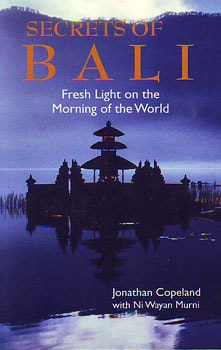
As with nearly everything in Bali, dress has a divine origin. According to manuscripts, Brahma created the world and then he created people. They were naked. Read more about it in Secrets of Bali.
Chakras
Chakras are energy centres in our bodies. It is believed that certain emotions and desires are associated with each chakra. The purpose of adat dress is to control some of these desires and to focus attention on a higher purpose. Adat dress therefore symbolically and functionally harnesses the lower instincts.
Formal Dress
The Balinese wear their finest traditional clothes for the temple. They consist of lengths of cloth draped, wrapped or tied around the body. Read more about it in Secrets of Bali.
Relationship between chakras and formal dress
There are six chakras of the body that are controlled by Balinese formal dress. They are:
“The third eye” (ajna)
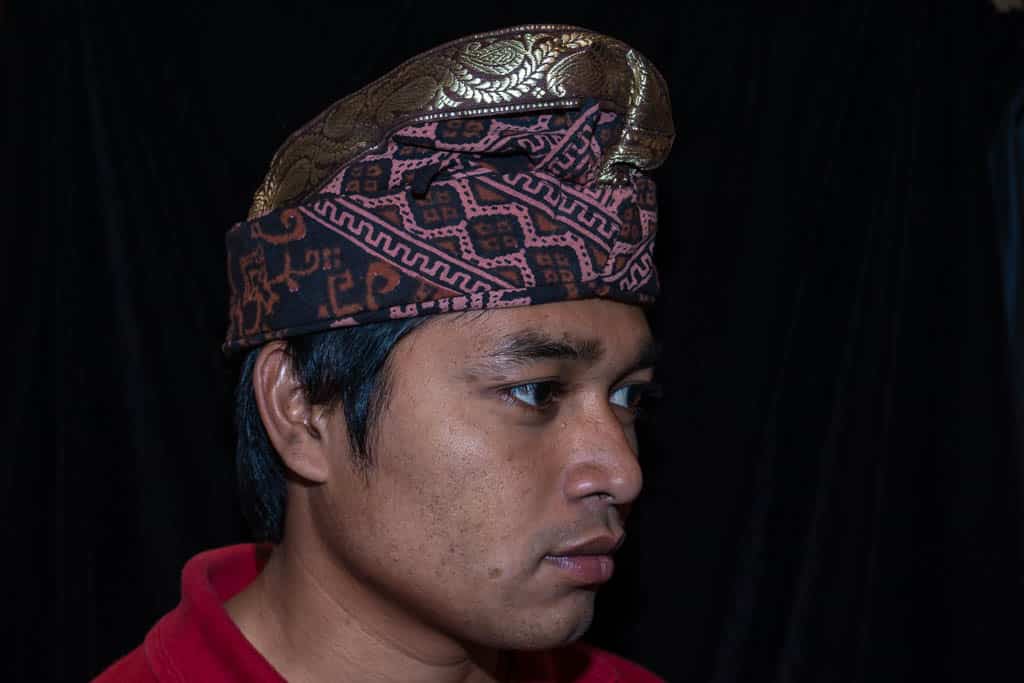
Balinese Udeng Headdress.
located in the pineal plexus, connected to pure energy or spirit, is associated with enlightenment. The purpose of a man’s udeng is to tie and focus his consciousness to this point of utter purity and distinguish it from all other personal desires, which hold a person down. Many women wear a white headband for a similar purpose. Balinese Udeng Headdress are available to buy in Murni’s Online Shop here.
The throat (vishuddha)
located in the crotid plexus, connected to the ether, is associated with knowledge, wisdom and understanding. This area remains open and flows freely.
The heart (anahata)
Kebaya.
The heart is located in the cardiac plexus, connected to the air, is associated with sharing, love, devotion, selfless service and compassion. It is above the boundary created by the selendang and although it is covered by a shirt or kebaya is open and flows freely.
The navel (manipura)
located in the solar plexus, connected to fire, is associated with immortality, longevity, fame, power, authority and wealth. These desires are harnessed by the selendang.
The genitals (svadhisthana)
located in the hypogastric plexus, connected to water, is associated with family, procreation, sexual urges and fantasy. These instincts are harnessed by the saput and sabuk.
The perineum (mulhadhara)
located in the pelvis plexus, connected to earth, is associated with being grounded, security, physical comforts, basic biological needs and shelter. These instincts are harnessed by the kamben.
Uniforms
The Balinese have become enthusiastic wearers of uniforms. Read more about it in Secrets of Bali.
Textiles
You can’t miss textiles in Bali. People wear them all the time. Read more about it in Secrets of Bali.
Textiles would probably also have been used as offerings to the gods. These sacred origins still resonate in Indonesia. Arabs and other traders would have used textiles as a primary medium of exchange. There is a report that in 1603 the price of imported cloth was worth 40 pounds of nutmeg on the island of Banda.
Silk
Silk was exported from China two thousand years ago and for a long time China was the only exporter. Read more about it in Secrets of Bali.
Endek
The most common traditional textile in Bali is endek. Endek is Balinese weft ikat. Read more about it in Secrets of Bali.
If you imagine a traditional backstrap loom, called cagcag, and the rectangular shape, with the weaver sitting on the floor at one end, shifting her weight backwards and forwards, the warp threads are the long ones facing her and the weft ones are the horizontal ones.
In Bali there is weft ikat, known as endek, and double ikat, known as geringsing. Read more about it in Secrets of Bali.
Originally only the courts wove endeks and only the princely families were allowed to wear them. Read more about it in Secrets of Bali.
The patterns started off being mostly geometric shapes, but later other motifs were employed, like animals, flowers, stars and wayang figures. Early endeks were red and then yellow and later green. Until the beginning of the 20th century traditional vegetable dyes were employed.
Not only in Bali, but the whole of western Indonesia, uses the word songket to describe a technique in which additional patterns are woven into a material with supplementary weft threads. Gold and silver threads are used in these textiles, the earliest ones being made of silk. Originally they would have been brought by Indian traders.
Songkets were restricted until the last 20 or 30 years to use by the princely castes. Now, anyone can wear them, but they are expensive.
Like silk cultivation, red dyeing, and songket weaving, Indian and Chinese merchants and travellers brought perada and its patterns to Java and Bali. The origin of perada lies probably in China.
Various cloths are used in ceremonies, particularly during rites of passage. They form part of the offerings. These sacred textiles are given the generic name of bebali – like the dances, which can only be performed in the inner part of the temple. Read more about it in Secrets of Bali.
Poleng
Every visitor to Bali notices very quickly the black and white checked cloths, wrapped around guardian statues, pavilions, people, kulkul drums in temples and even trees and stones wherein a spirit dwells. It is dazzling and powerful and has a special meaning for the Balinese: it represents the cosmic duality.
These beautiful, but rare, sacred textiles have a uniform design. There is always a red background, although varying shades of red appear, a patterned frame of fine black, white, blue and yellow lines, a centre field and border, both of which contain endek patterns. Read more about it in Secrets of Bali.
Geringsing
The most spectacular textiles ever produced in Southeast Asia are the geringsings made only in the small attractive village of Tenganan in east Bali. The only other places in the world where similar textiles are weaved are Japan and India. Read more about it in Secrets of Bali.
No place on earth has as much music as Bali, or as many kinds. The reason for the plethora of musical forms is attributable to the limited interaction between the many villages. It is therefore due to geographical reasons. Not to mention the talents of the Balinese themselves.
The Balinese orchestra is called a gamelan. Strictly the word refers to the instruments, not the players. The Bali-Hindu religion requires the gamelan for the success of the thousands of ceremonies performed every year. There are more than two dozen distinct types of gamelan, each with their own traditions, repertoire and social or religious functions. The music is full of insistent rhythms and elegant patterns. There is hardly any improvisation.
The primary function of gamelan music, as with everything else in Bali, is to entertain the gods and deified ancestors at various ceremonies. There is music at temple ceremonies, weddings, cremations, family temple ceremonies and processions. The players rehearse frequently and memorize the music. There are also secular performances, and of course, many tourist performances too. Often the musicians have other jobs during the day and meet in the evening to practise or perform.
Instruments
The mainly percussion instruments are played in unison:
Gangsas
These comprise a number of different sized instruments, metallophones that look like xylophones, called gangsas, which have bronze keys that are hit with little wooden hammers which causes bamboo resonators below the keys to vibrate. They may have four to 14 keys and are grouped in pairs. After the keys have been hit by the hammer in the right hand, the left hand immediately grasps the key to stop the sound merging in the next note.
Gongs
There are a number of single fine bronze gongs, which are hit at intervals with a cloth-covered mallet, to divide up the composition.
Ceng-ceng
These are small bronze cymbals, which add colour and excitement.
Reyong
This is a long framed instrument holding about a dozen inverted bronze pots, having small knobs on top, bosses, which are hit with sticks by four players sitting alongside, each player being responsible for his own section.
Trompong
Sometimes there is a second similar instrument, called a trompong, which is played by only one person, whose arms need to be long; this, along with the suling and rebab, are the only instruments which improvise.
Kendang
These are two sets of double-ended drums, held across the lap, lead the orchestra; in each pair, there is a higher pitched one, designated male and a lower-pitched one, female. The kendang is considered the most difficult instrument in the gamelan.
Suling
High pitched flutes, suling, are often part of the gamelan.
Rebab
The rebab is an ancient two-stringed instrument like a violin.
Scale
Usually only five tones are used – a pentatonic scale. All the instruments have unchangeable pitches – except for the rebab. They are tuned when the instruments are made, which means they don’t tune up before a performance. Read more about it in Secrets of Bali.
Lead
The drums lead but they are not visible to all members of the orchestra, so the lead gangsa player often flourishes his hammer to guide the others. The compositions always end with a big gong beat.
Melody
The tuned instruments play the melody or a variation of it, while the large gong and smaller gongs, cymbals and drums keep time and furnish a framework for the melody. The higher the pitch of the instrument, the more complicated the music it has to play.
Much of the excitement of Balinese rhythms arises out of kotekan, interlocking pairs of gangsa at the upper registers. Two interlocking musical lines sound as one melody. They could not be played alone. They are often played at unimaginable speed. The two drummers also play in patterns that are similar to kotekan.
History
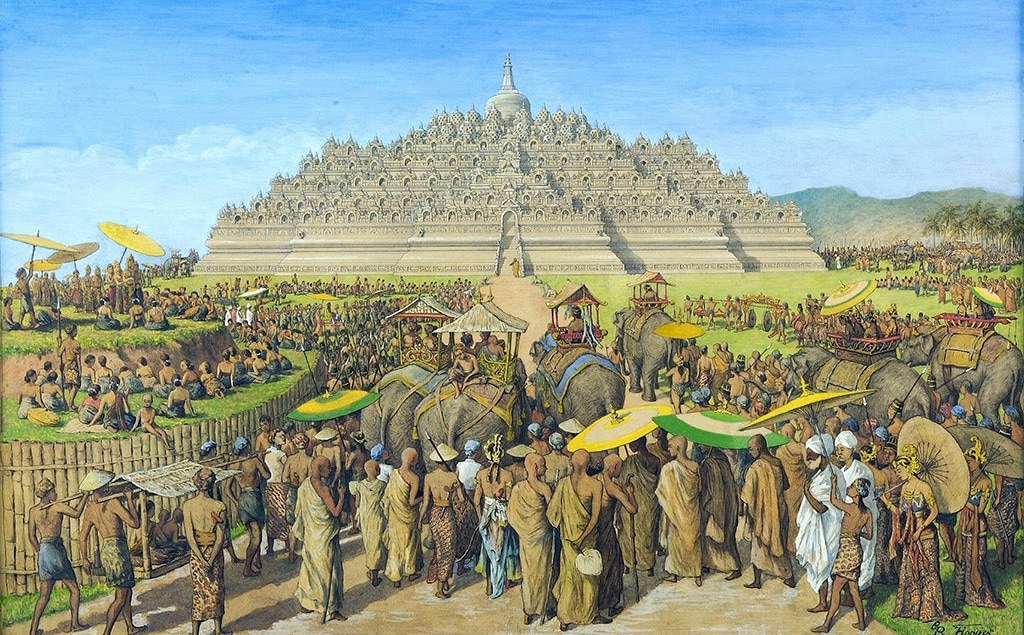
There are musical instruments on the friezes of Borobudur Temple, near Jogjakarta in central Java. The arrival of bronze from mainland Asia was the necessary breakthrough for music in Java and Bali. Smiths learned how to cast gongs and later forge keys. Then tuning evolved and ways of assembling instruments.
Borobudur Temple during a pilgrimage. The two figures in white robes on the right are the grandfather of the painter (with beard) D.A. Hooijer and his uncle Gijs Hooijer (about 1919).
One of the earliest gamelans is the Gamelan Gambuh, still played in a few villages, including Batuan, but more common is a gamelan called the Gamelan Gong Kebyar. Read more about it in Secrets of Bali.
The courts in Bali were patrons. Read more about it in Secrets of Bali.
Colin McPhee writes in his book Music in Bali that the Gong Kebyar was first introduced in Bungkulan village in 1914 and spread to almost every other village in Buleleng regency by the early 1930s, when it reached the height of its popularity. The word Kebyar derives from byar which means sudden intense sound or flash of light.
In the early 1960s a High School, KOKAR, and a College of Performing Arts, STSI, formerly ASTI, were established in Denpasar and have a high reputation for teaching, research and creating new works.
As with Balinese painting, tourism has provided a new kind of patronage, which has helped finance the purchase of gamelans, whilst civic pride has kept standards high. Ubud and Peliatan are particularly well regarded.
The Bali Arts Festival in Denpasar every June and July features performances from all over the island.
Influence on the West
The gamelan has influenced composers like Claude Debussy, Benjamin Britten and Philip Glass. It was introduced to the West at the end of the 19th century by some very successful music and dance tours. Read more about it in Secrets of Bali.
Colin McPhee
Colin McPhee was born in 1920 in Toronto of Scottish ancestry. At 24 years he showed promise of musical talent and went to New York and then Paris, where he met the young composers of the neo-classical style, including Aaron Copland. Read more about it in Secrets of Bali.
He wrote about his life and work in Bali in A House in Bali (in which he never mentions his wife) and a 600 page book called Music in Bali published 24 years after his return to the United States in 1941. He died in January 1964.
Ubud
There are active gamelans in each of Ubud’s 12 banjars and performances every night. There is also a respected women’s gamelan group in Peliatan.
The film The Year of Living Dangerously, set in Indonesia in 1965, opens with a Wayang Kulit performance. President Sukarno himself described 1965 as the year of living dangerously. The excellent novel by Christopher J. Koch has a vivid description of a performance and the theme runs through the story. These ancient, magical performances are very atmospheric and seem to symbolise Indonesia. Many say that Indonesian politics can only be understood in terms of the Wayang Kulit.
Wayang Kulit performances are sacred and form part of many ceremonies in village and family temples. Usually they accompany temple anniversaries and rites of passage ceremonies, such as baby ceremonies, tooth-filings, weddings and cremations. The performances have three functions in Balinese society: they are instructive, entertaining and religious. Wayang Kulit has profoundly affected the other Balinese arts.
The performances bring together visual art, vocal and instrumental music, drama, literature and dance. The puppeteer has to be expert in all these arts.
Origin
The shadow theatre exists, or has existed, in the lands between Turkey and China. Many think that Indonesian shadow puppet performances originated in India and that they came to Bali from Java between the 11th and 14th centuries. Read more about it in Secrets of Bali.
Wayang Kulit has been Bali’s cinema for centuries, but it is primarily a sacred matter. Read more about it in Secrets of Bali.
The first person to describe a Balinese Wayang Kulit performance was Chinkah, a Siamese master of a junk, which landed in Bali in 1846. The king of Klungkung gave a performance for him.
Two types of performance
There are two types:
The night wayang: wayang peteng
The most common occurrence of the night wayang is during a temple anniversary or odalan. Sometimes they are put on as thanks for a prayer coming true or during the celebration of a wedding or birth.
The day wayang: wayang lemah
The day wayang is the most revered of form of theatre in Bali. It is performed for the gods and is regarded as an offering.
Three types of stories
Three types of wayang stories have become popular in Bali:
Wayang Parwa
This depicts stories from the Mahabarata.
Wayang Ramayana
This tells stories of Rama.
Wayang Colon Arang
This tells the story of Rangda the witch.
Puppeteer
The puppeteer, dalang, and his puppets are treated with great respect. Indeed the dalang is a kind of priest and before a performance says prayers to bring the puppets to life. He can make holy water. Read more about it in Secrets of Bali.
He plays all the characters, in different voices, and controls the gamelan by tapping his foot on his wooden box. Read more about it in Secrets of Bali.
The most famous dalangs come from the village of Sukawati in south Bali. There are half a dozen families, all related, who pass the gift down from generation to generation. Read more about it in Secrets of Bali.
The stage
The audience is separated from the cross-legged dalang by a large white cloth (kelir), about 6 feet in length, bordered in black at the top and bottom and with red squares at the side. Behind the cloth are the dalang, a flickering, hanging coconut-oil lamp (damar) casting fluttering shadows on the sheet, the puppets of flat leather and the dalang’s two assistants (tututan), who sit on either side of him and hand him the puppets. The puppets are all placed in a yellow-green banana log (gedebong), at the base of the screen, ready for action.
The dalang’s puppet box is on his left. The filigree patterns of the puppets show up on the screen when held up against the oil lamp. Heroic figures are on the right and evil figures on the left
Behind the screen is a four or more piece gamelan, the Gender Wayang. It is the most demanding of all gamelans. It is quite an experience to go behind the screen and see how it is all done, but the better experience is to watch the performance. They take place at night and go on for hours.
The stories
The performances are the most literary and sophisticated of the Balinese performing arts. The stories are taken from the Hindu epics, the Mahabarata, the Ramayana and Prince Panji, with much improvisation, sometimes about politics. Jokes are told. Battle scenes are played out.
The dalang speaks in Kawi, which few understand. For the benefit of the audience, four clowns, also played by the dalang, translate and comment on the stories in Balinese. The clowns are the most important characters. In the Mahabarata stories they are Tualen and his son Mendah, servants of the Pandawas, and Delem and Sangut, servants of the Korawas. They are Sudras and have the most individuality of all the characters.
The story is finished in one sitting – unlike in Java, where it can last for several days. The plots usually start and end in the palace and take the viewer to the village and the forest. The village represents civilization, so that dialogues take place in the civilized world of the village, the court, the temple and the home. Battles are fought in the forest, a place where the hero also goes to meditate and make contact with unseen forces.
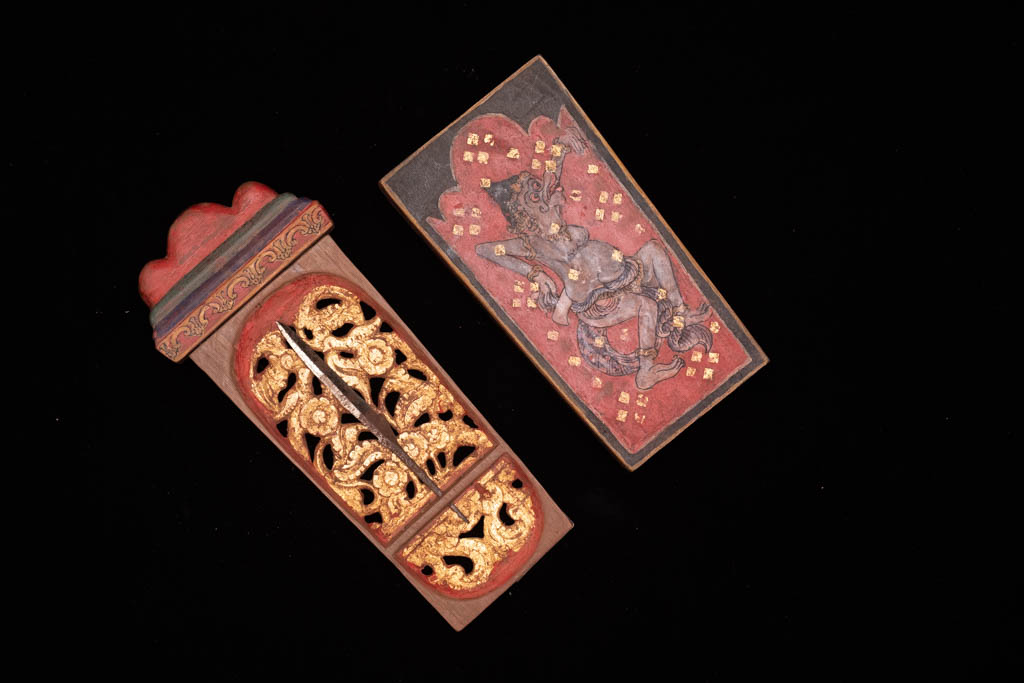
A standard collection comprises about 100 puppets, which are made of cowhide with a tapering buffalo horn or wooden handle. The handle ends in a point and is stuck into the banana stem, which lies at the base of the screen. Each puppet is chiselled, coloured and has a conventional headdress, which provides for instant recognition. They are kept in a wooden chest in a prescribed order: those on top are ritually the most important. The scenic one, the Kakayonan, is the uppermost figure, followed by the Supreme god, Tunggal. Ogres are on the bottom.
The figures are not naturalistic. They have disproportionately long necks, very long arms, and toes that are not in the correct position. Read more about it in Secrets of Bali.
A special puppet, called the Kayonan, in the shape of a tree, the tree of life, is waved by the dalang to indicate the start of the story. Read more about it in Secrets of Bali.
It is used to indicate scene changes and the end of the performance. It can also be used to represent a forest, the sea, bathing places, wind, rain, fire or a palace during the performance. More generally it may represent the five elements that make up the universe: air, wind, fire, water and earth.
Puppet-making
The art of puppet-making is passed down from one generation to the next. Apprenticeship takes between two and five years. The puppet-maker will carry out a ceremony to Wisnu and Siwa before he starts and will place an offering daily on a small shrine. Read more about it in Secrets of Bali.
The puppets are painted using five basic colours: white, red, yellow, black and blue. White is made from animal bones, black from soot and yellow from stones found on Serangan Island in the south coast of Bali. Gold leaf, prada, is used for the Kakayonan and the costumes of the Ksatriya characters. The head is painted first.
The head, torso and legs are one piece. The arms are separate and attached to the shoulders, so that they can move by means of rods tied to the puppets’ hands. They are all dressed, except for the Supreme god.
Life
The puppets represent life. They comprise celestial, human and demonic beings. Read more about it in Secrets of Bali.
There are not very many Brahman puppets. There are many more Ksatriyas. The visual similarity between the ruling kings and the gods is marked. They often wear the same headdress. This may well have derived from the fact that there was something divine in kingship, especially in Bali and Java in the 10th and 11th centuries.
Some of the puppets can be used for several characters. Major characters would not double up in this way, unless they were linked by a common heritage.
Body colours
The body colours represent symbolically major ideas and values in Balinese society. The colours are the five basic colours: white, red, yellow, black and blue, and a mixture of them. See the chapter entitled Balinese Symbolism in Secrets of Bali for the meanings associated with different colours.
Noble characters have light body colours, flat teeth and slit eyes; whereas coarse ones, like the ogres, are red or brown, have bulbous eyes and pointed teeth.
The music
There are always four gamelan instruments, which comprise the gender or xylophone, the rebab or two-stringed violin, the drum and the gong.
Music accompanies the placing of the puppets in the banana log, announces entrances, supports the dialogue, creates a benevolent atmosphere, and adds excitement to dramatic scenes.
Dalang’s preparations
As he sets off for a performance, the dalang will stop at his gate and feels his hair knot. If it pulsates to the right, he puts his right foot forward. Read more about it in Secrets of Bali.
It has already been mentioned that the dalang prays before the performance. He prays for protection from witches and evil spirits, for the gods to descend and enter him and the puppets, and for the audience to enjoy the performance. He sprinkles holy water and makes offerings to ensure that the stage is a pure area.
During the play the puppets are placed in the banana log. The main characters, the good characters, are placed on and enter the stage from the dalang’s right. Read more about it in Secrets of Bali.
The dalang sets the scene and describes the action. He speaks the parts. He needs to know the personalities of the various wayang characters and speak in an appropriate tone.
The most exacting part of the play is the fight against the giants, which usually takes place about 1 am or 2 am. It is the most difficult job for the dalang and is a test of his skill. Energetic tapping of the puppet box by the hammer held between the toes of his right foot always accompanies battle scenes.
After the performance the dalang recites a mantra to bring the puppets back to life symbolically.
Hand gestures
Puppets have stylized hand gestures. These are similar to the hand gestures of the priests, mudras, although priests use both hands whereas puppets only use one hand. See the article entitled Balinese Symbolism.
Symbolism
The music, stage and equipment symbolize the macrocosm. The clean white cloth screen symbolizes the sky. The cloth separates us from the real world of the gods. The puppets symbolize all that exists. The banana log is the earth. The oil lamp, which gives life and energy, represents the sun and the dalang is God. The music symbolizes the harmony of the cosmos and the puppets’ movements harmonize with the music.
The dalang wears headgear, waistcloth and dress, which represent heaven, earth and the underworld. He joins all three together during a performance.
The stage details are also symbolic. The stage is orientated to the propitious mountainward, kaja, direction, or to the east. The cloth has nine holes at the top, which represents nawa-sanga, the Balinese mandala. The lamp is lit with three bundles of wicks, reprsenting the Trinity (trisakti), the gods Siwa (or Iswara), Brahma and Wisnu. The cloth is also red, white and black. See the chapter entitled Balinese Symbolism in Secrets of Bali.
Tumpek Wayang
As mentioned in the chapter entitled Balinese Calendars in Secrets of Bali every 210 days is a day called Tumpek Wayang. It is also Kajeng-Keliwon, and special for Wayang Kulit shadow puppets, which are taken out and given offerings by the dalang. It also happens to be very unlucky to be born on that day. Such a child is prone to illness and injury from Kala, the demon god.
To cure the baby an elaborate ceremony called sudamala is carried out by a dalang after a night or day wayang. Read more about it in Secrets of Bali.
The day wayang: wayang lemah
This version of the shadow play is only performed during the day. Lemah means daylight. It is only for the gods and is a religious rite. Read more about it in Secrets of Bali.
It is a quiet performance, hardly audible to human beings. There is little or no conflict. Read more about it in Secrets of Bali.
Two musicians playing large metallophones, gender pemgumbang, provide the music. The music is less rich in tone and colour than the night wayang.
The stories deal with moral and spiritual themes and always relates to the particular ceremony or occasion. Read more about it in Secrets of Bali.
Conclusion
There may be no strict connection, but one cannot help remembering Plato’s famous allegory of the Prisoners in the Cave in the Republic. Read more about it in Secrets of Bali.
Very few Balinese dances do not have religious significance. The subject matter is usually the opposition between the noble and the ignoble, the refined and the coarse or as they say in Indonesian the halus and the kasar. The opposition of these forces then leads to conflict or war. Dances are frequently based on the epics.
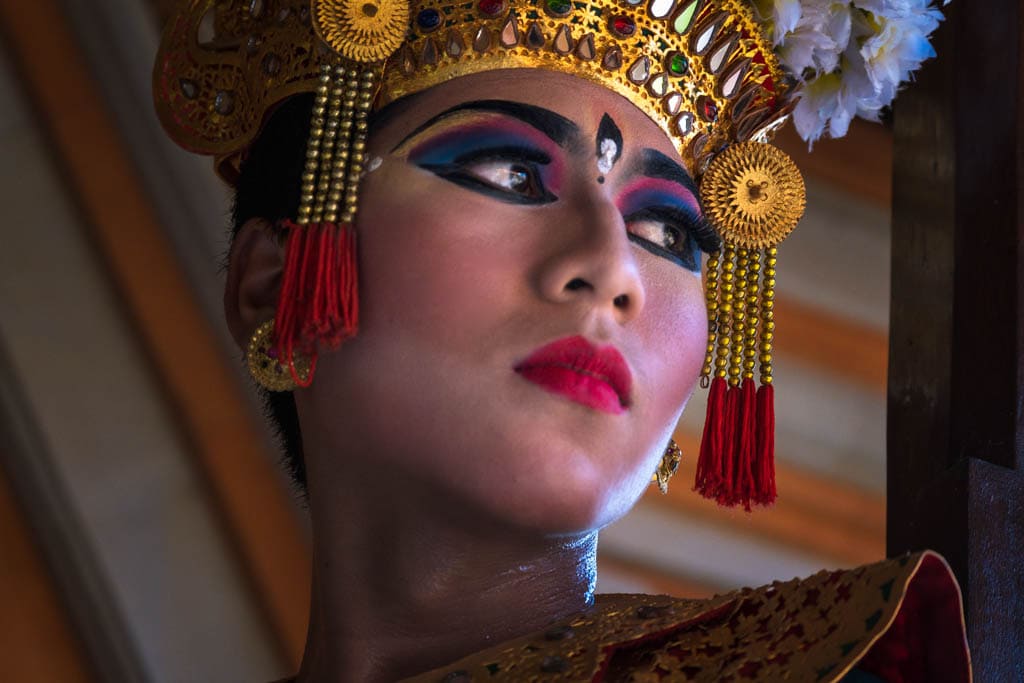
Balinese Dancers.
For the Balinese you are never too young to learn to dance. From the age of four, young girls are learning the legong dance. There are about two dozen dance schools in Denpasar.
Ramayana and Mahabarata
These two very famous epic poems are loved and well known all over Asia and inspire dances, puppet performances, paintings, sculpture, carvings and literature. The epics were originally written in Sanskrit, and then translated into Kawi. They flourished in the courts of East Java between the 11th and 15th centuries. The kings liked them because they enshrined and explained the authority of god-kings.
Both are extremely long.
The Mahabarata
Composed around the 10th century, the Mahabarata, which is 18 books, is one of the longest poems ever written, with about 90,000 couplets. It is about seven times the length of Homer’s Iliad or three times the length of the Old and New Testaments combined. It is about the battles between two related families, the Pandawas and the Korawas, for the control of the kingdom of Nastina. It culminates in a great war, the Bratayuda, in which the five Pandawa brothers confront their first cousins, the 100 Korawa brothers. After 18 days’ fighting and thousands of deaths, the Pandawas succeed. The stories form a large part of the repertoire of shadow puppet performances: wayang kulit.
The Ramayana
A Hindu sage, Valmiki, wrote the Ramayana in the 3rd or 4th century BC. It has about 24,000 couplets.
Rama, an incarnation of Wisnu, is robbed by his father’s second wife of his rightful position as heir to the throne of the kingdom of Kosala in India and is banished to the forest of Dandaka for 14 years. His beautiful and faithful wife, Sita, and his younger brother, Laksmana, accompany him. Read more about it in Secrets of Bali.
Rawana seeks Rama, Sita and Laksmana in the forest and falls in love with Sita and decides to capture her. He orders his minister, Marica, to change himself into a golden deer and to entice Sita. Read more about it in Secrets of Bali.
Rawana disguising himself as a priest seizes the chance and carries Sita off to his palace. Rama and Laksmana return and cannot find her, but they discover an old friend, Jatayu, the king of birds, who tried to rescue Sita from Rawana, but failed and had his wings cut off. As he dies, he tells Rama of the kidnapping.
Rama gets help from the monkey army of Sugriwa, one of the monkey kings, and the services of Hanuman, the outstanding white monkey, by helping Sugriwa get his lover, Dewi Tara, back from his brother, Subali.
Meanwhile Sita has been resisting Rawana’s advances. He decides to fool her into thinking Rama is dead by bringing her a severed head. She does not believe him. Hanuman arrives at the palace to check it out, disguised as a fly. Hanuman finds Sita, transforms himself back to normal and explains he has come at Rama’s request. Sita believes, however, that it is a trick and it is Rawana in disguise. Hanuman shows her Rama’s ring and she is then convinced. Sita gives Hanuman a letter and a hair clip for Rama.
On the way out Hanuman purposely gets caught, so as to ascertain Rawana’s strength. He taunts Rawana, who attacks him and ties him up. Hanuman tells them he can only be destroyed by fire. Hanuman grabs the torch and burns the palace, but carefully ensuring that Sita’s apartment is safe. He returns to the forest and shows Rama the letter and hair clip.
Rawana sends Sukarana to spy on Rama’s camp at Alengka. He disguises himself as a monkey, but is discovered. Rama lets him go and he returns and tells Rawana everything he has seen.
Rama then sends Hangada, the red monkey, to Rawana to persuade him to return Sita and avoid bloodshed. Rawana tries to kill him, whereupon Rama’s army appears and a huge battle ensues. Rama and Rawana direct the battle and Rama wins. Laksmana defeats Rawana’s giant brother, Kumbhakarna.
Rama and Sita return to India and Rama is enthroned, but he suspects his wife of adultery and puts her to a trial by fire. She is proved innocent, but he still banishes her.
Audience
The Balinese do not watch dances as intently as Westerners. The story does not trouble them. They know it already. The audience does not mind at which point the story is taken up, nor at which point it ends.
The clowns give necessary information about the main characters, in a series of witticisms, and improvised comments. Whereas Westerners look for a story, the Balinese are absorbed in the rhythm.
The dancers
The individuality of the dancer is not important. He or she is admired for technique. The dance movements are within a narrow frame. The beauty lies in this. It is not emotional, but formal and detached, and carefully worked out. The gestures and movements are traditional, reserved and understated.
The gestures in Indian dancing tell a story, but not in Bali. They are purely abstract, although a few have dramatic meanings. Shading the eyes with the hand indicates weeping. First and second fingers pointing at the end of a stiffly extended arm is a gesture of anger or denunciation.
Balinese Dancers.
Eyes move quickly from side to side to stress the rhythms and accents. Faces are like masks.
They make dramatic entrances. Special melodies are played. The entrance is delayed as much as possible. If there is a curtain, the only hint of the dancer is his voice or the twitching fold of the cloth. When the curtains are finally parted, the dancer remains framed in the entrance. The dancer advances slowly.
The dance known as Kebyar, which means a sudden release of emotions, resulted in individuality in dance. The composition was free. The dancer sits in a square surrounded by musicians. He dances from the waist up. The story is not important.
Dance classification
Dances are staged in temples to entertain visiting deities and deified ancestors. The holiest dances are performed in the holiest part of the temple. Dances can be classified as follows:
Wali
These are the holiest: Pendet, Rejang and Baris Gede, which tend to be group dances of Old Indonesian origin, danced in a row or circle, with no plot. They take place in the inner sanctum, the jeroan, of the temple. They are addressed only to the gods.
Bebali
These are less holy: Colon Arang, Topeng Pajegan, Gambuh and Wayang Wong, They take place in the middle courtyard of the temple. These dances have two audiences, the gods and humans.
Bali-Balihan
These are the most secular: Legong, Arja, Topeng Panca and Kebyar. Literally it means “things to watch” and they take place outside the temple gates or in the courtyard. These are performed for humans only and do not concern the gods. Usually the only language spoken is Balinese.
Pendet
This is the welcome dance, performed in the holiest inner part of the temple, by women, who welcome the visiting spirits and present offerings to them.
Rejang
This is an ancient, processional, group dance, very simple and elegant, danced by women in the inner temple to entertain the visiting spirits.
Baris Gede
This inner temple dance is by men, dressed as warriors, with triangular helmets, covered in pointed shells. They carry spears and go through warlike movements and battles. They protect the visiting spirits.
Topeng Pajegan
This masked dance takes place in the inner courtyard of the temple, always on the first day of a ceremony. It is a male dance where one dancer plays all the parts in an entire story, changing masks as the characters change, in other words a one-man show. It is also danced in family compounds at important rituals, such as marriages, tooth-filings and cremations.
Gambuh
This narrative dance is at least 400 years old and the story concerns Panji, a prince, and his adventures with Candra, who becomes his bride. Old-fashioned musical instruments are used.
Wayang Wong
This is a sacred masked dance-drama. Wayang Wong means “shadow men” and the movements resemble the jerky movements of the shadow puppets. Its origins are not known, but it is thought to have been devised in the 17th or 18th century by the palace in Klungkung.
The story comes from the Ramayana and involves the Rama’s defeat of the demon king, Rawana, and rescue of his wife, Sita, with the help of the army of monkeys. Many of the characters speak Kawi, which is translated into Balinese by four clowns.
It is not performed often, usually only during the anniversary ceremony of the village temple, Pura Desa. It is restricted to around 19 villages, including Batuan, Mas and Pujung.
Legong
Legong Dancer.
This very famous, graceful dance is danced by three young girls and is quintessentially Balinese. The first to appear is a servant, then the other two girls, dressed identically. The story is hard to follow as the girls change roles in an almost imperceptible way.
The Ramayana Ballet
This was created in Bali in 1965. The story is taken from the Ramayana. Rama, the hero, helped by the white monkey king, Hanuman, and his army, defeats the wicked Rawana and rescues Sita. The gamelan is lively with quick changes of tempo, mirrored by the dancers’ movements.
Arja
This is Balinese opera or more accurately musical comedy. The dancers sing in Balinese and dance at the same time. Women often play the leading men, especially refined types. Men play some of the coarser female roles. The stories are drawn from the Mahabarata, Javanese romances, Chinese tales and other sources. Sentimental situations are developed. It is like a comedy of manners. The costumes are sumptuous.
Topeng Panca
This masked dance, invented at the end of the 19th century, by topeng dancers in the court of Badung, now Denpasar, is played in the outer courtyard by a group of four or five men. Panca means five. Many different masks may be used, ranging from kings to clowns and even deformed people. It is faster than Topeng Pajegan. There is a gamelan orchestra. Entrances are full of drama and expectation.
Barong-Rangda
Barongs come in many forms, but the most common is like a Chinese lion, the Barong Ket. Its origins are obscure. The barong is not a god. It is on a level with animals, a servant of Siwa. A village takes care of its barong and gives it offerings and in return it takes care of the village by scaring away demons with its dance.
It is mostly seen in dances and processions. Two men are inside, one operates the lower movable jaw and wooden head with its beard of human hair, and the other holds up the back and arched tail. The beard is the most powerful part. The hairy hide is covered with small mirrors and decorations. Barongs protect villages from the harmful influences of dead souls and demons.
If the masks of several Barongs come from the same tree, they are considered to be brothers and they often visit each other during ceremonies. The Barong will attend the odalans of the temple where the tree from which its mask was carved grew.
Rangda is the Queen of the witches, has a long tongue, pendulous breasts, long fingernails, and a magic white cloth which she waves. She is not a goddess, but is powerful and threatening. She is not all evil, however, just as the Barong is not all good. The Balinese never have extremes.
There is a battle. The Barong’s followers try to attack Rangda. Through her magic they turn their daggers, krises, against themselves, but through his magic, they do not stab themselves to death and fall into trance. The dance-drama often ends at this point, where neither good nor evil triumphs, which is the balance that the Balinese strive for.
Colon Arang
The name means “the candidate witch” and is a version of the Barong-Rangda story. It is played at night in the villages and belongs the bebali class and ends up in the cemetery. It is a 12th century Javanese tale, which lost importance with the spread of Islam. It regained popularity in 19th century Bali, especially at the palace of Gianyar.
The primary masked character is Rangda or Colon Arang, the Queen of Witches and goddess of death, to whom Pura Dalem in each village is dedicated. The dance may be performed on the anniversary of the temple, which is timed for the full moon. It is also often performed if there has been an outbreak of disease or just for pleasure. Durga is the female incarnation of the destructive aspect of Siwa. Death and rebirth are intertwined in this manifestation of God.
The story concerns Colon Arang, a widowed witch, who lived during the reign of king Erlangga in East Java. No one would marry her daughter, Ratna Manggali, for fear of her mother. In revenge Colon Arang went to the graveyard with her apprentices, danced and made offerings of corpses and appealed to Durga to be allowed to devastate king Erlangga’s kingdom of Daha. Durga agreed and terrible plagues and epidemics broke out.
Siwa advised Erlangga to enlist the help of the sage Empu Baradah, who sent his son Bahula to marry Ratna Manggali. He took Colon Arang’s book of spells, showed it to Empu Baradah, who memorized it and could thereby reverse the spells. He confronted Colon Arang and in a battle killed her, then brought her back to life in order to purify her soul. She was then laid to rest.
King Erlangga thanked the sage and the kingdom prospered so much, that when he decided to retire and become a hermit, it was large enough for his two sons to succeed him with a kingdom each.
The tale has been told by Pramoedya Ananta Toer in The King, the Witch and the Priest.
Kecak
This is a very exciting dance, frequently photographed, and the best-known dance in Bali. It is the Monkey Dance, created by the Balinese, with suggestions from Walter Spies and Katharane Mershon for Baron von Plessen’s film Island of Demons in 1931. It was one of the first attempts to capture the romance of Bali and transmit it abroad. In May 2002 one member of the original kecak group of Walter Spies, 90 year old I Wayan Limbak, was still alive.
It is based on the Sanghyang, an old exorcism trance dance. About 100-150 bare-chested men, wearing black-checkered poleng sarongs, sit in concentric circles around an oil lamp. There is no gamelan orchestra. They chant and chatter and sway like monkeys, arms splayed out, chanting chak-chak-chak. The pitch and rhythm varies, whilst inside the circle, scenes from the Ramayana are danced.
In the 1900s a Javanese dancer and choreographer, Sardono Kusumo, came to Ubud and took the dance to new heights, making it more dynamic with a lot of movement. He introduced coconut torches and simplified the story. He also added the nonsensical sounds chuk and thak.
It can be seen throughout Bali. There is an especially good performance on Friday evenings in the Pura Dalem Temple, Ubud, next to Murni’s shop, Kunang-Kunang ll.
Oleg Tambulilingan
The great dancer, Mario, from Tabanan, created this dance in 1951 for the Peliatan gamelan’s world tour described in John Coast’s book Dancing out of Bali. Englishman John Coast mounted this spectacularly successful tour against all the odds at a difficult time in Indonesia’s history. The dance portrays two bumblebees in courtship.
Frog Dance
This was created for tourists from an old story. A princess marries a frog.
Sidha Karya, lord of innocence and childhood, is a comic and a demon. He chases children in the audience, who run away from him. One is always caught, but quickly given sweets or a coin. This sacred mask is also worn at the climax of a temple ceremony. It is danced to ensure the effectiveness of the ceremony.
There are numerous ceremonies in Bali, some of which are private, some public. Some are described throughout the book. To attend you must wear Balinese dress: see the chapter entitled Balinese Dress and Textiles in Secrets of Bali. It is unnecessary for tourists to be formally dressed: a sarong, sash and covered arms are sufficient.
Categories
There are five different categories of ceremonies, the panca yadnya. There are rituals for:
The gods (dewa yadnya)
An example would be a temple anniversary, odalan.
The higher spirits (pitra yadnya)
This includes the ancestors before they have been deified, such as cremation or Ngaben.
The consecration of priests and priestesses (rsi yadnya)
Humans (manusa yadnya)
These are rites of passage ceremonies from conception to just before death, such as pre-natal rites, birth ceremonies, the 12 day, 42 day and three months’ old baby ceremonies, tooth-filing, and marriage,
Evil spirits (bhuta yadnya)
Bhuta means element; kala, another word for demon, means time or energy. Demons are personifications of forces derived from the five elements and bring misfortune to man. The purpose of these ceremonies is to placate the demons and bring harmony to the world. One such purification sacrifice, taur kasanga, takes place on the last day of the lunar year at Besakih and elsewhere on the island.
Private ceremonies
All Balinese rituals are preceded by a purification ceremony to banish the evil spirits before the divine powers are addressed. This is done by offerings, holy water and hand gestures.
There follows brief details of some of the private family ceremonies.
During pregnancy
This is performed for the welfare of mother and child to anchor the embryo firmly in the womb.
Immediately after birth
The father collects the baby’s placenta, the ari-ari, which is the most important element of the Kanda Empat (for an explanation see the chapter entitled Balinese Religion Read in Secrets of Bali), takes it home, washes it, places it in a coconut with flowers and money, wraps it in a white cloth and buries it outside the door of his home. As you look out, girls’ placentas are buried on the left and boys’ on the right. The grave is covered with a black stone and spiky pandanus leaves to protect it. Finally a symbolic cremation fire is lit on the grave.
12 days
The baby can now be given a name. In some parts a grandparent may visit a clairvoyant priest, balian tenung, or he may be called to carry out a purification ceremony. The priest has the ability to communicate with the ancestors to identify whom the baby is a reincarnation of.
42 days
Mother and child are impure for 42 days after the birth. She cannot enter sacred places like temples and the child must be protected from witches. For the first three months the child is very vulnerable to witches and sorcerers. At the end of the period the mother and child cease to be impure and a small purification ceremony is held.
105 days or 3 months (tigang odalan)
This is the first big ceremony and takes place in the family compound. It is the day that a child attains a normal state and may enter temples. The baby ceases to be a divine creature.
It is the day that the baby first touches the ground – described as a return to the earth. Read more about it in Secrets of Bali.
210 days or First Oton
This is the baby’s first Balinese birthday, which takes place one Balinese year (six months) after birth.
The baby has its first haircut, a symbolic release of energies. The hair is cut from the five cardinal directions symbolically to remove impurities and is either buried or thrown in the river. There is a further exorcism ceremony to expel the 108 helpers.
All these rites of passage ceremonies are intended to remove impurities caused by the birth and the sins of previous lives.
Menstruation
A small ceremony is carried out at a girl’s first menstruation. From this age young people come under the influence of Semara and Ratih, the gods of love.
Tooth-filing
The shape of teeth separates the gods and humans from animals, birds and ogres. The former have flat teeth and the latter have pointed ones.
As mentioned in the chapter entitled Balinese Symbolism in Secrets of Bali. the purpose of a tooth-filing or matatah is to remove impurity by eliminating or reducing the Sad Ripu, the Balinese six deadly sins, lust, greed, anger, intoxication (through drink or passion), sadness, arrogance and jealousy. Raffles in his History of Java noted that the Balinese are “strangers to the vices of drunkenness, libertinism and conjugal infidelity…”
Sometimes there is a mass village-wide tooth-filing. This occurred in Ubud in July 2000. At that time over 100 men and women had their teeth filed in public.
Marriages
Unmarried motherhood is not an acceptable concept in Balinese culture, although premarital pregnancy is common and probably the norm. Pregnancy usually provokes the wedding. Read more about it in Secrets of Bali.
There is a preference for marriage to a patrilineal cousin (one’s father’s brother’s son or daughter). See the section Kinship in the chapter entitled Names, Titles and Castes in Secrets of Bali for an explanation.
Forms of marriage
There are three traditional forms of marriage:
Kidnapping a girl
This is now against the law.
Pre-arranged “kidnapping”
Everyone goes along with it but pretends not to know about it, is common and the least expensive.
Arranged marriage
This is a wedding agreed upon by the families. Right up to the 1950s arranged marriages were common. Conservative communities and social elites favoured it.
Wedding Ceremony
The ceremony takes place in the boy’s family compound and can be as elaborate as the family wish. The girl leaves her family temple and, unless she already is a relation, joins the boy’s family and ancestral group and will thereafter tend his ancestors. Read more about it in Secrets of Bali.
The wedding ceremony is fun; the couple wear their best clothes, gold thread and headdresses. Both wear make-up. Read more about it in Secrets of Bali.
Marriage allows the husband to join the banjar. At marriage he becomes an adult. See the chapter entitled Balinese Organisations in Secrets of Bali for details of the banjar.
Honorary male
As mentioned above, the bride joins her husband’s family temple and leaves her own. If it happens that a couple have only daughters, they will be left with no women in the family. Such a situation cannot be allowed to happen, as it would mean that ceremonies could not be carried out properly. There would be no one to look after the family temple and the cycle of reincarnation would be broken.
It is possible for a man to have more than one wife, but only a few do nowadays. It is usually only among the higher castes and the wealthy. Men do not usually take more than three wives.
Women
Although women are regarded honourably in the ancient Hindu scriptures, like the Manawa Drama Castro, which implies that when a woman is respected, the gods are delighted, they tend to be second class citizens. They do not have a vote at village banjar meetings, especially on matters of customary law. The village chiefs are invariably men. Many aristocratic women are expected to take care of domestic chores, such as preparing offerings, which prevents them from being able to pursue higher education.
Children
All Balinese have a duty to marry. It is vital to have children, as only they can perform the rituals for the dead and purification of souls, which are indispensable for reincarnation. Childlessness and impotence are grounds for divorce and in myths, ogres in the afterlife punish those without children. Often they are hung upside down from a tree and beaten. Being upside down is particularly degrading for a Balinese, as the head would be in touch with the ground: see the chapter entitled Balinese Symbolism in Secrets of Bali.
Twins
The birth of twins of the opposite sex to a Sudra family is regarded as a form of incest. The village is regarded as spiritually impure for 42 days after their birth. Read more about it in Secrets of Bali.
Even today twins born to a commoner result in postponement of major ceremonies. In the days of the Balinese kings the twins were taken as slaves by the king.
This does, not, however apply to twins born of a high-caste mother. Quite the reverse. It is auspicious. Read more about it in Secrets of Bali.
The idea that twins bring bad luck may date from pre-history. In the days of hunter-gatherers a woman could never nurse and carry two children. Statistically every 100 or so births are twins.
Divorce
Traditionally divorce is living apart. Read more about it in Secrets of Bali.
It is regarded so badly amongst aristocratic women that if she returns to her family compound, she will be treated like a servant and has to speak in the highest form of Balinese to her parents, brothers and sisters.
Caste
A high-caste woman should not marry a commoner. In the days of the Balinese kings both could be killed. These days the existence of the rule is rather controversial.
Inheritance
Marriage is largely about inheritance and responsibility for the family temple. Customarily daughters do not inherit. Male offspring take over responsibilities and authority, both within the family and the community. Read more about it in Secrets of Bali.
Death
Marriage denotes a break in the life cycle. Up to and including marriage, parents are responsible for their children’s purification and ritual protection; once married, the younger generation becomes responsible for their parents’ protection, primarily to carry out the death rites properly.
As soon as someone dies the hollow slit drum, the kulkul, is beaten to summon help from the banjar, which comprises men from the neighbourhood. They come to the deceased’s house and wash the body.
The body has now been prepared for burial or cremation. Bodies are frequently prepared and buried within hours of death. If they are not buried the same say, the family will stay up all night to guard the body against bad spirits. This is a time when gamblers play cards all night.
Cremation
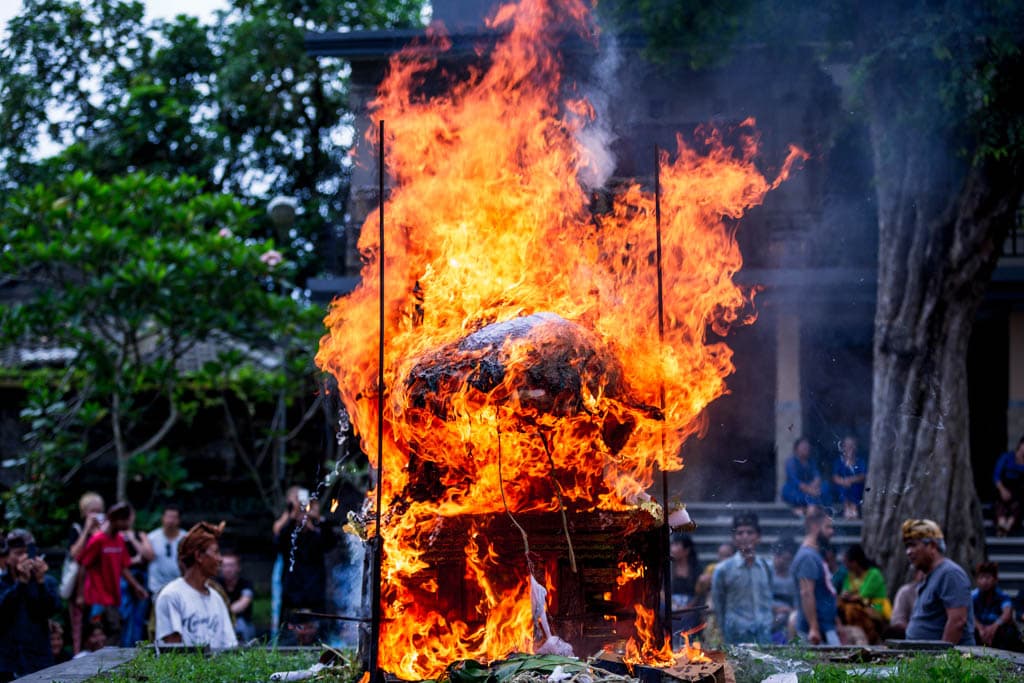
It is not known when cremation was introduced to Bali. A Balinese cremation is very different from a Western one. It is the grandest and the most important of all Balinese ceremonies. The most important ceremony as its success, that is to say the correct carrying out of the ceremony, determines whether or not the deceased will be reincarnated.
Cremation in Ubud.
Cremations are exceedingly expensive, so it is not uncommon for families to share the expense. Sometimes collective cremations are organized, like the one in Ubud in July 2000, when all 72 bodies in the village graveyard were cremated in one day or in December 2001 when 830 remains from 37 villages joined in the cremation of Ida Tjokorda Mengwi, a descendant from the 13th generation of the King of Mengwi, who reigned in the 17th and beginning of the 18th centuries. Unless the family is rich or a priest or a member of a royal family is the deceased, they are first buried to allow the family time to save up.
It should not be put off too long as uncremated spirits are restless and can cause the family and the village trouble. Read more about it in Secrets of Bali.
The ceremony takes place on an auspicious day. Read more about it in Secrets of Bali.
Chickens and ducks will be sacrificed. For a medium sized cremation two or three dozen women are required to make the offerings. It takes several weeks and they will be fed throughout. This adds to the cost. High caste priests, pedandas, carry out several of the preliminary ceremonies and officiate at the cremation.
Women make the offerings. Men from the banjar make the sarcophagus. It is in the shape of an animal. Status determines what kind. Read more about it in Secrets of Bali.
Having said this, it is not as rigid as it used to be and it is becoming a matter of choice which kind of sarcophagus is used. Either way there are always four feet to symbolise the four invisible brothers or sisters – see the chapter entitled Balinese Religion in Secrets of Bali for details of the Kanda Empat.
The men also build the cremation tower, the bade, which symbolises the universe. At the base is the world-turtle, Bedawang Nala, surrounded by snakes; in the middle, the world of man is shown by leafy forests and mountains, where the corpse is placed and at the top, there are meru roofs, like those of a pagoda, always an uneven number.
The meru roofs represent the tier of heaven to which the deceased aspires. Read more about it in Secrets of Bali.
The tower can be 60 or 70 feet high. The height indicates status. Nowadays telegraph poles have to be lowered to let the tower pass. Men who are of lesser rank than the deceased carry the tower.
On the main day guests and men from the banjar arrive at the house. If the body is in the house, it will have been prepared, with a Brahman priest in attendance, and will be placed in the cremation tower and tied to the shelf and covered by a white cloth.
There are three main phases. In the case of a large royal cremation, these would take place on separate days. Read more about it in Secrets of Bali.
If the deceased is a king, a Naga or dragon may be carried in a procession and placed to the west side of the remains. The Naga is a symbol of life. Two high priests will shoot arrows at it, which are intended to release the deceased’s soul from the world.
The procession to the cemetery will then start. The empty sarcophagus, tied to bamboo poles, will be carried by the banjar men, who intentionally turn it round roughly to confuse the deceased’s spirit, so that it will not return home. Read more about it in Secrets of Bali.
At the cemetery the sarcophagus is opened and the body – or the effigy – put inside and covered with offerings and pieces of cloth. The pedanda will pour in lots of holy water. Then the sarcophagus will be closed and firewood underneath set ablaze. Read more about it in Secrets of Bali.
Family members will pray and throw the ashes in the sea or a river, which leads to the sea. In Ubud, River Campuan is used. Thereby the body’s elements will be purified and returned to the universe.
The grandness of a cremation does not guarantee a good afterlife. It is karma, good deeds, that does that.
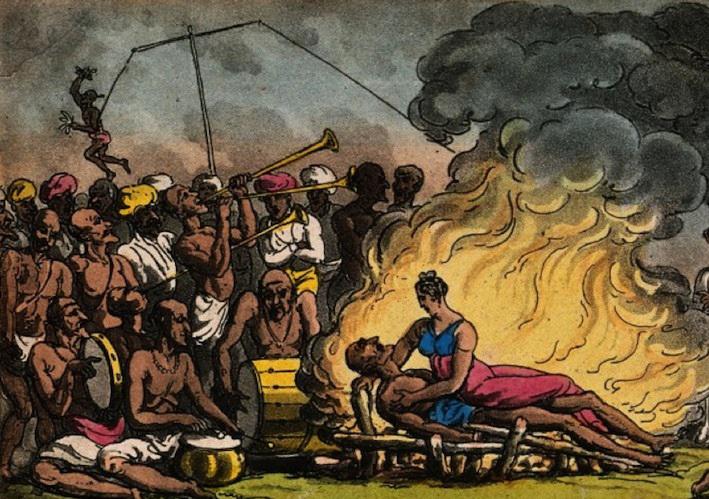
Suttee.
Suttee, the practice dating from at least the 1400s, whereby wives of Balinese rajas sacrificed themselves by jumping into the flames, sometimes stabbing themselves at the same time, was outlawed by the Dutch in 1895. Read more about it in Secrets of Bali.
The Bali Aga people – see the chapter entitled Balinese History – Pre-history to the Europeans in Secrets of Bali. for their origins – carry out death rites differently. The Trunyan people expose the corpse to the elements and the Tenganan people bury their dead.
Nyekah
A number of hours, days or weeks later, a second ceremony, sometimes called the second “cremation”, takes place to complete the matter. It is called Nyekah and it releases the soul, which still has some links to the body, from earth to heaven.
At this point the cremated dead are no longer individuals. They are good-natured ancestor gods.
Public ceremonies
Anniversaries: Odalans
All temples, public and private, have an odalan, usually every Balinese year of 210 days, which is the anniversary of their founding and dedication.
Two of the three main village temples have odalans every Balinese year. Pura Desa has one every lunar year of 355 days. Read more about it in Secrets of Bali.
New Year’s Eve, Ngerupuk
For weeks before New Year’s Eve a great din is made, banging tins and letting off firecrackers to frighten away the evil spirits from Bali. The purpose is to cast them out totally. It is an exorcism to purify the villages and towns. Large-scale cockfights are held.
On New Year’s Eve the Balinese carry out a ritual called Tawur, the aim of which is to give something back to nature. Read more about it in Secrets of Bali.
In the evening there are great processions around the villages of huge statues in grotesque shapes accompanied by loud gamelan music. They are symbols of demonic spirits, called Ogoh-Ogoh. Read more about it in Secrets of Bali.
A ceremony to cleanse the Ogoh-Ogoh is held before the parade takes place and after the parade they are usually burned at the village crossroads, but recently some have been kept and sold.
New Year’s Day: Nyepi
New Year’s Day usually takes place in March or April. It is calculated according to the Saka calendar.
On New Year’s Day total silence prevails. Read more about it in Secrets of Bali.
The idea is that Bali looks deserted and the evil spirits will leave the island. Men from the banjar, the traditional village guards, the pecalang, wearing black or red shirts with chequered black and white poleng sarongs, patrol the streets to ensure compliance and levy fines on transgressors.
On a personal level the silence, serenity and emptiness should lead to a revitalization of inner creative energy and enlightenment.
Galungan
Often described as the Balinese Christmas, this is the most important day of the 210 day Balinese year, the start of the period during which the deified ancestors descend to the family temple and are entertained and presented with offerings and prayers. Actually, strictly, they come down five days before Galungan. Those still in the cemetery will be given offerings as well. The villages are beautifully decorated with penjors. Read more about it in Secrets of Bali.
Penjor.
For the three days before, preparations are at their most intensive and disruptive spirits abound. It is a time to guard against arguments. On the first of these days bananas are bought or picked so that they will be ripe for Galungan. Tapé, a mildly alcoholic fermented rice pudding, is also prepared. Read more about it in Secrets of Bali.
On the day itself, always a Wednesday, in the eleventh week of the 210 day Balinese calendar, prayers are said, offerings made and families visited. There are barongs on the street, with crashing cymbals and gongs. Read more about it in Secrets of Bali. The holiday ends ten days later on the day called Kuningan.
Galungan also commemorates an historic battle, which symbolises good over evil. In 8 AD a bad giant king called Sang Mayadenawa forbade the Bali Aga Balinese people from carrying out their religious ceremonies. With the help of many Aryas from East Bali, a fierce battle took place and the king was killed. Peace was restored.
The Galungan kind of offerings are only made three times a year: Galungan, Kuningan and for family temple ceremonies.
Kuningan
Kuningan is also a day of prayers and visiting. Special offerings are made of yellow rice, rice made yellow by turmeric. Read more about it in Secrets of Bali.
It commemorates the spirits of the heroes who were killed during the battle against Sang Mayadenawa.
In Klungkung in the temple Paksa Bali, a Perang Dewa ceremony takes place – a symbolic fight between deified ancestors. It is very sensational. Many of the participants go into trance.
Saraswati
Saraswati Day takes place on the last day of the Pawukon calendar and is devoted to the goddess of learning, Saraswati, the wife of Brahma, the god of creation. She lives on the tip of the human tongue, and in written letters inscribed in poems on lontars and on the petals of lotus blossoms.
Her day is a public holiday in Bali. Read more about it in Secrets of Bali.
According to a religious text, Purwagama, our ancestors used to live like animals. Brahma sent Saraswati to change them into humans. She created poetry by attaching letters to the inner and outer worlds. Read more about it in Secrets of Bali.
Banyu Pinaruh
The day after Saraswati Day the Balinese clean themselves with water that has been blessed. Many people go to the beach in the morning to pray and bathe themselves with sea water (melukat). In the evening they eat a smoked duck feast.
Coma Ribek or Somaribek
The following day the Balinese pray to Dewi Sri, the rice Goddess, for wealth. No money is supposed to pass hands on this day.
Siwa Ratri
The same evening the Balinese fast and stay awake and meditate for 36 hours. On this day Siwa carried out his most important meditation. Those who do the same will be blessed and rewarded.
Pagerwesi
The following day offerings are made to Pramesti Guru for his blessing. This is to achieve balance in the world and its creatures.
Major ceremonies
There are many, but two stand out in importance:
Panca Wali Krama
This is a large purification ceremony, which takes place once a decade. The Balinese call it a year that ends in a zero.
Eka Dasa Rudra
This is the greatest of all Balinese festivals, an enormous purification ceremony, which takes place once a century. The Balinese call it a year that ends in two zeros. Read more about it in Secrets of Bali.
Eka Dasa Rudra means the eleven Rudras. Rudra is a god associated with wildness and danger, the Vedic antecedent of Siwa, with whom he later became linked. Eleven expresses the idea that he is everywhere in all directions.
It was planned to have the ceremony in 1963, but that was Saka year 1984, which did not end in two zeros. Read more about it in Secrets of Bali.
During the ceremony the Balinese were asked not to cremate their dead and not even to announce publicly, by beating the slit-drum kulkul that a death had occurred. Bodies were carried quietly to the graveyard and buried. Post-cremation rites that purify the soul of a body already cremated were, however, allowed.
The offerings were mind-boggling – more than 50 buffaloes, scores of other animals, thousands of ducks and chickens, tens of thousands of bananas, eggs and coconuts, tons of rice.
In February, during the preparations, Mount Agung began to erupt: see the chapter entitled Balinese History – the 20th century in Secrets of Bali..
Level of ceremony
Ceremonies may be carried out in three different levels:
Utama or elaborate. Madia or average. Mista or simple. sanggar cucuk.
These are sometimes sub-divided. They are all equally valid. Read more about it in Secrets of Bali.
Bhuta yadnya rituals with the generic name of caru begin with the offering of one fowl (eka sata) of multi-coloured plumage places at the foot of a little bamboo shrine. The next level is five fowl (panca sata) and five shrines, the colour of each fowl’s plumage corresponding to its direction. Larger bhuta yadnya ceremonies, called taur, require sacrifices of four-footed animals as well as fowls, a greater number of other offerings, the tall elaborate sanggar tawang shrine and the presence of a high priest.
There are several graded divisions of taur sacrifices, increasing in size from taur agung to taur gentuh to Panca Wali Krama and finally Eka Dasa Rudra.
As has been mentioned in many articles, Indian influence has been great on all aspects of Balinese culture. That includes architecture. It is evident in the mandala-like groupings of houses in the villages. The Chinese were a major influence on Indonesian culture, but not on architecture, and neither were the Dutch.
The family compound (kuren) is a centre of religious life for the family and is constructed according to traditional rules. It undergoes periodic cleansing rituals. The materials used have to cope with equatorial conditions, which are hot and humid, and heavy monsoon rains. There are wooden or bamboo walls and thatched roofs. Unlike the rest of Indonesia, Java and Bali do not build their houses on stilts.
Balinese Architecture.
Traditional Balinese houses, temples, rice barns and other structures are built according to traditional Balinese rules, called Asta Kosala Kosali, written down in lontar palm books and interpreted by traditional architects called Undagi. Balinese architects do not design buildings; they merely interpret the traditional rules.
The roles of architect, builder and client are a phenomenon of an industrialized society. Such classification is unknown in Bali.
Housing consists of a series of small constructions. They mostly consist of wooden pillars raised on a masonry base, which support a roof of radiating beam work, covered by thatch, tiles or bamboo. Roofs are crowned by a terracotta finial (ornament).
The buildings are assembled with very few nails. Tools are simple hammers, chisels, saws, axes and a plane. Walls are generally of brick, tuff or other masonry. Posts and beams carry the load of the roof.
Some roofs are still made of alang-alang grass. This thatch, often 45 cm (18 in) thick used to last for up to 50 years. But nowadays it is almost impossible to get good quality alang-alang and ceramic tiled roofs are more common. They are also less of a fire risk.
Orientation
The Balinese have a highly refined sense of place and orientation. Buildings are laid out in certain positions according to their function. This is described in the chapter entitled Everything comes in 3s in Secrets of Bali. Cardinal points and geographical features determine the layout.
A Balinese compound is made up of five basic elements, the door with its split arch and screen, the main sleeping area, with its open verandah, a raised barn for storing rice, a kitchen and a bathing area. There may be a workshop and a family temple. The family temple is in the northeast. Ideally the entrance would face southwest. The kitchen and rice barn are normally placed in the southerly kelod direction.
The Bale Dangin, the pavilion used to celebrate important rites of passage, like weddings and tooth-filings, is placed in the east. Read more about it in Secrets of Bali.
The Rules
The traditional methods of construction and rules of proportion are laid down in the palm leaf lontars, some of which date back to the 15th century. Anyone wishing to build will contact an Udangi who will measure the owner. He will transfer the measurements on to his bamboo measuring stick. The point is to construct buildings and courtyards scaled to the size of the head of the family.
A basic wall measurement is the length of the middle finger to the elbow plus the distance between the middle fingers when each arm is fully extended to the side. A little extra, the urip, is added to make the building alive. The urip is the width of the fist with the thumb extended.
The client’s wealth, caste and location are also factors to take into account in configuring the buildings. There are three levels of cost: expensive, moderate and cheap. The rules in the Asta Kosala Kosali forbid the building of a house that is greater, that is inappropriate, for one’s caste. Sickness and even death can result.
The lontars also specify what kind of wood is needed for the various structures. Pillars of a shrine or temple must be cut from a tree growing locally. Read more about it in Secrets of Bali.
Palace: Puri
In classical 19th century Bali the king was divine. His residence was the puri. During state ceremonies, the palace was seen as a temple.
The palace was a replica of the cosmos, a sacred symbol. Always square, walled, and courts within courts.
Typically there would be a number of functional areas:
Family temple and sacred areas which the gods were invited to visit during ceremonies.
Public areas for the public.
Royal chambers where the king would meet his nobles.
Living quarters for the king, his father, brothers and male cousins.
Bedrooms of his commoner wives.
An impure area for menstruating women, animals, bathrooms and rubbish.
Taking each block itself and each block in relation to any other block, a consistent pattern emerges. Parts that are more sacred are to the north and east or rather towards the mountains, more profane or unclean parts are towards the south and west or rather towards the sea, less prestigious areas are outside areas that are more prestigious, and public areas are outside private ones. Public areas are towards the front and private ones towards the back.
Entrance gate: Lawang
Balinese entrance gates, Lawang, have niches on either side for offerings to welcome those who come with good intentions and keep out those who don’t.
Rice Barns: Lumbung
We have two ancient Balinese rice barns, one on either side of the driveway as you enter the property. Rice barns have very steeply sloping thatched roofs and are always built high off the ground to prevent rodents getting in and eating the rice stored there. They are the only Balinese buildings raised on piles. Read more about it in Secrets of Bali.
Initial building ceremony
Before construction begins, certain ceremonies have to be performed.
Sacred buildings
five metals, gold, silver, bronze, iron and copper, are buried in the foundations, along with a coconut wrapped around with five differently coloured threads.
Secular buildings
a brick wrapped in a white cloth is buried. The day of the ceremony must be auspicious, as must the day that building starts.
Melaspas: Bringing buildings to life
All buildings must be brought to life and ceremonially purified before they can be occupied in a ceremony called Melaspas. The wood, stone and thatch, cut down and killed for the construction, are, as it were, re-incarnated. All parts are symbolically unified.
Many offerings are made; there are small animal sacrifices, including a small puppy of certain special colours. The ceremony is nearly identical to the ritual used to bring a sacred wooden mask to life.
It is often said that there are more temples per square mile in Bali than anywhere else in the world and this could well be true. There are hundreds of thousands of them, many more than the number of 20,000 that is often cited. Swellengrebel in his Bali: Studies in Life, Thought and Ritual, 1960, mentioned that figure.
There are family temples, village temples, royal temples, rice temples, mountain temples, river temples, water temples, market temples, temples to particular gods or goddesses and so on and so on. The key point is that each temple represents, and has a congregation of, a particular social unit. In that temple offerings will be made on a regular basis to the gods that are linked to and concerned with their affairs. Read more about it in Secrets of Bali.
Great gods are worshipped in great temples and lesser gods are worshipped in local temples. The Sea God, for example, has relevance for more than one community and so is not be worshipped in a mere local temple.
The temple will have a shrine to the principal deity, but possibly also smaller shrine to other deities that are connected in some way. So, for example, the principal deity in a market temple is Maya Sih, who is the mistress of illusions. But there will also be smaller shrines to Dewi Sri, the Rice goddess. Rice is sold in markets and markets are therefore important to the Rice goddess. This has the effect of linking market temples to rice temples
Other places can become holy. Trees can become holy. Rocks can become holy. Places holding a holy object engender respect, as do the dwelling places of spirits, and become holy.
Pura means temple. (Puri means palace, the place where royal families live). Balinese only visit those temples that have a social relevance for them. There are some temples, however, that have relevance for everyone.
State temples: Sad-Kahyangan
There are six state temples, all ancient historical sites, in which all Balinese have an interest, as they protect the entire island and the Balinese people as a whole. They are called the Sad-Kahyangan or Six Great Temples.
Different regions mention different temples, but most commentators describe them as:
Pura Besakih
the Mother Temple, which is the most important temple in Bali and is the spiritual and religious centre of the universe, where Brahma, Wisnu and Siwa are worshipped, as well as many kings and princes of the past, who have become divine ancestors. See the chapterent itled Famous Balinese Temples in Secrets of Bali for a detailed description of the temple.
Pura Uluwatu
which sits on a cliff in the most southern tip of Bali and is also described in the chapter entitled Famous Balinese Temples in Secrets of Bali..
Pura Goa Lawah
the bat cave temple, near Kusamba on the coast.
Pura Lempuyang Luhur
in the Karangasem district in East Bali.
Pura Batukau
on the slope of Batukau mountain in the Tabanan district, which is said to be the oldest temple in Bali, because Siwa sent seven of his children from Mount Semeru in Java to the sacred places in Bali and the gods arrived at Batukau first as they were coming from the west.
Pura Pulaki
the second largest temple in Bali, in the Singaraja district in North Bali.
The stake that every Balinese has in these six great temples reinforces the notion of the oneness of Balinese civilization and that despite the so-called caste system that the Balinese people are one.
Village temples: Kahyangan Tiga
There are the following three temples in nearly every village. They are called the Kahyangan Tiga, the Three Great Temples, and are said to have been initiated by Empu Kuturan, the legendary Javanese priest in the 11th century:
Pura Puseh
in the mountainward kaja area devoted to the founders of the village and dedicated to Wisnu, god of water, called the Origin or Navel Temple.
Pura Desa
in the centre of the village, at the village courtyard or main crossroads, devoted to the affairs of the village, men in other words, where the banjar meets and dedicated to Brahma.
Pura Dalem
in the seaward kelod area, devoted to the souls of the dead but not yet cremated, and dedicated to Siwa or his wife, Durga, called the Death or the Underworld Temple.
All members of the village, regardless of caste or status, may visit the village temples. A wantilan or meeting hall for cockfights is usually very near the Pura Desa and a huge sacred banyan tree often shades the area.
Kahyangan is an elevated word for temple, meaning place of the gods, and indicates a summing-up of an entire social order, be it the state or the village. Pura is the ordinary word for temple. The individual temples are, however, called Pura so and so.
Functional temples
Then there are functional temples. The irrigation societies, subaks, have temples, the farmers have temples, the merchants have temples, and the fishermen have temples and so on.
Temple anniversaries
Each temple, private or public, has an anniversary celebration, usually every Balinese year, which is every 210 days. These odalans are major events, usually with music and dancing. A few temples fix their odalans by reference to the lunar calendar and then they take place either at full moon, Purnama, or new moon, Tilem. Most odalans last three days.
Public temples layout
As mentioned in the chapter entitled Everything comes in 3s in Secrets of Bali., temples are divided into three sections. Gates divide the sections.
Between the furthest, holiest part and the middle part is a gate called the Kori Agung, on top of which is usually a carving of a bulbous head, called a Bhoma, who protects the inner sanctum.
In front is a free standing wall called the Aling Aling, which is to prevent evil spirits entering, evil spirits being able only to walk in straight lines. Private houses usually have Aling Aling too.
Between the middle section and the outer section of the temple is usually the famous Balinese split gate, called a candi bentar, which some believe symbolizes Mount Meru, the world mountain.
Structures within temples
Drum: Kulkul
Public temples have a hollow log, a kulkul, with a hammer hanging beside it, used to call the villagers to ceremonies or to warn them of disasters, like fires or emergencies or the discovery of a thief. The double sounding of the kulkul followed by a rapid striking means that there has been a robbery. It is usually in the corner of the middle part of the temple in a special pavilion or bale.
Empty seats: Padmasana
Padmasanas, the empty seats or thrones described in the chapter entitled Balinese Symbolism in Secrets of Bali, are found in public and family temples. They may also be outside in particular places.
They are regarded as the throne of Siwa. Read more about it in Secrets of Bali.
Literally it means lotus seat. The base is Bedawang Nala, the turtle that supports the world with the two snakes. Read more about it in Secrets of Bali.
Phallus: Lingga
Linggas are oblong rocks, rounded at the top, which represent Siwa’s phallus. Thanks to it, he established his superiority over Brahma and Wisnu. They are found in temples and sacred spots. Several are in the Elephant Cave in Bedulu near Ubud.
Pagodas: Merus
There is a beautiful meru in Campuan Temple, opposite Murni’s Warung. They are expensive to build, but very spectacular. These shrines are symbolic of the mythical world mountain, Mount Meru at the centre of the world, which is the home of the gods. Merus are likewise the homes of the gods when they visit during temple ceremonies. They descend to the temple down the open shaft, which is the centre of the meru.
Merus have an uneven number of tiers, one to eleven… Read more about it in Secrets of Bali.
You can also tell the rank of a temple by the height of its merus. You cannot tell by the style of architecture. There are eleven-storied merus at Besakih and Mount Batur Temples, the two most important temples in Bali.
The height of the merus in family temples indicates the family’s caste. Read more about it in Secrets of Bali.
Family group temples
Each large family group or clan has its own temple, the Pura Dadia, where family members pray to the founders of the family. Dadias are explained in the chapter entitled Names, Titles and Castes in Secrets of Bali..
Private family temples
Every Balinese does belong to a family temple and they need constant attention.
Family temples vary. Some shrines, however, are obligatory. The temple is always surrounded by a wall and built in the sacred northeast, kaja-kangin, corner of the family compound. In it will be shrines, about ten feet tall on chest-high carved plinths, mostly devoted to deified family ancestors. Offerings are usually placed there daily and always on important days.
There is always a roofed shrine in the family temple with three compartments devoted to Brahma (on the right), Wisnu (on the left) and Siwa (in the centre). It is called the Sanggah Kemulan, sometimes also the Shrine of Origin. It is a holy place and the central place of worship.
A Balinese origin story is that God created man as follows:
Brahma formed the bones, flesh, nerves and body temperature.
Wisnu formed the blood, marrow, fat, glands and body fluids.
Siwa formed the breath, the link between body and soul.
There is always a roofed shrine called taksu on the kaja north side devoted to the god of one’s art or profession. A performer of a particular art form, be it shadow puppets, acting, music or singing, will make offerings at this shrine for as long as the person performs. Great performances are said to have taksu.
There will be a high throne-like altar in the auspicious northeast corner called a padmasana. It is orientated towards Mount Agung. If a member of the family cannot attend a particular temple ceremony, he will pray at this shrine instead.
There is also always a roofed single compartment shrine in the family compound, but not in the family temple, the Sanggah Pengijeng, whose spirit protects the property. It usually stands in the centre of the compound.
Kitchens and wells always have small shrines, often high up out of the way, devoted to Brahma, god of fire, and Wisnu, god of water.
Balinese Holy Men and Women
There are many kinds of respected ritual practitioners in Bali. The most common are:
Pemangkus: local priests. Pedandas: high priests. Balians: mediums. Sengguhu: exorcists. Dalang: puppeteers.
Pemangkus: local priests
The common Sudra priests, pemangkus, have direct day-to-day charge of their temples, their affairs and their maintenance. They dress in white from head to toe, say prayers, invite the deities to attend ceremonies and sprinkle holy water over offerings and those who are praying. Read more about it in Secrets of Bali.
Pedandas: high priests
The other kinds of priest are Brahman high priests, pedandas, who are well educated and versed in the holy books. They dress splendidly in black and white, wear mitres and carry out major ceremonies. They chant holy mantras, ring bells, waft incense and make elaborate symbolic hand gestures. They are more involved with families than with temples.
In pre-colonial times there was a close symbiotic relationship with the rulers. Priests largely manned the royal courts. No priest could be consecrated without permission of the local ruler. No local ruler could be legitimately installed except by a priest.
Only a priest can directly address the gods in order to sanctify water. The pedandas enter into daily contact with Siwa, unifying their souls with his, and thereby make holy water. Read more about it in Secrets of Bali.
Holy water can also be gathered from certain holy springs and lakes, but only that made by pedandas has sufficient power for certain, especially royal, ceremonies.
Their income is restricted to the consecration and sale of holy water, tirta, but they are allowed to accept gifts. Manual labour is denied them. They are the only group in Bali subject to dietary restrictions: Read more about it in Secrets of Bali. They meditate daily in their houses, called geria.
In earlier times they advised and prayed for royal families and strengthened the ruler spiritually. They settled disputes and were exempted from taxes.
Part of the ceremony of becoming a pedanda involves his symbolic death. Read more about it in Secrets of Bali.
Being unified with Siwa also means that there will no longer be a series of rebirths. For this reason the multiple roofs representing the heavens do not appear above the lotus seat of the pedanda.
There is a small number of Buddhist pedanda (pedanda boda), who take part in some ceremonies. They largely differ in their ritual practices.
Balians: mediums
There is another category of person, the balian or medium, who is consulted in case of illness. Balians cure illnesses arising from supernatural causes. Read more about it in Secrets of Bali. It is estimated that there are about 2,500 different types of balian.
They base their knowledge on different sources, for example, palm leaf manuscripts, trance messages from the gods, ancestors or spirits, divine gifts like a piece of cloth, jewel or kris, Some specialize in divination, midwifery, abortions (now illegal), massage, preparing corpses for cremation, casting harmful spells or handing out charms.
In the south and southwest of Bali the father or grandfather of a new baby visits a balian several days after the birth. Read more about it in Secrets of Bali.
Sengguhu: exorcists
These priests specialize in exorcism.
Dalang: puppeteers
The shadow puppeteers are also priests. See the chapter entitled Wayang Kulit – shadow puppet performances in Secrets of Bali.
A symbol is something that represents something else. Balinese culture is very rich in symbolism. It seems that everything is symbolic and that even the symbols are symbolic. There are numerous examples.
Sounds
These tend to represent different names for God. The most famous is OM, which represents Brahma or Sanghyang Widi Wasa or God. You will often hear priests intone this sound. The sound is made up of the letters which symbolise the Trinity, which is Brahma, the Creator, who is symbolised by the letter A, Wisnu, the Preserver of Life, who is symbolised by the letter U and Siwa the Destroyer, who is symbolised by the letter M. This spells AUM or OM. OM is the most important sound in Bail and starts every stanza of every mantra and prayer.
Writing
Writing can be just as sacred as the message it conveys. One story says that Saraswati, the goddess of poetry, brought humans into existence by the use of writing. Written symbols represent different aspects of God and are often joined together. Powerful symbolic writing on pieces of white cloth, Ulap-ulap, hang above doorways in Balinese homes.
Written symbols are written on the teeth of a person about to have his or her teeth filed. Written symbols are also placed on offerings and on the shroud of a deceased person.
The anthropologist Lansing has made the point that letters are used to create poetry. Poetry is a vehicle for the imagination. This allows us to see beyond the surface appearance of things.
The mandala
The Balinese universe is organised according to fundamental principles of classification. It includes directions, colours and numbers. There are 11 directions. These are the eight compass points, plus the centre and up and down.
Each direction has a sound, a colour, a written symbol and a weapon. They are linked to the nine gods, their consorts and organs of the body. lswara is white and east; Brahma red and south; Mahadewa yellow and west; Wisnu black and north. Brahma’s consort or wife is Laksmi, Wishnu’s is Saraswati and Siwa’s is Durga. The goddesses are regarded as their husbands’ sakti (spiritual power). All the gods merge into Siwa, who constitutes a higher unity, at the centre, with mixed colours.
They are also linked to days of the five day week and numbers. East with Umaris and number 5. South with Paing and number 9. West with Pon and number 7. North with Wage and number 4. The centre with Klion and number 8.
The enormous Eka Dasa Rudra sacrifice (see the article entitled Balinese Ceremonies) was structured on the 11 directions. The animals were assigned to particular directions. However the animals of the central group were further sub-divided into an 11-fold structure. The animals of the outer circle included white cow, goose, duck (east), goat (southeast), cow (south), dog (southwest), buffalo (west), deer (northwest), black monkey and garuda (north), and horse (northeast). The bulk of the animals fell into the inner circle and were divided according to their nature. For example, birds other than fowls were placed in the northeast, footed reptiles in the west, fishes in the north, creatures that crawled (centipede and snake) in the nadir, beetles in the zenith, flies and hornets in the centre.
Goris has suggested that, in the context of colour, the Balinese mandala is pre-Hindu.
Nawa-sanga: the Balinese Mandala
North
Kaja
To the mountains
Wisnu
Sri
Black
Purity, sacredness, prosperity
Gall
Head of household lives
Northwest
Kaja-Kauh
Sangkara
Rodri
Green
Spleen
Purity, sacred, prosperity
Northeast
Kaja-Kangin
Sambu
Mahadewi
Blue
Peritoneum
Shrines located
West
Kauh
Mahadewa
Sanci
Purity (but less than white)
Kidneys
Yellow
Centre
Puseh
Siwa
Wind
Mixed colours
Pancreas
East
Kangin
Sun
Iswara
Uma
White
Heart
Southwest
Kelod-Kauh
Camodi
Rudra
Orange
Colon
Southeast
Kelod-Kangin
Laksmi
Mahesora
Pink
Lungs
South
Kelod
To the sea
Brahma
Saraswati
Red
Impurity, strife, coarseness, lack of self-control
Liver
Pigs and rubbish
Abstract symbols
There are many non-representational symbols. The gods have their own weapons, such as the Cakra, the magical discus of Wisnu, a circle with eight radii, with powerful energy. Iswara’s weapon is Badjira, Brahma’s weapon is Gada. Mahadewa’s weapon is Naga, the snake and Siwa’s weapon is Padma.
Similarly the swastika represents the energy of the universe in the form of rotation. The four ends of the swastika plus the centre represent the nine manifestations of God, as symbolised in the compass. The Nazi swastika rotates counter-clockwise, whilst the Hindu swastika rotates clockwise.
Representational symbols
There are also many representational symbols. The Cili, in the shape of Dewi Sri, with an hourglass figure, formed by two triangles, represents the Rice goddess. The rice farmers make a Cili out of rice stalks just before harvesting.
Every god is male and female, so there are the male and female aspects of Dewi Sri. For the story of Dewi Sri’s birth, see the article entitled Balinese Rice. The same goes for Siwa and Durga, who are a single force having two opposite forces. Cili are often used for decoration. She is symbolic of food and, of course, rice is food The Cili symbol is frequently woven into long palm leaf offerings called lamaks. They hang from shrines and traditionally temporary shrines, erected outside homes in the street at Galungan and other ceremonies. They are placed next to another symbolic offering called a penjor.
Places
Mountains symbolise the dwelling places of the gods. They also climb towards the sky.
Temples, in their three divisions, symbolise the underworld of evil spirits, man and God, each courtyard being reached by a flight of steps and higher than the previous one.
Animals
Many animals are symbolic.
The goose is the only animal in Bali that can live in the sea, on the land and in the air. As a result it represents the three levels of the universe. If one is killed, a purification ceremony is required.
Ducks and chickens are frequently used in ceremonies. A girl may have to kiss a live chicken or duck at her first menstruation ceremony to symbolise her identification and oneness with nature.
The turtle, surrounded by two snakes, looking like dragons, supports the earth on its back. They are often carved supporting the empty seat shrines, Padmasana.
Elephants have never lived in Bali, but appear as the popular God Ganesha, who can get things done. The curved dagger, called a kris, sometimes has an elephant to symbolise the strength and magic power of the weapon.
Dogs, especially those that have a reddish skin with black spots on their mouths and tips of their tails, are believed to be able to cleanse the universe. They are used in mecaru purification ceremonies. There are two kinds of dogs in Bali, village or peanut dogs, and Kintamani dogs. The peanut dogs, the anjing kacang, are so called because their bodies are small and tiny. The Kintamani dogs come from Kintamani, a village in Tabanan regency.
The gods have their animals that carry them. These animals have become symbols of the gods who ride them. The eagle-like bird, Garuda, is Wisnu’s carrier and Siwa rides a bull, called Nandi. There are several Garudas above the doors of Murni’s Villas. It happens that the eagle has 17 flight feathers on each wing, 8 tail feathers and 45 neck feathers. The Indonesian Declaration of Independence was proclaimed on 17 August 1945. The Garuda is on the Indonesian coat of arms and is the name of the national airline.
Plants
Betel chewing is a habit these days mostly of the older generation. The chew consists of three ingredients, the green betel leaf, the betel or areca nut and white lime. The colours are symbolic. Green is Wisnu’s colour. Red saliva caused by the chewing is Brahma’s colour and white is Siwa’s colour. These three gods comprise the Trinity.
Nearly all offerings have these three colours. As mentioned in the article entitled Balinese Offerings, the gods actually sit on their colours while they enjoy the offering.
Rice is symbolic of life. After praying in the temple, the priest gives the worshippers some grains of wet rice to press against their foreheads, temples and throats and to eat.
Flowers carry prayers and make them effective. The banyan tree, with its aerial roots, is a very sacred symbol. The leaves are used in some ceremonies. Coconut trees are also important.
Colours
As mentioned, certain colours symbolise certain gods. Colours also symbolise characters in plays; for example, Rama always has a green mask, because he is an avatar of Wisnu, whose colour is green (or black). A white mask symbolises a refined person, red or black a coarse, rough person. This colour symbolism is carried into the faces of shadow puppets for the Wayang performances. It also appears in the early Kamasan paintings. It is carried into facial make-up in dance-dramas.
The Balinese feast, Ebat has dishes placed in the direction of the colour of the food, so that green dishes are in Wisnu’s north direction, red, bloody lawar is placed in Brahma’s south direction, yellow turmeric is in Mahadewa’s west direction and white coconut is in Iswara’s east direction. To continue, saffron is in Maheswara’s southeast, green in Sangkara’s northwest, pink in Rudra’s southwest and blue in Cambu’s northeast. In the centre is Siwa with a mixture of white, red, yellow and black.
Umbrellas, flags and fabrics used in ceremonies have a similar correspondence with the names of deities and directions of the compass.
Water
Water cleans symbolically. Holy water is sprinkled on everything. It purifies. Holy water is used so extensively that Bali-Hinduism is called the holy water religion. Water has always been significant in Hindu culture. The king’s association with water and rainfall is a manifestation of both his power and his purity. The worst drought in living memory in Bali broke out the day that Sukarno flew in for a visit.
Inanimate objects
Penjors are long bamboo poles placed outside temples or houses having a ceremony and especially at Galungan. (For details on Galungan, see the article entitled Balinese Ceremonies). A long string is attached, at the end of which is the offering. The arched peak represents Mount Agung, the body symbolises the earth and the dangling head represents man’s earthly needs.
Babies wear a necklace containing the dried umbilical cord to ward off evil. The cord symbolises their four invisible brothers and sisters, the Kanda Empat, who accompany them throughout life. For details about the Kanda Empat, see the article entitled Balinese Religion.
Gestures
Pedandas, Brahman high priests, and pemangkus, ordinary temple priests, use elaborate hand movements called mudras, during ceremonies, which have symbolic meanings. Zoete and Spies said that a dancer’s hand movements were faint relics of a sign language. Wayang puppets have similar hand gestures.
Elaborate hand movements accompany even everyday offerings.
Ceremonies
Some ceremonies are themselves symbolic, such as a tooth-filing, which eliminates animal-like behaviour, such as lust, greed, anger, drunkenness, arrogance and jealousy.
The cremation ceremony uses fire as a symbol of purification and cleansing, so that the deceased’s spirit can be released and join the spirit of God.
For details of the ceremonies, see the article entitled Balinese Ceremonies.
Numbers
3,5,7,9 and 11 are extremely important in determining activities. Each god has his (or her) own numbers.
The Dutch banned cockfighting in Indonesia. The British banned cockfighting in England in 1840. The independent Indonesian government also banned it – except in Bali, but only for certain purposes. On 1 April 1971 President Suharto also declared gambling illegal, which is in line with Islamic teaching. Cockfighting is part of the Balinese way of life. The Balinese loophole gave the Balinese a lifeline.
Antique Balinese Cockfighting Spur Container. See here.
Cockfights, which in Balinese are known as tajen, meklecan or ngadu, are required at temple and purification (mecaru) ceremonies. No one knows when they started. The Tabuh Rah ritual to expel evil spirits always has a cockfight to spill the blood. Read more about it in Secrets of Bali. The blood of the loser spills on the ground, an offering to the evil spirits. Three cockfights are necessary for this purpose. Only men participate. Women do not even watch.
To the Balinese cockfighting is much more than a religious ritual. Raffles in his History of Java commented,
“their predominant passions are gaming and cockfighting. In these amusements, when at peace with the neighbouring states, all the vehemence and energy of their character and spirit is called forth and exhausted.”
Men in villages tend their roosters lovingly. Read more about it in Secrets of Bali.
The roosters, often of very splendid colours, are kept in wicker bamboo cages placed outside their owners’ houses. It is important that the roosters get used to the commotion of everyday life. They are trained not to be distracted by unusual sounds when they get to the all-important fight. They are fed a special diet of maize. Red pepper is pushed down their beaks to give them spirit. The birds are at their fighting peak at about three years old.
A cockfight is an offering: see the chapter entitled Balinese Offerings in Secrets of Bali. Cockfighting is a sacred matter. The rules are written down in the ancient lontar palm books, which are village heirlooms. The umpire’s word is final. In the case of cocks dying at virtually the same time, he decides. Before the cockfight begins, a pemangku priest will present offerings to the evil spirits and also the gods. Then the serious business begins.
In pre-colonial times cockfights were normally held on market days. The ring is usually near the market in the wantilan in the centre of the village. Read more about it in Secrets of Bali. Anyone can attend. It is a noisy, busy affair. Be careful during the fight, the cocks have lethally sharp steel blades attached to their spurs. They can cut a finger off.
There are usually about nine or ten matches. It goes on for three or four hours until sunset.
The fight
Men travel to cockfights with their roosters. They sit in a circle in the wantilan or an open area. Women sell lawar (mixed vegetables and meat), grilled pork, chicken satay, snacks and colourful drinks.
Each fight is treated equally and, as soon as one fight ends, men look for a suitable match for the next. Read more about it in Secrets of Bali.
Antique Balinese Cockfighting Spur Container. See here.
The expert spur affixers affix the spurs. The sharp steel spurs, called taji, are single blades, about four or five inches long, tied around the leg with string. Spurs are sharpened only at eclipses and during a dark moon and should not be seen by women. The word for cockfight, tajen, comes from tajian, the taji being the blade.
Once done the cocks are placed on the ground in the middle of the ring. The timekeeper sits at a desk on the right hand corner. He pierces a coconut with a small hole and puts it in a bucket of water. Read more about it in Secrets of Bali.
The process is repeated. Read more about it in Secrets of Bali.
The coconut is now sunk three times. Read more about it in Secrets of Bali.
Gambling
Gambling seems to be a necessary part of the cockfight. There are two sorts of bet:
Between the principals.
Between members of the audience.
Between the principals
This bet is usually large and arranged quietly between collectives of mates, including the owner backing his own bird. The bets are even money. The umpire oversees the bet, which is the formal one, and holds the stakes. This is the larger of the two kinds of bet.
The winner takes his bet and also gets to keep the body of the beaten bird. Out of the takings about 10 per cent. is paid to the umpire and the sponsors of the fight. If there is no winner a draw is declared. Then the next fight begins.
Between members of the audience
The side betting takes place after the centre bet has been concluded. These side bets are usually small. They are between individuals, who yell and gesture to each other from their positions in the audience. The bets are always odd. The odds are 10-9, 9-8, 8-7, 7-6, 6-5, 5-4, 4-3, 3-2, and 2-1.
The gambler wanting to back the underdog, not the favourite, shouts the short-side number of the odds he wants to be given by someone else. Read more about it in Secrets of Bali.
The men search for a suitable partner in the audience. Read more about it in Secrets of Bali.
The favourite is determined by a hard-core group of experts.
The birds
The rules of the fight, the colours and the shape of the birds have been laid down for centuries.
In the past only local birds were allowed. Now, cocks from Lombok, Java and even as far afield as the Philippines. Read more about it in Secrets of Bali.
The real point
Geertz studied the Balinese cockfight and his essay Deep Play – Notes on the Balinese Cockfight, published in The Interpretation of Cultures, refers to the real meaning of the cockfight for the male participants. Read more about it in Secrets of Bali.
Offerings are called banten in Balinese. It is possible that the word comes from the Sanskrit word bali, which means tribute, obligation or gift. Or it may be derived from the word enten, which means to wake up or be conscious. It is a consciousness of the gods.
If you stay at Murni’s Houses you can learn how to make them .
Purpose
Offerings are gifts. They are a means of giving something back. But, of course, gifts obligate the recipient and so the system creates mutual obligations and favours, even between humans and spirits. With offerings to the demons, however, the offeror does not expect a gift in return, just the favour that the demons will go away.
There is another indirect purpose. The chapter entitled Balinese Religion in Secrets of Bali describes their function.
Preparation
One of the most striking things about Bali is the daily profusion of offerings. Offerings are important: they are to give pleasure to the gods (and the demons). They provide good karma to those involved in their preparation. Nearly every village has its own unique forms of offerings.
Some Balinese spend all their lives making them. Women mostly, but not exclusively: it depends on type of offering. Men prepare certain offerings as described in Secrets of Bali. Some can only be made by Brahman women. The work in preparing an offering, itself is an element of worship, and is regarded as part of its content.
Bokor
An offering must have a container. Some offerings are placed in round containers carved of gold or silver. They are made in various sizes. Nobody knows when the Balinese started using bokor as ritual utensils. There are no recorded documents.
It is said that the Pande clan of silversmiths, who lived in the village of Nongan in Karangesem in East Bali, about 60 kilometers from Denpasar, made them first. Now there are only seven artisans in Bali, who do so.
During the Dutch colonial period, it was difficult to find the raw materials and the only way was to collect tin coins, called pis bolong, and melt them in a heated kiln at 200 degrees Celsius. Finding the coins was a risky business. The Dutch imposed a prison sentence for anyone found collecting, much less using them to make bokor.
Components
The tall offerings have a soft banana tree trunk in the centre to serve as a core for inserting bamboo skewers to which the fruits and other things are attached.
Every offering has at least three ingredients as described in Secrets of Bali.
Offerings accompany ceremonies and prayers. They vary considerably in complexity. Some are very simple, some very tiny; others can be several meters high. If there is an important ceremony, such as a temple ceremony, enormous towers of flowers, fruit, cakes, meats and eggs are made at home and carried to the temple by women on their heads, often for long distances. Offerings are made of entirely natural things. They all have a very short life, but they contain the things that the gods like, the things that the Balinese like.
On very special occasions, like a wedding or a tooth-filing, figurines of coloured rice dough are made, fried and attached to a huge bamboo frame, several meters high, which represent the universe symbolically. There are ascending levels. They often have a gate, shaped like the kori agung gateway in a temple, the gateway to heaven. There are many flowers, fruits, leaves and other floral elements. Bhoma, with his large round face and bulging eyes, is above the gateway, symbol of the middle world and fertility, son of Mother Earth and Wisnu. The Cili, symbol of the Rice goddess and fertility, always has a place. The base is often Bedawang Nala, the turtle, on which the world rests, with the two snakes. These sarads take many people several days’ work. They last a week or so and are never eaten. They are accompanied by big meat offerings consisting of pig meat, intestines and fat, which are made by men.
Another kind of offering, much smaller, is made by pinning palm leaves from the coconut palm, sugar palm or lontar palm trees, and sewing them together with little pins of bamboo, or alternatively plaiting them into little containers. These are fashioned in numerous quantities.
Offerings for Durga and the demons always contain some pork or fish, onions, ginger and alcohol (palm wine or brem).
Temple offerings
You may stumble across a long procession of women, dressed in fine Balinese costumes, offerings on their beads, threading their way to the temple. It makes for a great photograph. It is, of course, appropriate for offerings to be carried on the head, as the head is the most sacred part of the body. Offerings are gifts to the gods and deified ancestors. When they are brought to the temple they are placed on special pavilions and sprinkled with holy water symbolically to remove any impurities. Then the priest offers the spiritual essence to the deities, after which the worshippers pray. Once the deities enjoy them and take their essence, their Sari, their function has been fulfilled. They are usually taken home and eaten and never re-used.
Family compound offerings
Family shrines are given daily offerings in the morning – after the meal has been prepared, but before it is eaten. On important days there are special offerings: days like Kajeng-Keliwon, Tilem, Purnama, the Tumpeks, Galunggan and other festivals. A female family member presents the offerings. She must be dressed in Balinese dress. The offerings are carried on a tray with a stick of burning incense. She wafts the essence of the offering towards the shrine.
The chapter in Secrets of Bali entitled Balinese Ceremonies explains the five different types of ceremony.
Very quickly dogs come and eat offerings on the ground, but that is alright, as the essence will already have been taken by the spirits by the time the dogs get there and in any case it is appropriate for dogs to take them. Dogs are not regarded highly by the Balinese. To call someone a dog is a monstrous insult.
Important offerings
All offerings are important, of course, but there are two that make an especially striking appearance on certain days:
Lamaks
These are runners, made usually of palm leaf, but they can also be made of cloth, whose main function is to decorate an altar or shrine. They also serve as a base for offerings. They are fairly narrow, but can vary in length from about 30 cm to more than 10 meters. The short ones have geometric patterns only, but the longer ones have representational and geometric patterns, often of a Cili, Dewi Sri, the Rice goddess.
The tree of life, sometimes on a little mountain, is the main motif, symbolizing the unity of all forms of life on earth. Pinning on contrasting dark green or dyed red leaves makes the patterns. The lamak is described as clothing for the altar or shrine.
Every Galungan festival, lamaks hang from the main shrines in every house temple and in front of people’s houses. The province of Gianyar, where Ubud is, is famous for very tall lamaks, five to eight meters long, erected outside houses where a wedding has taken place since the previous Galungan.
Penjors
Penjors are tall, decorated bamboo poles, whose curved upper ends, on which are attached elaborate offerings, perhaps in the form of a Cili, dangle graciously over the middle of the road. The gods on Mount Agung and visiting ancestors will see them clearly. They are erected outside temples and family houses during certain ceremonies, and always at Galungan, beside a temporary altar dressed with a lamak.
In Gianyar, if there has been a wedding, two penjors are set up, a large one representing the man with a white cloth and a smaller one representing the woman with a yellow cloth. If Galungan falls on the same day as a full moon, additional decorations and strings of shells are attached, which emit a beautiful tinkling sound in the wind.
There are many theories about the symbolism of penjors. See Secrets of Bali for more information.
Cosmic Symbolism of Offerings
Mountains are represented in the shapes of offerings in many different ways. Rice is frequently moulded like a cone. The big offerings are mountain shaped. Mountains also often appear on lamaks. The bamboo pole of a penjor looks like a mountain. It represents Mount Agung.
Mount Agung, the highest mountain in Bali, is very sacred, as it is the abode of the gods, and represents Mount Mahameru, the sacred Hindu mountain, on earth. Mount Mahameru links the underworld, the middle world and the upper world. The constant stream of water down mountain slopes is a source of life.
Another holy mountain is Mount Mandara, which the epic Mahabarata describes being used as a paddle by the gods and demons to churn the Sea of Milk to obtain amerta, which is the elixir that gives everlasting life.
Colour and Directional Symbolism of Offerings
Secrets of Bali explains the numerous symbols operating in Bali. The compass points, colours, numbers and other attributes, called the Nawa Sanga system, have direct relevance in many aspects of offerings.
Cockfights
An offering is a gift. Many things can be viewed as offerings, like dances or cockfights. Even a cockfight is an offering. See the chapter in Secrets of Bali entitled Balinese Cockfights.
The Balinese conceive of everything as having a tri-partite structure. They are not alone in attributing three as a special number. Christianity does: the Father, the Son and the Holy Ghost. Freud attributes everything to the father, mother and child. The ancient Egyptians were very interested in the number three (and the number seven).
The Balinese divide everything into:
A high or sacred part (swah).
A middle or everyday part (bwah).
A low or unclean part (bhur).
An understanding of Balinese spatial symbolism explains many features of Balinese life.
The Outer and Inner Worlds
The Balinese also see things as belonging to:
the Outer World or Bhuana Agung,or
the Inner World or Bhuana Alit.
They are connected. Something amiss in the Outer World can cause problems in the Inner World.
Outer World tripartite divisions
Some examples of the tripartite division as it appears in the Outer World are:
The universe or cosmos
The universe is constructed on three levels:
Heaven, where man’s spirit will return after cremation.
The middle world of man.
The underworld, where man’s spirit may be punished according to his karma.
Bali
Bali has:
High, sacred mountains, where the gods reside.
The middle ground where men live and work.
The low, impure sea.
Strictly it is the direction, not the place that is considered pure or impure. Mountainwards is called kaja, seawards is called kelod. Kaja comes from two words – ke (towards) and aja (in the direction of the interior). Kelod consists of ke and lod (lod meaning sea).
The Balinese use these words to indicate directions and so directions are stated according to the speaker’s position relative to the mountains or the sea. So Northern Balinese mean south when they refer to kaja, the mountains, and Southern Balinese mean north. This system of orientation is also found among some Dayak clans in Kalimantan and may pre-date Hinduism in Bali.
It would not be right to conclude that the Balinese think that upstream or kaja is good and downstream or kelod is bad. Both are needed. They are seen as complementary opposites.
Village
Every village is laid out in three sections, each section having its own appropriate temple:
The most sacred is towards the mountains with the temple, Pura Puseh, dedicated to Wisnu, the god of water, where the village worships its deified ancestors.
In the centre is the village temple, Pura Desa, dedicated to Brahma, the creator.
The most profane towards the sea and away from the mountains, is the cemetery and the temple, Pura Dalem, dedicated to Siwa, the god of destruction and rebirth, or his wife, Durga, where the deceased who are not yet fully purified, through cremation, are remembered.
Temples
Temples are usually laid out in three sections:
The inner sanctum, called the jeroan, higher than the rest, where the holy relics are kept, located at the far kaja end.
The middle section, called jaba tengah, is the transitional section, where the storerooms and kitchen are to be found and pavilions for storing offerings before they are taken into the inner sanctum.
The lowest part, called jaba, is the most secular part, where blood sacrifices to the demons are made and cockfights held and where people eat, chat and play cards.
Temple walls
Images on the temple walls follow the same pattern:
At the top of the walls are symbols of the gods and the upper world.
In the centre are scenes from the human world.
At the bottom are pictures of serpents. Serpents coil around the foundations of the world in Balinese mythology.
Inner World tripartite divisions
This is the world of the self, of the microcosm. Examples of the tripartite division are:
Family house compound
The family compound is walled with a single gate in the southwest, kelod-kauh, corner Every house compound, and the buildings in it, is laid out similarly according to the kaja-kelod axis:
The family temple with its shrines to the gods and ancestors must be in the northeast, kaja-kangin corner, and separated by a wall.
The living areas are in the middle.
The kitchen, animal pens and garbage pits are at the southerly kelod end. The kitchen will be placed further kelod than the rice-barn, because rice is sacred, whilst eating is animalistic. Walls give protection against evil spirits.
Each building has three parts:
A roof.
Walls.
Foundations.
Bale
The bale, the tower, which carries the body of an aristocrat to cremation, is in three parts.
The lowest is characterised by a serpent or turtle.
The middle part displays a mountain, indicating the earth.
The top part is a pavilion representing the atmosphere.
Pillars are divided into three sections.
Padmasana, described in the article entitled Balinese Symbolism, are seats for Sanghyang Widi Wasa, the Supreme God, and are divided into three:
The base is carved with Bedawang Nala, the turtle, which supports the world with two snakes.
The centre represents the world of man, where his daily activities are sometimes carved.
Various aspects of God are displayed at the top.
Offerings are constructed so that there is:
A base.
A place for food.
At the top some symbolic representation of the gods.
Balinese language is divided into three separate languages:
High Balinese, derived from Sanskrit, used when speaking to priests or referring to sacred objects.
Medium Balinese, a mixture of High and Low Balinese, used when speaking to strangers or persons of a higher caste.
Low Balinese, derived from Malayo-Polynesian dialects, is the language of friends and family. High castes speak Low Balinese to Sudras.
Each person
The Balinese view their own selves as the cosmos in miniature.
A head, the seat of the soul, the most sacred part.
A body or middle part.
Profane feet and lower parts.
Life comprises:
Birth.
Life.
Death.
This code, a mix of altitude and orientation, leads to a code of etiquette and manners, which it is important to observe. The difficulty for foreigners, new to all this, is that the Balinese are unlikely to put them right. It would be exceedingly impolite to tell someone that they were being impolite!
Balinese Etiquette
The following matters of etiquette, which arise out of this view of the world, should be observed:
Take off your shoes before entering a house.
Don’t pat anyone on the head.
Don’t let a baby touch the ground for the first six months.
Don’t point with your foot.
Don’t put clothes on a temple wall.
Don’t walk under a clothes line, which may contain underwear, which would then be above your head.
Put underwear on a low rung on a clothes line.
Sit lower than sacred objects and honoured guests, especially higher castes and priests.
Don’t step in front of someone, but if you can’t avoid it, adopt a submissive posture and ask forgiveness.
Carry offerings and holy water on your head.
Don’t step over an offering or a sacred object, such as a shadow play puppet, mask or gamelan.
Don’t sit on a pillow.
Sleep so that your head points north or east, which is kaja, to the mountains.
East and West
There is a second axis, arising from sunrise in the east, kangin, to sunset in the west, kauh, and therefore running at right angles to the mountain-sea axis. As the sun rises, it brings day and life, which are uranian forces associated with the mountains. As it sets, in the west, towards the sea, it enters a chthonian sphere and sinks into the underworld. The lines of these two axes provide a system of co-ordinates and varying force fields. These determine ritual behaviour and the position of buildings.
In Bali you can describe a person in at least six ways:
Personal names.
Birth order names.
Kinship.
Teknonyms.
Status or caste names.
Public occupation titles.
Personal names
All Balinese have personal names. Traditionally the Balinese did not attach much importance to them. Children are the ones most likely to be called by their personal names, given to them on the first anniversary of their birth. (See the chapter entitled Balinese Ceremonies in Secrets of Bali.) The name, which does not change during a person’s life, is often totally made-up name – not taken from a stock of names. Also the name, once given, would not be used by anyone else in the same village community (banjar).
This does not seem to apply so much any more. Personal names do not convey the amount of information the other more commonly used names do.
Birth order names
Birth order names enable a person’s position in the family to be immediately identified. It is automatically taken at birth; even a stillborn child is so named.
1st born: Wayan, Gede or Putu.
2nd born: Made, Nengah or Kadek.
3rd born: Nyoman or Komang.
4th born: Ketut.
Then the names are repeated, so the fifth and ninth child is called Wayan, etc. The system resembles the endless cycles of rebirth, the repetitious days of the week and the music of the gamelan. There is no difference in birth order names for males and females.
To find someone called Wayan in Bali is like trying to find Paddy in Dublin. In Bali you meet many Wayans. Because of the obvious potential confusion, another identifier is needed, like Wayan Restoran or Made Tabanan (Tabanan being a large town in West Bali) or Nyoman Duduk (Nyoman the Sitter).
Once a child is born, the parent’s birth order name ceases to be used. The teknonym appears. So, birth order names are reserved in the Balinese mind for children. This reinforces the point that having children is a desirable, adult thing to do. It is expected. A man without children does not carry much weight in village affairs.
Western surnames
Western surnames are a relatively recent phenomenon. It was only in the 16th century that Francis I of France and Henry VIII of England required every person to take or be given a surname. This was deemed necessary because of an increase in the population and also because of increased mobility of the population.
Many famous people of the time are still known by their first names: Rafael, Leonardo, Michelangelo, Dante. If confusion was likely, a place name would be added: Rafael da Urbino, Leonardo da Vinci.
Kinship
Kinship in Bali has two aspects:
Private kinship.
Public kinship.
Private kinship
Kinship within the family compound is quite a simple system – it is called the “Hawaiian” or “Generational” system. A person classifies his relatives according to their generation – siblings, half-siblings and cousins; mothers, fathers, uncles and aunts; children of brothers, sisters, cousins; grandparents; grandchildren, etc.
The Balinese refer to the third generation above the person and three generations below the person by the same name. So, great-grandparent and great-grandchild are both called kumpi. They are therefore culturally identified.
To be the eldest and part of four generations is regarded as the ideal, like living for three score years and ten.
A consequence of this identity of generations reveals itself in prayers to the dead. The three generations below pray to the dead person in the graveyard, but the fourth generation, the great-grandchildren, the kumpi, do not. They are regarded as being part of the same generation and not junior to the deceased. Prayers are only offered to gods and seniors. So, also, the deceased’s contemporaries do not pray to him either.
The next generation, the great-great grandchild is regarded, as senior to the deceased and so he also would not pray to him. So, once again, a circular system emerges.
Public kinship
Public kinship is an unusual, perhaps unique, kinship system. The basic unit is called a dadia, that is to say a unit composed of all those individuals who have a common ancestor. A dadia is a kin group. It can be of any size. Each dadia is a self-contained entity, which, by definition, cannot break into segments. According to tradition, in the case of the gentry, the triwangsa, an illustrious Majapahit immigrant would be the common ancestor.
The dadias compete for power and a number of characteristic practices operate to enhance that power.
One such practice is the search for the most preferred marriage partner. Dadia groups are not exogamous. By preference they are endogamous (that is, marriage within one’s own circle of close kin). The ideal partner is a patriparallel cousin, which, for a male, would be his father’s brother’s daughter, that is, his first cousin on his father’s side. This ensures that the resources of the bride stay within the dadia and enhance it. It therefore prevents fragmentation of land and other property. A personal benefit is that the bride does not have to leave her family. Her children belong to the same descent group.
Marrying within the family
Marriage within the family in the Middle East, Africa and Asia is not uncommon and has been so for centuries. In parts of Saudi Arabia, 39 per cent. of marriages are between first cousins. Buddha married his cousin. The Ancient Egyptians preferred to marry their own flesh and blood. Rameses II, 3,500 years ago, had many wives. Nefertari, his principal wife, died when he was 48 years old. He then married his eldest daughter and she was promoted to principal wife. Later he married another daughter. 10 of the 15 Ptolemy rulers married their sisters. The censuses of Egypt about the time of Christ reveal that perhaps one in six marriages in Greek Macedonian families were between brother and sister.
In many parts of Europe, 1,500 years ago, men and women married within their own extended families until the Christian church banned marriages between cousins in the 4th century. It seems that the aim of banning marriages between cousins was to make their loyalty to Christ higher than loyalty to their own family. The Roman Catholic Church still bans it, but gives dispensation to couples considered worthy. There is not Biblical support for it. The patriarch Jacob married two of his first cousins, Rachel and Leah; Isaac and Rebekah were first cousins once removed.
Marriage between first cousins is still illegal in 24 American states; five others allow it only if the couple are unable to bear children.
Charles Darwin married his cousin Emma and had 10 children, including four brilliant scientists. Albert Einstein’s second wife Elsa was his first cousin. Queen Victoria married her cousin Albert.
Research published in the Journal of Genetic Counseling 2002 indicates, however, that marriage between first and second cousins is not as dangerous as many experts had previously believed.
Clifford Geertz in Kinship in Bali explains the sinking status pattern that applies within royal and noble dadias. It determines relative status.
The head of the dadia is the eldest son of the eldest son, stretching back to the common ancestor, which, in the case of the gentry, would be to a Majapahit founder of the family.
The other sons of the head of the family will found their own families, which will be continued by the same primogenitural succession rules. The status of these sub-dadias diminishes as time goes by and as they become more distant from the current head of the family, who is in the direct core-line.
So, each royal or noble house has its own authority, which is ranked according to the sinking status pattern, but all houses within the same dadia are related to one another and are an inseparable whole. Dadias are power blocks.
Royal lineage can be viewed as a set of concentric circles. The most powerful, the Puri Gede, is in the centre.
Teknonyms
This is how the Balinese – or at least the Sudras – refer to each other most of the time. As soon as a person’s first child is born (even if the child dies) they are called “Mother of X” or “Father of X”. This name continues until their first grandchild is born, when they will be called “Grandmother of Y” or “Grandfather of Y”. If and when their first grandchild is born, they will be called “Grandmother of Z” or “Grandfather of Z”. “X”, “Y” and “Z” do not change as more children of the same generation come into existence.
This identifies the parents through their common children. It stresses the importance of having children in Balinese society. It advertises the couple’s current role in society.
There is a sharp contrast with the Western position, where a wife loses her name to her husband’s. Further, the system defines a person by reference to his descendants and not his ancestors. In the West, people tend look to important ancestors.
Status titles
Every person in Bali inherits a status title. It is a personal attribute and is not dependent on any other group the person may belong to or job that he may perform. It places that person in a particular rung on the ladder and appropriate politeness is paid.
Common titles are Ida Bagus, Gusti, Pasek, and Dauh. There are numerous titles. It is not known exactly how many titles there are or how many people belong to them. No census has ever been done.
A person’s title reflects his paternal line. One’s standing derives from ancestral origin. That position determines social behaviour throughout the whole gamut of daily life. A code of etiquette determines the style of speech, posture, dress, eating, marriage, burial ground, mode of cremation and even house construction. The precise codes are described in the relevant chapters.
Title has a religious basis. All titles come from the gods. Some titles are closer to the gods than others. The code of etiquette respects the religious basis of title, not necessarily the person himself. It does not say anything about the particular person’s moral worth, wealth or power.
Caste system
In some villages, such as Ponggang, everyone in the village is of the same Sudra caste. Indeed about 93 per cent. of Bali’s whole population is Sudra. Elsewhere, however, for instance, in Ubud there are people of all four castes. In descending order they are:
Brahmans.
Satrias.
Wesyas.
Sudras.
The caste system in Bali derives from the caste system in India and was imposed on the title system. It gave the untidy title system a simple shape. The first three castes are referred to as the triwangsa, gentry, or aristocrats. The caste system is a classification of a whole bunch of aristocratic titles rather than people. The fine nuances of title are what matters to the Balinese. Adoption of the Indian caste system linked the old Balinese title system to Hinduism, which was desirable, especially from the gentry’s point of view.
The word “caste” comes from the Portuguese word “casta” which itself comes from the Latin word “castus” meaning pure.
Members of the gentry are referred to and called by their titles, Ida Bagus, Gusti, etc., whereas members of the Sudra caste are called by their teknonyms.
Indian caste system
The Rig-Veda, the oldest religious text in the world, 1,028 sacred hymns in archaic Sanskrit, probably composed between 1500 and 900 BC, tell the story of how a primeval man, Prajapati, the Lord of Beings, who existed even before the founding of the universe, was sacrificed.
When they divided the Man
Into how many parts did they divide him?
What was his mouth, what were his arms?
What were his thighs and his feet called?
The Brahman was his mouth,
Of his arms was made the warrior,
His thighs became the Vaisya,
Of his feet the Sudra was born.
The moon arose from his mind,
From his eye was born the sun,
From his mouth Indra and Agni,
From his breath the wind was born.
From his navel came the air,
From his head there came the sky,
From his feet the earth, the four quarters from his ear,
Thus they fashioned the worlds.
With Sacrifice the gods sacrificed to Sacrifice
These were the first of the sacred laws.
These mighty beings reached the sky,
Where are the eternal spirits, the gods.
(translated by A.L. Basham)
This indicates a certain classification of people and the particular parts of the body would appear to be significant. The caste system in India was not closed at that time. There was mobility between classes.
In India the caste system divided society into four major endogamous groups or Varna:
The rest, the 90 per cent. of the population, are called Sudras.
All castes in Bali are further stratified, for example, there are five Brahman strata, all of equal importance. All Brahmans are said to be descended from Nirartha, the Javanese priest who came with the Majapahits and influenced Balinese Hinduism. For more on Nirartha, see the chapter entitled Balinese History – Pre-history to the Europeans in Secrets of Bali. Everyone knows his stratum.
The gentry are also referred to as wong jero, which means insiders and the Sudras are referred to as wong jaba or outsiders, because the Sudras lived outside the palace or puri. The others lived in or near the puri.
There are no Untouchables in Bali and intermarriage is allowed (unlike India). There always was a certain amount of mobility. The king of Klungkung changed from being a Brahman to a Satria when he became ruler. Brahmans are debarred from ruling in Bali (unlike India). Deserving subjects could be raised by the ruler and call themselves Gusti. The Dutch made the caste system rigid.
Mixed marriages, however, still result in a change of status. The rules concerning mixed marriages are complex. Read more about it in Secrets of Bali.
The Dutch forbade discrimination on account of caste. This was adopted by the Republic of Indonesia, which holds that everyone is equal. Nevertheless, caste still exists and is respected by many people. Read more about it in Secrets of Bali.
When a Sudra meets a nobleman, he bows his head. Pavilions in palaces and houses are tiered to allow people to sit in accordance with their status. High castes sit high. Read more about it in Secrets of Bali.
When Balinese meet they speak in Middle Balinese. As soon as it becomes apparent that a person is a Brahman, he will be spoken to in High Balinese, no matter what his job may be, and a lower posture will be adopted.
In India caste is an outcome of one’s own actions in previous incarnations. In Bali, however, one’s title indicates how far one’s family has sunk from its divine origin or to be more precise how far one’s paternal line has sunk.
Clans
There is another classification. People are divided into clans or Warga, which is a separate category from caste. There are about 22 clans and they have each enjoyed a golden age in ancient Bali. Read more about it in Secrets of Bali.
Paseks
The Pasek clan has many responsibilities, the most important of which is to maintain four very sacred and important temples in Besakih, Gelgel, Padang Bai and Amlapura. Read more about it in Secrets of Bali.
Pandes
Another well-known and respected clan is the Pandes, a clan, who started as smiths and specialised in forging metals and krises. The kris originated in Indonesia. It is a long asymmetrical dagger with distinctive blade patterns, achieved through alternating laminations of iron and pamor (nickelous iron). It is in two parts, the blade, the wilah, and the scabbard, the warangka. Scabbards may be decorated with gold and jewels, but the real value is in the blade. The blades and scabbards may be made by different artists. Unlike the other arts, there is no Indian influence.
The Pandes are a hereditary clan, as are the Paseks. Read more about it in Secrets of Bali.
Blacksmiths in other cultures were miracle makers. In the eyes of Homer metallurgy was probably the king of crafts. In The Iliad, the stars were the handiwork of the god Hephaestus, who worked with the anvil and bellows.
Kris
Although classified as a weapon, the kris has a ceremonial function. The oldest krises come from the Buddha age, between the 6th and 7th centuries. There are approximately 20 periods, named according to the kingdoms that commissioned them, up to the present day. Each has their own distinctive markings. At the end of the 15th century the Majapahit kingdom was responsible for the spread of the kris to Cambodia, Thailand, the Philippines and Malaysia.
Even today a real kris is regarded as sacred and believed to possess sakti and have magical power called tuah. They are heirlooms. A man is not considered a real man unless he has a kris. A kris can increase bravery, help avoid illnesses and protect the owner from black magic and misfortune. They can be worth as much as US$100,000.
Bali’s wonderful volcanoes, rice terraces and temples, dramatic ceremonies, cremations and dances, processions, offerings, carvings, paintings, masks, puppets and gamelan music are spectacular and colourful but pretty much devoid of meaning without an appreciation of Balinese religion. The vital thing to appreciate is that there is hardly any division between the religious and the secular world. God is everywhere and in all things.
Origin
The Balinese had a religion before Hinduism arrived on her shores. Many aspects of the old religion are still practised today. The Balinese share a common ancestry with the Malayo-Polynesians, who settled the islands of the Pacific several thousands of years ago. They worshipped many nature gods and ancestors. Their temples were open rectangular spaces with shrines. The gods were invited to visit the shrines during ceremonies. Fruit offerings were presented to the gods. All these are common to the Balinese practice of religion and suggest its origin.
Binary opposites
The Balinese believe that the world is divided into opposites, ruwa-bineda. This philosophical principle is also found in Java: good and bad, day and night, mountain and sea, the Pandawas and the Korawas in the Mahabarata stories, right and left, young and old, male and female, sun and moon and so on.
The Balinese view of the world is somewhat reminiscent of Heraclitus, the Greek philosopher, (c540-c480 BC). Read more about it in Secrets of Bali.
Balance
Many influences have been involved in the Balinese religion, which is known as Bali Hindu Dharma. The cardinal belief is that the world lies between two opposing and antagonistic poles. Read more about it in Secrets of Bali.
The aim is to achieve a state where the two forces of good and evil are in balance. This is the purpose of ceremonies, prayers and offerings. Read more about it in Secrets of Bali.
Conflict
Hildred Geertz in Images of Power takes a more radical slant and says that conflict is the fundamental characteristic of life in the Balinese view of the world. Read more about it in Secrets of Bali.
On this view, temple ceremonies are best understood as procedures for accessing sakti in order to persuade spiritual beings not to destroy the vitality and fertility of the congregation and its lands, to hold off those that cannot be persuaded and to bless the congregation with the strength to continue to oppose them.
The Soul
Soul comes from the word for blowing; it is the breath of life. There are three main beliefs about the soul:
Vedic and Balinese view
This is that the soul migrates through bodies by means of reincarnation, like a game of snakes and ladders. The soul slowly progresses on its journey. Even Buddha went through countless lives. According to this view, the soul is separate from the body.
Abrahamic view
The Abrahamic view of Judaism, Christianity and Islam that this life is where you are tested. If you pass the test, you go to Paradise or Heaven, but if you fail, you go to Hell. Originally Judaism did not have much of an idea about the afterlife.
Chinese
The Chinese have all those views plus a view on immortality. Immorality depended on the body being made immortal. If it was not made immortal, the soul did not survive. To make it immortal it was necessary to drink mercury, gold and jade.
Reincarnation
There is a strong belief in reincarnation. Read more about it in Secrets of Bali.
A central theme of Hinduism, which was brought to India by Indo-European migrants, is that God is everywhere at all times. Read more about it in Secrets of Bali.
Reincarnation is seen today as essentially Indian, being a major part of Hinduism and Buddhism, but it is also found in the Western tradition. Read more about it in Secrets of Bali.
Animals evolved out of humans. Animals were humans in a previous life who could not reason well. Also, plants have souls, but they can only feel, not reason.
Aristotle also believed that plants and flowers have souls, but not consciousness. Read more about it in Secrets of Bali.
Monotheism
The concept of the Trinity arose early in the history of Hinduism, namely Brahma, Siwa and Wisnu: Brahma, the Creator, Wisnu, the Preserver, and Siwa, the god of destruction and rebirth. Some say they are three manifestations of the one God and that the name for the one God is Sanghyang Widi Wasa. Read more about it in Secrets of Bali.
The State
After Indonesian independence, there was a debate over whether Indonesia should become an Islamic or secular state. Domination by an Islamic majority had long been a concern in Bali. The debate continues, but, for the time being, has been settled. Indonesia is a secular state.
To placate Islam, it became politically important for the Balinese to be clearly monotheistic. Read more about it in Secrets of Bali.
World religions
According to The Vatican Handbook 2000 and The World Christian Encyclopaedia there are 1.9 billion professed Christians around the world, 1.45 billion baptized Catholics and 1.2 billion Moslems. There are 811 million Hindus, 360 million Buddhists, 23 million Sikhs and 14 million Jews. There are 768 million non-religious people.
By contrast Bali-Hindus number 3 million.
Max Weber, the German sociologist, distinguishes traditional religions from rationalized religions and said that the world religions evolved from traditional ones, folk cults and folk mythologies. Read more about it in Secrets of Bali.
Gods and Demons
Supernatural power in Bali is easily converted to good or bad.
The evil spirits, which live on the ground, and receive their offerings there, are called the Bhutas and Kalas. There are also witches, Leyaks. They study black magic, are usually married women initiated by a sorcerer, and get their power through secret rituals in the graveyard. Read more about it in Secrets of Bali.
Anything, animate or inanimate, can be possessed by a spirit, good and/or bad, and is worthy of an offering to keep things in balance. Read more about it in Secrets of Bali.
God of Thieves
One of the more curious Balinese gods is the God of Thieves, Pelinggih Sang Hyang Maling. Read more about it in Secrets of Bali.
Ancestors
The Bali Hindu belief in ancestors is different in nature from Indian Hinduism’s belief. Reincarnation takes place more quickly than in Indian Hinduism, occurring within a generation or two after cremation.
When someone dies, they are usually buried, and their spirit resides in Pura Dalem, the Temple of Death. Read more about it in Secrets of Bali.
The deified family ancestors (leluhur) are part of God and can help the family if they are accorded due respect. The reverse is also true: they can cause trouble to the family if they are not treated properly. Read more about it in Secrets of Bali.
Ancestors more than four generations back begin to lose their identities. That is because they may already have been reincarnated. Geertz calls this “genealogical amnesia”. Read more about it in Secrets of Bali.
Attendance
Most people belong to half a dozen or more temples and will attend them when there is a ceremony. Read more about it in Secrets of Bali.
There are no sermons – only a blessing with holy water and simple prayers and entertainment for the gods and ancestors.
The physical and the spiritual
Like the ancient Greeks, the Balinese do not draw a sharp distinction between the physical and the spiritual, so a deformed person is regarded as ritually unclean, mala. The inner life of a person is reflected in his appearance. Therefore, during important ceremonies, people who are badly handicapped, for example, by being blind, lame, or hare-lipped, are not allowed to enter the temple. Menstruating women are never allowed in temples.
Processions
Processions are a feature of many religions and a frequent occurrence in Bali. Read more about it in Secrets of Bali.
Most temple anniversaries start their celebrations by taking the gods, their spirits residing in wooden images called Pratimas, to a holy river or the sea for symbolic cleaning and purification.
Holy Water
Bali-Hinduism is called the holy water religion, Agama Tirta, which indicates how important holy water is. It is used in every ceremony, in every ritual. It is poured over every offering, every sacrifice, every building, every rice paddy and every person. It blesses and purifies. Read more about it in Secrets of Bali.Read more about it in Secrets of Bali..
Prayers
Prayers are an act of homage to God and form part of every ceremony. There are no formal prayers. In the temple prayers are said sitting on the ground. Read more about it in Secrets of Bali.
People collect their offerings and take them home to eat. Their essence has already been taken by the gods and enjoyed.
Entertainment
Music, dance and shadow puppet performances, staged to entertain the gods, who have been invited to the ceremony, usually take place in the evening.
See the chapters devoted to these subjects in Secrets of Bali: Balinese Music, Balinese Dances, and Balinese Shadow Puppet Performances: Wayang Kulit.
The chapter entitled Balinese Dances explains that performances take place in different sections of the temple. The holiest, purely for the gods, take place in the inner sanctum. Performances for two audiences, the gods and humans, are performed in the middle section.
Programme of a typical temple ceremony
These vary from village to village, but the basic scheme is the same. Normally a temple anniversary, odalan, takes three days. The main purpose is to invite the gods to the temple. The programme is described in Secrets of Bali.
Everyone’s Four Invisible Brothers or Sisters: Kanda Empat
Males have four brothers; females have four sisters. They are conceived and born at the same time. At birth they take up positions inside the baby’s body. Read more about it in Secrets of Bali.
Adat
Adat is knowledge as to how to behave properly, imparted by the founders of the village, who have since become deified ancestors. It is from a word of Arabic origin meaning custom, but it means more than that. Read more about it in Secrets of Bali.
Indian Hinduism
The foundations of Indian Hinduism and Balinese Hinduism are the same, but they have evolved and are practised in very different ways. Read more about it in Secrets of Bali.
Chinese influence
The Chinese came to Bali as traders and plantation workers. They were Confucianists and their influence on Balinese culture remains profound. Read more about it in Secrets of Bali.
Kawi
Kawi is Old Javanese, the language of the Hindu kingdoms of Java from the 8th to the 14th centuries. It became the language of the courts of Bali, but has not been spoken since the 16th century. Read more about it in Secrets of Bali.
Lontars
Lontars are palm leaf manuscripts. Characters are inscribed on the leaf and rubbed with a mixture of lamp soot and oil. Religious writings are written on lontar books in Kawi. Few survive more than 100 years in Bali’s tropical climate. Many have been copied many times since writing started in the first millennium AD. Read more about it in Secrets of Bali.
Traditional versus modern
There are currently two opposing camps struggling over the fundamental teachings of Bali Hinduism. The first camp comprises the traditional religious leaders, mostly pedanda high priests and traditional political figures from the Satrias caste. They tend to come from various royal houses. Prominent members of this camp are the nobility of the Ubud palace. The other camp comprises a loose coalition of various clan-based organisations and progressive Hindu scholars. Read more about it in Secrets of Bali.
Islam
Islam was a late arrival in Indonesia. One of the earliest surviving signs is a tombstone found in east Java and carved in about 1082.
Islam is believed to have entered Bali between the 15th and 16th centuries. Traders from Gujarat in India and the Middle East brought their religion. Some believe that there may even have been a special Islamic mission to Bali to spread the word.
It is also possible that Balinese kings invited Muslim communities to Bali. A.A.W. Wirawan, the author of The History of Islam in Bali says that King Dalem Ketut Ngulesir (1380-1460), who was king in Gelgel, visited the Majapahit kingdom in Java and brought back 40 Muslims, who established a Muslim village called Kampung Gelgel.
In 1867 a Dutch Reformed Church missionary, Jacob de Vroom and his associate, Van Eck, appeared in Bali. The mission was not a great success. Read more about it in Secrets of Bali.
Tsang To Han
In 1929 the Dutch Governor General in Java allowed Tsang Ho Tan, who was a Chinese representative of the Christian and Missionary Alliance, to come to Bali to look after Chinese Christians. Many of them had married Balinese wives. He was not allowed to proselytise and if he did he would be expelled.
The first Christian community was established in Blimbingsari in 1939 and the first ordained Balinese minister was Made Rungu in 1942. In that year 1942 there were 200 Christians, in 1950 there were 500 and in 1960 there were 2,000. In 1965 there were 6,500.
Christian Contextualisation
An important milestone was reached in 1972 when the Synod in Abianbase in March 1972 resolved to rid itself of the anti-cultural legacy of Tsang and accept, or as they put it, contextualise Balinese culture. This has led to the Bali Church using Balinese art forms in its architecture and services – paintings, gamelan music, dance, shadow puppets, and woodcarving. Read more about it in Secrets of Bali.
Balinese Catholics
Catholicism has existed in Indonesia since the arrival of the Portuguese in the 16th century, but it did not make headway in Bali until the 1930s. The first missionaries arrived in Bali on Easter Day 1936 and shortly thereafter converted a number of people in Tuka, a village, which is about 10 kilometers north of Denpasar.
Balinese Hinduism is not a missionary religion. In fact, there have been instances among the Balinese royal families of openness and tolerance. They have provided lands and helped build mosques for Moslem communities.
The traditional versus modern debate is an argument of the elite. The ordinary person is not much concerned with it. For them to cease to be a Balinese Hindu is to cease to be Balinese. Their lives are full of ceremonies. During a ceremony, the place of ritual activity is a stage. The believers are actors, the priests are directors, their helpers are assistant directors, and the gods and demons are the invisible but critical audience.
A pious Balinese leads a busy and crowded life full of rites and ceremonies, whose purpose is to cleanse the unclean, reconcile the irreconcilable, worship, appease, avert danger, obtain nourishment and secure a happy life after death and a good reincarnation. It is a full life and very difficult to maintain these days in cases where a business is being run at the same time.
abound and grow easily. There are many varieties of bananas in the tropics.
Flamboyant trees
With their scarlet blooms and long seed pods they contrast strikingly with a tropical blue sky. They originated in Madagascar, an island that was populated by Indonesians 1,500 years ago.
Banyan or waringin trees
are places where powerful spirits reside – a belief common in many Asian countries. The tree is easily recognized from its thick twisted multiple trunk and numerous secondary aerial roots. Buddha received his enlightenment under a bodhi tree, a kind of banyan, in Benares, now called Varanasi in India, so it is sacred to his followers. In Indonesia the banyan is symbolic of the cosmos and society itself. There are always banyan trees in temples and usually at crossroads. There is a fantastic banyan tree on the way down to the Campuan Temple opposite Murni’s Warung.
Kepuh trees
are a feature of graveyards and temples associated with death. These trees have bare limbs and a desolate appearance and are very tall.
Manioc or cassava
is called ubi or ubi kayu in Balinese. When it is ground, it becomes the source of tapioca. It is a root plant and grows in dry areas. It is very common in lrian Jaya. Almost pure starch, it has little taste, except if cooked imaginatively. It can be steamed or boiled. The roots, which are long and slender, must be cooked thoroughly. The large lobed leaves, when young, are eaten as a vegetable. The older leaves are fed to cattle. Manioc flour is the principal ingredient of Indonesian crackers, Krupuk, of which there are many kinds. The manioc chips are put in very hot oil for a few seconds, swell enormously and curl up. Sometimes as a snack manioc is boiled with the skin on, then peeled, and eaten with grated coconut. Or it can be sliced and fried and served with salt.
Morning Glory
a green vegetable, much favoured in Asian cooking.
Coconut (kelapa)
These are one of the most common trees in Bali. Indeed the Malay archipelago is thought to be the coconut’s first home. All parts are useful. They can be made into bowls and the shell fashioned into salt and pepper holders. They provide food and drink, vessels, clothing and houses – although you can die if a coconut falls on your head. They tend to drop without warning.
The Javanese revere the coconut palm as the symbol of knowledge. In Bali, it is the symbol of life and fertility. In the old days, women were not allowed to touch a coconut tree in case they ruined its fertility. Newborn Balinese babies used to be given coconut juice after birth.
It contains potassium and natural lecithin and is a good source of fibre. Oil is extracted from the dried fruit flesh and is used for soap. It is the preferred cooking oil in Bali. It has a distinctive flavour and tastes good with spices. Olive oil is not suitable for Asian cooking as it has a low smoking point, whereas coconut oil has a high smoking point.
Young coconuts are used for water and the jelly-like white flesh is eaten as a snack. The mature flesh is grated to extract coconut milk, mixed with warm water and then strained, and used in many Indonesian dishes. Unfortunately it is high in cholesterol.
Generally, the Balinese use a light, standard coconut milk, whereas the Thais use coconut cream. In choosing a coconut, ensure that it is heavy with juice and that there are no cracks.
The hard shell is used to make utensils and fabulous furniture. The wood of the tree is used for beams and rafters in houses. The hard shell can also be used as charcoal and is very good for barbecues. The coarse husk fibre is woven into ropes, mats and brushes.
There are 18 varieties growing in Indonesia. In Bali the small nyuh bulau or moon coconut is used in. Its skin is saffron yellow, which is a holy, symbolic colour.
Bamboo
There are more than 700 species of bamboo in the world and approximately half grow in Southeast Asia. There are many colours. Black and yellow are particularly striking. It is one of the most important building materials in Southeast Asia, valuable for its strength, being used for scaffolding and roof supports. Much furniture in Bali is bamboo. It can also be used to make musical instruments. The tender young shoots are eaten as vegetables. Long strips are woven into mats and baskets. Very fast growth is normal: on average one foot a day.
Palm trees
serve many uses. They provide woven walls in temporary huts. The tall palm is the source of strips of palm dried and carefully treated for traditional lontar books, on which are written religious texts. Another type of palm provides the alcoholic drink, tuak, and palm sugar. The areca palm nut forms part of the mixture for betel chewing, a practice enjoyed all over Asia, but now mostly among the older generation.
Giant tree ferns
grow all over Bali: the cooler climate in the north encourages their growth. Staghorn ferns grow wild on tree trunks and branches.
Umbrella plants
are common.
Sweet basil
grows well – the leaves are used to flavour food and are cooked with vegetable or fish dishes. The leaves are very fragrant.
Pumpkins
grow and we use them for pumpkin soup, which is a fairly new thing in Bali.
There are very few serious Indonesian cookery books in print. The leading writer is Sri Owen, who was born in West Sumatra and lives in London. She has taught at Murni’s Warung and has stayed at Murni’s Houses & Spa.
Measurements and equivalents
The following recipes use Imperial measurements. Most Imperial units of measurement have the same names in the United States, but they are not all identical in measure! Weights are mostly equivalent but volume is not.
1 English teaspoon = approximately 1¼ US teaspoons.
1 English dessertspoon = approximately 23/4 US teaspoons.
1 English tablespoon = approximately 1¼ US tablespoons.
1 English teacup = 5 fluid ounces.
1 Imperial pint = 2½ US cups or 20 ounces.
To convert
Ounces to grams, multiply ounces by 25.35.
Grams to ounces, multiply grams by 0.035.
Litres to US quarts, multiply litres by 0.95.
US quarts to litres, multiply US quarts by 1.097.
Basic Ingredients
Lemon Grass: Sereh
This intensely fragrant herb is used to impart a lemon flavour to soups, seafood and meat dishes and spice pastes. It can also be used as a skewer for satés.
Cut off the roots and peel off the hard outer leaves; use only the tender bottom portion (15-20 cm / 6-8 in). If the lemon grass is not required sliced, it is normally hit a couple of times with the edge of a cleaver or a pestle to release the fragrance, and tied in a knot to hold it together during cooking.
Prawn Crackers (krupuk kedele)
Prawn Crackers (krupuk kedele).
Dried crackers made from soybean mixed with various types of flour are used as a garnish or eaten as a snack in Bali. They must be thoroughly dry before deep-frying in very hot oil for a few seconds, so that they puff up and become crisp.
Tamarind pulp (lunak)
The dark brown pod of the tamarind tree contains a sour fleshy pulp which adds a fruity sourness to many dishes. Packets of pulp usually contain the seeds and fibres.
To make tamarind juice, measure the pulp and soak it in hot water for 5 minutes before squeezing it to extract the juice, discarding the seeds, fibre and any skin.
Pandan leaf (daun pandan)
The fragrant leaf of a type pandanus is sometimes known as fragrant screwpine. It is tied in a knot and used to flavour desserts and cakes.
Krupuk melinjo
Dried crackers made from Gnetum gnemon fruit mixed with various types of flour are used as a garnish or eaten as a snack in Bali. They must be thoroughly dry before deep-frying in very hot oil for a few seconds, so that they puff up and become crisp.
Nutmeg (jebug garum)
Grate the whole nutmeg just before using as the powdered spice quickly loses its fragrance.
Garlic (kesuna)
Adjust the amount to suit your taste. Balinese garlic cloves are considerably smaller and less pungent than the garlic found in many Western countries.
Kaffir lime (lemo)
The most popular and also the most fragrant, the double leaf of this lime (don lemo) is often very finely shredded and added to minced fish, or left whole, and added to food cooked in liquid. Use kitchen scissors to ensure that the leaf iscut into hair-like shreds. If fragrant lime leaf is not available, use the zest of a lime or lemon.
The milder juice of a small round thin-skinned lime (juwuk lengis) is also used in Bali, as elsewhere in Southeast Asia. A large lime similar to those found internationally grows in Bali, and makes an acceptable substitute for the Kaffir lime. If limes are not available, use lemon juice.
Cinnamon (kayu manis)
The thick, dark brown bark of a type of cassia is used in Bali, rather than true cinnamon. The latter is far more subtle in flavor and considerably more expensive. Look for the bark rather than ground cinnamon.
Cardamom (kapulaga)
A straw-colored, fibrous pod encloses pungent black seeds. Each pod contains about 8-12 seeds; try to buy the whole pod rather than a jar of seeds as the flavor is more intense.
Kencur (cekuh)
Sometimes known as lesser galangal, the botanical name of this ginger-like root is Kaemferia galanga. It has a unique, pungent flavor and should be used sparingly.
Wash it and, if you’re fussy (most Balinese cooks aren’t) scrape off the skin before using. Dried sliced kencur or kencur powder can be used as a substitute. Soak dried slices in boiling water for 30 minutes; use 1/2 -1 teaspoon of powder for 2.5 cm (1in) fresh root.
Turmeric (kunyit)
A vivid yellow root of the ginger family, this has a very emphatic flavour. Scrape the skin before using. If fresh turmeric is not available, substitute 1 teaspoon of powdered turmeric for 2.5 cm / 1in of the fresh root.
To make turmeric water, peel about 20 cm (8in) of fresh turmeric root; slice finely and combine with 1 cup of water. Process in a blender until very fine, or pound the sliced turmeric in a mortar and then mix with water and let it stand for a couple of minutes. Strain through a sieve, pressing firmly with the back of a spoon to extract all the juice. Store in a jar in the refrigerator.
If fresh turmeric is not available, combine 4 tablespoons of powdered turmeric with 1 cup of water and mix well.
Steamed Rice
The Balinese eat rice at all meals and make it fresh every day. It is the basis of every meal. This is the traditional way of making rice, still followed, although the rice cooker is making inroads.
Steamed Rice.
2 cups white rice.
Method
1. Put the rice in a large shallow basket.
2. Shake the basket to toss the rice into the air to get rid of the husks.
3. Wash the rice in cold water and drain.
4. Put the rice in a conical basket over a large pot filled with water and cover it with a terracotta lid.
5. Steam the rice for 30 minutes.
6. Place the rice in a bowl with 2 cups of hot water.
7. Allow it to sit for 15-20 minutes to absorb the water.
8. Return the rice to the steamer and cook for another 30 minutes to dry it out.
9. Do not add salt during the cooking. Put a separate bowl of salt, fried shallots, chopped chillies and coconut oil for guests to add to taste.
Basic recipes for condiments, sauces, stocks and spice pastes
Bawang Goreng – Fried Shallots
1. Peel and thinly slice 10-15 shallots.
2. Dry on a paper towel.
3. Heat about ¼ cup oil until moderately hot.
4. Add shallots and fry until golden brown.
5. Remove and drain thoroughly.
6. Store in airtight jar.
Kacang Goreng – Fried Peanuts
1. Heat 1 cup of oil until moderately hot.
2. Add 1 cup of shelled raw peanuts.
3. Fry for 2 minutes until crisp.
4. Drain on paper towel and sprinkle with salt just before using.
Alternatively, packaged fried salted peanuts can be used.
Acar – Pickled Vegetables
1 small cucumber
1 medium-sized carrot
10-15 bird’s-eye chillies
6 shallots, peeled and quartered
1/2 cup water
1/2 cup white sugar
1/2 cup distilled white vinegar
pinch of salt
Method
1. Cut the cucumber in half lengthwise.
2. Remove the seeds and cut in half crosswise. Cut into match-sticks.
3. Peel the carrot and cut the same size as the cucumber.
4. Combine water, sugar, vinegar and salt in a pan, bring to the boil, simmer 1 minute.
5. Cool.
6. Mix vegetables with the dressing and refrigerate for at least 24 hours.
7. Serve at room temperature.
Sambal Sere Tabia – Fried Bird’s-Eye Chillies
1. Clean and discard the stems of about 25 bird’s-eye chillies.
2. Heat 1/4 cup oil in a wok or saucepan until smoking hot.
3. Crumble 1 1/2 teaspoons dried shrimp paste (terasi) and combine with ¼ teaspoon salt.
4. Add chillies, shrimp paste and salt to the oil.
5. Stir over heat for 1 minute.
6. Remove from heat and allow to cool.
Tabia Lalah Manis – Chilli in Soya Sauce
1. Slice 15 bird’s-eye chillies and mix with ¼ cup each of sweet soya sauce (kecap manis) and thin soya sauce (kecap asin).
2. Do not store for long as this sauce can become sour.
Saur – Fried Shredded Coconut
1 cup finely grated fresh coconut or dessicated coconut, moistened with warm water
2 tablespoons chicken spice paste
11/2 tablespoons oil
1 tablespoon chopped palm sugar
a pinch of salt
Method
1. Combine coconut with spice paste.
2. Heat oil in a wok, add coconut mixture and palm sugar and saute over low heat until the coconut turns golden brown.
3. Allow to cool before adding salt.
4. Store in an airtight container and it will keep fresh for several days.
Sambel Tomat – Tomato Sambal
This sambal can be deep-frozen. Served together with Sambel Matah, it makes and ideal accompaniment to grilled fish.
4 tablespoons oil
15 shallots, peeled and sliced
14 large red chillies, seeds removed, sliced
2 medium-sized tomatoes each cut in 6 wedges
2 teaspoons roasted dried shrimp paste
2 teaspoons freshly squeezed lime juice
Method
1. Heat oil in a heavy saucepan or wok.
2. Add shallots and garlic and saute 5 minutes over low heat.
3. Add chillies and saute another 5 minutes.
4. Add tomato and shrimp paste and simmer another 10 minutes.
5. Add lime juice.
6. Put all ingredients in a food processor and purée coarsely.
7. Season to taste with salt.
8. Cool before use.
Sambel Matah – Shallots and Lemon Grass Sambal
15 shallots
4 cloves garlic, sliced finely
10-15 bird’s-eye chillies, sliced
5 fragrant lime leaves, cut in hair-like shreds
1 teaspoon roasted dried shrimp paste
4 stalks lemon grass, tender part only, very finely sliced
1 teaspoon salt
¼ teaspoon black peppercorns, finely crushed
2 tablespoons freshly squeezed lime juice
1/3 cup oil
Method
1. Peel shallots and slice in half lengthwise, then cut in fine crosswise slices. Cutting them in this fashion ensures the slices do not separate into fine rings.
2. Combine with all other ingredients and mix thoroughly for a couple of minutes before serving with fish or chicken.
Base Satay – Satay Sauce.
500g (1lb) raw peanuts, deep fried for 2 minutes
5 cloves garlic, peeled
6-10 bird’s-eye chillies
10cm (4 in) kencur root, peeled and chopped
1/2 cup chopped palm sugar
2 liters (8 cups) fresh coconut milk
4 tablespoons sweet soya sauce
1 tablespoon freshly squeezed lime juice
1 tablespoon fried shallots
Method
1. Comibine peanuts, garlic, chillies and kencur in a food processor and purée or grind coarsely in a stone mortar.
2. Put in heavy pan with coconut milk and sweet soya sauce.
3. Bring to the boil, reduce heat and simmer uncovered, stirring frequently to prevent the sauce from sticking, for 1 hour.
4. Add lime juice and sprinkle with shallots just before serving as a saté sauce.
Base Rujak – Rujak Sauce
6 tablespoons tamarind pulp
1 cup palm sugar syrup
1 teaspoon dried shrimp paste, roasted
6 bird’s-eye chillies, left whole
1/2 teaspoon salt
1/2 cup water
Method
1. Combine all ingredients in a heavy pan and bring slowly to the boil.
2. Stir well and simmer for 10 minutes.
3. When cool, squeeze to extract all the juice from the tamrind and strain through a sieve.
This sauce is used as a dressing for vegetable salads or cooked vegetables.
500g (1lb) raw peanuts, deep-fried for 2 minutes
4 cloves garlic, peeled
8 cm (3 in) kencur root, peeled and coarsely chopped
10-15 bird’s-eye chillies, sliced
1/2 cup chopped palm sugar
1 1/2 litres (6 cups) water
1/2 cup sweet soya sauce
3 fragrant lime leaves
2 teaspoons salt
1 tablespoon freshly squeezed lime juice
2 tablespoons fried shallots
Method
1. Combine peanuts, garlic, kencur, and chillies and process or grind using a mortar and pestle until coarsely ground.
2. Put in a heavy pan with all other ingredients except lime juice.
3. Sprinkle with shallots just before serving.
Kuah siap – Chicken stock
To make beef, duck and pork stock, use same quantities but reduce simmering time for pork to 2 hours.
Makes 3 liters.
5 kg (11lb) chicken bones, chopped in 2 1/2 cm (1 in) pieces
1 1/2 cups of soup marinade
1 stalk lemon grass, lightly bruised
3 fragrant lime leaves
2 salam leaves
1 teaspoon black pepercorns, coarsely crushed
1 teaspoon salt
Method
1. Rinse bones until water is clear.
2. Put in large saucepan with cold water to cover and bring to boil.
3. Drain water and wash bones again under running water.
4. Return bones to the pan, cover with fresh water and return to the boil.
5. Reduce heat and remove scum with a ladle.
6. Add all seasoning ingredients and simmer stock gently for 3-3 1/2 hours, removing scum as it accumulates.
7. Do not to cover the pan during cooking as it will make the stock cloudy.
8. Strain stock, cool and store in small containers in the deep freezer.
Santan – Coconut Milk
This is used in many Balinese recipes. The thickness is determined by how much coconut and water is used.
Coconut and warm water.
Method
1. Grate the coconut.
2. Put the grated coconut in a large bowl.
3. For each cup of grated coconut, add one cup of warm water.
4. Squeeze the coconut for a few minutes to release the milk.
5. Strain the coconut mixture and discard the grated coconut.
Base – Spice Paste
The basic seasonings used in Balinese cooking are known as base – pronounced bahseh. They can be prepared in advance and stored in a refrigerator for up to a week. They can also be divided into smaller quantities and deep-frozen.
If you are using a mortar and pestle, grind the dry spices such as pepper and coriander first, then add the hardest ingredients, the roots such as laos and kencur. When these are finely ground, add the shallots and chillies, then finally soft ingredients such as shrimp paste. If using a food processor, blend the dry spices first, then add all other ingredients, except the oil.
Base Gede – Basic Spice Paste
This basic marinade is used mainly to neutralise the strong flavour of duck, lamb or pork.
Makes about 2 cups.
25 shallots, peeled and chopped
12 cloves garlic, peeled and chopped
7 large red chillies, seeded and chopped
5 cm (2 in) laos, peeled and chopped
5 cm (2 in) kencur root, peeled and chopped
10 cm (4 in) fresh turmeric, peeled and chopped
1 tablespoon coriander seeds
6 candlenuts
2 teaspoons dried shrimp paste
1/2 teaspoons balck peppercorns
1 pinch freshly grated nutmeg
3 cloves
4 tablespoons oil
Method
1. Pound or process all ingredients except oil as above.
2. Heat oil in wok or heavy pan, add all ingredients, and cook over high heat, stirring frequently, for 5 minutes until the marinade turns golden.
3. Cool before use.
Base Be Sampi – Spice Paste for Beef
To maximise the flavor of meat, make sure it is thoroughly coated with this marinade and refrigerate for 24 hours before using.
10 shallots, peeled and chopped
6 cloves garlic, peeled and chopped
5 cm (2 in) ginger root, peeled and chopped
10 cm (4in) laos, peeled and chopped
6 large red chillies, seeded and chopped
7 bird’s-eye chillies
10 candlenuts
1 tablespoon coriander seeds
1 tablespoon black peppercorns
2 salam leaves
4 tablespoons chopped palm sugar
4 tablespoon oil
Method
1. Combine all ingredients except salam leaves and oil, place in food processor and grind coarsely
2. Heat vegetable oil in heavy saucepan or wok until very hot.
3. Add ground ingredients together with salam leaves and cook over medium heat for 5 minutes, stirring frequently, until marinade changes to golden colour.
4. Set aside and cool before use.
1. Put shallots, garlic, kencur, laos, candlenuts, turmeric and palm sugar into a food processor and grind coarsely.
2. Heat oil in a wok until very hot, stirring frequently, until the marinade changes to a golden colour.
3. Set aside to cook before use.
Base Be Pasih – Spice Paste for Seafood
10 large red chillies, seeded and chopped
6 cloves garlic, peeled and chopped
15 shallots, peeled and chopped
10cm (4in) fresh turmeric, peeled and chopped
1 medium-sized tomato, skinned and seeded
10 cm (4in) ginger, peeled and chopped
10 candlenuts
1 teaspoon dried shrimp paste, roasted
4 tablespoons oil
3 tablespoons tamarind pulp
2 salam leaves
2 stalks lemon grass
Method
1. Process all ingredients except oil, tamarind and pulp, salam leaves and lemon grass until coarsely ground.
2. Heat oil, add ground ingredients and cook over moderate heat for about 5 minutes, stirring frequently, until golden.
3. Cool before use.
Soto Ayam – Indonesian chicken soup
This is a Balinese recipe of a very popular soup-stew eaten all over Indonesia. It originated in the Madura region of Java. Balinese chickens are free range – literally – they run all over most Balinese compounds. They are smaller, tougher and tastier than battery-produced birds. If you wish the soup can be cooked with glass noodles, chilli and/or kidney beans.
For 4 people
2 chicken breasts
Salt
Garnishes
1 medium potato
6 shallots or 1 medium onion, sliced
Oil, preferably coconut oil
6-8 prawn crackers (krupuk)
2 hard-boiled eggs cut in four
60g / 2oz beansprouts
4-5 sliced spring onions
2 small sprigs seledri or curly-leaved parsley
Condiments
2 cloves garlic, minced
Walnut-sized piece of fresh root ginger
1 cm / ½ in fresh turmeric root or ½ tsp ground dried turmeric
2 candle nuts or macademia nuts (optional)
1-2 tbsp oil, preferably coconut oil
8 cm / 3 in piece of fresh lemon grass or 4-5 leaves dried
2 daun salam leaves or 8 bay leaves
Salt
1 tbsp kecap manis or molasses
Method
1. Put the 2 chicken breasts in a pot, add a litre of water and add salt to taste. Cover tightly and simmer until well done.
2. Prepare the garnishes: slice the potato thinly. Then cut into quarters. Fry the sliced shallots in 3-4 tbsp oil in a wok, initially on a high heat, then turn down. When brown and crisp, remove and drain. Add the sliced potato to the wok (with the remaining oil), fry, stir occasionally. When golden brown remove and set aside.
3. Put more oil in wok. Add prawn crackers one at a time. When they expand put them on absorbent paper.
4. Put the shallots, potato and prawn crackers into separate bowls. Put them and other garnishes aside.
5. Remove chicken breasts when cooked and shred with a fork.
6. Prepare the condiments: heat 1-2 tbsp oil and fry the garlic, ginger, turmeric and nuts quickly. Add 375 ml / 2/3 pint of the chicken soup, lemon grass, daun salam or bay leaves and salt to taste. Stir and cover. Cook on a very high heat for 5-8 minutes. Add kecap manis or molasses, the shredded chicken and the remaining chicken soup.
7. If necessary dilute with water. Heat thoroughly.
8. Put beansprouts, seledri or parsley and hard-boiled eggs equally into 4 separate bowls and add the soup. Serve the shallots, potato and prawn crackers separately in bowls.
Tom
It is pronounced “toom”. Originally a banana leaf would be used instead of aluminium foil, and blood would be used instead of black pudding or pig’s liver.
For 4 – 6 people
450g / 1lb boneless pork chops
168g / 6oz / 1½ cups papaya or cassava leaves, or young vine leaves or curly kale
10 cm / 4 in stem of rhubarb or 1 green apple, peeled and chopped
285 ml / ½ pint / 1¼ cups coconut milk or cold water
85-110 g / 3-4 oz / ½ cup black pudding or pig’s liver
Salt and pepper
For the paste
5 shallots or 1 onion, chopped
5 cloves garlic, chopped
2 tsp coriander seed
2 tsp chopped ginger
3-6 red chillies, deseeded and chopped
2.5 cm / 1 in piece of galingale, chopped
1 tsp turmeric powder
½ tsp kencur powder (optional)
1 tsp shrimp paste
1 tsp salt
5 tbsp coconut milk or peanut oil
Method
1. With a cleaver, chop the pork chops, or mince them in a mincer. Keep aside.
2. Shred the leaves finely, and chop the black pudding, discarding the skin. If liver is used, chop this also.
3. Put all the ingredients for the paste in a blender or food processor and blend until smooth.
4. Then transfer to a small saucepan and simmer for 6 minutes, stirring often. Add the shredded leaves and the chopped rhubarb or apple, stir well, and then add the coconut milk.
5. Continue to simmer for about ten minutes. Adjust the seasoning and leave this to get cold.
6. Meanwhile put the chopped or minced pork together with the chopped black pudding or liver in a large glass bowl. When the paste with the leaves is cold, mix this well into the meat.
7. Divide the mixture into equal proportions, wrap each in a banana leaf square, and steam for 35-40 minutes.
8. Alternatively, place the meat mixture on a large piece of aluminium foil, roll it to make a sausage shape, and wrap it loosely in the foil, preferably with a second layer of foil around it. Put this parcel on a baking tray, and cook in a pre-heated oven at 160C / 320F / Gas Mark 3 for 50-60 minutes.
9. Serve hot and warm with rice.
Lawar Babi – Shredded Spicy Pork
Family ceremonies are always accompanied by food and lawar is always served. Lawar means “sliced thinly”. Men sit in a large circle and rhtmically chop the food. The expert at mixng lawar sits at the head. It is a style of cooking meat, fruit or vegetables. In the traditional recipe animal blood and entrails are used, but this is not necessary. In Bali pork is plentiful and a popular ingredient.
For 4 people
3 shallots or 1 small onion
2 cloves garlic
500g / 1lb lean, boneless pork, cut into thin strips
1 tsp ground cumin
1 tbsp ground coriander seed
1 tsp ground galangal (optional)
1 tsp salt
2 tbsp peanut oil
1 fresh red chilli, finely chopped
1 daun salam leaf or 4 curry leaves
250ml / 9oz coconut cream
1 tbsp dried tamarind
Method
1. Pulverize the shallots or onion and the garlic in a food processor or with a mortar and pestle. Rub this mixture into the meat, with the cumin, coriander, galangal and salt.
2. Heat the peanut oil in a pan and sauté the pork mixture for several minutes.
3. Add the chopped chilli, daun salam or curry leaves and coconut cream.
4. Simmer uncovered until the meat is tender and the liquid has reduced.
5. Break the tamarind into small pieces. Place in a small bowl and cover with boiling water. Leave for 5 minutes.
6. Squeeze to extract all the juice. Rub through a sieve to remove any pith and stones.
7. Stir the steamed juice into the pork.
Babi Kecap
This is a popular pork dish with a spicy sauce.
1 lb pork
2 long red chilllies
5 hot chillies
5 shallots
3 cloves of garlic
1 piece of turmeric
1 piece of ginger
1 piece of lesser galangal
1 piece of greater galangal
1 teaspoon terasi
1 teaspoon pepper
1½ teaspoon salt
4 lbs sweet soy sauce
2 tablespoons oil
Method
1. Cut pork into strips.
2. Blend the chillies, shallots, garli
Real Balinese food is not readily available to tourists unless a Balinese family invites the tourist to a meal or he goes to a temple. Restaurants catering for tourists do not serve authentic Balinese dishes, nor do hotels. The reason is that there is too much preparation, large quantities have to be prepared and it has to be eaten when it is fresh. It is often spicy and very tasty. The Balinese traditionally used banana leaves as plates.
Balinese chickens are much healthier and have the taste of real chicken, but can be tougher than Western battery-fed chickens. Battery-fed chickens only live for 41 days, especially and artificially bred to produce large chunks of breast and short legs. The rush is now on to reduce the period of 41 days.
Etiquette
There are a number of rules concerning food, drink and behaviour. Read more about it in Secrets of Bali.
Famous Balinese Dishes
Recipes are contained in the chapter entitled Balinese Recipes in Secrets of Bali..
Famous Balinese dishes are:
Lawar
traditionally cooked by men, who chop up strips of turtle or mango or coconut, add various spices and mix it with uncooked blood, so that it is red.
Babi Guling
roast suckling pig is a great favourite amongst the Balinese, although the pigs are usually too old to be suckling – from three to six months old, they are stuffed with spices, impaled on a wooden pole and turned over a fire of coconut husks and wood for one or two hours.
Bebek Betutu
duck stuffed with spices and vegetables, wrapped in a banana leaf, and cooked for three or four hours, this dish is eaten on special occasions.
Rujak
a refreshing sweet and sour salad containing unripe fruit such as mango or papaya, mixed with sugar, chill and salt.
Sauces
There are some common sauces:
Sambal
very spicy chili seasoning.
Kecap asin
sour soy sauce.
Kecap manis
sweet soy sauce.
Snacks
very tasty, but not spicy, dishes or snacks are:
Tahu or beancurd
also known as tofu: soy bean curd.
Tempe
crunchy shelled soy beans that have been mixed with a special strain of yeast to form a small flat cake, which are then fried – it tastes a bit nutty.
Krupuk
prawn crackers.
Desserts
There are a number of desserts:
Black rice pudding
black glutinous rice is cooked and served with brown palm sugar and coconut milk. It is delicious and can also be eaten at breakfast and is served at Murni’s Warung and Murni’s Houses & Spa.
Jaja
numerous different kinds of delicious rice cakes, rice flour mixed with water and palm sugar, and steamed, baked or fried, wrapped in a banana leaf.
Balinese Drinks
Tuak, arak and brem are the main Balinese home brews:
Tuak
Tuak is made by cutting the undeveloped flower of either the coconut or the sugar palm tree. You then collect the sugary liquid that exudes into a bamboo container and ferment it. Read more about it in Secrets of Bali.
Arak
Arak is distilled tuak. It has a much higher alcoholic content and is colourless. It has a very sharp, biting taste. Since there is no fermentation, it can be bottled and sold. Read more about it in Secrets of Bali.
Brem
Brem, pronounced “brum”, is rice wine. It can be bought commercially, but ours at Murni’s Warung and Murni’s Houses & Spa is home made. Like arak, it is used in almost all ceremonies. It is a pleasant drink and can be drunk neat, over ice or mixed with arak. It is sweet and is made from glutinous rice or sticky rice (as it is also called). The rice is cooked for hours. Yeast is added. It is then allowed to ferment for three days, whereupon the brem drains into a pan. There are commercial factories, but the taste is not so good. It is not exported.
Balinese Wine
In the last few years, local wines have been produced, using Australian grapes. There is red, white and rosé, grown and bottled by two companies, Hatten and Wine of the Gods.
Spices
The Balinese use a wide range of ingredients. Instructions on how to prepare them are contained in the chapter entitled Balinese Recipes in Secrets of Bali..
Fragrant seeds and nuts: Base Wangen
Candlenut: Kemiri
The candlenut is oily and similar to the macadamia. It is obtained from the candlenut tree. It is used for thickening sauces. It is worked into a paste. It tastes nutty and cannot be eaten raw. Substitutes would be cashews, macadamias, almonds, and brazil nuts.
Cloves: Cengkeh
They grow in the Moluccas in East Indonesia. They have a distinct camphor-like smell. They are used to make the distinct kretek cigarettes in Indonesia.
Coriander seeds: Ketumbar
Coriander seeds are used in curries. Freshly ground coriander seeds cool the body and settle the stomach. They can be used as a substitute for pepper.
Nutmeg: Pala
Cloves launched the European spice race. It is sweet, cools the mouth and helps digestion.
Pepper: Merica
Pepper stimulates the appetite. Black pepper is more aromatic than white pepper, but white pepper is hotter.
Long Pepper: Tabiabun
This is a hotter and sweeter type of pepper. It has a similar shape to a chilli pepper.
Sesame Seeds: Lenge
They are ground and used as a thickener. They are from India and are one of the oldest seeds in the world.
The rhizomes and roots: Base Bebungkilan
Galangal: Isen/Lengkuas/Laos
Galangal is a member of the ginger family. It is similar but larger in appearance. It has a sweet, woody smell.
Ginger: Jae
Ginger grows in Bali, but it probably comes from China. Fresh ginger is much better than dried ginger. It helps digestion, stomach aches and sore throats. Store it in a cool place. Break or cut off a piece, then peel before slicing, chopping or crushing.
Resurrection Lily: Kencur
Smaller than galangal, it is very fragrant and has a distinct taste that is typical of Balinese food. It is mixed with candlenut, turmeric and garlic to make suna cekoh, which is a delicious seasoning. It is used in herbal remedies. The Thais call it pro hom.
Turmeric: Kunyit
Turmeric grows in the ground and is about one meter high. It has many fingers and is a member of the lily family. The skin of the fingers is brown and the bright orange-yellow colour of the spice is underneath. It is used to give colour to curries. It is also used in herbal medicine for skin problems and cosmetics.
Kunyit is a sacred dye because of its colour. The Balinese grow red, black and white rice in the rice fields. To make yellow rice they colour white rice with kunyit. It is required for certain offerings. Buy small amounts only. For the story of the origin of kunyit, see the chapter entitled Balinese Rice in Secrets of Bali..
The Shoots
Torch Ginger: Bongkot
This is a tall, wild ginger. The flowers are pink. The young shoot and bud are known as kecicang and are used for cooking. In some sambals the bud is eaten raw. It can be added to soups or curries as an aromatic. The young shoot can be ground into a paste or bruised and put in whole like lemongrass. It is used with seafood.
Lemon Grass: Sereh
It is a short, thin grass with a distinct lemon flavour. It is related to citronella and has a bulbous root. It is the bulbous root that is used but it is not used much in Balinese cooking, but is used a lot in Thai cuisine. It has vitamins A and D.
The Sour Flavours
Kaffir Lime: Jeruk Purut/Lemu
The leaves and the fruit are both used. The fruit is small and has a strong lime flavour. The leaves, known as daun jeruk purut or daun lemu, are dark green and smooth. The Balinese also use a type of lime called calamondin or kalamansi, as it is called in the Philippines. It is smaller than the Thai type.
Tamarind: Lunak/Asam
Tamarind is a common spice used to give a sour taste. Tamarind trees favour dry areas and are common in Bali. There are many in Singaraja, north Bali. They are very tall, spreading trees with a peculiar, lobed, tan fruit. The tamarind seed is in the fruit. Soak the seed in water and use the solution to give the sour taste to dishes.
See the chapter entitled Balinese Recipes in Secrets of Bali on how to make tamarind water. The dark red pulp is sold in blocks and can be soaked in water, then strained and the juice used. Rhubarb or lemon juice could be used as substitutes.
Sweet and Salty Flavours
Sea Salt: Garam
Sea salt is the only salt used in Balinese cooking. It is produced in the coastal regions, such as Goa Gawah in east Bali. It is added to coconut milk.
Shrimp paste: Terasi/Belacan
This smelly seasoning is made from fermented crustaceans. In Bali it is fried or roasted. It is stored wrapped in foil in a glass jar and kept in the fridge. It is high in protein.
Soy Sauce: Kecap Asin/Kecap Manis
The Chinese introduced this to Indonesia. Kecap manis is sweet and is used in marinades, stir-fried vegetables and sambals.
Palm Sugar: Gula Merah or Gula Bali
This caramelised sugar from the areca palm’s flower bud is widely used. It has iron, vitamin B and is lower in calories than white sugar. Substitutes would be golden syrup or maple syrup.
Chilli: Cabe/Lombok/Tabia Krinyi
Christopher Colombus discovered the chilli in America. Read more about it in Secrets of Bali.
Cabe
This is the small, hot variety.
Lombok
This is the larger, milder version.
Tabia Krinying
This is the smallest and hottest and the most popular in Bali. They do not need to be seeded. The red ones are usually the hottest and sweetest.
Garlic and Onions
Garlic: Bawang Putih
Balinese garlic is sweeter and smaller than in the west. They are usually smashed and chopped up with a cleaver or ground into a paste with other spices. It is sometimes deep fried and added with deep-fried coconut for extra flavour.
Red Shallot: Bawang Merah
The Balinese use a lot of onions. The Balinese onion is similar to a shallot but stronger and smaller. They are peeled and finely sliced or pounded with other ingredients. The Balinese believe that onions protect children from black magic. They are used in traditional medicines. They cool the body and help skin problems and infections.
Fried onions: Bawang Goreng
Small golden pieces of onion are frequently added to dishes, including rice.
Herbs and Leaves
Bay leaf
The leaves are pointed at both ends. The leaf is medium green on top, lighter on the underside, with veins on the bottom.
Hoary Basil: Kemangi
This is added to yellow rice for special occasions, such as the day after Saraswati Day.
Pandan Leaf: Daun Pandan Harum
The Pandan leaf is used primarily for desserts, like black rice pudding. The leaves are long and spear-shaped. Rice can be steamed with pandan leaves. Water boiled with pandan leaves is very refreshing. Pandan is a cooling ingredient in traditional medicines. It helps with bleeding gums and skin disease.
Salm Lead: Daun Salam
This leaf has a distinctive flavour and is usually used dried. It has a subtle flavour.
Fruits
The exotic, interesting fruits of Bali, and indeed the rest of Asia, are one of the best reasons for visiting. Bananas, coconuts and pineapples are well known – although you may not be prepared for the numerous varieties of bananas that are available.
The mangoes and papayas or pawpaws, which are now available in the West, are better in Bali. They have their seasons. Others are not available outside the tropics because they do not travel well and may not even be known outside Bali.
Tasty, interesting fruits are:
Durian
The durian legendary is in the tropics. Read more about it in Secrets of Bali.
Lychee
These are a native of South China. Payangan is the only place in Bali where they are cultivated. Read more about it in Secrets of Bali.
Mango
Mangoes are particularly good in Bali. The season starts in September. They can be big. The best way to cut them is in four lengthwise cuts and then peel. Mango juice is good.
Mangosteen
Everyone likes this delicious sweet fruit. Queen Victoria offered to knight the first person who could get it to England in an edible condition. Read more about it in Secrets of Bali.
Jackfruit
These big, heavy, yellow fruits are very unusual and versatile. They be fried or eaten raw. They can also be cooked when they look like chunky pieces of meat. They are therefore ideal for vegetarians. They are the largest of all tropical fruits and weigh as much as 50 kilos.
These are known as pawpaws in the West. They are bigger in the tropics. The flesh is pink and rich in vitamin A. They are eaten at breakfast. There is no season.
Pomelo
The grapefruit is a descendant of the pomelo. Pomelos are bigger than grapefruits. The flesh is coarse and needs to be cut away to reveal the pomelo segments. They are bigger, sweeter and have a more subtle taste than a grapefruit.
Rambutan
This red, hairy fruit grows in bunches in tall trees. Its name means “hairy”, which describes it well. Take off the skin and eat the white, refreshing acid-sweet flesh that covers the single seed. The season starts in December.
Salak
This fruit looks like a pear and has a reddish-brown, snake-like, scaly skin, which is easily peeled off to reveal crunchy, slightly astringent, white flesh. It grows in east Bali.
Sirzak
This large fruit is green on the outside, white on the inside, with an acidic-sweet taste.
Star fruit: Blimbing
This yellowish-green five starred fruit is crisp and usually sweet.
Rice is the stable food of half the world’s population and is the world’s most important crop. Rice cultivation in Bali goes back at least 2,000 years. The current method of irrigation goes back at least 1,000 years. Sir Stamford Raffles was impressed by the rice cultivation when, as the British Lieutenant-Governor of Java and its dependencies, he visited the ruler of Buleleng in North Bali in 1815.
Words for rice
Rice is the staple diet of the Balinese. The word nasi (rice) also means “meal”. The Balinese cannot really conceive of a meal without rice and the number of words for rice indicates its importance:
Padi
Rice growing in the field or rice that has been cut but not threshed, or cut and threshed, but not husked (the husk and bran are removed at the mill, or in the old days by pounding with a mortar and pestle); the English word “paddy” comes from padi.
Gabah
Unmilled rice that has been separated from the stems.
Beras
Milled, uncooked rice.
Nasi
Cooked rice.
Nasi – Cooked Rice.
Types of rice
There are three different types of rice:
Barak
Red rice.
Injin
Black rice, which is in fact a dark, blackberry purple.
There are four sacred directions, each of which has a sacred colour, red, black, white and yellow. God intended to give the Balinese rice of all these colours, but there was a problem in transmission. Siwa sent a bird to bring the rice to the Balinese but the bird ate the yellow rice – except for a little bit which it planted under the eaves of its house. From the seeds grew turmeric, kunyit. Yellow rice does not grow in Bali, but mixing white rice with turmeric can make it. This is the fourth type of rice. Offerings of yellow rice are needed for certain offerings, and especially during Kuningan: see the chapter entitled Balinese Ceremonies in Secrets of Bali for an explanation of Kuningan.
New or miracle rice
Rice grows very well in Bali and the quality is excellent. Padi Bali is the old traditional Balinese rice, grown from time immemorial, but now largely replaced by “new” or “miracle” rice. Padi Bali takes 210 days to grow, the length of the Balinese year.
During the 1950s Indonesia was forced to import nearly one million tons of rice every year. After 1965, Suharto made self-sufficiency a major goal. Oil revenues in the late 1960s were invested in setting up bureaucracies and Bali was one of the first targets for the Green Revolution.
See Secrets of Bali for details of the so-called Green Revolution.
In the well irrigated south of Bali, rice is wet rice, while in the dryer areas to the north, dry rice is grown. Dry rice produces only one rain-fed crop a year.
World market
Indonesia does not figure in the leading world rice exporters. They are Thailand, Vietnam, China, the United States, Pakistan, India and Burma – in that order. According to the year 2000 figures, annual exports by them totalled 18 million tons. Apart from the United States, they account for 70 per cent. of the world’s rice exports.
Rice cycle
Just before planting, the fields are flooded and ploughed by cows. Tractors are used in Bali, but not in these parts. The fields look like reflecting mirrors. Then they are fertilized. After planting – by hand over several days – the yellow-green shoots of young rice sprout up. The little seedlings are reflected in the silvery water. This is a dangerous time. Scarecrows, wind chimes, bamboo bird-scarers and pulleys of cloth are put up to frighten the birds. People keep watch and yell at them.
Women Preparing Rice 1860s – 70s.
Two months later the rice will have grown taller and green. When they turn, the plants are mature and ready to harvest. It takes about five months in all. After harvesting, the stubble in the fields is burnt or alternatively flooded, so that the old rice stalks slowly decompose under the water.
Ceremonies
Balinese Offerings for the Rice Goddess, Dewi Sri.
The divine rice plant is considered an animated female being and is treated with particular respect. Each stage is carried out on an auspicious day, accompanied by appropriate offerings. Rites of passage, just like for a human being, are conducted.
Some of the rituals are carried out by the farmer at a small temporary shrine in the upstream corner of the field, others at the water temples. The rites include water opening, field preparations, transplanting, growth, panicle appearance, flowering and harvesting.
The upstream corner of the rice field is sacred. Here offerings are made to Dewi Sri. At harvest time a sacred image of Dewi Sri herself is made from rice that grows closest to this spot. It is not eaten but carried to the rice barn and given offerings.
Subaks
Control of irrigation, which is water coming from a higher source and directed into the many terraced rice paddies, is very important to the life of the population. It requires the rice farmers to co-operate with each other in social units, as mentioned in the chapter entitled Balinese Organisations in Secrets of Bali.
Water temples
The powers of the water temples, and the Temple of the Crater Lake, Batur as the supreme water temple, are therefore considerable and considerably important. The Dutch didn’t understand this. They didn’t have to. They were religious matters as far as they were concerned and posed no threat to their interests. The Dutch were more concerned about collecting tax.
The Indonesian Government also didn’t understand the water temples or even know about them. They passed laws demanding constant cropping of the new rice and farmers were forced to abandon traditional cropping patterns. Soon there was chaos in water scheduling and terrible outbreaks of pests.
It was not until well into the 1980s that the role of the water temples was appreciated, thanks largely to anthropologist Stephen Lansing, who has written a lucid account of his research in a book called Priests and Programmers. See Secrets of Bali for the details.
For more details on the Temple of the Lake see the chapter entitled Famous Balinese Temples in Secrets of Bali.
Dewi Sri
The Rice goddess, Dewi Sri, is the favourite manifestation of God amongst the Balinese. She is male and female, as indeed are all the gods, people and things in the cosmos. At important times in the rice cycle, images of Dewi Sri, made of rice stalks, are set up in the rice fields, in the shape of two triangles, with a pinched waist. This is called a Cili.
There is a nice story of Dewi Sri’s origin in Secrets of Bali.
Dewi Sri, as befits her importance, is a symbol of Bali and appears everywhere in many guises. Anthropomorphic deities, like Dewi Sri, evoke and remind us of the human presence in engineered landscapes.
Paddy fields
Rice paddies do not just produce rice. They produce a lot of protein. There are eels, frogs and fish in the paddies. There are also dragonflies. Little kids hunt the dragonflies with long, sticky rods, pull off their wings, pierce them alive on a stick, roast and eat them.
Rice Paddies.
The rice paddies also provide a living for Balinese ducks, which, by the way, cannot fly. Read their contribution and how they inspired numerous paintings in Secrets of Bali.
Genetic Code of Rice
In April 2002 the genetic code of rice was published and it was discovered that rice has 15,000 more genes than humans. See more in Secrets of Bali.