Famous Balinese Temples
Introduction
Visitors to temples must dress appropriately, which means a sarong and sash for both men and women. Shorts should not be worn. Balinese temples are at their most interesting and colourful when a ceremony is in progress.
Pura Besakih: the Mother Temple
This is the most important temple in Bali, named after the region of Basuki in East Java, from where the first settlers came in Balinese tradition around the end of the 8th century. It is about 1,000 meters (3,333 feet) above sea level on the southwest slope of the volcano Mount Agung. Read more about it in Secrets of Bali.
The traditional lontar texts often call the mountain To Langkir (to means man, langkir means highest), suggesting that it was the home of a mighty spirit or ancestor. In other texts, the deity is called Putranjaya, eldest son of the great Hindu deity Pasupati, or is equated with Mahadewa. Read more about it in Secrets of Bali.
There are 18 public temples, four special subsidiary temples, many temples honouring deified ancestors, and clan and family temples of local villagers. Every temple has its name. Pura Besakih refers to the whole complex.
The temple is in three parts and by one count has 198 structures. Read more about it in Secrets of Bali.
There is another classification of the temples: into two groups. The dividing line is in front of the Pura Pantaran Agung. The temples above the line are luhuring ambal-ambal (above the terraces) and those below it soring ambal-ambal (below the terraces). Read more about it in Secrets of Bali.
Three Besakih temples are counterparts of the three main temples, the Tiga Kahyangan, found in most villages. Read more about it in Secrets of Bali.
Beside the public temples, there are four special temples, associated with particular clans that have an intimate relationship with Pura Panataran Agung. Read more about it in Secrets of Bali.
Also to the right of Pura Pantaran Agung is the complex of padharman temples which honour the deified ancestors of particular clans. Read more about it in Secrets of Bali.
You walk up 52 steps and enter the temple through a split gate. In front of it is the Bale Pegat, the dividing line between the mundane world and the sacred. In the first courtyard are two pavilions used by the gamelan orchestras.
Walk up more stairs to the entrance to the second terrace. The most important buildings are the Sanggar-Agung, the throne of the Trinity, which was built in 1917, and the Samuan Agung where the deified ancestors gather to receive offerings. There is also a Bale Agung, where villagers meet. A little further east is the Gedung Kawas, where holy meals are prepared. Read more about it in Secrets of Bali.
For a detailed explanation of merus, see the chapter entitled Balinese Temples and Holy Men in Secrets of Bali.
Continuing up the staircase is the third terrace. On the western left side are two merus with nine and eleven tiers. The smaller one is dedicated to Ratu Geng and worshipped by the village people and the larger one is dedicated to Ratu Mas paid homage by the Dewa Agung, king of Klungkung. Read more about it in Secrets of Bali.
The male god of Mount Agung and the female goddess of Lake Batur are the supreme gods of Bali and the king of Klungkung is the supreme king of Bali. Read more about it in Secrets of Bali.
The fourth terrace has one central meru with eleven roofs, dedicated to Ratu Sinaring Jagat, the light of the world. East are two shrines, where dancers and artists pay homage to the Bhataras of fine arts. At the end of the staircase is a pavilion closed on three sides which houses two couples, 12th century divine statues. Against the western wall is a pair of pavilions for Ida Ratu Ayu Subandar, the Bhatara for trade. On the west is a little shrine for the Pande clan.
The fifth terrace has two pagodas dedicated to deified ancestors.
The highest terrace contains two little shrines, both for the deities of Mount Agung itself.
The main yearly festival is the Bhatara Turun Kabeh (the Gods descend all together) held on the full moon of the tenth lunar month, which usually falls in April. Every year in the fourth lunar month the leading lords of Bali make offerings at Besakih in the name of the whole population. At least every ten or 100 years the two greatest ceremonies held in Bali are celebrated – the Panca Wali Krama – and Eka Dasa Rudra.
The Panca Wali Krama – it was held in 1933 (the road to Besakih was built the previous year), 1960 and 1978. In 1963 Mount Agung erupted during the preparations for that year’s Eka Dasa Rudra. There was extensive damage. After partial restoration the ngenteq linggih ceremony was held in 1968 to consecrate the new buildings.
Two very sacred edicts, written on wood panels, survive from the 15th century and during ceremonies are regarded as symbols of the presence of the deities of the Pura Panataran Agung. Read more about it in Secrets of Bali.
As the major temple in Bali, the state has ultimate responsibility for its upkeep and provides much of the finance. Read more about it in Secrets of Bali.
There are ten official pemangkus, each having one or more temples in his care.
Mount Batur
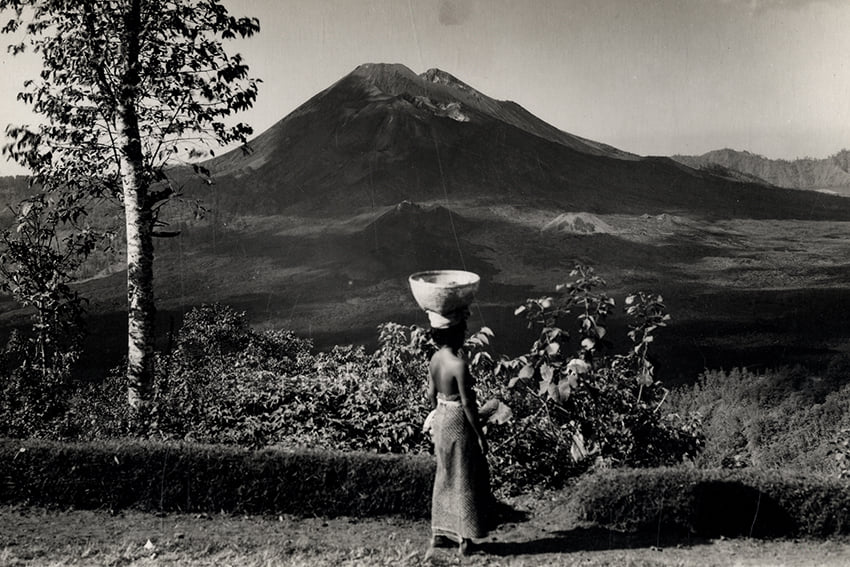
Batur is an area that is a profoundly sacred part of Bali. It is 35 kilometers (22 miles), about a 40 minute drive north of Ubud, the road gently rising all the way. The area comprises Mount Batur, 1,717 meters (5,633 feet), which is a live volcano, often to be seen smoking and rumbling, Lake Batur, Bali’s largest lake and, a lava scarred terrain with many temples. Around live the villagers who serve them.
As mentioned in the chapter entitled Balinese Origins, Volcanoes and Civilisation in Secrets of Bali Mount Batur is an example of a double caldera and is one of the biggest in the world. It is eight and half miles wide. It has been partly filled by the beautiful Lake Batur, which is four miles north to south, and another volcanic cone.
Pura Ulun Danu: Head of the Lake Temple
This temple is at the northeast shore. Read more about it in Secrets of Bali.
The villagers of nearby Songan maintain the temple.
Pura Ulun Danu Batur, Temple of the Crater Lake
This is Bali’s second most important temple after Pura Besakih. It is the ceremonial throne for Dewi Danu, the goddess of the lake. Read more about it in Secrets of Bali.
There are two other nine-tiered merus, dedicated to the god of Mount Batur and to the deified King Waturenggong. King Waturenggong is discussed in the chapter entitled Balinese History – Pre-history to the Europeans in Secrets of Bali.
One of the most interesting shrines is a pavilion in the inner courtyard to the far left. It is Chinese looking, dedicated to a Chinese princess, who resembles one of the Barong Landung characters in the dance play.
The temple stands at the head, physically and symbolically, of the water temple system and controls all water in central Bali. It is the supreme water temple. The temple is maintained by the several hundred irrigation societies, subaks, of the surrounding regions. Subaks are described in the chapter entitled Balinese Origins, Volcanoes and Civilisation in Secrets of Bali. They pray to the goddess of the lake for rulings on water distribution. The high priest, her earthly representative, lays down her rulings. The subaks also pray that there will be no crop pestilence and honour the mountain gods and deified ancestors.
The high priest is an interesting character. Read more about it in Secrets of Bali.
The Paseks of the Black Wood believe that they are the oldest of the Balinese descent groups and that they pre-date the kings. Read more about it in Secrets of Bali.
The second-ranking priest is called the Lesser Jero Gede. Read more about it in Secrets of Bali.
Unlike other temples in Bali, it is permanently open, and has a permanent staff of priests. A virgin priestess selects the 24 permanent priests when they are children. They serve for life.
The age of the temple is unknown, but there are references to it in 11th century texts. There was an eruption of Mount Batur in 1905, when the lava stopped at the main entrance. It was damaged in the 1917 eruption, although again the lava stopped at the walls. Another eruption at 1 am on 3 August 1926 covered the temple in tons of rubble and the village in many feet of lava rocks. Read more about it in Secrets of Bali.
Pura Uluwatu: Temple above the Stone
This is a very beautiful, very sacred temple, whose full name is Pura Luhur Uluwatu, down south on the western part of the Bukit. Read more about it in Secrets of Bali.
The first is Empu (Sage) Kuturan, who came to Bali from Java in the 10th century AD riding a deer. Read more about it in Secrets of Bali.
The other is Nirartha, also a Siwaistic priest who arrived from Java in 1537 AD. Read more about it in Secrets of Bali.
The temple has several unique architectural features. Because it is built of strong coral stone, it is fairly well preserved, although the monkeys have caused some damage. It is set on a spectacular cliff. Read more about it in Secrets of Bali.
It is part of a number of sea temples on the south coast, including Tanah Lot, Pura Sekenan, Pura Rambut Siwi and Pura Petitenget. All pay homage to the guardian spirits of the sea. This one is the most spectacular and is one of the Sad-Kahyangan group of temples of Bali.
For many years entrance was forbidden to everyone except the prince of Badung, who owned the Bukit and visited the temple right up to his death at Dutch hands in the puputan massacre of 1906. Read more about it in Secrets of Bali.
Prior to Bandung the Royal dynasty of Mengwi controlled the temple, but coastal parts of southeast Bali were lost to Bandung around 1810.
You go through a simple limestone entrance and up 71 steps to the rectangular outer courtyard. Read more about it in Secrets of Bali.
All three courtyards are surrounded by coral, which has enabled the temple to survive for centuries and gives it a brilliant white appearance. Read more about it in Secrets of Bali.
When the demon Kala Rahu stole the water of immortality from the gods, the sun and the moon saw him. Read more about it in Secrets of Bali.
The entrance to the inner courtyard is an enormous arched kala gate flanked by Ganesha guardians. Ganesha is the elephant God, the son of Siwa.
At various times parts of the temple have fallen into the sea. Some new parts have been added. The candi-like building is new.
From the centre of the northwest wall is a beautiful view of the steep cliffs and ocean. Go down into the outermost courtyard and from there you can see the tip of East Java 50 kilometers away. Sunset is a beautiful time, when the temple is covered in rich golden light.
The temple has an unexplained rule that nobody can carry a red hibiscus or wear the black and white chequered poleng cloth. See the chapter entitled Balinese Dress and Textiles in Secrets of Bali. for a description of poleng.
Tanah Lot: Sea Temple of the Earth
Tanah Lot is one of the most beautiful temples in Bali, as well as being one of the most important. It means “Sea Temple of the Earth” and looks like a small pagoda. 13 kilometers west of Tabanan in Berabon village, it is built on a huge eroded outcropping of rock on black volcanic sand. World Monuments Watch lists it as one of the 100 most endangered and historical sites in the world.
Read more about it in Secrets of Bali.
It is said that Nirantha, King Waturenggong’s priestly teacher and poet, who came to Bali from East Java in 1537, built Tanah Lot. Read more about it in Secrets of Bali.
The snakes (ular suci) live in sandy holes just above the waterline along the beach. When the tide is out, they slide into the temple. Snakes are holy creatures in Bali. They should not therefore be disturbed.
Many Balinese also come to pray and they must be respected. There are two pavilions and two black thatched-roof meru shrines-one with seven-tiers, dedicated to Sanghyang Widi Wasa, the Supreme God, and the other with three-tiers, dedicated to Nirantha.
Like all Bali temples, Tanah Lot celebrates odalans, once every Balinese year of 210 days; the birthday falls close to the festivals of Galungan and Kuningan, when ancestor spirits are invited to visit their family shrines. Read more about it in Secrets of Bali.
At high tide, when the walkway is submerged, the waves can be rough. It is best to arrive at low tide, which is around noon during a full moon.
To prevent further erosion around the south of the temple, ugly concrete tetrapods have been lowered into the sea. More in front of the temple are planned with the help of soft loans from the World Bank and other international donor agencies.
Famous Balinese Temples
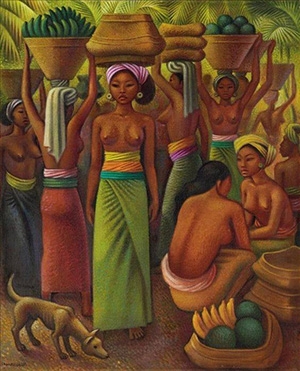
 KLM Poster of Amsterdam to Batavia (Jakarta), 1934.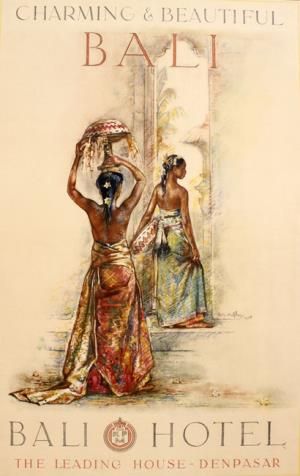



 Soder Havets Paradis. Dance of the Virgins (1935). Swedish movie poster.







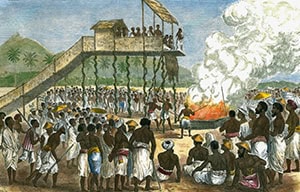 Widow burning in Bali 1860.