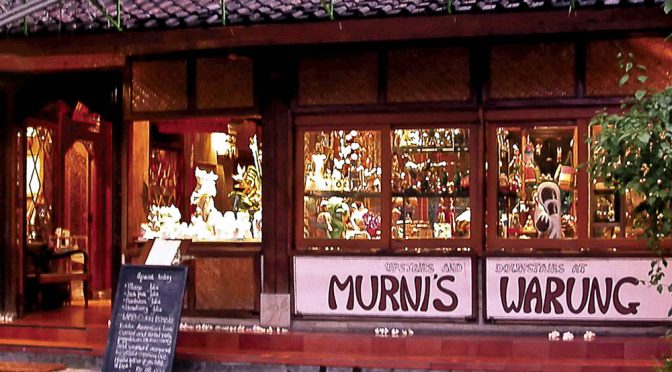
 “Renowned antique collector Ibu Murni founded the first real restaurant in Ubud in 1974, and still manages it actively…”
ShopSmart
Bali & Lombok 2006
“Renowned antique collector Ibu Murni founded the first real restaurant in Ubud in 1974, and still manages it actively…”
ShopSmart
Bali & Lombok 2006
All roads lead to Murni’s Warung

All roads lead to Murni’s Warung, Mary, Martha, Murni’s Warung and Me
Bud Smith
The Times, Lombok, August – September 2007
Mary is my wife, Martha is my mistress, Murni’s Warung is a famous restaurant and I am myself. It is a long story but we all found ourselves on the island of Bali in late 2006. A spur of the moment thing, as often the best – and the worst – of things in life are. Summer is a busy time in London for a jazz singer and I was dead beat, so I proposed to my wife that we take off to Bali in October. I remembered the wonderful mushroom pizzas in the late Sixties and Mary, an interior designer, remembered the fantastic art.
Little did I know that my mistress Martha would be there. Martha is a 25 year old blonde living in Greenwich Village, a beautifully talented poet. I was singing in Soho last year and noticed a book signing in Borders right close to the club. I went in between sets, lined up, told the young poet that I was a man in a hurry, a jazz man in a hurry, had to rush and could she write something poetic. Dear Bud, Harvey Wallbanger, 10.30 in the club tonight, Martha!
Hardly had we got over our jet-lag than Mary and I made a bee line for our favourite restaurant in the whole world: Murni’s Warung in Ubud. We both love good food and drink, but even more we love good food and drink in beautiful places, where the prices are reasonable. Murni’s Warung is one of the most beautiful places on Earth! You walk in, facing you are coconut trees, palm trees and betel nut vines. Suddenly a blue-winged kingfisher glimpses by and a second later his mate. It is no surprise that the Bali Bird Club meets there keeping beady eyes out for bird and butterfly life.
The beauty is not only natural. Murni is a well-known collector of fine arts from all over Asia. At the entrance are Balinese statues, all chosen for their fine carving and fabulous expressions. On the walls are antique shadow puppets: the tree of life, which starts and closes the Balinese shadow puppet play, and the expressive clowns, who explain the story to the audience. They are for sale and I have a fine collection of them. The restaurant is on four levels and all the rooms, and especially the Lounge Bar, are decorated with Asian textiles, tribal pieces and objets d’art. Murni is often at hand expounding on art and food in the same breath.
Mary and I went to our favourite part of the restaurant, which is on the lowest level, just above the river, which you can hear rushing by underneath. So romantic. The President of East Timor and his Australian wife were on the next table. Mary ordered the Balinese Smoked Duck, which comes with Balinese vegetables. President Gusmao leaned over and said, ‘Good choice. It’s really smoked. They don’t fry it here.’ I ordered Bali Guling, a spicy pork dish eaten at special festivals. When I’m in Bali, I can’t get enough of it, and it was especially great that evening. Jacobs Creek Chardonnay helped the food go down. President Gusmao’s wife told us it’s the most popular wine in the World.
Murni’s Warung is famous for desserts. I just love the cheesecake in a strawberry coulis – better than New York cheesecake, which is saying something – and Mary adored her Cashew Pie and ice-cream. We then went to the Lounge Bar to have a chat with Murni, who was preparing to go to San Francisco to exhibit some of her collection, and drink a couple of cocktails. They play rather good jazz in there too.
Nyoman, the bartender, discreetly handed me a note. ‘Dear Bud, Harvey Wallbanger,10.30 in the Lounge Bar tomorrow morning, Martha!’. It was the Readers and Writers Festival in Ubud and Martha was launching her latest book of poetry. Nyoman smiled and said, In Bali all roads lead to Murni’s Warung!
All roads lead to Murni’s Warung
Rough Guide, Bali
Murni’s Warung: Follow the stairs all the way down to the lowest level of this multi-tiered restaurant and you’ll approach the setting for it’s built into the wall of the steep-sided Wos River valley. This restaurant is an Ubud institution and serves curries, home-made soups and Indonesian specialties as well as serving things, such as strawberry cheesecake and banana caramel cake. Also free WiFi.”
Rough Guide, Bali, September 2008

Ubud News
Ayu Intipid
Bali Advertiser, December 2007
I remember a time when you were lucky to find anything more than fried bananas on local restaurant menus. Then came Murni’s Warung. Established in the early eighties [actually 1974], Murni’s Warung was one of the first restaurants to serve a selection of international sweet dishes to appease the cake eating, chocolate-craving tourist. It was the chocolate brownies and home-made pies that served many a home-sick traveller.
Perched on the edge of the Tjampuhan suspension bridge, Murni’s Warung is run by none other than Ibu Murni. Ibu Murni is a well-known local identity, hailing from the narrow streets of Penestanan and is one of the culinary tour-de-force mothers who set the gastronomic standard of Ubud.
But it is more than that.
Murni and others in her league shaped the eating style of Ubud by adding loads of gracious Balinese hospitality and charm to their establishments. Ibu Murni still runs her world famous Murni’s Warung, in between belting it out with the local badmington team. Drop in and say hello over a piece of pie.
She loves having a chat.
Ubud News
Ubud & Beyond
Bali Advertiser, 2008
You can’t visit Ubud without going to Murni’s Warung, its most romantic restaurant at the Campuan bridge. The food is simply excellent and very reasonably priced. The setting above the Campuan River is stunning and it’s open every day, 9am – 10 pm.
There are great local and Western dishes or you can just have a snack washed down by a tropical fruit juice or something stronger. Murni’s has the best yoghurt and cheesecake anywhere.
It is owned by Murni, a very charismatic lady, who founded it in 1974. She’s usually around and enjoys a chat. She’s a treasure trove of information and was the consultant for Secrets of Bali which explains all you need to know about Bali.
Murni also has one of the best shops in Bali, known for rare ethnic pieces from all over Asia. She’s the place to go for textiles, jewelry, gifs and high quality handicrafts. Murni’s Warung Shop is very convenient as it’s part of the restaurant. The best pieces are upstairs.
Murni has accommodation too. Murni’s Houses are in the centre of town. Murni’s Villas with its jaw-dropping infininity swimming pool and uninterrupted views of hills and rice terraces are about 15-20 minutes’ drive outside Ubud. They are a favourite place for weddings, very private and luxurious, and about third the price of a 5 star hotel.
2008
Ubud & Beyond
 Bali, The Ultimate Guide to the World’s Most Spectacular Tropical Island
“West of Central Ubud. Murni’s Warung, Campuan. An old favorite, on the Ubud side of the Campuan bridge overlooking the stunning rainforest and Wos River. This multi-storied restaurant, decorated with Asian antiques from Murni’s collection, is where the eclectic mix of Western, Indonesian, and Balinese favorites got its start in 1974. Murni’s menu and dishes have stood the test of time and the satay, gado-gado, and grilled fish are delectable. The Lounge Bar, loved by expats, plays soft jazz. The lower dining areas offer tranquility with only the sound of the river accompanying the peace. Outstanding desserts and freshly-squeezed fruit juices.”
Bali, The Ultimate Guide to the World’s Most Spectacular Tropical Island
Linda Hoffman
Tuttle Publishing, 2012
 “The best place to have a meal is Murni’s Warung. A four-story open-air eatery and bar overlooking a jungle-clad bend of the Campuan River, it was the first restaurant to open in Ubud, way back in 1974.”
Hip, Hitched, Hooray
Ian Lloyd Neubauer
The Sydney Morning Herald
10 March 2013
Aussie brides choose Bali to wed over any other destination. Ian Lloyd Neubauer reveals the island’s most popular venues to say I do.
Murni’s Houses @ Ubud
Set in a velvet-green valley in south-central Bali, Ubud is the spiritual capital of the island. Like something out of a Rudyard Kipling novel, the town is overflowing with Hindu temples – thousands in fact.
Don’t miss the lotus pond-ensconced Pura Saraswati temple, which is next door to a Starbucks, or the Gunung Kawi archaeological park half an hour out of town. And while it’s a no-brainer destination for Hindu weddings, this moss-covered fairytale of a place is also a popular destination for Christian weddings.
The best place to have a meal is Murni’s Warung. A four-story open-air eatery and bar overlooking a jungle-clad bend of the Campuan River, it was the first restaurant to open in Ubud, way back in 1974.
A few blocks away is Murni’s Houses, a traditional Balinese compound with four temple-like houses and an award-winning day spa set in a pixie’s garden.
“Why get married in Ubud? For starters it’s more traditional and authentically Balinese,” says owner Murni who, like many Indonesians, goes by one name only.
“And it’s cooler than the coast, which can be very hot. But the main difference is the scenery – many people like the backdrop of rice terraces for the ceremony.
“I’ve lost count of how many weddings we’ve done over the years,” Murni says. “I enjoyed them all, but the most memorable was the first, as I wasn’t sure we could do it. I was more nervous than the bride.
“We set the place up beautifully for the wedding by the pool: lots of tropical flower arrangements, tall Balinese umbrellas, ritual offerings and an antique table for the wedding book. Then it poured down. We quickly had to change everything, and then have the ceremony in my living room.
“But it all went well. And it gave us the confidence we could do weddings well, because we could deal with the unexpected.”
The Sydney Morning Herald
Half Century Restaurant
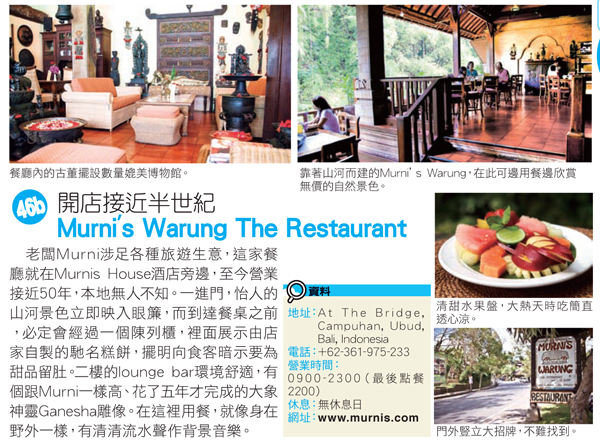
Murni’s Warung The Restaurant
Sky Publishing Guide to Bali 2013-14
Hong Kong
Murni has a lot of businesses and this restaurant is another one. Right next to the hotel, the restaurant has already been open for nearly 50 years. Every local knows about it. Once you step into the restaurant, the pleasant river and mountain view first come into sight. On the way to the table, you will walk past a display case in which the famous pastries are delightfully presented. The lounge bar on the 2nd floor has a cosy environment. It houses the hugh sculpture of the Elephant god Ganesha. The sculpture is as tall as Murni and took 5 years to finish!
Half Century Restaurant Murni’s Warung
 “Calling itself Ubud’s “first restaurant,” Murni’s Warung has introduced Balinese food to the likes of Richard Gere, Mick Jagger, Richard Branson, Jean-Claude Van Damme, and David Copperfield. Since opening as a warung (roadside stall) in 1974, Murni’s has grown to four levels running down the river’s edge. (Book a table at the bottom for the best views.) The menu has also grown, adding Indonesian and Western choices, but the foundation remains Balinese, with local standards like ayam betutu (spicy roast chicken), babi guling (roast pork), and black rice pudding, plus rarer specialties such as smoked curry duck. It’s great for lunch.”
Fodor’s Guide, 2013

Murni’s Lounge Bar – Ubud’s most haunting watering hole
Ian Lloyd Neubauer
Travel and Leisure Asia
January 2014
“Set above a gentle bend in the Agung River, Murni’s Warung holds the estimable title of being the village’s first real restaurant. Like something out of a Rudyard Kipling novel, the Lounge Bar on the second floor is crammed with museum- quality antiques, including a 400-year-old plate of armor and a Sumatran sarcophagus. Soft jazz music, old-fashioned cocktails and the sounds of the jungle lurking outside make this Ubud’s most haunting watering hole.”
Eat, Pray, Shop
A one-time haven for hippies, the village of Ubud in Bali’s southern highlands now caters to more sophisticated travelers too.
Travel and Leisure Asia
Ubud Icon Murni’s Warung Turns Forty
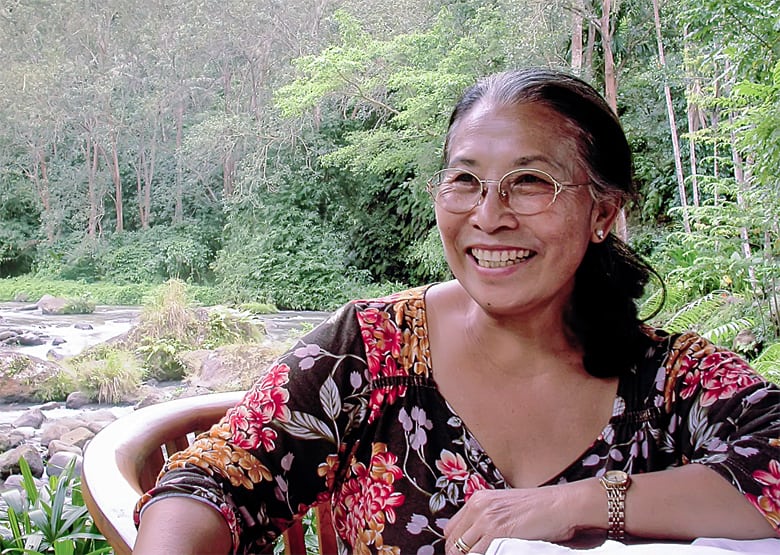
She is often referred to as the “mother of Ubud,” and her restaurant has been a longtime favorite among both travelers and locals: Ni Wayan Murni, a Bali native who recently celebrated the 40th anniversary of Murni’s Warung with the launch of a book that includes personal memories and anecdotes of people who have accompanied her on her journey from the 1970s until today.
Author and photographer Jonathan Copeland, co-editor of “Forty Delicious Years,” as well as a good friend of Murni, said that it felt right to celebrate this milestone “in a more tangible way than simply a T-shirt and party.”
“We didn’t want a book blowing our own trumpet — there are enough of those vanity publications around — but instead a book focussing on the times and life of Murni’s Warung as seen through the eyes of its guests over 40 years,” he said.
It is an approach that gives readers the chance to learn more about Murni and also about Ubud and Bali in general, and particularly how significantly it has changed over the years.
The first thing that needed to be done was to decide on the number of contributors; 40 contributor for 40 years was the logical solution.
“We then compiled a list of colorful, engaging and interesting characters whom we thought we could contact,” Copeland said. “We went through the time-consuming process of trying to track them down. Some were easy to locate but some were impossible to find. We were delighted with the final list as they comprised a wide range of nationalities, occupations and ages which cover the life of Murni’s Warung from day one until the present. They are all busy people with big jobs and we are very grateful for the time they spent on this.”
Murni, who was born in Penestanan, just a few minutes away from Ubud, began selling breakfast snacks before going to school in the 1950s. Less than 20 years later, Murni already owned four shops on Sanur Beach and established Murni’s Warung in Campuhan-Ubud.
Besides traveling the world and collecting Asian antiques and textiles, Murni built Murni’s Houses and Murni’s Villas catering to the growing number of tourists, and recently opened the Tamarind Spa at Murni’s Houses.
In the book, Murni writes that she still finds it incredible to look back at how she started Murni’s Warung — with no more than a bowl of soup and a sandwich.
“I wasn’t a cook and had no knowledge of what Western food was. I had no business plan, no mission statement, and no spreadsheets. I didn’t have electricity or a fridge or an electric oven. I didn’t have staff or suppliers or a car,” she said. “But I did have passion and drive and energy. And I had friends and customers and hard work. Luckily, Murni’s Warung grew and prospered and has been able to serve food and drinks to thousands of people these 40 years.”
Murni also has a very special connection to the restaurant’s location on a gorge above the river Wos, which is sacred to the Balinese people.
“It has been part of my life, going back more than 40 years,” she said. “When I was a very young child […] I played and bathed down there at the river and among the rocks. When I was older, I helped carry rocks up from the river bed to the road for construction use. Later still, after my parents split up, I secretly met my mother below the bridge. I never dreamed that I would be able to buy part of the gorge, live there and go to sleep to the sound of the sacred river crashing over the rocks.”
Jonathan Copeland, who has worked with Murni on three previous publications, said that not many people can survive in the highly competitive F&B industry, especially these days, when new restaurants pop up everywhere in Bali.
“Restaurants often start out as flavor of the month and fizzle out,” he said. “It is not an easy business and diners are demanding and unforgiving customers who don’t give you a second chance.
“I think it’s easy, in retrospect, to see how Murni’s early success came about,” he added. “In the early days there simply wasn’t a place in Ubud to get good food. Murni’s Warung was a beacon for early travelers to hang out. They spread the word and they still do. But obviously there had to be substance to it. I think the substance is what has made Murni’s Warung remain a favorite for so long. Murni is a perfectionist. She is very concerned about the comfort and happiness of her guests. And she is a traditionalist concerned about the preservation of Balinese culture. Murni’s Warung is a Balinese building with Balinese food served by Balinese waitresses in Balinese dress.”
Dr. Lawrence Blair, an anthropologist, author and filmmaker who has been based in Bali for almost 40 years, was among the warung’s earliest customers and still vividly remembers a quiet Ubud.
“Instead of tourists, there were only a few ‘travelers’ and barely a handful of eccentric resident expats,” he writes in his section in the book. “And the place to meet them was Murni’s Warung. But the first real draw to Murni’s was the discovery that hers was the sole place in Ubud to have mastered that most rare and esoteric art of producing a sunny-side up properly fried egg. Further cause for enthusiasm was when she also became the first person in Ubud to provide natural yoghurt and wild honey with one’s tropical fruit.”
Blair was also witness to some of the illustrious figures who have visited Murni’s Warung over the years, including Richard Branson, Mick Jagger, Richard Gere and Diane Von Furstenberg.
“My only regret is that they weren’t all there at the same time,” Blair wrote.
Australian-born Janet de Neefe, founder of the Ubud Writers and Readers Festival, has also been a regular to Murni’s since the 1980s.
“Many of my fondest memories of Ubud in the Eighties are wrapped up in the walls of this multi-leveled eatery,” she writes in the book. “We’d sip on freshly squeezed lime drinks brimming with crushed ice while slowly eating nasi campur or nasi goreng . Lunchtimes drifted into dinner and it didn’t matter. There was nothing urgent to be done except chat about life, love and cosmic heroes — there were no mobile phones, Internet, e-mails, reality TV, not even Facebook.”
De Neefe, like the other contributors, have always enjoyed the peaceful surroundings as much as the delicious food. But they also all agree that Murni, the heart and the soul of the restaurant — some might even argue, of Ubud — has always been the real draw and the secret of the restaurant’s lasting success.
“Back then, I remember that one of the greatest joys about visiting Murni’s Warung was simply Murni,” de Neefe said. “She used to sit at the front desk and invariably wander up to your table and have a chat. There is so much to love about Murni. Whether it be her heart that’s as big as the moon, her gentle nature, grace or soft humor.”
Ubud Icon Murni’s Warung Turns Forty

Worlds on a plate
A fusion revolution is firing up Ubud’s fine dining scene
Ian Lloyd Neubauer
The Australian Financial Review, 17-21 April 2014
“An hour’s drive, but a million metaphorical miles away from the crowded beaches of southern Bali, the village of Ubud has long been cherished by travellers as a place to tune in and drop out, practise meditation or yoga, recharge with spa treatments or immerse oneself in velvet green jungle surrounds. In sync with the zeitgeist, Ubud’s culinary scene has focused around neighbourhood warungs – curry houses, satay grills and noodle shops run by charismatic village women.
“The warung is an extension of the home, where the cooking is done by mothers and grandmothers, where the food is practical and the recipes have been passed down through generations,” says Janet Deneefe, the Australian author of the definitive Indonesian cookbook Bali – The Food of My Island Home. Warungs are still as popular as ever and eating at one is an indispensable part of every visit to Ubud. But, in recent years, the village has seen an influx of gastronomes such as Deneffe, who have paired European culinary techniques with the flavours of Bali to create a fine-dining scene writ large. Here are venues that stand out…:
Murni’s Warung
Set in a jungle-clad gorge overlooking the Wa River, Murni’s Warung was Ubud’s first real restaurant. “When tourists first started coming to Ubud in the 60s, there was nowhere for them to sit down for a meal,” says Murni, who like many Indonesians goes by one name only. “The warungs closed after lunch. But I thought I could offer more. So I made friends with an American girl who gave me the recipe for apple pie, cheesecake and guacamole. At first, I didn’t even know what these were. We never had this food in Indonesia!”
The cakes at Murni’s are still as comforting as ever, though for a real taste of Ubud, order the bebek betutu – Balinese duck. Marinated overnight in Indonesian herbs and spices, and served with finely chopped vegetables, a pyramid of yellow rice and confit sauce, the meat literally melts in your mouth…”
The Australian Financial Review
forty forte
Hello Bali, Editor’s Finds, February 2015
If you have been living in Bali for some time, chances are you know and love Murni’s Warung in Ubud. Dating back to the 1970s, Murni’s Warung is a treasured food joint with authentic Balinese food and Campuhan River views. Furthermore, Ibu Murni herself is a beloved figure whose hospitality has earned her many friends and loves over the years.
However, if you don’t yet know who Ibu Murni is or where to find Murni’s Warung, it’s high time you do. One of the best ways to do that is to read Forty Delicious Years, a compilation of stories about the warung and the namesake founder told by the warung’s eclectic patrons. It’s an interesting insight into what it’s like to be among the island’s insiders.
To Buy: click here.
Murni’s Warung,
forty forte

Bali 2016 Petit Futé.
L’avis du Petit Futé sur MURNI’S WARUNG
Ce vieux restaurant, tenu par une Balinaise, fut le rendez-vous des branchés des années 1975-1980. Dans un superbe cadre (descendre les terrasses successives accrochées à la gorge pour arriver tout en bas, dans un bain de fraîcheur et de végétation), Murni concocte depuis des décennies une cuisine indonésienne et thaïe à la fois authentique et travaillée (elle a hérité des recettes de sa mère et de sa grand-mère), à base d’ingrédients frais et de qualité. On peut aussi goûter aux lasagnes, aux hamburgers et aux salades, mais surtout aux gâteaux maison simplement divins. Pains et yaourts maison.
Murni, qui est également le propriétaire de Murni’s Houses et du Spa Tamarind, ouvra le premier restaurant d’Ubud en 1974 dans un petit coin de jungle sur les bords de la rivière Wos. Ce lieu est incontournable pour de nombreux expatriés, visiteurs, artistes, écrivains et photographes. Le menu est international, varié et savoureux, notamment le célèbre canard fumé balinais et autres spécialités locales. Très bons desserts. Dinez sur un des quatre étages et surplombez la rivière, flânez dans la boutique Murni’s Warung Shop et venez écouter du jazz au Lounge Bar décoré avec la collection personnelle d’art tribal asiatique et d’antiquités de Murni.
Bali 2016 Petit Futé
This page contains several Videos of Murni’s Warung.
Drew’s Travel Adventures – Biyahe Ni Drew is a popular TV travel show in the Philippines that takes its viewers on an adventure every week.
It is broadcast by GMA News TV and GTV and hosted by actor Drew Arellano and has won many awards.
Murni’s Warung in a Minute!
This video is a very brief overview of what’s available in Murni’s Warung. It is part of a series, including Murni’s Warung Shop, Murni’s Houses and Tamarind Spa at Murni’s Houses.
Brian and Melissa’s Balinese Blessing, Murni’s Warung, Ubud, Bali
We can arrange a Balinese Wedding or Blessing at Murni’s Warung (as well as a Wedding Reception).
Murni’s Warung can accommodate at least 100 people over the four levels. We can also arrange entertainment.
Brian and Melissa from Australia close to renew their wedding vows in formal Balinese dress before a Balinese priest at a wonderful, private ceremony at Murni’s Warung to the sounds of the priest’s bell, the sacred river below and 2 Balinese tingklik players.
Videos of Murni’s Warung
Murni’s Warung‘s fame has meant that it’s been the setting for a couple of works of fiction: Gotton Island and Bali Gods Crying and has also figured prominently in two recent works of non-fiction about culinary tourism and Balinese food: Ubud, The Spirit of Bali and Balinese Food, The Traditional Cuisine & Food Culture of Bali.
Fiction
Golton Island
 Golton Island
Douglas Gellatly
Smashwords, 2013
The novel is the second of an ebook trilogy following the lives of two gay guys called Richard and Max, who live on Golton Island, Australia.
“Being much nearer to the equator than their own Golton Island, the sun set at about six o’clock and nighttime descended quickly. Max and Richard asked at the reception desk where they could go out for dinner, and were directed to Murni’s Warung, just over the river on the main road. The restaurant is also set on the side of the same ravine and, in daylight, some tables have a view down to the flowing river below. That night, Richard and Max enjoyed an entrée of Lumpia, a deep-fried spring roll served with peanut dipping sauce, followed by Cap Cay, a vegetable stir-fry with everything thrown in together, and then Black Rice Pudding. Bintang beer accompanied their meal. Having made an easy start that day in order to catch their flight, Max and Richard then walked along the dimly lit road and hotel pathways back to their room and slept soundedly cuddled up to each other….
Back in the hotel, they rested and swam in the pool during the afternoon, then that night decided to go back to Murni’s Warung for dinner. As they were concluding their meal, Murni herself came to join them at their table, having introduced herself first. In her friendly way Murni chatted animatedly about her restaurant and her life, a smile often crossing her broad, dark face, her eyes twinkling. “What were things like in Ubud when you were a child?” Richard asked. Murni smiled and said, “Oh, very basic. We had no electricity, no running water, the roads were dirt tracks. No-one had any money and we had to make do with whatever came along.” “What did you do for food?” Max asked. “We ate whatever we could catch or collect. As a bare-footed child, I would catch capung dragon flies, with a sticky substance on the end of a long bamboo pole, and we would cook and eat them. Or I would catch eels in the rice paddies, or shrimps in the river, which we would also cook. And there was always fruit like pisang, bananas, or durians or coconuts.” “And now you’ve got this restaurant,” Richard observed. “Yes, and I hope that you have enjoyed coming here,” Murni said. “What else have you gentlemen being doing while you have been staying in Ubud?” They told her of the various things they had done, including the cooking class, and Murni said, “Thank you for contributing to the economy of this town. We all need as much help as we can get.”
The whole chapter is narrated here by Douglas Gellatly:
Bali Gods Crying
 Bali Gods Crying
Richard Mann
Gateway Books International, 2013
The novel is based on true events in which unscrupulous criminals are threatening Bali’s Hindu religion and civilization. The heroine lives in Ubud.
“Maybe something romantic will happen to you,” said Oz wickedly. Celine was silent, looking around her. They had a late lunch at Murni’s Warung next to an old Dutch suspension bridge across the two rivers of Rsi Markandya in a comfortable lounge decorated like a Balinese antique gallery and overlooking the gorge she had seen from the suspension bridge. “Even your lunch venue has a special meaning,” smiled Oscar. “Murni’s was almost the very first tourist restaurant in Ubud. Sometimes Murni is here and loves to tell visitors about Bali’s culture.” On their way out of the restaurant the French language caught Celine’s eye from a selection of promotional materials on a low side table. “Un Momento Oz,” she called pointing at the table. “I want to see what they have in French.”
…
Celine remembered her way to Murni’s so she went there for a breakfast of eggs, fruit and coffee, much more than her normally frugal, diet conscious fare in France … Outside Murni’s she walked down a slight hill along an asphalt lane romantically overhung with long tendrils of trailing creepers, past the temple housing the statue of Maharesi Markandya that Oz had told her about, turned right and was almost immediately in the rice fields.”
Non-Fiction
Ubud, The Spirit of Bali
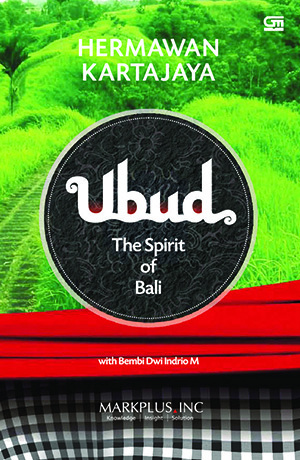 Ubud, The Spirit of Ubud
Hermawan Kartajaya
Gramedia, 2009
Chapter 6 The Food Paradise
One of the major attractions of Ubud is its culinary tourism … For the Hindu-Balinese cooking is a form of devotion to Almighty God. Most of the traditional Balinese dishes we know today, such as grilled chicken or roast suckling pig, were formerly prepared for traditional religious ceremonies. These dishes only began to be served in restaurants after tourism became a major industry.
Restaurants began to develop in Bali in the 1970s. Though foreigners have been visiting Bali since the 1930s, there weren’t many restaurants because many of the early visitors were artists who stayed in local people’s homes, where they also took most of their meals. It was only in the 1970s when a greater variety of tourists started coming and the tourism sector in Bali began to expand, that restaurants started appearing one by one…
The restaurants eventually became meeting places where all kinds of people came together and interact, and not simply places to fill one’s stomach. Restaurants are venues for discussions on many topics…
A number of restaurants have become legends among food lovers, both for their food and for other reasons. Below are the stories of a few of these restaurants, some established by native Ubudians and some by expatriates.
Murni’s Warung
Murni’s Warung was probably the first restaurant to become popular among tourists, especially foreigners. It’s located on Jalan Raya Sangginan, directly opposite the old iron bridge from the Dutch colonial days known simply as The Bridge.
The founder and owner of this restaurant is Ni Wayan Murni; this is why it’s called Murni’s Warung. The restaurant has a long history. Ibu Murni started out as a salt trader in the 1950s when she was not yet ten. She had to carry large baskets of salt from her home in the northern part of Ubud to Desa Penestanan, about two kilometers away.
Also, when she was very young, her parents separated. Little Murni went to live with her aunt in Denpasar. There she had to get up at two in the morning and sell food until five, before going off to school.
Some time later, young Murni returned to Ubud and lived with her mother. They had a small shop in Pasar Ubud where they sold products such as beer, soft drinks and batik to foreign tourists. At the time theirs was the only stall in the market that sold beer and soft drinks, so drinks were often purchased from their stall to entertain guests at Puri Ubud. And President Sukarno, who often visited Ubud, once bought some of their batik.
In the early 1970s, Murni opened her own shop on a small plot of land on Jalan Raya Sangginan – the venue of the present restaurant – which she rented from a man called Pak Munut. The shop sold sarongs, carvings and paintings. Ibu Murni was no cook, so it didn’t occur to her to open a food stall. And there was little furniture, just one bamboo table and two chairs.
There was a customer from the United States, one Patrick Moore Scanland, who often asked Ibu Murni to make him sandwiches and beer at the warung. Eventually many other guests wanted the same, and that was the start of Murni’s Warung.
In 1974 Ibu Murni married Patrick. One year later, they bought the land and opened the restaurant, Murni’s Warung. At the same time they opened an antique shop with a collection of art works from all parts of Asia.
Murni’s Warung had, and has, a very loyal clientele. The customers helped promote Murni’s Warung and taught Ibu Murni how to cook Western food. This is how Murni’s Warung became known as the first restaurant in Ubud to offer Western food to tourists.
The architectural design of Murni’s Warung is in traditional Balinese style, with an open air concept. The building has four storeys, going down from street level, as it is built on the banks of the Wos river. There are paintings and statues throughout the restaurant; one of the most interesting portrays the scene around Murni’s Warung in the 1970s.
On one storey, there is a room for special private events. Inside The Lounge Bar there is a large statue of Ganesha. On the lowest level, we can enjoy our food while watching the Wos flowing past.
The favourite dishes here are Nasi Campur Bali (rice with various side dishes), Nasi Goreng (fried rice) and typical Indonesian dishes such as cendol and sweet iced tea. As well as traditional dishes, Murni’s Warung offers many other choices.
In addition to the food, as mentioned earlier, Murni’s Warung has an antique store that sells a variety of souvenirs and antiques from throughout Indonesia: textiles, statues, traditional heirlooms, paintings and so on. Ibu Murni herself often travels abroad and collects antiques from the countries she visits and to display and sell in her shop.
The present building of Murni’s Warung is very different from the original structure built in 1974. The present building is the result of a major renovation in 1992, but the traditional Balinese architecture remains the same.
Balinese Food, The Traditional Cuisine & Food Culture of Bali
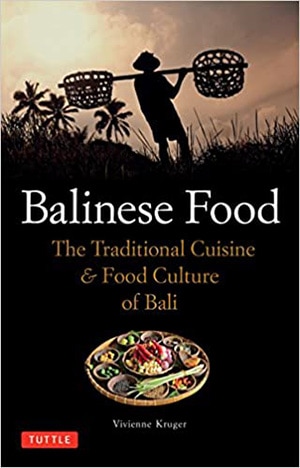 Book Review: A Spiritual Journey Into The Culinary World of Bali
Jonathan Copeland
Jakarta Globe
17 April 2014
What a joy this book is! I love recipe books, but it’s short-lived; I enjoy the pictures for several minutes, read a few pages, and then my eyes glaze over. They are basically books to be used in the kitchen for one recipe at a time. This book, however, is in a different class altogether and designed to be read in its entirety. It’s in its own sui generis category; it has recipes at the end of most of the twenty-one chapters, but it’s a book to be read from cover to cover, yet it could easily be read chapter by chapter, in any order, as they are all self-contained. Every bite-sized chapter is a flowing narrative from a well-stocked brain encompassing Balinese culture, geography and history, while not losing its main focus: food.
As you would expect from a scholar with a PhD in history from Columbia University, the subject matter has been meticulously researched, not from books and articles and other people’s work, but from actually being on the ground and in the markets and in the kitchens of Balinese families, where the Balinese themselves learn their culinary skills, hands on, passed down orally, manually and practically from generation to generation.
Vivienne Kruger has lived in Bali long enough to get it right. That’s no mean feat, as the subject has not been fully studied before.
Yes, there are so-called Balinese recipe books, most, if I’m not mistaken, written by foreigners, and heavily adapted. The dishes have not, until now, been systematically placed in their proper cultural context, which is extremely important for the Balinese, nor has there been any examination of the numerous varieties of each type of recipe, nor have they been given their true Balinese names.
This groundbreaking book is a pleasure to read, not just for its fascinating content, which I learnt a lot from, but for the exuberance, enthusiasm and originality of the language. There’s not a dull sentence in the book. You just can’t wait to read the next phrase.
There are eye-opening and jaw-dropping passages for the general reader as Kruger describes delicacies from the village of Tengkudak in Tabanan district — grasshoppers, dragonflies, eels and live baby bees — and explains how they are caught and cooked. She does not shy away from controversial subjects, such as eating dog and turtle. Parts of it are not for the faint-hearted, but other parts make you want to go out and join the participants, such as the Nusa Lembongan fishermen, who sail their outriggers at 5.30 a.m.
The author quotes Miguel Covarrubias, the great Mexican Bali observer of the 1930s, who wrote the wonderful Island of Bali, and which has inspired all writers since, including myself and my co-author, Ni Wayan Murni, in our book Secrets of Bali, Fresh Light on the Morning of the World. There is, however, no bibliography, which I found strange at first. I can only imagine it’s a reflection of how original the subject matter is; there simply are no other sources.
The author in many, if not most, places mentions the prices of ingredients and dishes. This is interesting and helpful in giving an idea of the relative cost of goods, but it’s already out of date. I’m afraid that with Indonesian inflation currently at over 7 percent, and more for some items, the prices she quotes are on the low side. Furthermore, there are seasonal swings in prices. As every Balinese housewife knows, when a ceremony is approaching where, say, bananas are required to make the offerings, the price of bananas goes up. So, if the author quotes the price of pepper, just take it with a pinch of salt.
Throughout the book Kruger mentions Balinese and Indonesian words and sometimes discusses their derivations. It’s a Herculean task. I was intrigued to read that “satay” comes from the Tamil word for flesh ( sathai ) and that South Indians brought satay to Southeast Asia before Indonesia developed its own tradition. The book is full of interesting titbits like this.
I was hoping that there would be a glossary of all these words for future reference, but I can quite understand the publishers’ reluctance, as it would have doubled the length of the book. Perhaps an accompanying glossary for future publication would be worth considering. The book contains 47 recipes in all, 11 of which came from Murni’s own restaurant, Murni’s Warung, in Ubud. Mr Dolphin of Warung Dolphin in Lovina also contributed a number of recipes. Kruger adds an introduction to each recipe, with a detailed and usually very personal commentary.
I think my favorite, though, is from a village priest (pemangku), I Made Arnila of the Ganesha (Siwa) Temple in Lovina.
Mantra Ganesha Mantra
Guru Gayatri Mantra
Mantra Durga
I don’t think many readers will be qualified to use the recipe for holy water, but I am sure most will enjoy this book enormously; I certainly did.
The author was interviewed for the Indonesia Expat magazine.

Vivienne Kruger: Balinese Food
Bill Dalton
Indonesia Expat
6 May 2014
Considered a leading authority on the culinary arts of Bali, Vivienne’s book Balinese Food: The Traditional Cuisine and Food Culture of Bali was published by Tuttle in April 2014.
What inspired you to get into food writing?
I started out writing articles about a prominent Balinese restaurateur, Ni Wayan Murni, the owner of Murni’s Warung in Ubud. While researching her fabulous restaurant and the foods on her menu, my interests took an unexpected turn into traditional Balinese cooking—and I just kept going!
What’s so special about Balinese Food?
Balinese food is singular among the leading cuisines of the world. Dedicated to the gods and fuelled by an array of fresh spices, it’s inextricably bound to the island’s Bali-Hindu religion, culture and community life. The Balinese cook with love, art, reverence and exactitude. My book bears witness to Bali’s time-honoured, authentic village cuisine as well as its spectacular ceremonial feasts when food is carved, etched and painted into the rich spiritual shapes and divine colours of holy temples and imposing royal palaces. Curious strangers can only gape in awe, respect and admiration as they struggle to learn how to make these intricate food offerings.
Murni’s Warung in Literature
To contact us:
We always reply to emails – and the form – within 24 hours, usually more quickly, often immediately. If you don’t get a reply using the form, something has gone wrong, so please email us.
To call Murni’s Warung directly to make a booking:
Tel: +62 361 975233
WhatsApp +62 812 391 69648
Chat on WhatsApp between 9 am and 10 pm:

Murni
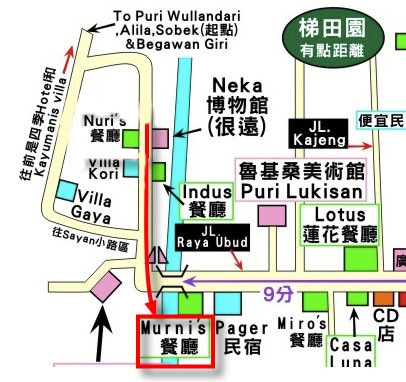
Click on the map for a larger version.

Murni’s Warung is just 5 minutes walk from the town centre.
From the town centre, start on the side of the main road where the market is, opposite the palace, and go towards Murni’s Warung.

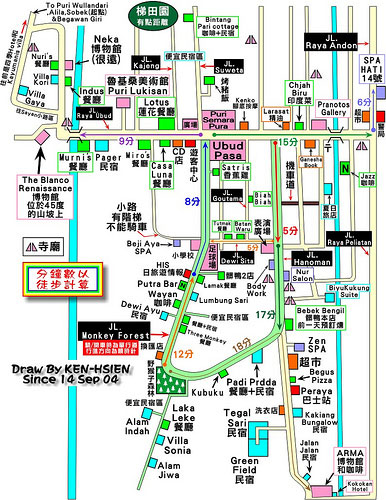
Transport and Map to Murni’s Warung
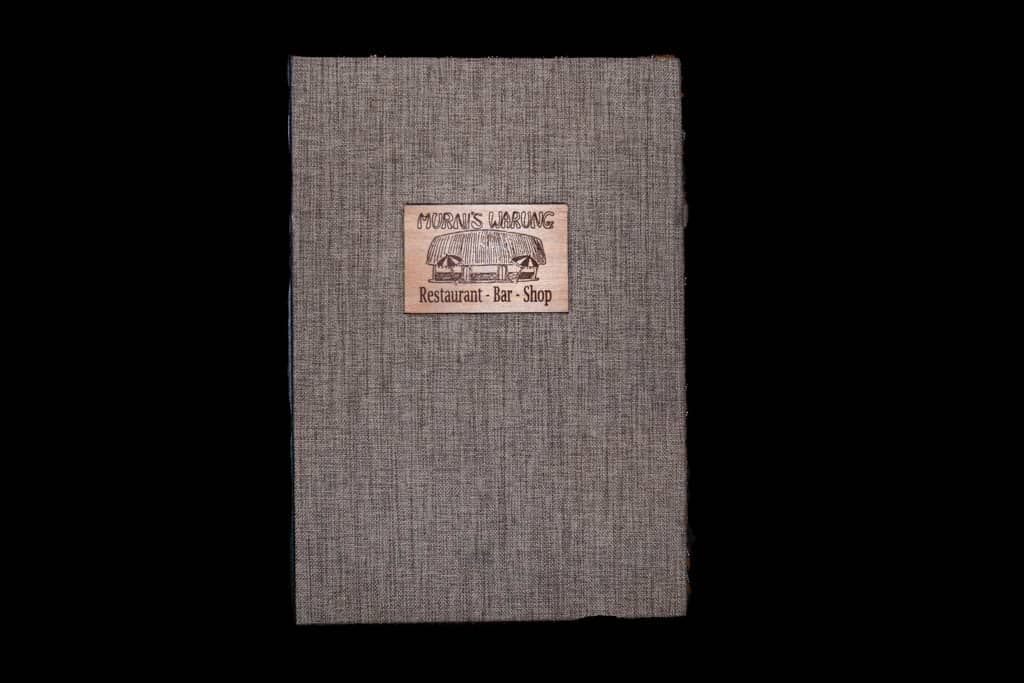
 Our great new menus:
Also see Buffet Menus and Set Menus:
To book: