Category Archives: Murni’s Warung Shop

Secrets of Bali – Book review by Rob Goodfellow

Book review by Rob Goodfellow

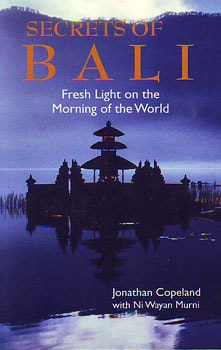
Secrets of BaliSecrets of Bali, Fresh Light on the Morning of the World
by Jonathan Copeland
with
Ni Wayan Murni

Published by Orchid Books


Book review by Rob Goodfellow

An account of Bali’s past and present

(Jakarta Post, 5 September 2010)

Bali is one of the world’s best-known “tourist brands”. It is not just an island, but a phenomenon. Ironically, until recent times, most Americans, Europeans, Japanese and Australians knew something about Bali, but were not sure where Indonesia was.

   Yet, increasingly, Bali is the prism through which the world sees and judges Indonesia, one of the most important countries on Earth.

   As far as the pervasive global media industry is concerned, if all is well in Bali, then all must be well in Indonesia. The world-wide media coverage of the 2002 and 2005 Bali bombings is evidence of what happens when this tranquility is disturbed. Suddenly, Indonesian home-grown terrorism was thrust onto the world’s conceptual radar screen, where it has remained ever since.

   This perspective has come into sharper focus as “the West” has become increasingly concerned with the advent of a pan-Southeast Asian Islamist movement—one that combines a collective base of 200 million Indonesian Muslims, mistreated Muslims in southern Thailand, internationally organized Malaysian Muslims, the wealthy Muslims of Brunei and the Muslim guerrilla fighters in the southern Philippines.

   On the outer rim of this potential ideological “ring of fire” is the extraordinary outpost of Hindu culture and religion known as the Island of Bali.

   Indian prime minister Jawaharlal Nehru once poetically called Bali “the morning of the world”. The island gives us a glimpse of what Indonesia might have become had the Java-based Islamic Kingdom of Mataram not defeated the Hindu kingdom of Majapahit over five hundred years ago, irrevocably changing the character of the then “East Indies”, and in turn, modern Indonesia.

   For this reason Bali is sometimes referred to as a “living museum of Hindu-Buddhist Java”. However, for many visitors the fascination with Bali is not about the past at all, but it is about the right now—today. Bali can teach us many lessons. One lesson is about the values of an ancient culture that has stood the test of time despite the forces of globalization and cultural homogenization.

   Above all, Bali represents the hope that human diversity can survive the 21st Century. For reasons not completely understood by anthropologists, Balinese culture remains vibrant, complex and colorful, both in spite of mass tourism and because of it.

   Bali has not withered into a pale brochure-like parody of itself because of the onslaught of mass tourism, but instead has thrived and prospered by continually reinventing itself in parallel with, and not in isolation from, other influences.

   Human cultures are never static; they are always changing. They may be in decline like some tribal cultures in Africa, the Indian sub-continent, China, Russia and Australia, or they may be in ascendancy, like the American consumer “Coca Cola culture”, none of which ever stand still.

   Bali is changing, but in ways that often surprise and delight.

   In Secrets of Bali, Jonathan Copeland and Ni Wayan Murni present a wonderfully fast moving account of Bali from the outside in and from the inside out. Secrets of Bali places Bali into the warp and weft of a rich historical tapestry of ever changing contemporary life.

   The book explains, clarifies and reveals. It generously offers us a feast of rare and passionate insights from a man who has so obviously fallen in love with Bali, and from a woman, who in so many ways, is Bali.


Book review by Ni Luh Dian Purniawati

Book review by Ni Luh Dian Purniawati

Secrets of BaliSecrets of Bali, Fresh Light on the Morning of the World
by Jonathan Copeland
with
Ni Wayan Murni

Published by Orchid Books


Book review by Ni Luh Dian Purniawati

(Bali & Beyond January 2011)

When I reminisce back to my childhood days, I remember how the Balinese people were so proud of their ‘Bali-ness’. There was one joke they frequently brought up. It goes that when a Balinese asks a tourist, “what do you think of Indonesia”, tourists back in the day would often look confused and say that they had no idea, “Indonesia? Which side of Bali is Indonesia?” No offence to their depth of geography, though. The joke is still relevant up to this day. There are still some who know Bali, the island, far better than Indonesia, the nation.

   Small wonder that Jonathan Copeland in a chapter in his book wrote, “Bali is a small island with a big reputation.” This small island has indeed become an inspiration to many of its visitors. Many foreigners have come, fallen in love with, and then stayed on in Bali. There are also those who came and left but still keep Bali in memory, be it in the form of paintings or books.

   One of the latest to have put Bali down in writing is Copeland through his book, Secrets of Bali. Copeland was born and went to school in Belfast, Northern Ireland before going to London to study law at University Collage London. He practiced law in two major law firms in the city of London for 25 years. Throughout that time he traveled to Southeast Asia. He came to Bali with a travel survival kit in hand and knew nothing about the island.

   Soon he found out that there were so many things that he did not comprehend about Bali. Indeed, Bali has many things that seem to not fit into mainstream logic and cannot be easily comprehensible to the western way of thought. The latter, being identical to individualistic living patterns and logical thinking, while the Balinese live a communal life with their banjar community groups being the smallest social group and at the same time the strongest.

   The Balinese are also very inseparable from their rituals and have strong beliefs in dynamism. Many things remain incomprehensible. This reminds me of the big question from a German friend. Back then she saw me preparing offerings for rituals. There were many fruits, flowers, and young coconut leaves used. Also a great deal of time used in arranging them. She asked, “What are these offerings for? It looks like a frittering away of time and resources.” It is not surprising that she asked, because it was not the first time, but many time she had seen such a procession.

   This question would never be asked by a Balinese due to their perspective differences. Offerings or banten in the local tongue is derived from the word ‘enten’ meaning awakened or conscious. Offering banten can be defined as a form of self awakening that humans are subjects of a universal energy. All that exists and humans possess come from God. Ceremonies are not processions that are meant to waste money. Besides attaining meanings, what’s left of the rituals can be taken back and enjoyed by the offering’s arranger.

   Copeland perhaps had the same question. But luckily he met up with Wayan Murni, a lady from Ubud who had and ran a warung there. Murni is a Balinese woman with a keen insight on tourism. She realized that Bali has many unique aspects that invoke foreigner’s curiosity. It seems that the realization of the many hidden secrets Bali keeps pushes them to dig up explanations and record them in books. This 412-page book tries to summarize every aspect of Bali. Starting from the creation of the universe from a Hindu approach (the major religion in Bali), Balinese architecture, rituals, and the arts and up to the paradigm shift among the modern Balinese. All are explained in the 60 chapters. This book is very interesting in particular for those who want to know about Bali and are eager for answers to general questions. However for more specific and profound questions, a book with a more complete assessment is yet to be published. And in several volumes, perhaps.

Secrets of Bali – Book review by Hello Bali

Book review by Hello Bali

Secrets of BaliSecrets of Bali, Fresh Light on the Morning of the World
by Jonathan Copeland
with
Ni Wayan Murni

Published by Orchid Books


Book review by Hello Bali

(Hello Bali Magazine, 5 February 2011)

The production of books about Bali isn’t driven by the identification of a hole in the market, but the never-ending curiosity for the land of enigmas. Secrets of Bali: Fresh Light on the Morning of the World is an excellent book that examines almost everything about the island.

   When it comes to books covering Balinese culture, Fred Eiseman Jr’s three volume Bali: Sekala & Niskala, a collection of detailed essays first collated between 1985 and 1988-revised twice since-is hard to beat. Any ventures into similar territory are bound to be compared to it. But that is not to say there isn’t room for more forays into the arena.

   Indeed, there would seem to be no stopping them because what really drives visitors to write books about Bali is not the identification of a hole in the market, but the intense love and curiosity the island inspires. Secrets of Bali is an excellent and welcome example of this. It is a book whose encyclopaedic scope and many fascinating detours are enlivened by a passion for the subject matter and the awareness that there is always more to know.

   For a number of reasons, the definitive reference on all things Balinese is yet to be—and may never be—written: Bali’s fabulously arcane and frequently opaque cultural and religious life continues to evolve and throw up new enigmas. Eiseman’s essays, as he himself admitted, are so specifically about the community near his house in Jimbaran, every other region will have differences and idiosyncrasies worth recording, especially as we venture away from Balinese Hindu heartland. Lay-cultural anthropologists and their informants furthermore, frequently have very different interpretations of the same practices or rituals.

   The quality of the relationship between knowledge seekers and their informants is a major factor in the success of any book like this. While Copeland has assumed the greater responsibility for the book’s authorship, his avid curiosity has clearly been ably abetted by his good friend of 25 years, the Ubud insider and restaurateur Ni Wayan Murni of Murni’s Warung fame.

   The result is an eclectic, lively and very accessible account of Bali since the Big Bang, one that dips into such diverse, foundational subjects as geology, DNA, and prehistoric migrations, as well as culture, history, politics and religion. Mixing up rocks, biology, archaeology, language, ritual and culture offers tantalising possibilities, but at the same time it also presents organisational and structural challenges.

   The book’s ambitiousness does occasionally open up some small weaknesses. Its attempt to touch on all there is to know from the pre-Cambrian era to the present day stretches it thin in places, particularly in some of the earlier sections, yet there is something entirely admirable in a book whose eyes are bigger than its stomach, an enthusiasm that is infectious.

   My only criticism is for the book’s designer and editor: the captions to the numerous line drawings repeat verbatim passages that appear just millimetres away and were read just milliseconds before. At first this seemed like serial déjà vu, but then it just seemed like a waste of precious space on pages already packed with information.

   A book of these modest dimensions can’t afford those sorts of redundancies. This was a slight annoyance more than anything else but it did sometimes disrupt my reading pleasure and unnecessarily detract from what was otherwise the perfect travel companion: a playful, informative and easy-to-read single-volume introduction to Bali—which I now know, if I was ever in any doubt, to be a relatively young island in geological terms but one already crammed with scintillating and complex mysteries.

More Reviews

Book review by William Dalton, Bali Advertiser

Another Book review by William Dalton, Bali Advertiser

Book review by Professor Michael Hitchcock, ASEASUK News

Book review by Andrew Charles, Tropical Life Magazine

Book review by Hello Bali Magazine

Book review by Michael Clugston, The South China Morning Post

Book review by Ni Luh Dian Purniawati,  Bali & Beyond]

Book review by Roy Thompson, The Bali Times

Book review by Rob Goodfellow, The Jakarta Post


Book review by Roy Thompson

Book review by Roy Thompson

Secrets of BaliSecrets of Bali, Fresh Light on the Morning of the World
by Jonathan Copeland
with
Ni Wayan Murni

Published by Orchid Books


Book review by Roy Thompson

(Bali Times 18 June 2010)

In the past few years there has been a plethora of new books on Bali. Most of these books are primarily illustrative, for example, books of old photos of Bali, paintings of Bali, great homes and architecture of Bali, its arts and crafts, travel guides, and on and on.

   Since Fred Eiseman first published what still remains the most important and definitive English language text on the essence of Bali, his brilliant work, Bali, Sekala & Niskala in 1990, there has been no other tome which has attempted to define and present the endless intricacies of Balinese culture and religion in an understandable and accurate manner.

   Authors Jonathan Copeland and Ni Wayan Murni have bridged the gap between the scholarly and excessively detailed analysis presented by Eiseman and all the “fluff only” books subsequently published. Moreover, Eiseman freely admits in his seminal work that most of what he presents is based on his own studies in Jimbaran and thusly not indicative or representational of other areas of Bali.

   Copeland and Ibu Murni present a broader picture, one which is based in what can arguably (be) called the cultural heart of Bali, which is Ubud.

   Secrets of Bali is an insightful book which touches on virtually all facets of Balinese life and religion but it is not a watered down version of Eiseman’s seminal work. On the contrary, Secrets of Bali is a very easy read dealing with an almost incomprehensible and most surely confusing topic. It is well organized, carefully thought out and, most importantly, accurate. It is a must read for anyone who considers Bali as beyond the playground that is Kuta, or who comes here yearning for more than sun, fun and sex.

   Secrets of Bali is the best book about the island written and published since 1990 when Eiseman’s book was first published. And on a personal note, I have little doubt that it could not have been accomplished without the input of the “Dame d’Ubud,” a brilliant and wonderful lady who is well known to all “Ubudians” as Ibu Murni, Ni Wayan Murni.

   While a seasoned Baliphile may be left with a desire to dig deeper into certain topics, this brilliant primer into Balinese culture will surely satisfy those who are more serious about their Balinese studies, yearning for more than is available in guide books or books that are outdated and no longer representative of the Bali of today.

Secrets of Bali – Book review by Michael Clugston

Book review by Michael Clugston

Secrets of BaliSecrets of Bali, Fresh Light on the Morning of the World
by Jonathan Copeland
with
Ni Wayan Murni

Published by Orchid Books


Book review by Michael Clugston

(South China Morning Post 22 August 2010)

Any visitor to Bali with a shred of curiosity will wonder what, exactly, is going on: all that art, music, dance and celebration. Everyone’s a sculptor, painter or jeweller, it seems. Don’t these three million people know the world is supposedly hurtling towards a Western monoculture?

   As Secrets of Bali makes amply clear, the profusion of visible culture is just the gateway to a complex inner world of belief and custom, based on centuries of bending outside influences to mesh with local ways. Secrets is a sort of love letter by Jonathan Copeland, a British lawyer who visited the island often during his 25-year working career in London. Upon retirement he set out to research and write the book with Ni Wayan Mumi, a knowledgeable Balinese personality and entrepreneur.

   They produced about 400 pages of accessible, bite-sized entries on a host of subjects, but this is not a standard travel guide to gamelan and nasi goring-it’s an almost encyclopedic snapshot of a people and what makes them so startlingly distinct and interesting. Readers will find a host of interesting tidbits.

   For example, Balinese architects scale homes and their courtyards to the size of the head of the family. “The architect measures the owner and transfers the measurements to his bamboo measuring stick,” Copeland writes. Imagine what Yao Ming’s house would look like.

   Much of Balinese culture is a variation on Asian themes such as community-before-individual. The emphasis on sociability extends even to the ranking of animals as suitable offerings for the temple. “Pigs and chickens, which are highly individualistic in their behaviour, rank behind ducks, which are more sociable characters.”

   Yet their table manners are puzzling for so sociable a people: very little talking is the rule. “A Balinese family rarely sits down to eat together. The concept of the family meal is almost unknown. They rarely (if ever) give dinner parties,” Copeland writes.

   Secrets of Bali also delves into the island’s Hindu traditions with a profusion of ceremonies, and its sometimes grim history.

   This book will definitely go with me on my next trip to Bali.

Secrets of Bali – Book review by Andrew Charles

Book review by Andrew Charles

Secrets of BaliSecrets of Bali, Fresh Light on the Morning of the World
by Jonathan Copeland
with
Ni Wayan Murni

Published by Orchid Books


Email Murni

Ebook: US$7.99

Amazon

Ebook: US$9.06

Amazon UK

Ebook: £7.85

Amazon AU

Ebook: $11.99

Book review by Andrew Charles

(Tropical Life September-December 2011)

It isn’t often that a reviewer has the time to read a book from cover to cover, but Secrets of Bali is an exception for me as I was asked to edit the text and therefore had to devote many hours to the work but please don’t feel sorry for me because I enjoyed every minute of reading through this excellent book and I am very happy to recommend it.

   The author, Jonathan Copeland, is probably one of the most unlikely people to produce a book on the history, culture and traditions of Bali, as he is a Belfast-born lawyer with many years experience of practising law in the City of London. However, he is also an inveterate traveller and has acquired a great deal of knowledge about Asia and Bali in particular. The subject matter has been meticulously researched and the latest findings carefully analysed. His forensic skills are apparent on every page. He has also had the great advantage of being able to consult Ni Wayan Murni, the famous Ubud personality, who has lived through, and contributed to, many aspects of Balinese culture; especially those relating to tourism.

   He wanted this book to be useful for both tourists and students of Southeast Asia and he has achieved this aim by writing a very easy to read account of so many aspects of life in Bali. Local residents, expatriates or otherwise, will all find out something they didn’t already know and the style of writing makes everything so easy to understand. As the noted medical anthropologist, Angela Hobart says, “it is eloquent, enthusiastic and jargon-free.”

   There are so many books on Balinese culture and traditions but Secrets of Bali is the single most comprehensive approach to the important aspects of Balinese life; including religion, offerings, architecture, music, dance, textiles, dress, carvings and paintings. The book also gives detailed explanations of how things are made; including shadow puppets, musical instruments, textiles, masks, paintings on glass and palm-leaf manuscripts.

   Fascinating Western parallels are drawn, from Darwin to Palladio and from the ‘Big Bang’ to the treatment of witches. I am not aware of any other book on the market attempting such an analysis. Learn some Balinese recipes and not just how to cook the food but how to eat it and how to comply with Balinese etiquette.

   The book is divided into 60 self-contained chapters and most of them are fairly short, which makes it all the easier to read. You can either read it straight through or check in the index for whatever interests you. The final chapter is perhaps rather controversial, but fascinating, and I haven’t seen it tackled elsewhere: ‘Do the Balinese think like Westerners?’

   Numerous line drawings by a talented Balinese artist save a lot of explanations and are a delight in themselves. There are no colour photographs and this is unfortunate but colour adds to the cost of production and it is important that this book be available to as wide a readership as possible at a reasonable price. I think, however, that it may be an attractive proposition to publish a future edition lavishly illustrated with colour photographs for those who enjoy that kind of thing.

   Coverage of historic events is very informative and written in a way that anyone can understand. Several chapters deal with life in Bali under the Dutch colonialists who, despite their brutality, left some long-lasting benefits. The author explains how the caste system was enforced by the Dutch in order to keep control of the population and perhaps this was one of their less wise decisions but it has resulted in a hierarchical order that will probably endure for a very long time.

   It seems that the majority of books about Bali have been written by foreigners and most people will be familiar with the writings of people such as Miguel Covarrubias, Fred Eiseman, Urs Ramseyer, Angela Hobart and Hugh Mabbett, to name just a few. I feel that Secrets of Bali will join the ranks of the definitive and authoritative volumes of reference books for lovers of Bali everywhere.

Secrets of Bali – Book review by Professor Michael Hitchcock

Book review by Professor Michael Hitchcock

Secrets of BaliSecrets of Bali, Fresh Light on the Morning of the World
by Jonathan Copeland
with
Ni Wayan Murni

Published by Orchid Books


Email Murni

Ebook: US$7.99

Amazon

Ebook: US$9.06

Amazon UK

Ebook: £7.85

Amazon AU

Ebook: $11.99

Book review by Professor Michael Hitchcock

(IMI University Centre, Switzerland)
(In ASEASUK News 50, Autumn 2011)

This is the second time that I have been asked to comment on this book as my positive assessment of the pre-publication draft appears in the foreword of the published version. However, what I did not have chance to examine was the overall appearance of the book and, in particular the charming and very accurate line drawings. What I wrote in my original review was that fortunately for the reader Secrets of Bali was not in the slightest bit secretive and that the outcome was an accessible and wide ranging guide to the island’s culture and history. I also noted that the casual reader could dip into it to answer specific questions, while an enthusiast could read the book from cover to cover with equal pleasure. My viewpoint has not changed with publication, but what has is my realisation that the addition of the drawings brings a whole new feel to the book.

   The drawings rely on spare outlines, sometimes with shading, and remind me of the illustrations that were once common in ethnographic treatises until the rise of inexpensive photography and in particular digital photographs. By the early 1990s electronic drawings and diagrams were also becoming quite common in ethnographies of Southeast Asia and it appeared that the hand drawn illustration had largely fallen into abeyance, though I included line drawings alongside photographs in my book on Bima, Sumbawa (Hitchcock, 1996). What this volume shows us is that the drawing is far from obsolescent as an analytical and communicative aid since it guides the eye to key elements of material culture in a way that the photograph cannot. This author is well aware that this kind of debate has been around since the 19th century, but it is refreshing to consider it in the context of a user friendly compendium on Balinese culture in the 21st century.

   The drawings work because they focus on key details much in the way that a limited depth of field excludes visual confusion in photography. We may liken this to the very helpful observation by Clifford Geertz (1973), namely that one of the ways of interpreting culture is through the use of what he termed ‘thick description’. The drawings in Secrets of Bali work in a similar way as they provide us with insights that strengthen our understanding alongside a well informed text. Geertz was largely thinking of ‘thick description’ in terms of the written word and he was writing before the rise of the critical debates on visual anthropology that appeared in the 1980s. Interestingly, the drawing seemed to slide out of these debates, though it has a very long history in the interpretation of culture. This book serves therefore to remind us that hand drawings can do certain things that other media cannot do so well and this is particularly the case with regard to mythology. The artist can, for example, imagine what a demon or a goddess might look like thus providing the reader with the fullest possible insight. A drawing can also lay out the intentionality of a site’s design revealing very clearly the orientation of great temples such as Pura Besakih, something that this reviewer has tried very hard to capture in photography with limited success. The drawing is not a substitute for the written word in ethnography and what makes this book a delight is how the two work together so well to provide an accessible and very accurate overview of Balinese culture. I would imagine that like one of its forerunners, Miguel Covarrubias’ Island of Bali, which also makes widespread use of drawings, Secrets of Bali will be around for some time. It is a delightful and highly informative book, and it is a pleasure to have this review copy.

References:

Covarrubias, M. (1937) Island of Bali, New York: Knopf (Reprinted by Periplus Editions 1999)
Geertz, C. (1973) The interpretation of culture, New York : Basic Books
Hitchcock, M. (1996) Islam and identity in eastern Indonesia, Hull: Hull University Press

Secrets of Bali – Another Book review by William Dalton

Another Book review by William Dalton

secrets of bali

Secrets of Bali, Fresh Light on the Morning of the World
by Jonathan Copeland
with
Ni Wayan Murni

Published by Orchid Books

Email Murni

Ebook: US$7.99

Amazon

Ebook: US$9.06

Amazon UK

Ebook: £7.85

Amazon AU

Ebook: $11.99

Another Book review by William Dalton

(Bali Advertiser ‘Toko Buku’ column, 17 February, 2016)

Secrets of Bali, Fresh Light on the Morning of the World, co-authored with Jonathan Copeland, was published by Orchid Press in 2010. This comprehensive account of Bali’s history and culture arose from questions that guests staying at Murni’s Houses asked her to explain The persistence of inquiries gave her the idea of researching specific subjects in more detail and putting it all down on paper so that it was available for everyone.

   The book offers succinct and wide ranging information about Balinese life, religion, festivals and offerings, architecture, music, dance, textiles, dress, carvings and paintings, manuscripts and food Secrets of Bali is not a guidebook per se. but a valuable and authoritative reference source as well as an entertaining read for the visitor, scholar and Bali aficionado. Encyclopedic in its coverage, the result of prodigious research, difficult subjects from the sublime to the arcane are simply explained in this well written and up to date work which will reveal a great number of facts and misconceptions that are little known to even long-term residents of Bali.

Secrets of Bali – Book review by William Dalton

Book review by William Dalton

Secrets of BaliSecrets of Bali, Fresh Light on the Morning of the World
by Jonathan Copeland
with
Ni Wayan Murni

Published by Orchid Books


Email Murni

Ebook: US$7.99

Amazon

Ebook: US$9.06

Amazon UK

Ebook: £7.85

Amazon AU

Ebook: $11.99

Book review by William Dalton

(Bali Advertiser ‘Toko Buku’ column, 11 August, 2010)

Incredibly, ancient Balinese cultural traditions remain intact today alongside 21st century modernity and a highly developed tourist industry. Yet few visitors ever begin to really understand the colorful pageantry and the origins of the ritual practices that surround them virtually everywhere they travel on the island.

   Unpretentious and easily readable in its approach, Secrets of Bali is the key to this understanding. For succinct and wide ranging information about Balinese life, religion, festivals and offerings, architecture, music, dance, textiles, dress, carvings and paintings, manuscripts, food and much more, this is the book to which the visitor or the student can turn for answers which explain both traditional culture and the ever changing realities of contemporary life.

   A close reading will reveal a great number of facts that are little known to even long-term residents of Bali, whether it be such fascinating trivia as Walter Spies introducing Balinese artists to picture frames, the earliest surviving photographs of Bali were taken between 1862 and 1868, or that food prepared using a mortar and pestle tastes noticeably better than grinding the ingredients with a blender.

   The “secrets” revealed are not just about Bali but about the island’s historical and cultural significance in the larger universe of Indonesia and Southeast Asia. Did you know that Sembiran in northern Bali was visited by Indian traders as early as 210 B.C., that the first English colony founded anywhere was on the tiny island of Run in the Bandas, that there is no depiction of rice on Borobudur, and that wealthy homes in 18th century Batavia had cells to incarcerate Balinese slaves if they were disobedient.

  Most readers are also probably unaware that a major sect of Balinese Hinduism is based on the Hare Krishna philosophy, how dark complexions evolved in tropical regions, the Pejeng drum is the largest bronze drum ever found, the first Christian missionary to Bali was murdered, many Balinese temples in on the west coast have shrines dedicated to Muslim ancestors and that 11% of Bali’s population are migrants.

   A few misconceptions and misinterpretations are also exploded. For example, the sea is not seen as evil and unclean, an assertion found in much of the popular and even academic literature on Bali. Purification ceremonies regularly take place in the sea, ritual objects and a person’s ashes are taken to the ocean for purification, and the sea is the source of holy water.

   The quality of the book’s index enables the reader to readily access information. Indonesian and Balinese words in italics indicate the page number where the subject is discussed and there’s also a nine-page glossary that gives even more thorough definitions. Topics not found in the index can be found in the contents pages. If you wanted to find out about tumpek (certain days dedicated to respect for objects) or the origin and choreography of the Kebyar Duduk dance, both the index and the glossary provide information.

   Educated at the University College London, Jonathon Copeland spent 25 years practicing law while traveling extensively in Bali where he researched and photographed all aspects of the culture. His formal university training is undoubtedly the source of his deep knowledge of the classics of Western literature and philosophy and of modern psychology which is so evident in the text. His many years as a lawyer taught him how to explain complex subjects easily.

   Co-author Ni Wayan Murni, born in Penestanan, is a well-known personality on the Bali scene and a pioneer of Balinese tourism. In 1974 Murni opened Ubud’s first real restaurant, Murni’s Warung, and also established the town’s first proper gallery of antique ethnic artifacts. On numerous occasions Murni took the author to places and religious ceremonies where he was the only non-Balinese.

   In many ways, the book is also a cultural and social history of mankind and the planet as seen through the microcosm of the tiny island of Bali, constantly drawing parallels and comparisons with other cultures. The author consistently explains phenomena—from the Big Bang to the Bali Bomb—as it fits in the larger global context. Thus when the author discusses of Balinese history we get to learn about Chinese and Indian seafaring empires and 16th century Portugal; when he explains the Balinese calendar we learn about ancient Egypt and Rome.

   Copeland takes us back to the beginnings of human life in Indonesia as he discusses Java Man and even devotes three pages on the discovery in 2003 of “island dwarves” (the Hobbits) who died out 12,000 years ago. The book is full of small essays like how Bali got its name, a chapter on the core beliefs of Bali Hinduism, and the dramatic story of Danish trader Mads Lange, the White Raja of Bali.

   The last chapter, Summing Up, lays out the differences between Western and Asian cultures, the first step in avoiding misunderstandings, and the myriad ways in which the Balinese perceive and reason differently than Westerners.

   Encyclopedic in its coverage, the product of prodigious research, difficult subjects from the sublime to the arcane are simply explained in this well written and up to date work. Secrets of Bali is a valuable and authoritative reference source as well as an entertaining read for the visitor, scholar and Bali aficionado.

[Read another review from the Bali Advertiser]

[Read a review from ASEASUK News]

[Read a review from Tropical Life Magazine]

[Read a review from Hello Bali Magazine]

[Read a review from The South China Morning Post]

[Read a review from Bali & Beyond]

[Read a review from The Bali Times]

[Read a review from The Jakarta Post]

[Read about the remarkable life of co-author Murni]

QR Codes for Murni’s Warung, Murni’s Warung Shop, Murni’s Houses & Spa and Tamarind Spa

QR Codes

QR Codes

Murni’s Warung

Fabulous Food at Local Prices!

To view our Menu:

scan this QR codes with your phone’s camera:

QR Code for Murni's Warung Menu

To call Murni’s Warung using Whats App:

scan this code with your phone’s camera:

To call Murni's Warung using Whats App

Murni’s Houses & Spa

To view our À la carte Breakfast Menu:

scan this code with your phone’s camera:

QR Code Murnis Houses A La Carte Breakfast Menu

To view our Breakfast Menu included in the Room Rate:

scan this code with your phone’s camera:

Breakfast Menu included in the Room Rate

Payments

DOKU can be used for payment with these local banks:BANKS USING QR CODESTo pay Murni’s Warung:

scan this code with your phone’s camera:

QR CODE To pay Murni's Warung

To pay Murni’s Warung Shop:

scan this code with your phone’s camera:

QR CODE To pay Murni's Warung Shop

To pay Murni’s Houses & Spa:

scan this code with your phone’s camera:

QR CODE To pay Murni's Houses & Spa

To pay Tamarind Spa at Murni’s Houses:

scan this QR code with your phone’s camera:


QR CODE To pay Tamarind Spa at Murni's Houses

Coronavirus (Covid-19) – Murni’s Warung Shop and Murni’s Houses Shop – in Bahasa Indonesia

Murni’s Warung Shop dan Murni’s Houses Shop memprioritaskan Kesehatan dan Keselamatan: 15 Perlindungan Kesehatan dan Keselamatan.

Murni’s Warung Shop and Murni's Houses Shop Health and Safety Protections
1. Kami melakukan pemeriksaan suhu inframerah non-kontak staf setiap hari ketika mereka tiba dan ketika mereka pergi, dan mencatatnya dalm sebuah buku. Jika mereka demam, mereka harus segera pulang.

2.  Kami mengambil suhu inframerah non-kontak pelanggan untuk keselamatan semua orang. Jika ada yang demam, kami akan mengundang mereka untuk melakukan tes cepat dari klinik terdekat di Ubud, yang buka 24 jam sehari.

3.  Murni’s Warung Shop memiliki 2 pintu masuk.

4. Seragam kerja dicuci setiap hari.

5.  Staf memakai masker.

6.  Masker dicuci setiap hari.

7.  Kami tidak berjabat tangan atau melakukan kontak fisik dengan orang lain dan menjaga jarak aman dari semua orang setiap saat.

8.  Kami berlatih menjaga jarak sosial setidaknya 2 meter, sebanyak yang kami bisa, dan tidak perlu berkumpul di satu tempat.

9.  Kami sering membersihkan dan membersihkan pegangan pintu, konter, telepon, mesin kartu kredit, dan area lain yang sering disentuh dengan deterjen anti-virus dan anti-bakteri.

10.  Kami sering mencuci tangan dengan sabun dan air selama setidaknya 20 detik, (terutama setelah menggunakan kamar mandi, setelah meniup hidung, batuk atau bersin).

11.  Jika seorang karyawan merasa sakit atau tidak sehat atau demam, atau siapa pun dalam keluarga mereka berada dalam kondisi yang sama, mereka harus tinggal di rumah.

12.  Kami meminta siapa pun yang menyentuh barang untuk dijual membersihkan tangan mereka terlebih dahulu.

13.  Kami dapat menjual dan menerima pembayaran secara online.

14.  Kami dapat mengirimkan ke mana saja di dunia.

15.  Silakan tanyakan apakah Anda ingin barang yang kami miliki tetapi belum ada di situs web.

Murni

Coronavirus (Covid-19) – Murni’s Warung Shop and Murni’s Houses Shop

Murni’s Warung Shop and Murni’s Houses Shop prioritises Health and Safety

Murni’s Warung Shop and Murni’s Houses Shop have implemented the following health 15 measures.


Murni’s Warung Shop and Murni's Houses Shop Health and Safety Protections

  1. We conduct non-contact infrared temperature checks of staff every day when they arrive and when they leave, and log these in a book. If they have a fever, they must go home immediately.


  1. We take non-contact infrared temperature of customers for the safety of everyone. If anyone has a fever, we will invite them to have a rapid test from the nearby clinic in Ubud, which is open 24 hours a day.


  1. Murni’s Warung Shop has 2 entrances.


  1. Work uniforms are washed every day.


  1. Staff wear masks.


  1. Masks are washed every day.


  1. We do not shake hands or have physical contact with other people and maintain a safe distance from everyone at all times.


  1. We practise social distancing of at least 2 meters, as much as we can, and do not unnecessarily gather in one spot.


  1. We frequently clean and sanitise door handles, counters, phones, credit card machines, and other frequently touched areas with anti-viral and anti-bacterial detergent.


  1. We wash our hands frequently with soap and water for at least 20 seconds, (especially after using the bathroom, after blowing our noses, coughing or sneezing).


  1. If an employee feels sick or unwell or has a fever, or anyone in their family is in the same condition, they must stay at home.


  1. We request that anyone touching an item for sale sanitises their hands first.


  1. We can sell and take payment on line.


  1. We can deliver anywhere in the world.


  1. Please ask if you would like an item that we may have but is not yet on the web site.

Murni’s Warung Shop – Trip 101.com

Murni’s Warung Shop – Trip 101.com

 
Murni’s Warung Shop Introduction

Instead of settling for generic postcards and fridge magnets, head to Murni’s Warung Shop to purchase items unique to Bali and bring them back as gifts for friends and family. You don’t even have to go out of your way to find it, as you can simply stop by after having lunch at the restaurant. A purveyor of Balinese and Asian art, Murni’s own collection is displayed all around the hotel property in the form of sculptures and wall art. At the gift shop, you can purchase a number of quality items, including Asian antiques, Balinese puppets, rattan handbags, handmade fans, and ethnic jewellery. During your visit, you might even run into Murni herself, as she’s known to spend time either at the shop or the restaurant. From handpainted batik cards to authentic gold pieces, this is a great place to get your shopping done while visiting Ubud.

Murni’s Warung Shop – – Trip 101.com

Murni’s Warung Shop

Murni’s Warung Shop

Periplus Guide to BaliMurni’s Warung Shop  “Traditional arts and crafts from all over the archipelago assiduously collected by Murni who has formidable fine arts credentials and seasoned and sophisticated taste.”

Periplus Guide to Bali, the Island of the Gods, 2005


Murni’s Warung Shop


Murni’s Warung – Epicure – Bali Guide

murni's warung, epicure, baliBali Special

Famed for its pristine beaches, striking sunsets and rich culture, the sought-after Indonesian destination also boasts a burgeoning number of highly lauded hotels, restaurants and bars. Meredith Woo goes on a gastronomic eight-day journey to the Island of the Gods.

An Ubud Invitation

An hour from the closest beach town, inland Ubud offers other attractions: art and culture, serenity and some of Mother Nature’s best views.

A day trip to the central foothills of Gianyar regency will not suffice. Ubud has so much more to offer – from meditative sunrise mountain peak views to villages known for intricate silver-smithing and the delicate craft of egg painting.

SHOP AND SAVOUR

If you seek museum quality relics, visit Murni’s Warung Shop. A plethora of rare pieces such as a Balinese comb bearing green and red carnellians (Rp 5,750,000) and intricate batik stamps (from Rp 385,000) feature in this 41-year-old establishment, which is part gallery.

The adjoining four-storey restaurant offers daily specials such as stir-fried duck (Rp 79,000) and beef rendang. Beyond Murni’s expertise in Asian antiques, textiles and food, she has expanded her portfolio to include a spa and guest houses in downtown Ubud.

Murni’s Warung – Epicure – Bali Guide

Murni’s Warung Shop

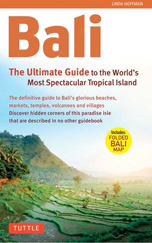
Murni’s Warung ShopBali, The Ultimate Guide to the World’s Most Spectacular Tropical Island, Linda Hoffman, Tuttle Publishing, 2012

“Murni’s Warung Shop at Murni’s Warung, Jalan Raya, Ubud, beside the Campuan bridge, tel 972146. Traditional arts and crafts from all over the archipelago, as well as overseas, assiduously collected by Murni who has formidable fine arts credentials and seasoned sophisticated taste. If she’s around Murni will sign the best-selling Secrets of Bali, Fresh LIght on the Morning of the World by Jonathan Copeland and Ni Wayan Murni. You can download her ebook Murni’s Very Personal Guide to Ubud from her web site. [Note from Murni: you can also download Secrets of Bali from the web site.]

Bali, The Ultimate Guide to the World’s Most Spectacular Tropical Island, Linda Hoffman, Tuttle Publishing, 2012

The New York Times, 9 April 1995

Murni’s Houses.
Carey Lovelace,
The New York Times
9 April 1995

New York Times Murni's Houses“I was lucky enough to spend 14 of my 18 days in Ubud at Murni’s Houses …
 
Aside from running one of the area’s best-known restaurants, the enterprising Murni (in Bali, last names are considered sacred and never used) is also the proprietor of a group of stylish boutiques in Campuhan called Kunang-Kunang that sell Indonesian goods in a sedate atmosphere tailored to Western tastes.”
 
Carey Lovelace

The New York Times, 9 April 1995

Favourite Places in the World

the-australian

Jane Rutter’s Favourite Places in the World

Murni’s Warung Shop

The Australian, 8 December 2007

“I feel as if I grew up in Bali, as I went there so often as a teenager and young woman. Murni’s is a veritable Aladdin’s cave of luscious Asian objets d’art, furniture and textiles. It’s a wonderful place to shop and there is a great restaurant attached.”

Jane Rutter is Australia’s best-known flautist and one of the most versatile; she performs in the classical, jazz and pop arenas.

Jane Rutter’s Favourite Places in the World
The Australian, 8 December 2007


Favourite Places in the WorldFavourite Places in the World

Murni’s Warung Shop

“Murni’s Warung Shop at Murni’s Warung, Jalan Raya, Ubud, beside the Campuan bridge, tel 972146. Traditional arts and crafts from all over the archipelago, as well as overseas, assiduously collected by Murni who has formidable fine arts credentials and seasoned sophisticated taste. If she’s around Murni will sign the best-selling Secrets of Bali, Fresh LIght on the Morning of the World by Jonathan Copeland and Ni Wayan Murni. You can download her ebook Murni’s Very Personal Guide to Ubud from her web site. [Note from Murni: you can also download Secrets of Bali from the web site.]

Bali, The Ultimate Guide to the World’s Most Spectacular Tropical Island, Linda Hoffman, Tuttle Publishing, 2012

Weaving a Spell


Weaving a Spell
Carol Walker

Weaving a Spell

Carol Walker
Travel Today Egypt, September/October 2004


Years before I first saw geringsing, I had heard stories of this famous, supposedly magical textile of East Bali. Experts on Southeast Asian weaving assumed a reverent tone whenever speaking of this fabled cloth. Even the name — pronounced “GRINGsing,” with a rolled “r” — sounded like an incantation.

Bali’s magical textile geringsing is back at the market.

Made only in the village of Tenganan, a tiny insular community whose strict rituals and religious beliefs differ from those of even their closest neighbors, a single piece of geringsing can take five to fifteen years to produce. The cloth is used in various rites and is believed by villagers to offer magical protection from harm. It is also worn by both men and women, in the form of belts, wrapped skirts and hip cloths.

Because of its rare and painstaking method of production, along with its muted, natural colors, the cloth is both distinctive and beautiful. But over the years, fewer villagers were engaging in the grueling production process, and geringsing had become increasingly rare.

If you wanted to see geringsing, much less purchase it, you had to go to Tenganan itself, about 65 kilometers from Denpasar, Bali’s capital city. In the late 1980s, I finally did visit Tenganan and held an antique piece of geringsing in my very own hands.

Ironically, as vivid as the experience was, the look of the cloth barely made an impression. I viewed it inside a dark hut, but I recall the feel: It was surprisingly coarse and papery, and the threads — more loosely woven than I had expected — made a faint whispery noise as I unfolded it. A villager stood nearby ready to stop me if I handled it too roughly.

Did the geringsing have a magical effect? Probably, because I came close to purchasing it — and with a price tag of $2,000, it was far more than I could afford. Of course, that same piece today would probably be worth more than $10,000, so perhaps it would have been a wise investment. But I didn’t have a clue about geringsing. I vaguely knew that it was double ikat, but didn’t appreciate what that meant.

To understand double ikat, you have to know what ikat is — and before that, resist dyeing. Resist dyeing is a technique in which the textile’s design is marked on cloth or threads with wax, mud, or any substance that repels dye. The material is then colored and the resisting substance removed, leaving a motif in the original hue of the threads, surrounded by the color of the dye. This process can be repeated several times to create a design.

For ikat, the dye is kept from penetrating by tying fibers in knots around small bundles of the warp or weft (vertical and horizontal) threads. Sound painstaking? It is. Now imagine dyeing both the warp and weft threads in such a way as to produce distinct patterns when they are woven together on a hand-loom. That is double ikat, a technique so difficult that despite Indonesia’s sumptuous tradition of making fabulous textiles, the Bali Aga — the ethnic group inhabiting Tenganan — are the only people in the entire archipelago to practice it.

Once you’ve developed an eye for ikat, it is unmistakable. When both warp and weft are variegated, the overall effect is striking. The colors are always shades of cream, reddish-brown, brown, and blue-black, produced by dyeing and overdyeing with colors made from local roots and indigo. The weave is a loose tabby, a simple over-under-over-under weave.

The mechanics of geringsing are scarcely the whole story. The complexities of the Bali Aga’s belief system make anthropologists ecstatic. The holy book of the Tengananese states that the Bali Aga are of divine origin. Accordingly, their central purpose is to honor their gods, demons and ancestors through rituals, and even clothing.

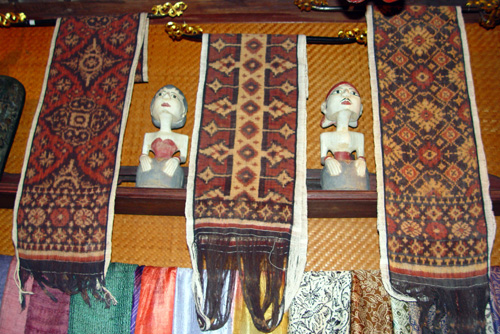
Through the years, I continued to dream, hopelessly I thought, of owning a piece of this mythical cloth. So this spring I was stunned to see several examples of genuine geringsing available for about $100 and up, at Murni’s Warung Shop in Ubud, Bali.

To my astonishment and delight, the clerk told me that Ibu Murni, a well-known connoisseur of fine textiles, had convinced five Tegananese women to weave geringsing for her. Their knowledge and expertise creates beautiful results. However, the work is so demanding that perhaps only one in four cloths is of top quality.

My only decision was which one to buy. The clerk offered to measure me so that I could select a piece of the correct size to wear as a chest cloth, but I declined, preferring to make my choice based on a combination of motif, size, and price. Now, my very own geringsing hangs in my home where I can admire it every day. It’s been close to twenty years since I first heard about geringsing. It was worth the wait.

Weaving a Spell