Bali has many unique traditions and one of the most colourful is Melasti, three days before the Balinese New Year, known as Nyepi. On this day, beginning in the morning, Balinese Hindus parade in Balinese dress down to the beaches, major rivers, holy springs and lakes. One such beach is called Masceti.
Melasti is a religious ritual to cleanse and purify temple objects and recharge the spiritual power within them. So, you see monstrous Barongs and tall Rangda statues, various god like masks and colourful umbrellas. High priests surrounded by worshippers on the ground say prayers, facing the ocean.
The Balinese believe that the ocean’s waters have powerful healing properties and provide protection. Sand protects houses from black magic.
Many years ago people travelled on foot, but now they go by car and motorbike and large trucks carry the sacred objects plus gamelan instruments plus people.
Bali is The Top Destination in Asia – the Number 1 Travelers’ Choice by Trip Advisor 2018 – and the Number 4 Destination in the World after Paris, London and Rome.
Trip Advisor say “The artistic capital of Ubud is the perfect place to see a cultural dance performance, take a batik or silver-smithing workshop, or invigorate your mind and body in a yoga class.”
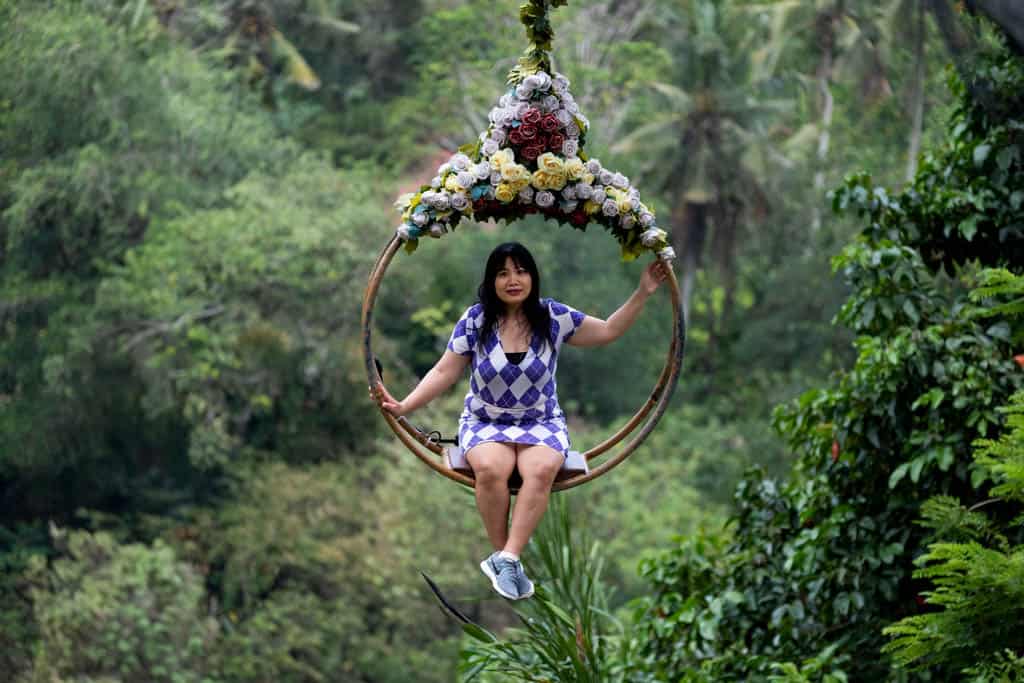
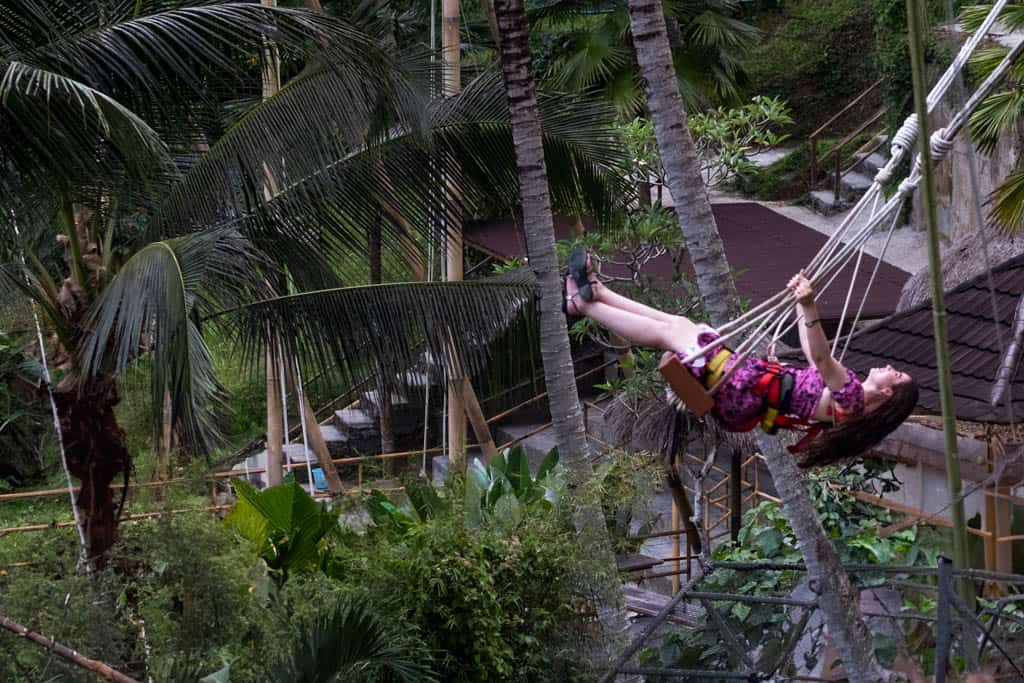
There’s actually a lot more than that. For example we arrange the following for our guests: photography tours, helicopter tours, chocolate factory tours, cooking classes, Indonesian or Balinese language lessons, white water rafting, elephant safari park trip with a ride on an elephant, Bali Swing, Jungle Buggies, bicycle drive through the villages, climbing a volcano at sunrise, rice paddy trek, bird walks, herbal walk through rice paddies, tarot reading, Balinese dance classes, batik painting classes, making Balinese offerings, snorkeling or scuba diving or a boat trip to a deserted island.
Murni’s Houses, my boutique hotel in Ubud, hosted a gaggle (is that the right word?) of excitable photographers from Austria, Australia and England last week, drawn by the prospect of huge, scary, colourful demons of Bali awaiting them on the streets in various stages of creation.
The ogoh-ogoh are inventive and frightening. There is always a black, hooded, faceless angel of death. There are usually dragon-like figures and mythical creatures. In the early days the artists were inspired by Balinese folklore but latterly Hollywood characters have come to the fore, some sporting Mohawk hairstyles.
The ogoh-ogoh are symbols of demonic spirits, made from wood and bamboo, covered with papier-mâché and Styrofoam, and painted with garish colours. They can reach 10 feet (3 metres) high and the same wide.
In the evening of Balinese New Year’s Eve, these huge grotesque statues, with lights aglow, accompanied by loud gamelan music, are paraded by their makers on wide bamboo platforms around the village. They are remarkably life like.
After the parade they are usually burned at the village crossroads, but recently, as they are really works of art, some have been kept for display in community halls, temples, hotels, and private houses, admired as works of art. The ‘tradition’ became popular in the 1980s.
Start your engines and get ready to embark on a journey into the jungle to experience Bali’s first and only ‘purpose-built ATV track’. This thrilling new course, spanning 4.5 km over each lap, was crafted with the hardiest adventure seekers in mind to provide an exciting and intense driving experience like no other on the island.
Utilizing Polaris Buggies, guests have the option of choosing between single-seated ACE models or to ride tandem with a friend or guide in double-seated RZR models, as well as deciding the amount of laps to complete. The challenging and varied trail will make you feel like a rally driver, testing your capabilities and leaving you yearning for more.
Your adventure starts at Koko Bambu Restaurant, a beautiful natural structure comprised of bamboo. A safety video and demonstration will be shown outlining the necessary precautions and procedures involved with handling the buggies, before helmets with visors are distributed. Then, you’ll get in your vehicle and after a brief warm up session; you’re ready to tear up the track!
Afterwards, you can choose to take some time to relax and enjoy a drink or meal by the pool, overlooking scenic rice paddies and the jungle’s edge.
Drivers must be over 18 years old and have a valid driving licence
Passengers between 12 and 65 years old do not need a driving licence.
Tandem passenger must be 12 years or over.
Don’t do it if you suffer from epilepsy or a chronic heart condition.
Closed footwear recommended. Solid shoes.
A pair of extra clothes.
Sun screen.
Sun glasses.
Bring swimmers if you want to swim in the pool.
Including lunch you’ll spend about 2 hours there.
SINGLE PERSON
or
2 PEOPLE
or
TANDEM PASSENGER – YOU WILL BE THE PASSENGER AND THEIR STAFF WILL DRIVE
(1 Person)
Pick Up and Drop back to Murni’s Houses.
Pick up Morning: 8.00 – 8.30 am
Pick up Afternoon: 1.30 – 2.00 pm
Pay them direct.
Book as much in advance as possible.
Email: murni at murnis.com or tell Reception.
We will check availability and reserve the places.
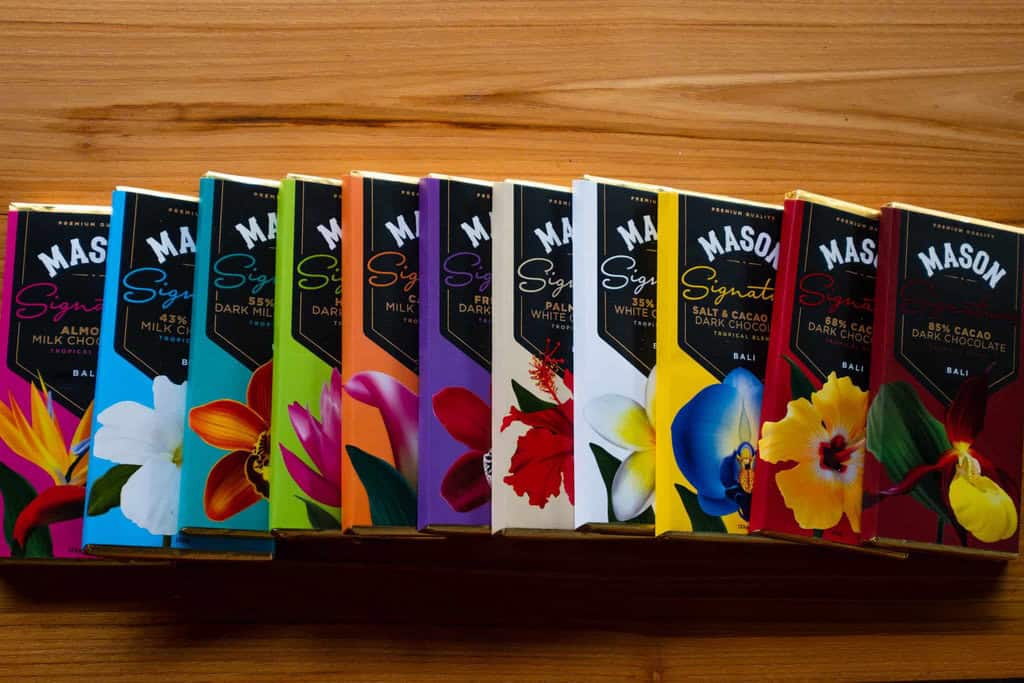
The Mason Gourmet Chocolate Factory is located inside the stunning Koko Bambu Restaurant, overlooking scenic rice fields.
Within this ‘state of the art’ factory, using only the latest Italian chocolate making machinery, you can watch the chocolate making process, starting from the cocoa bean through to an exotic range of deluxe chocolates, in a modern showroom, where you can watch, taste and purchase from a large selection of pralines, truffles, super thins, chocolate coated nuts and bars of dark, milk or white chocolate, using only the best hand-picked cocoa beans sourced throughout the Indonesian archipelago.
Learn what it takes to make craft chocolate. Make your own range of chocolate bars.
Included
Return Transfers
Welcome Chocolate Drink
Introduction to Chocolate Making from Tree to Bar
Chocolate Tasting
Make your own range of Chocolate Bars to take home (White, Milk, Dark)
Lunch with Chocolate Desserts
15% discount in the showroom.
Minimum 2 people. Maximum 5 people. Children: over 5 years old.
This book is a guide to walking through the streets of Cheltenham. It is a delightful town, full of wonderful architectural gems, all of which have interesting stories to tell. It was a fashionable place to visit in Georgian and Regency England at a time of momentous change, when foreign kings ruled the country. It was when Britain successfully fought to be the leading player on the world stage, becoming modern and global in the process.
Fortunately the most interesting places to see can be covered on foot in a day or two. Don’t rush. It is a town full of history, buildings, shops and many fine restaurants. You will find the locals are friendly and happy to chat.
I hope you enjoy the book and the photographs and most of all the town of Cheltenham.
151 pages
Colour photographs
Bibliography What they said about Walking Tour of Cheltenham, The Most Beautiful Regency Town in England
“Jonathan Copeland takes us on a lucid and enlightening stroll through the streets of Cheltenham. Whatever your pace – and whatever your distance – this wonderful guide gives context and depth to the city’s rich history and architecture.”
Peter Stark, adventure writer, author of Astoria: John Jacob Astor and Thomas Jefferson’s Lost Pacific Empire
“A sublime account of 18th century British history when the country changed out of all recognition and the kings were foreign and sometimes mad.”
Ni Wayan Murni, owner of Murni’s Warung, Murni’s Warung Shop and Murni’s Houses and Spa, Ubud, Bali
“The architecture, the history, what to look for, all simply explained.”
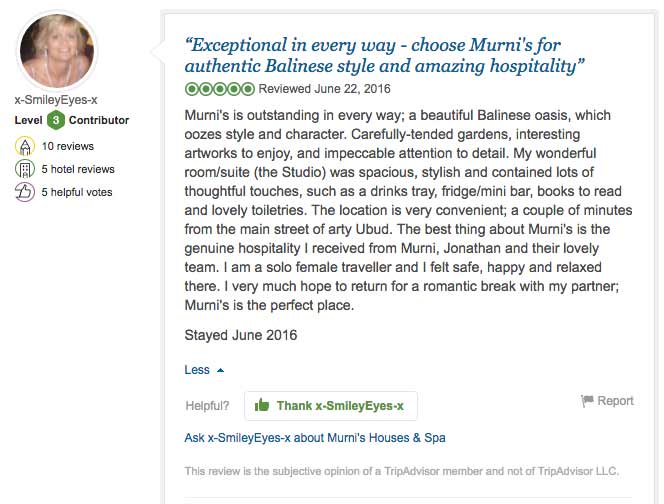
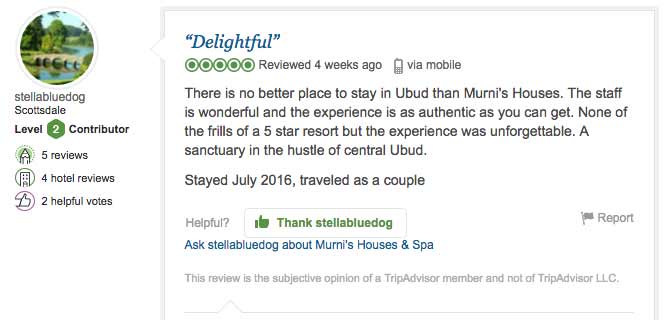
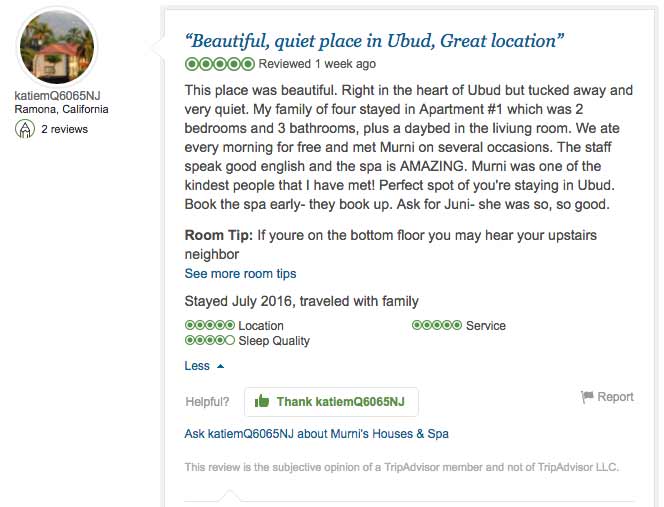
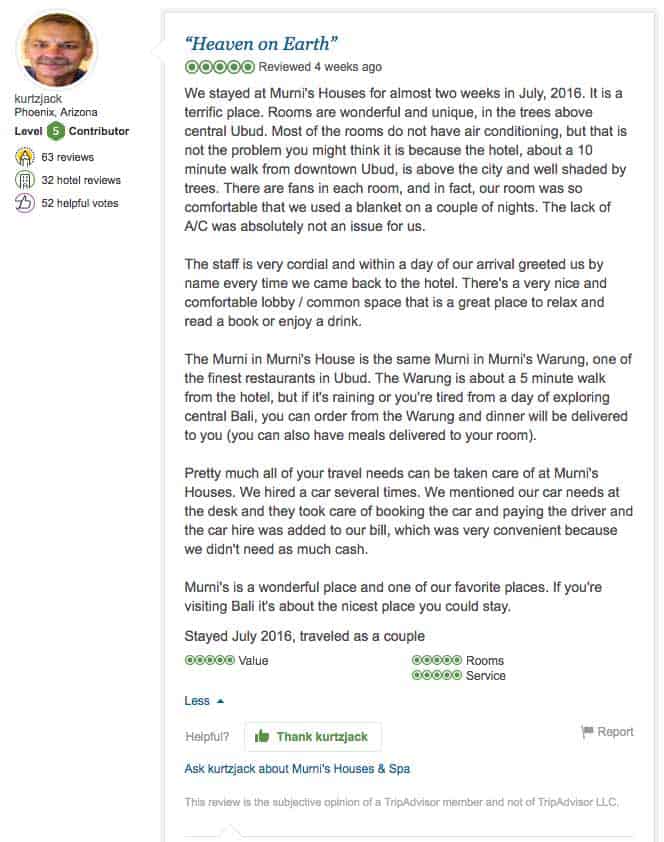
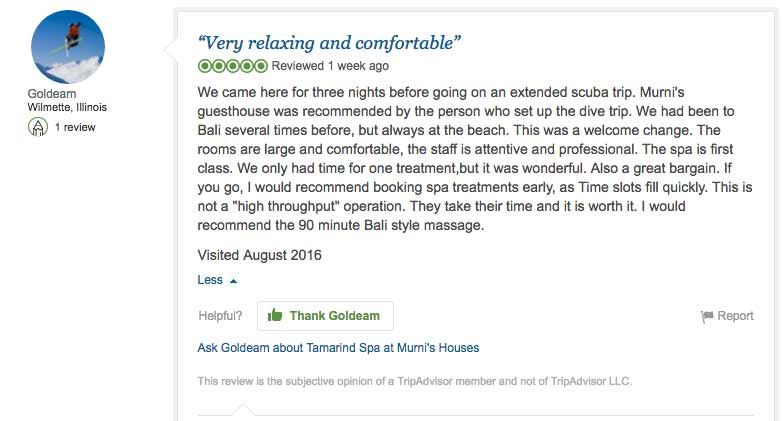
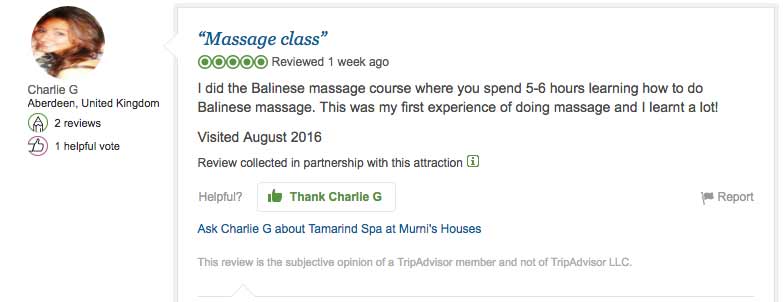
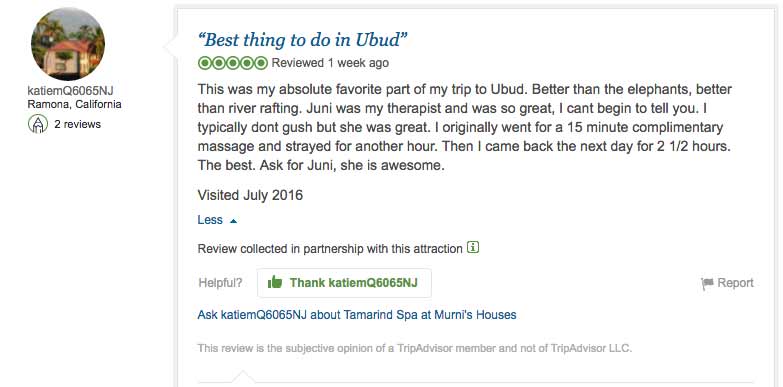
Murni’s Houses and Spa appartenait au célèbre pionnier local Murni qui a fondé Murni’s Warung, le premier restaurant international d’Ubud en 1974 ainsi que le magasin Murni’s shop, le premier magasin d’arts tribaux et d’antiquités à Ubud. Cet établissement possède sept maisons confortables à la décoration traditionnelle balinaise. Chaque maison comporte deux chambres, un salon, une véranda et deux baignoires extérieures. Le salon possède également un lit. Les objets d’art ornent les murs et font de ce lieu un véritable musée. A seulement trois minutes de la rue principale d’Ubud, vous pouvez profiter du calme de ce lieu devenu une institution. Aux maisons, au restaurant et à la boutique s’ajoute un Spa (Tamarind) où le personnel qualifié vous accueille dans une ambiance propice à la détente.
Murni’s Warung Shop “Traditional arts and crafts from all over the archipelago assiduously collected by Murni who has formidable fine arts credentials and seasoned and sophisticated taste.”
Periplus Guide to Bali, the Island of the Gods, 2005
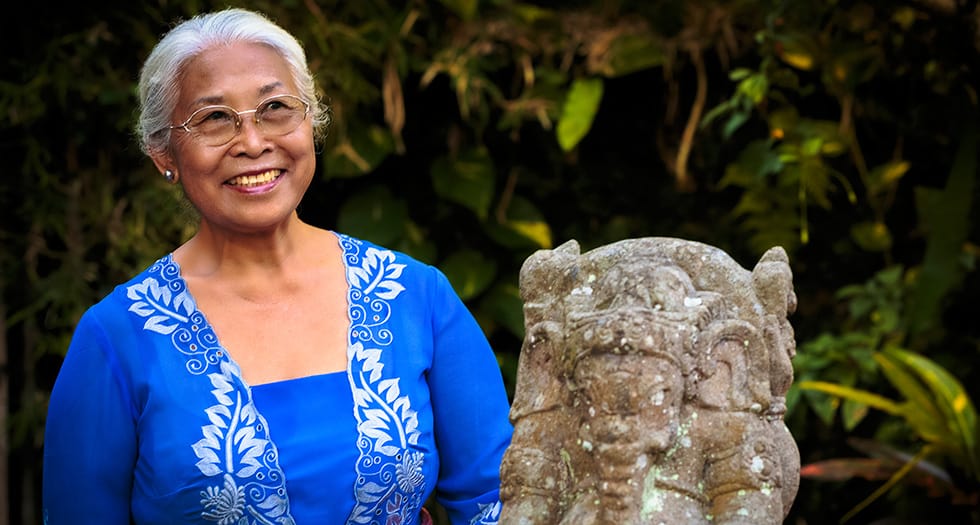
Interview with Ubud’s Leading Lady: Murni is a unique and fast moving Balinese lady who knows how to get things done. She has a contagious smile and a genuine passion for life. FRV had a chat recently while staying at Murni’s Houses in her home town of Ubud.
FRV: They call you the ‘Ibu of Ubud’ … What does ‘Ibu of Ubud’ mean?
Murni: It actually means ‘Mother of Ubud’. There are in fact many Ibus of Ubud and I’m just one of them.
If you had all the money and time in the world, what would you be doing right now?
I’d probably be doing the same things that I’m doing now.
What is that?
I try to create beautiful spaces filled with beautiful objects. After moving from Sanur in 1974 where I had four shops on the beach, I set up Ubud’s first real restaurant just beside the bridge in Campuhan. That was 43 years ago and I’m still running it! I’ve filled it with Asian tribal art pieces I’ve collected over the years, especially in the Lounge Bar, where people often have a drink before dinner or liqueurs afterwards.
Have you always been a collector?
It’s very difficult to be just a collector as the pieces are increasingly rare and expensive, so inevitably you end up being a dealer as well. You try and get better and better examples and sell the others. It’s been very helpful having a tribal art and textiles shop as part of the restaurant.
Why did you build your boutique hotel ‘Murni’s Houses’?
That was in the early 1980s because there was so little guest accommodation available. There was hardly any giving a good degree of comfort and convenience. I was very lucky to get the land, which is only five minutes walk from the centre of Ubud, but set back above the road, so it’s a bit like being in the countryside but still in the middle of Ubud. I like it so much I live there myself. The guests are from all over the world and invariably really interesting and we often have breakfast together. It’s a great way to start the day. Murni’s Warung and the Shop are only a few minutes walk so it suits me fine.
And the spa?
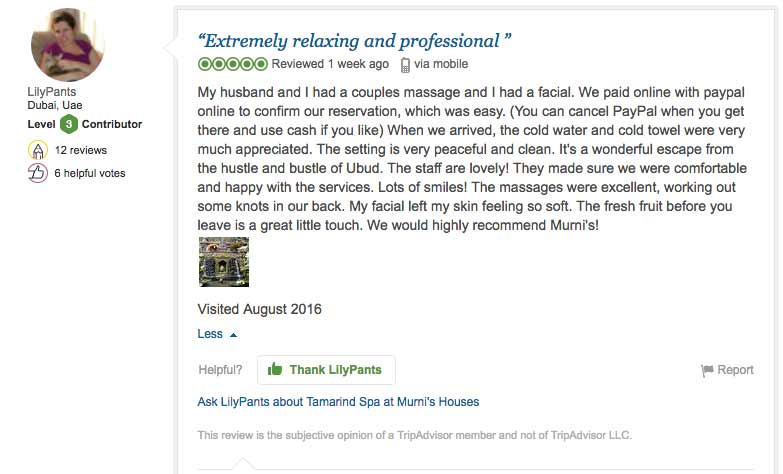
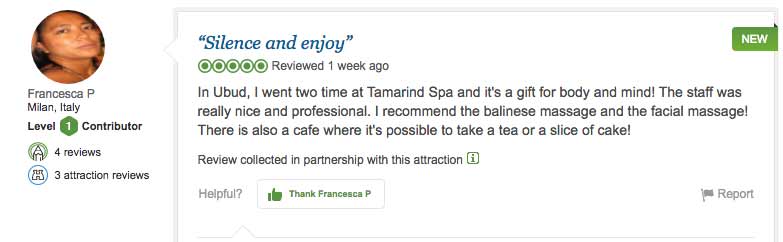
Tamarind Spa happened by chance on the suggestion from a friend. I had a spare building and turned it into spa rooms and employed the very best therapists I could find. I tested them all myself. My plan was to have a massage every day, and now I can’t get in because it’s so busy!
Is that the Tamarind Spa that won the UK Luxury Travel Guide Awards 2017 Contemporary Spa of the Year INDONESIA?
That was an incredible surprise, and of course, we’re all delighted, especially the therapists. They’ve done very well.
I hear you’ve written or co-written books on Balinese culture. Any tips on … Writing books?
Yes, something incomprehensible is what I recommend. The thing about comprehensible books is they are too difficult! Leave that to other people.
You have a website, a Facebook site, a Twitter account, a blog and you’re on Instagram … tell me about your experience with social networking and what advice you would give.
Concentrate on the widgets.
You seem to have a lot on your plate already and we haven’t even talked about Balinese culture. Do you have any current projects?
Well, yes. I seem to have got into long-stay accommodation. There are more and more people staying longer and longer in the Ubud area. I think many of them are digital nomads as they always ask about the internet. I’ve finished two Villas for long-term rentals in Katik Lantang, South Penestanan, where I was born, just 10 minutes away, and right now I’m finishing a large building at Murni’s Houses which will have rooms with and without kitchens, a gallery and a pool – and maybe, if I can squeeze it in, a shop!
As we haven’t talked about Balinese culture, and I know that you are steeped in it, would you like to write a regular column for the magazine on Balinese life and culture?
I’d be delighted and for you I’ll make it comprehensible.
Thank you. Well, Murni. You’ve had an incredible life so far. I’d like to ask you one final question. How would you like to be remembered?
I’m too short at five foot four. I’d like to be remembered as five foot eleven!
Murni is a well-known and much loved personality on the Bali scene and a pioneer of Balinese tourism. During her extraordinary life Murni has lived in Sanur and Ubud and has travelled widely. Everything you could want to know is on her web site.
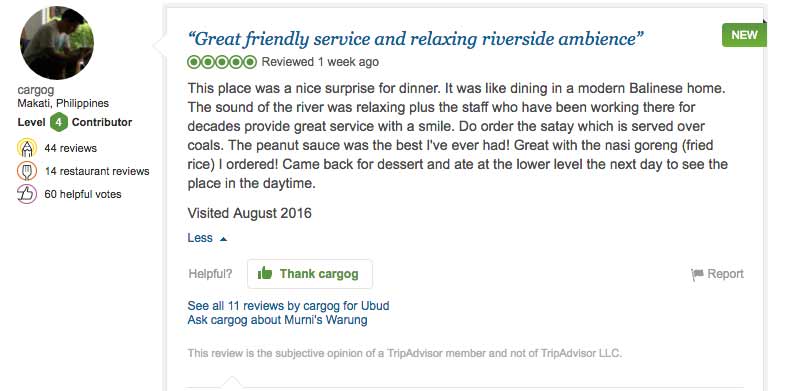
“The countryside is all around Ubud if you just know where to look: get out there with the Bali Bird Walk (US$37). Curious travellers will find the tour worth every dollar: as you stroll through the rice fields you’ll spot egrets, herons, kingfishers and amphibians, and learn about the traditions that have shaped these ancient landscapes. The tour includes an Indonesian lunch at Murni’s Warung (Jalan Raya Campuhan), Ubud’s first real restaurant, dating all the way back to 1974; the nasi campur (rice with a range of vegetables and curries) is a classic choice. ”
Murni’s Warung, Ubud – Smile inflight magazine for Cebu Pacific Airways, November 2017
The people, stories and hidden treasures of downtown cosmopolitan Yangon (Rangoon)
by Bob Percival and Jonathan Copeland
Ebook: US$4.99
My Balinese partner Murni and I first met Bob shortly after he left China and moved to Yangon. He had set up his successful walking tours of local streets around the neighbourhood where he lived on 29th Street. The streets were amazingly contrasted, colourful and pulsating with life. At the same time everything was crumbling and paint peeled off the mildewed walls. It was a photographer’s paradise. Bob seemed to know everyone. He was excited to be living there in a time of transition, in a place that was changing before his eyes.
We met in his office, the Shangri-La Hotel reception. It had the best wifi and best breakfasts in the city and was the perfect starting point for his tours. We hit it off immediately and got together for meals and drinks and breakfasts after that. He came to Bali with his daughter Gina a few months later.
I suggested that he write a book about his walks and he said that he was already thinking of that. I told him that I’d be delighted to come back and take the photographs.
We kept in touch and the next time I visited he’d finished the book and had printed it himself. It was doing well. The photographs were his own, in black and white.
We talked about an ebook, so that the streets and their stories could reach a wider audience, with photographs in colour to bring the streets to life. I came back a month later and met him in his Shangri-La office, the day before his return to Australia. He had to go back and live there for two years to establish residence to claim his pension and also to see his doctors. Some years earlier he had had a heart attack in Amsterdam.
I spent a week walking up and down Bob’s streets, book in hand, going into as many of the buildings and chatting to as many of the people he describes as I could. I accomplished the whole thing with a day to spare, which I used to photograph the colonial side of Rangoon, which is totally different and gave rise to the accompanying ebook Strolling down the Streets of Old Rangoon, The History and the Buildings.
Bob was back in Sydney, catching up with friends and doctors. I’m pleased to say that he approved the photographs and added another five streets to the book. The book is a real contribution to the history of Yangon, a unique and valuable record of real life in the city. We’ve kept his black and white photographs for Local Products, Local People, Odds and Ends.
Bob Percival
Jonathan Copeland
Colour photographs
Bibliography
What they said about
WALKING THE STREETS OF YANGON
The people, stories and hidden treasures of downtown cosmopolitan Yangon (Rangoon)
“An authoritative and poetic insight into the streets of Yangon. If there was ever one book that purportedly held the magical secret of downtown Yangon, we may have discovered it, at last.”
Sondang Grace Sirait, MYANMORE, 12 September 2016
“Bob Percival’s Walking the Streets of Yangon, a collection of vignettes on downtown blocks, local restaurants and random shops.”
Coconuts Yangon, 21 September 2016
“Whether new to the city or a Yangon veteran, the book makes one feel as if Yangon is full of nooks and crannies begging to be explored.”
Strolling down the Streets of Old Rangoon: The History and the Buildings by Jonathan Copeland
I first went to Rangoon in 1981. It was called Rangoon then before the military government changed the name to Yangon in 1989. They also changed the name of the country to Myanmar, but most people preferred to use the old, poetic, evocative names, partly to make a political statement.
I was immediately struck by the time warp that the city was languishing in. Old-fashioned limousines cruised around the city. Old British fire engines languidly poked out from the old British Fire Station. It was as if time had stopped still at the very moment that the British had sailed away in 1948.
Since then I have become even more enchanted, but even more concerned by the endangered condition of the colonial buildings. Hence I determined to photograph thirty-five of my favourites and place them in their historical context, because each one of them has a fascinating story to tell and is best understood and appreciated as a milestone in the history of Rangoon.
Jonathan Copeland
190 pages
Colour photographs
Bibliography
What they said about Strolling down the Streets of Old Rangoon, The History and the Buildings
“Take a leisurely stroll through Old Rangoon and be mesmerized by the fin-de-siècle architecture—a unique time capsule of a bygone age.”
San Tin Lun, Yangon writer and author of ten books, including The Legendary Heroes of Myanmar, Ancient Myanmar Heroes, and Reading A George Orwell Novel in A Myanmar Teashop and Other Essays
“Follow in the footsteps of Somerset Maugham and Noël Coward: high tea at the Strand Hotel—five-star history at its best.”
Ni Wayan Murni, owner of Murni’s Warung, Murni’s Warung Shop, Murni’s Houses and Tamarind Spa, Ubud, Bali
“The highest number of colonial buildings in one square mile—a fascinating glimpse of a distant corner of the British Empire.”
Audrey Pipe, Anglo-Burmese, resident of the United Kingdom
Strolling down the Streets of Old Rangoon: The History and the Buildings
 Bali has many unique traditions and one of the most colourful is Melasti, three days before the Balinese New Year, known as Nyepi. On this day, beginning in the morning, Balinese Hindus parade in Balinese dress down to the beaches, major rivers, holy springs and lakes. One such beach is called Masceti.
 Melasti is a religious ritual to cleanse and purify temple objects and recharge the spiritual power within them. So, you see monstrous Barongs and tall Rangda statues, various god like masks and colourful umbrellas. High priests surrounded by worshippers on the ground say prayers, facing the ocean.
 The Balinese believe that the ocean’s waters have powerful healing properties and provide protection. Sand protects houses from black magic.
 Many years ago people travelled on foot, but now they go by car and motorbike and large trucks carry the sacred objects plus gamelan instruments plus people.