Located next to the old Campuhan Bridge, a five-minute ride from Ubud Central, Murni’s Warung sits peacefully on a river’s hillside, boasting the view of River Wos flowing water. Built from the ground up, the restaurant first opened in 1974 and has been serving food and hospitality for 47 years now.
Owned and run by a Balinese woman, Ni Wayan Murni, the warung has expanded to four open-air levels, complete with shop and lounge bar. However the atmosphere remains the same. Each guest will be immersed in its traditional interior design carefully decorated with exquisite antiques and artworks.
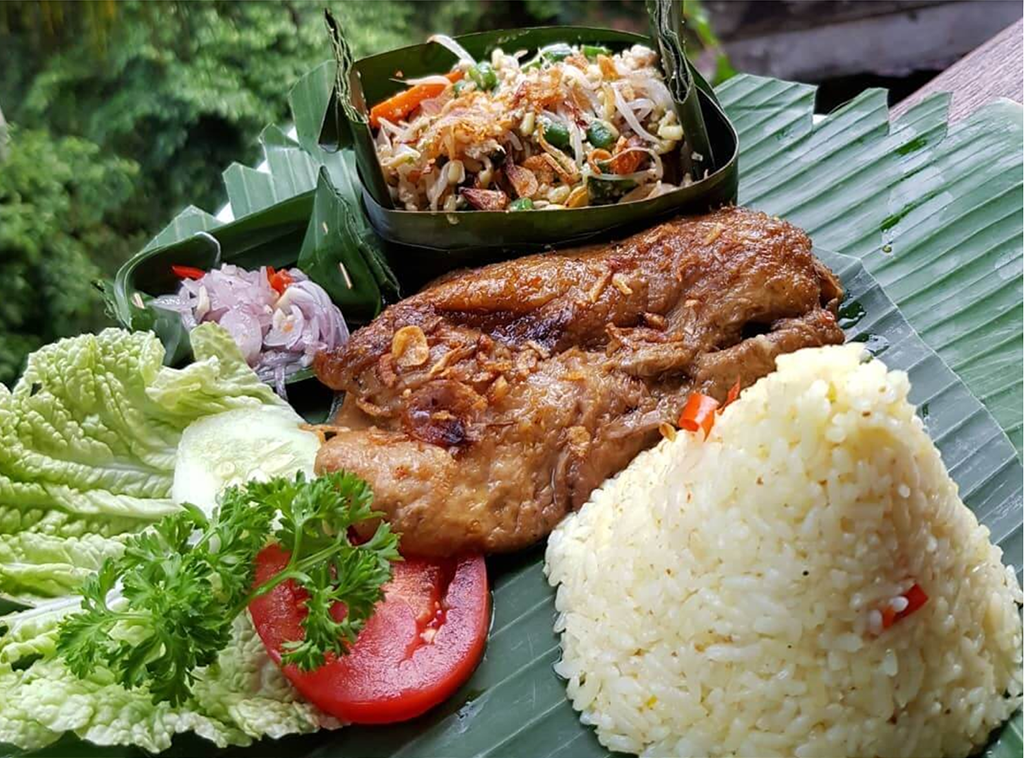
Similarly, the menu has also been expanded to cater to both local and international tastes where guests can find pasta, steak and a hot dog, for example. But you cannot miss the time tested signature dishes, such as Bebek Betutu (Balinese Duck), Murni’s Tutu Ayam, and Nasi Campur.
“It’s hard to imagine that present-day Ubud holds any secrets, given how well trodden it’s become. But like everywhere, the hidden is often right under your nose.
The tiny cocktail bar downstairs at Murni’s Warung is like a lost world, an artefact from another era, haunted by the strains of crooners and the crackle of torch songs; a hint of the 1930s all cast against the dark green ferny precipice of the primordial Wos river ravine. When I approach the bar, I feel like Jack Nicholson in “The Shining”; patrons like spectres, nothing outside but the wildness.”
Murni’s Warung memprioritaskan Kesehatan dan Keselamatan
Kami berkomitmen untuk kesehatan dan keselamatan para tamu dan karyawan kami. Tidak ada yang lebih penting bagi kami.
Karena Coronavirus (Covid-19), dan dengan bimbingan dari Organisasi Kesehatan Dunia, dan Asosiasi Hotel dan Restoran Indonesia, Murni’s Warung telah menerapkan langkah-langkah kesehatan sebagai berikut.
1. Kami melakukan pemeriksaan suhu inframerah non-kontak karyawan setiap hari ketika mereka tiba dan ketika mereka pergi, dan mencatatnya dalam sebuah buku. Jika mereka demam, mereka harus segera pulang.
2. Kami melakukan hal yang sama dengan tamu dan pengunjung untuk keselamatan semua orang. Jika ada yang demam, kami akan meminta mereka untuk melakukan tes cepat dari klinik terdekat di Ubud, yang buka 24 jam sehari.
3. Pada saat kedatangan, kami akan menunjukkan kepada para tamu di mana mereka dapat mencuci tangan. Pengering Tangan Listrik dipasang di kamar mandi.
4. Kami dapat menyimpan detail kontak tamu jika diminta.
5. Anda dapat pesan dan memesan di muka melalui email atau telepon jika diinginkan.
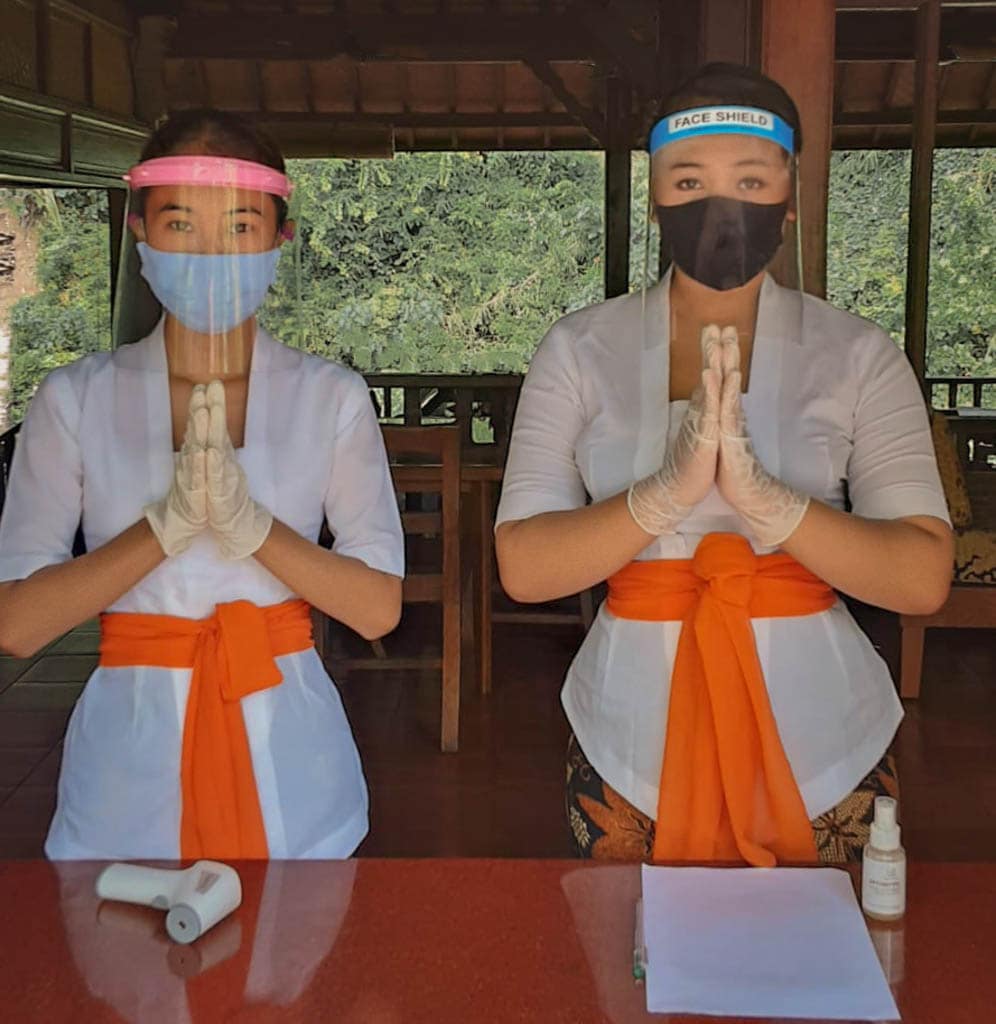
6. Staf mandi ketika mereka tiba untuk bekerja dan mengenakan seragam dan pelindung muka baru mereka. Sepatu dan pakaian luar mereka disimpan di loker masing-masing.
7. Loker staf didesinfeksi setiap hari.
8. Seragam kerja dicuci setiap hari.
9. Staf memakai pelindung muka dan wajah.
10. Pelindung muka dan wajah dicuci setiap hari.
11. Kami tidak berjabat tangan atau melakukan kontak fisik dengan orang lain dan menjaga jarak aman dari semua orang setiap saat.
12. Kami berlatih menjaga jarak sosial setidaknya 2 meter, sebanyak yang kami bisa, dan tidak perlu berkumpul di satu tempat.
13. Kami sering membersihkan bangunan, termasuk toilet, pegangan pintu, pegangan tangan, meja, menu, telepon, mesin kartu kredit, dan area lain yang sering disentuh dengan deterjen anti-virus dan anti-bakteri.
14. Kami sering mencuci tangan dengan sabun dan air selama 20 detik, (terutama setelah menggunakan kamar mandi, setelah meniup hidung, batuk atau bersin).
15. Kami mencuci tangan sebelum menyiapkan, menyajikan dan setelah menyajikan makanan.
16. Kami membersihkan meja sebelum dan sesudah menyajikan makanan.
17. Kami memiliki banyak ruang dan menyajikan makanan di atas meja yang berjarak 2 meter.
18. Meja untuk makanan tidak tertutup dan berada di udara terbuka (dengan atap tertutup).
19. Murni’s Warung memiliki ventilasi yang baik dan tanpa AC.
20. Anda dapat membayar dengan kartu kredit (MasterCard atau Visa), atau dengan pemberitahuan yang cukup, melalui email online, sehingga tidak ada kontak dengan uang.
21. Jika seorang karyawan merasa sakit atau tidak sehat atau demam, atau siapa pun dalam keluarga mereka dalam kondisi yang sama, mereka harus tinggal di rumah.
22. Seorang karyawan harus bebas demam selama setidaknya 24 jam, tanpa menggunakan obat penurun demam, sebelum kembali bekerja.
23. Jika seorang karyawan didiagnosis menderita Covid-19, mereka harus tinggal di rumah setidaknya selama 14 hari karantina.
24. Jika ada anggota keluarga mereka yang merasa tidak sehat, mereka harus memberi tahu saya dan saya akan menyelidikinya.
25. Jika ada anggota keluarga mereka yang didiagnosis menderita Covid-19, karyawan tersebut harus tinggal di rumah.
We are committed to the health and safety of our guests and staff. Nothing is more important to us.
Due to Coronavirus (Covid-19), and with guidance from the World Health Organization, and the Indonesian Hotels and Restaurants Association, Murni’s Warung has implemented the following 25 health measures.
We conduct non-contact infrared temperature checks of staff every day when they arrive and when they leave, and log these in a book. If they have a fever, they must go home immediately.
We do the same with guests and visitors for the safety of everyone. If anyone has a fever, we will invite them to have a rapid test from the nearby clinic in Ubud, which is open 24 hours a day.
On arrival we will show guests where they can wash their hands. Electric Hand Dryers are installed in the bathrooms.
We can keep guests’ contact details if requested.
You can book and order in advance by email or phone if you wish.
Staff have a shower when they arrive for work and change into their uniforms and new mask. Their outside clothes and shoes are kept in their own individual lockers.
Staff lockers are disinfected every day.
Work uniforms are washed every day.
Staff wear masks and face shields.
Masks and face shields are washed every day.
We do not shake hands or have physical contact with other people and maintain a safe distance from everyone at all times.
We practise social distancing of at least 2 meters, as much as we can, and do not unnecessarily gather in one spot.
We frequently clean and sanitise the building, including toilets, door handles, handrails, tables, menus, phones, credit card machines, and other frequently touched areas with anti-viral and anti-bacterial detergent.
We wash our hands frequently with soap and water for at least 20 seconds, (especially after using the bathroom, after blowing our noses, coughing or sneezing).
We wash our hands before preparing, serving and after serving food.
We clean the tables before and after serving food.
We have lots of space and serve food on tables that are 2 metres apart.
Tables for food are not enclosed and are in the open air (with a covered roof).
Murni’s Warung has good ventilation and no air-conditioning.
You can pay by credit card (MasterCard or Visa), or, with enough notice, by email online, so that there is no contact with money.
If an employee feels sick or unwell or has a fever, or anyone in their family is in the same condition, they must stay at home.
An employee must be fever-free for at least 24 hours, without the use of fever-reducing medication, before returning to work.
If an employee is diagnosed with Covid-19, they must stay at home for at least 14 days quarantine.
If any member of their family feels unwell, they must tell me and I will investigate.
If any member of their family is diagnosed with Covid-19, the employee must stay at home.
Traditional dish is so good that food critics struggle to describe it
Ian Lloyd Neubauer
Nikkei Asian Review, 28 February 2020
It’s what’s on the inside that counts: A duck is stuffed with the special mix of spices necessary to create the Indonesian delicacy bebek betutu.
UBUD, Indonesia — “No question about it, this is the best pig I have ever had. Absolutely the best. You think even the finest French chef could ever come up with anything as delicious or as beautiful as this?”
When the TV chef Anthony Bourdain uttered these words while filming in Indonesia in 2006, he turned babi guling — Balinese pig roasted on a spit — from a local favorite into a global delicacy.
There is, however, another Balinese dish that rivals or even exceeds babi guling: bebek betutu — roasted leaf-wrapped duck. Richly seasoned with chili, ginger, candlenuts and garlic, this melt-in-your-mouth masterpiece upstages the flavor profiles of China’s Peking duck, France’s confit de canard and every duck dish ever conceived, according to many prominent food judges.
“The duck meat was black and moist and so tender that it fell from the bone with a touch. It was so delicious and entirely unlike anything I had ever eaten,” wrote Sri Owen, the Indonesian food writer credited with introducing her country’s cuisine to the world, after she sampled bebek betutu for the first time in 1962.
Nicholas Jordan, a Sydney-based food writer, voiced similar sentiments after recently discovering the dish in Bali: “It’s one of the few things I’ve eaten in my life that’s so good it’s taken up a mythical status in my mind … something so beyond regular deliciousness it shouldn’t exist without some sort of paranormal ingredient.”
To learn more about bebek betutu I traveled to Ubud, the Balinese spiritual hub made famous by Elizabeth Gilbert’s bestselling memoir “Eat, Pray, Love” and the 2010 film based on the book. Now a booming tourist town with a cosmopolitan dining scene, Ubud has several restaurants that list bebek betutu as a signature dish. Among them is Murni’s, where duck legs are plated with pyramids of yellow rice and a spicy green bean and shredded coconut salad called lawar. With a lightly sweet and herbal finish, the recipe has not been altered since Murni’s opened in 1974.
Indus, a restaurant overlooking a coconut tree-fringed river valley owned by Australian-Indonesian culinary icon Janet DeNeefe, is also known for its bebek betutu, though it must be ordered as a whole bird for two or three people to share.
Aperitif, an extravagant 1920s-style restaurant that cost $2 million to build at the luxury Viceroy Bali resort, offers an East-West interpretation of the dish: duck magret (the boned breast of a duck reared for foie gras) injected with bebek betutu spice mix in place of orange sauce.
But according to Astrid Maharani Prajogo of Good Indonesian Food, a culinary tour company, the best bebek betutu is not found in any restaurant. It is made by specialists who work from home and supply locals with ducks for Hindu ceremonies, celebrations and Sunday roasts.
“There are lots of these duck specialists in Bali,” Prajogo says. “But the one I always take my clients to is Pak Rimpin near the Royal Palace in the center of Ubud. I went there because someone told me his duck was the freshest.”
“They’re all very good at what they do … but with Pak Rimpin, it was his idealism that struck me … his desire to preserve the culinary tradition. He was very keen to open up his kitchen and share his recipe and stories with tourists.” She adds: “It’s also where the royal family of Ubud get their bebek betutu.”
The labyrinthine streets and alleys of Ubud are still semi-deserted at 8 a.m. when I arrive at Rimpin’s home, a traditional Balinese compound with intricately decorated stone gates and Hindu shrines. There I find the specialist at work in a central courtyard kitchen filled with cooking aromas and shards of bouncing light.
Rimpin’s bebek betutu must be ordered at least two days in advance. Normally he cooks between 15 and 20 a day, but today it is relatively quiet; he is making only four, plus an order of duck satay sticks. When I ask his age, he consults quickly with his daughter-in-law Junek, who tells me he is “about 60.” He has been cooking duck “since the 1980s” and learned the craft from an older brother. “I asked him to stop working because he’s getting old and the work is exhausting,” Junek says. “But he won’t listen.”
Rimpin sighs and turns his attention to the four ducks soaking in a pail of water. He chooses one, rinses it dry and starts massaging it with a marinade of coconut oil, fermented shrimp paste, soy sauce and salt. He also adds tamarind paste to the blend to neutralize the naturally unpleasant odor of duck meat.
He then stuffs the bird’s cavity with a handful of bay leaves and bumbu — Balinese for “spice mix” — which in this case also contains sesame seeds, galangal and pepper. “There’s no secret recipe. If people think my bebek betutu tastes good it’s because of the attention to detail. I make them one at a time,” he says, wrapping the bird like a birthday present in betel-nut bark, which contains natural oils to further enhance the flavor.
Next, he takes the package to a room blackened by decades of soot with a series of raised mounds for cooking on the floor. He places the package in a steel wok, covers it with a second wok, rests it on one of the mounds and then covers it with a 30-cm-tall pyramid of rice husks. Finally, he tops the pyramid with a few coconut husks, adds a few squirts of kerosene and sets it alight.
The term “betutu” refers not to the recipe but to the use of rice husks — a time-consuming cooking process that gives the ducks cooked by specialists a robust flavor. The ducks are baked in these medieval-style ovens for a minimum of five hours, although Rimpin cooks his for 12 hours.
“You get this dry roasting effect similar with steaming and braising that commercial kitchens designed 1,000 years later still can’t replicate,” says Will Meyrick, an expatriate chef from Scotland who teaches tourists how to make chicken betutu, a popular variant, at the Canggu Cooking Retreat on the coast. “All the spices and ingredients get broken down into this rich juice and the flavor is amazing.”
Rimpin’s customers normally eat his bebek betutu at home. But I want to taste it straight out of the oven and unwrap my parcel in the middle of his kitchen. As the bark curls open I am struck by an aroma so complex it seems to possess texture.
The meat at the top is golden-yellow from the turmeric and black on the inside from the spice mix. I collect some on a fork, mop up some of the golden juice, and take my first bite. The flavor is so remarkable it speeds my heartbeat for a few moments. As much as I try, I can’t find the words to describe what I am tasting.
“What words would you use to describe the emotion of hearing ‘I love you’ for the first time, or the sensation of the sun on your face after a month of winter rain?” says Jordan. “How do you describe one of the best things you’ve ever eaten?”
Bali scores gastro-points with ‘indescribable’ roast duck
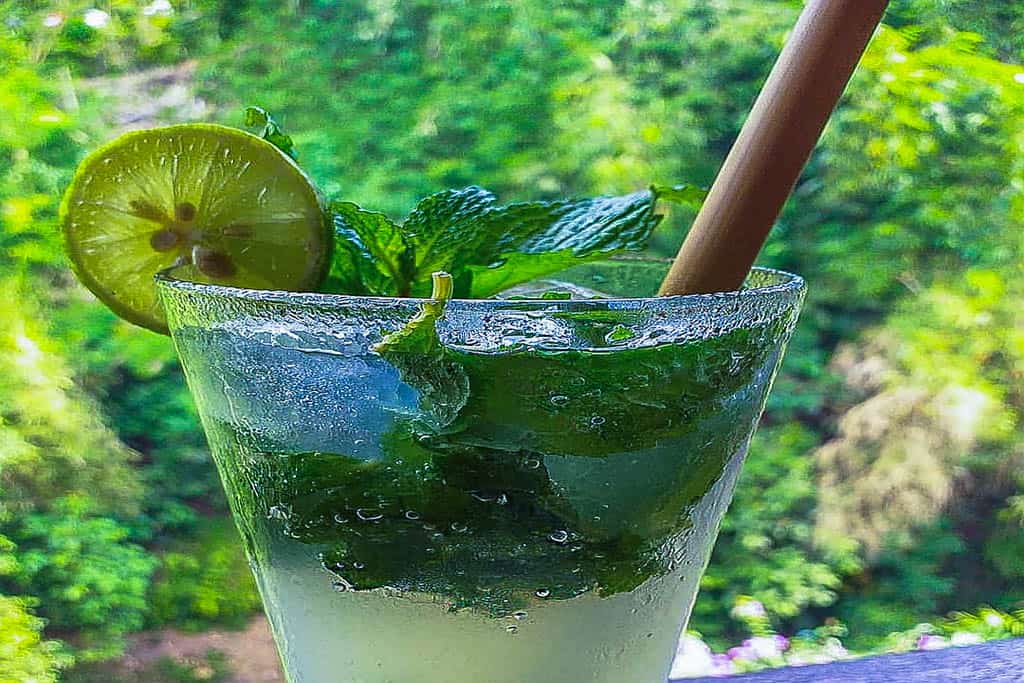
Fresh mint leaves, squeezed lime juice, simple syrup, topped with soda water, with a view of the green Campuhan jungle.
An extremely refreshing thirst quencher (try repeating that 10 times!)
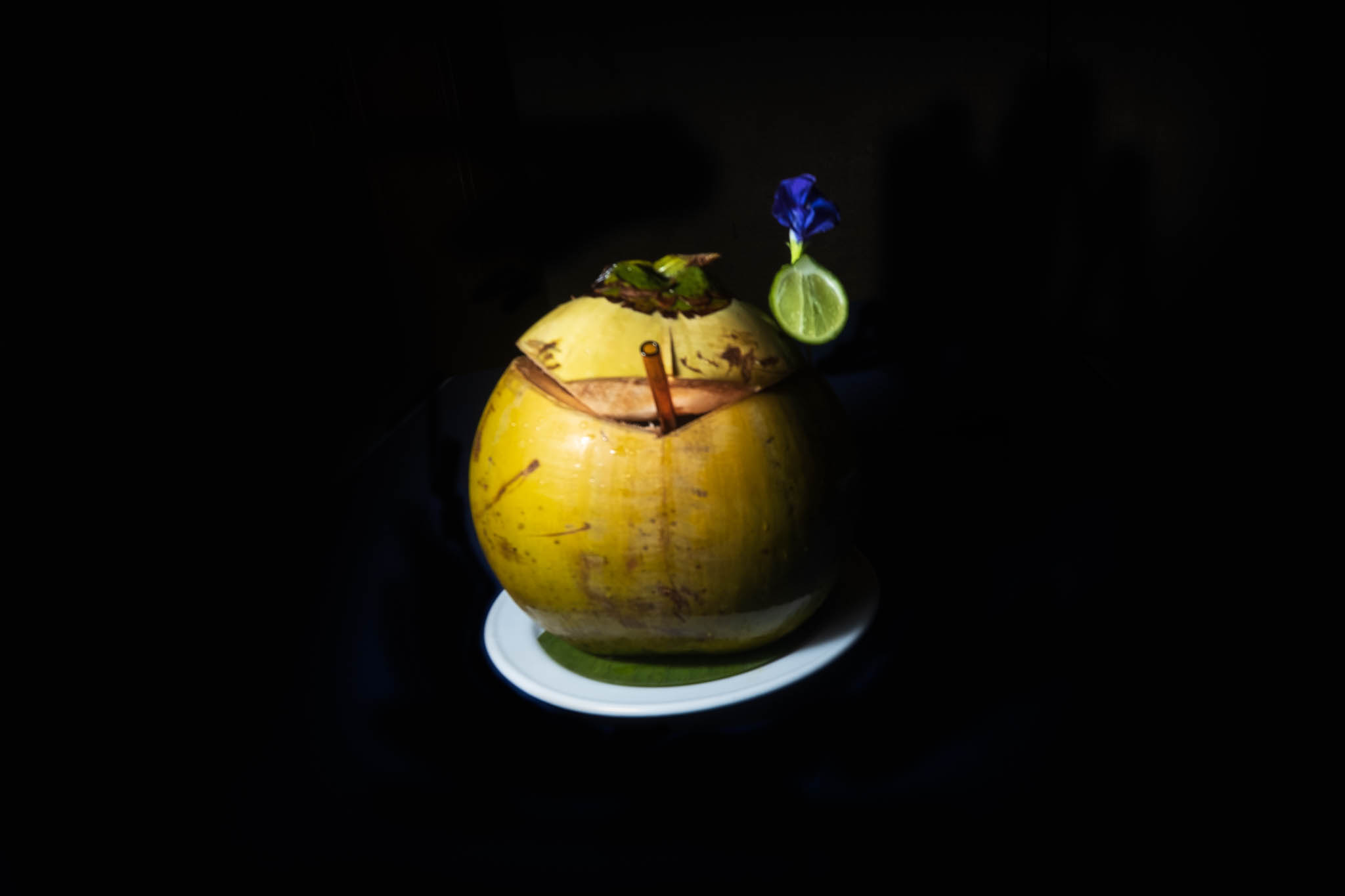
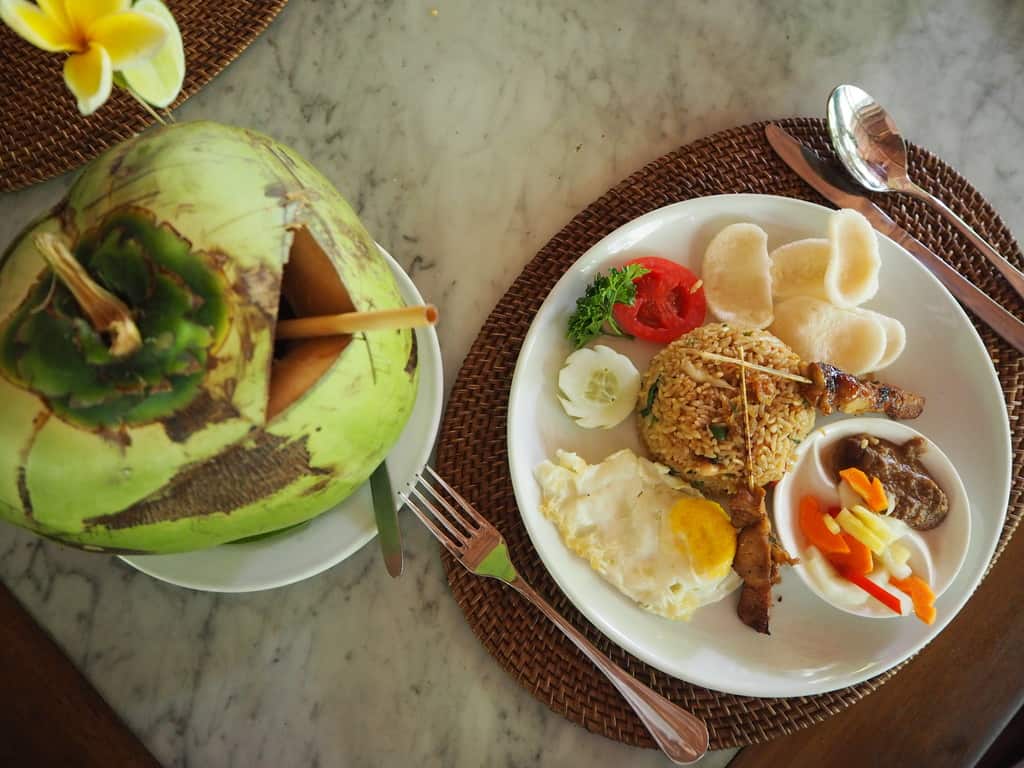
Coconut.
Whole young coconut fresh from the tree.
Piña Colada.
Puerto Rico officially declared the Piña Colada as its national drink in 1978.
The cocktail is so popular that 3 bartenders claim to have invented it, all from Puerto Rico, and 2 of them from the same bar. Ramón Pérez says he spent months perfecting it before launching it on 15 August 1952 at the Caribe Hilton Hotel’s Beachcomber Bar in San Juan. But his colleague Ricardo Garcia claims he discovered it. Then Ramón Mingot, bartender at Barrachina, a restaurant, also in San Juan, says he invented it in 1963.
Who cares? It’s a great drink. 10 July is National Piña Colada day. Murni’s Warung makes it from Bacardi, Pineapple Juice, Coconut Milk, and Triple Sec.
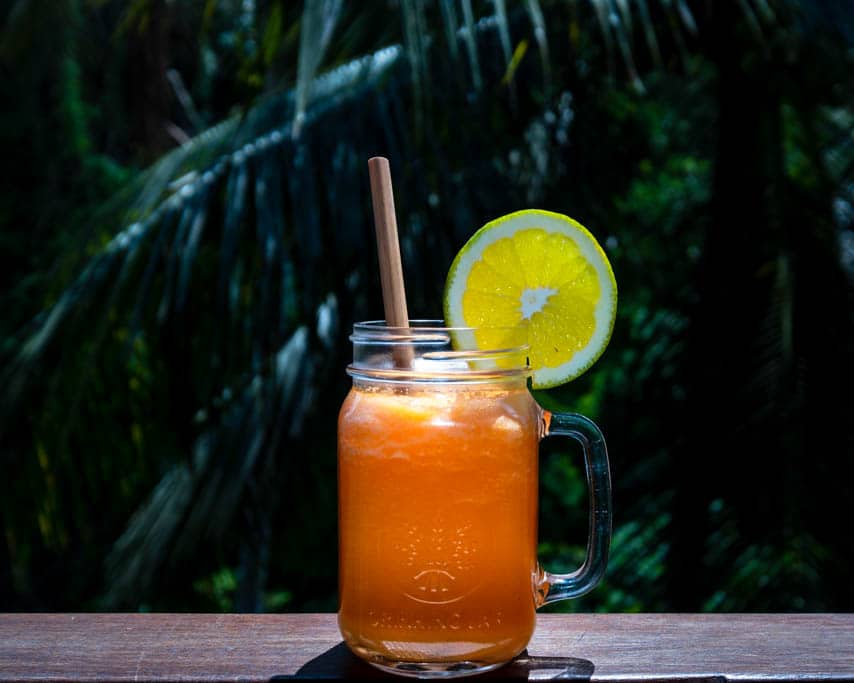
Cold and Flu Buster.
From our Healthy Juices Menu: Tangerine, carrot, apple and lemon.
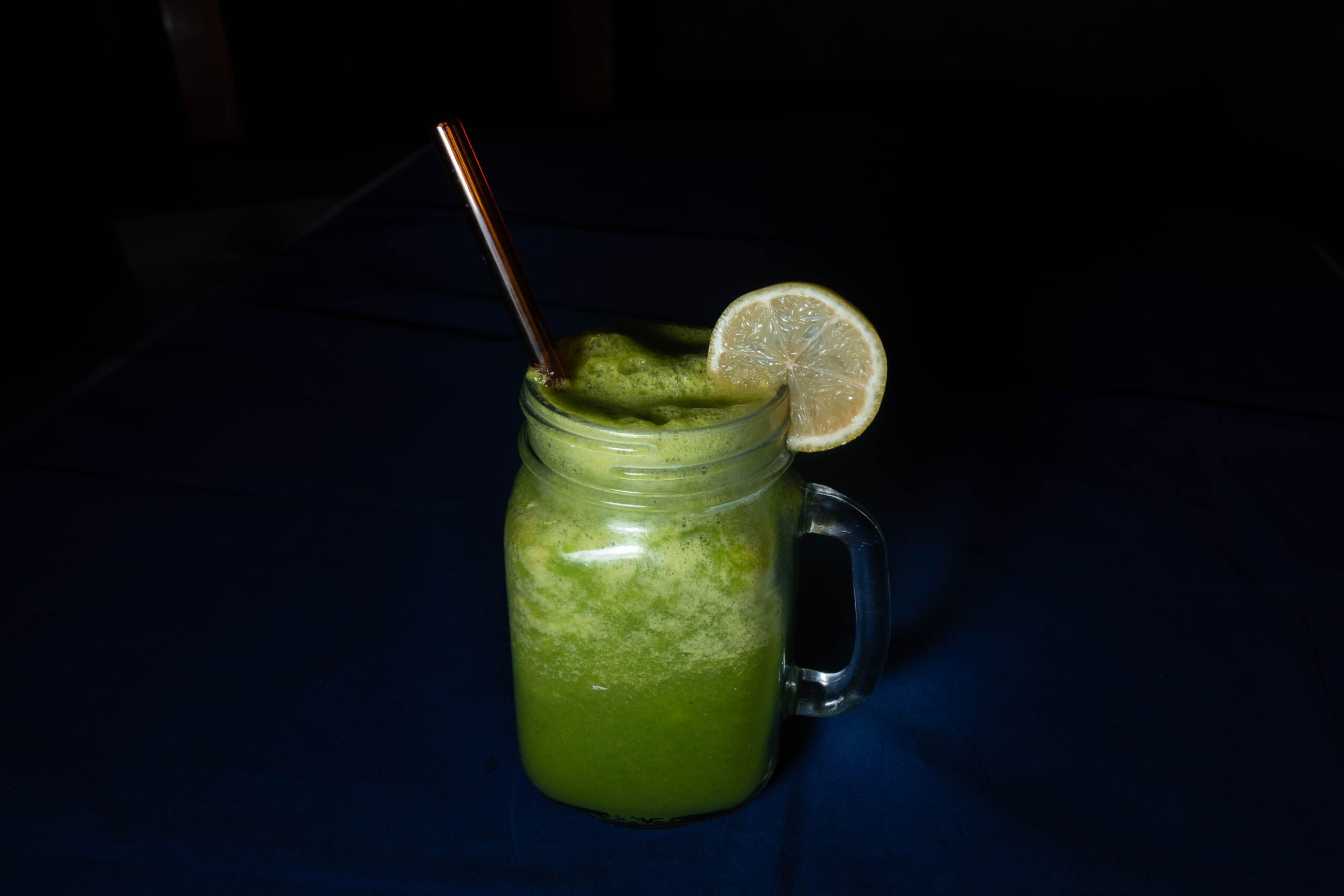
Super Green Juice.
From our Healthy Juices Menu: Cucumber, green vegetable, celery, ginger and lemon juice – helps reduce blood pressure.
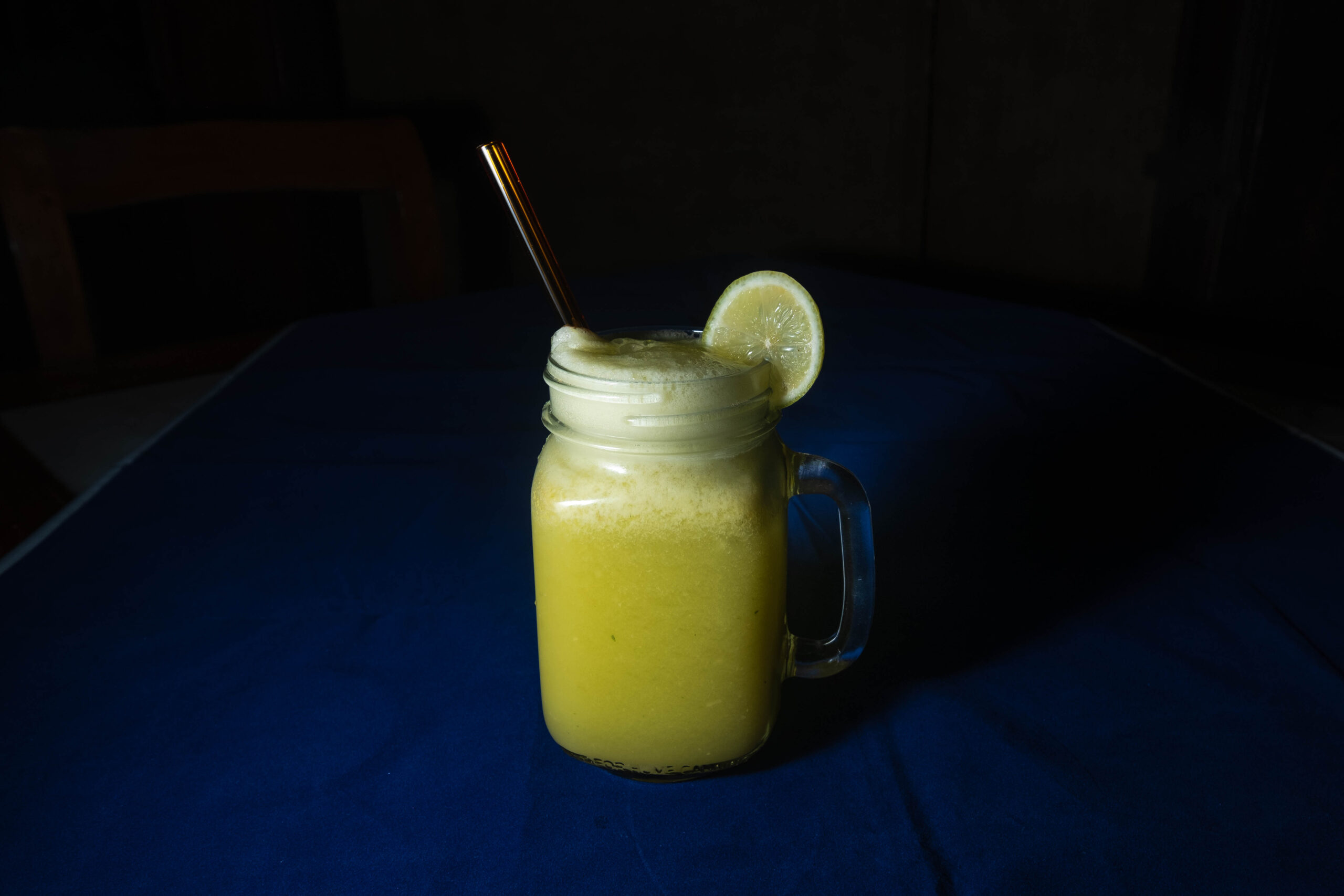
Moisturiser.
From our Healthy Juices Menu: Fresh cucumber, ginger, orange – improves skin texture, moisturizer and reduces body heat.
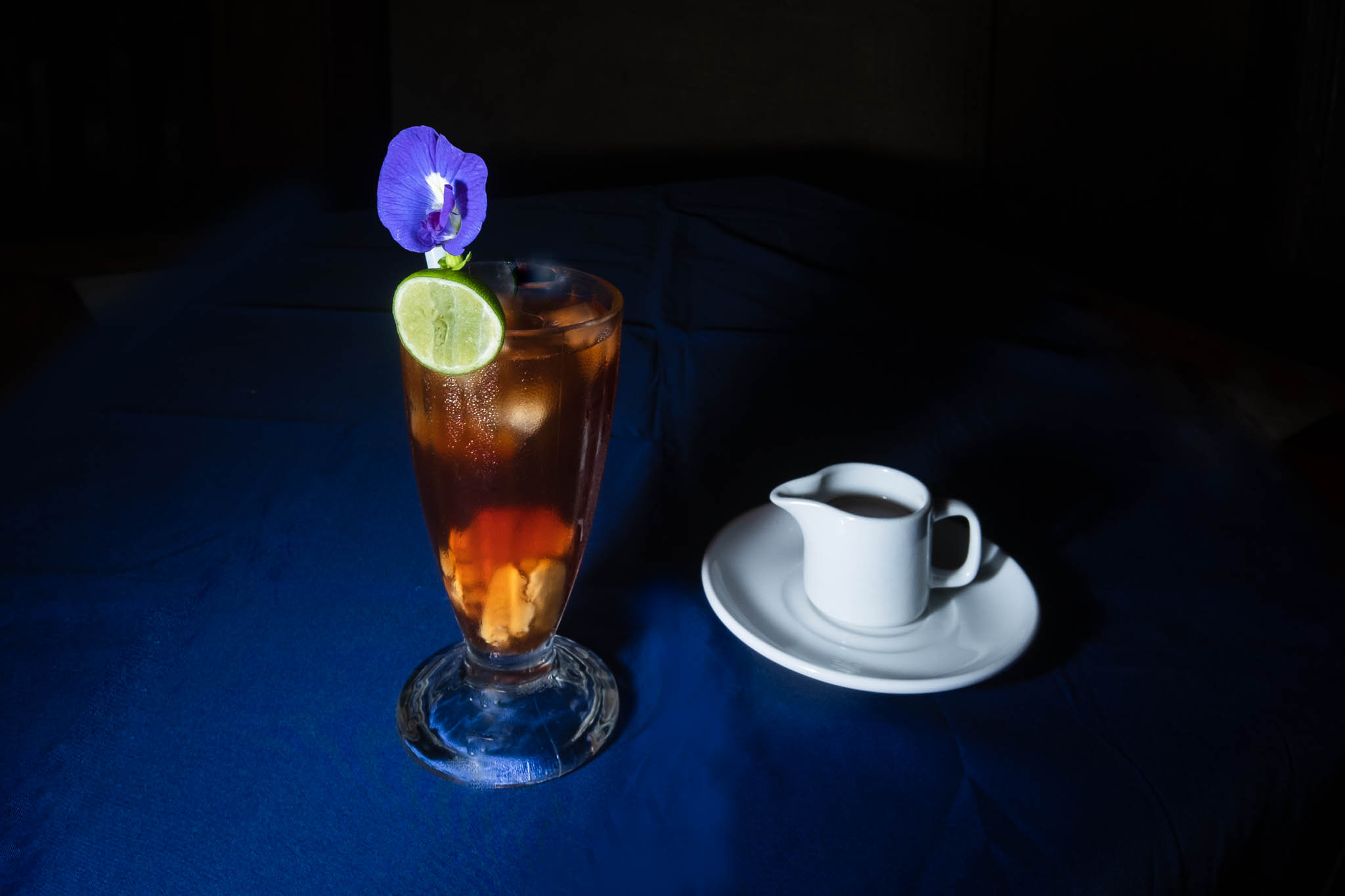
Iced Ginger Tea.
Ginger tea has a long history dating back to China some 5,000 years ago, where it was traditionally used as a health tonic. It’s good for digestion.
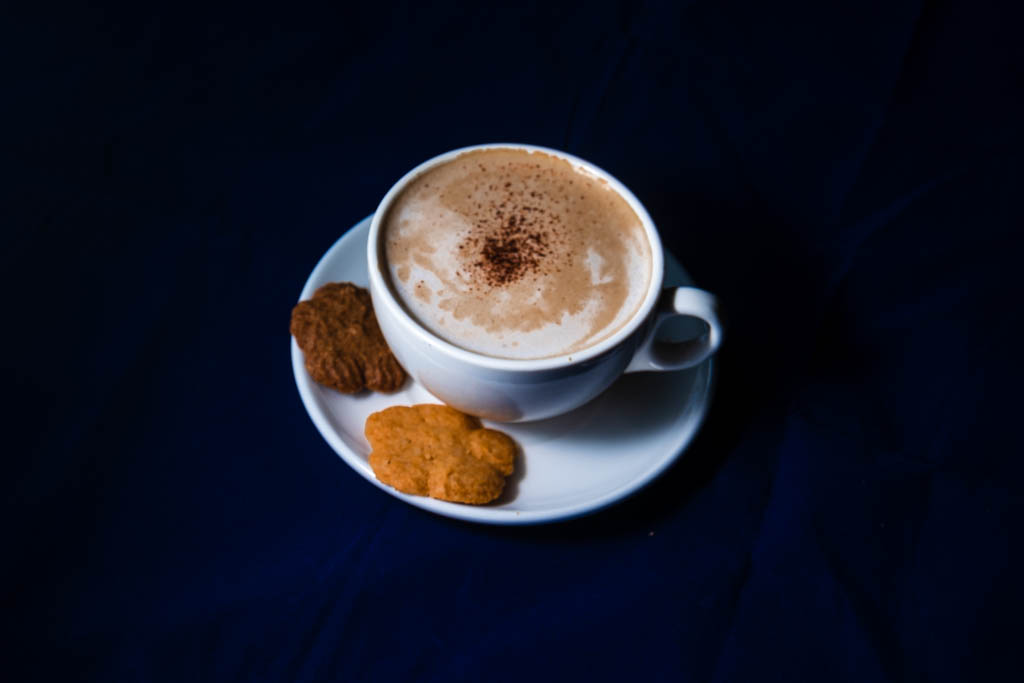
Cappuccino.
Made popular during both World Wars, a cappuccino has a bottom layer of one or two shots of espresso, a middle layer of steamed milk, followed by a thick, airy layer of foam to give a perfect, luxurious, velvety texture.
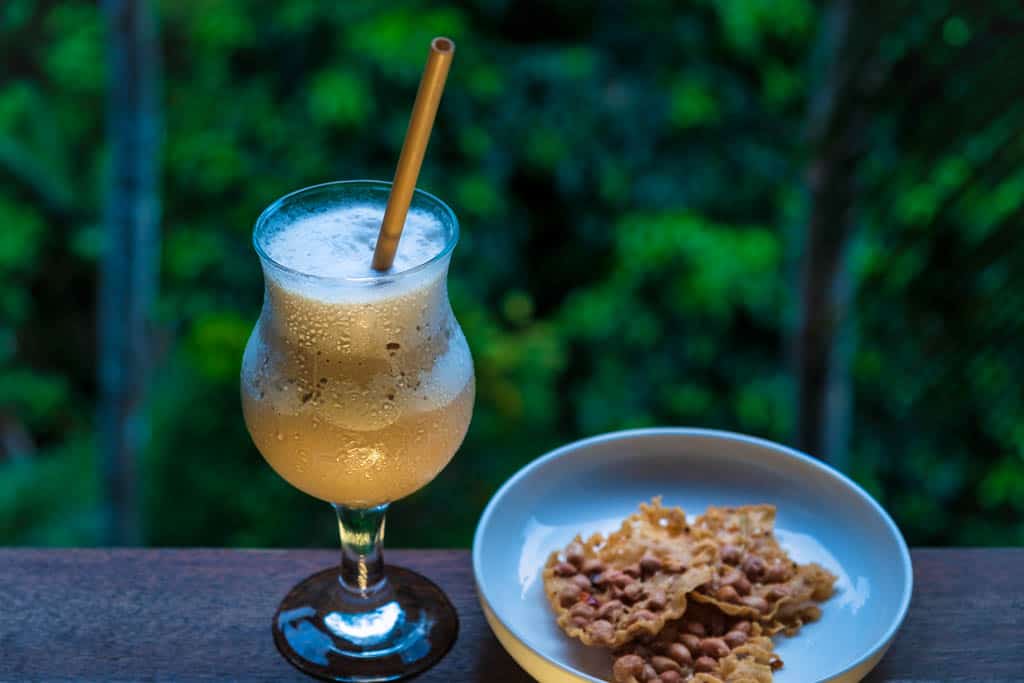
Vanilla Caramel Light Frappé.
Blended milk, cream, a dash of espresso, caramel and ice.
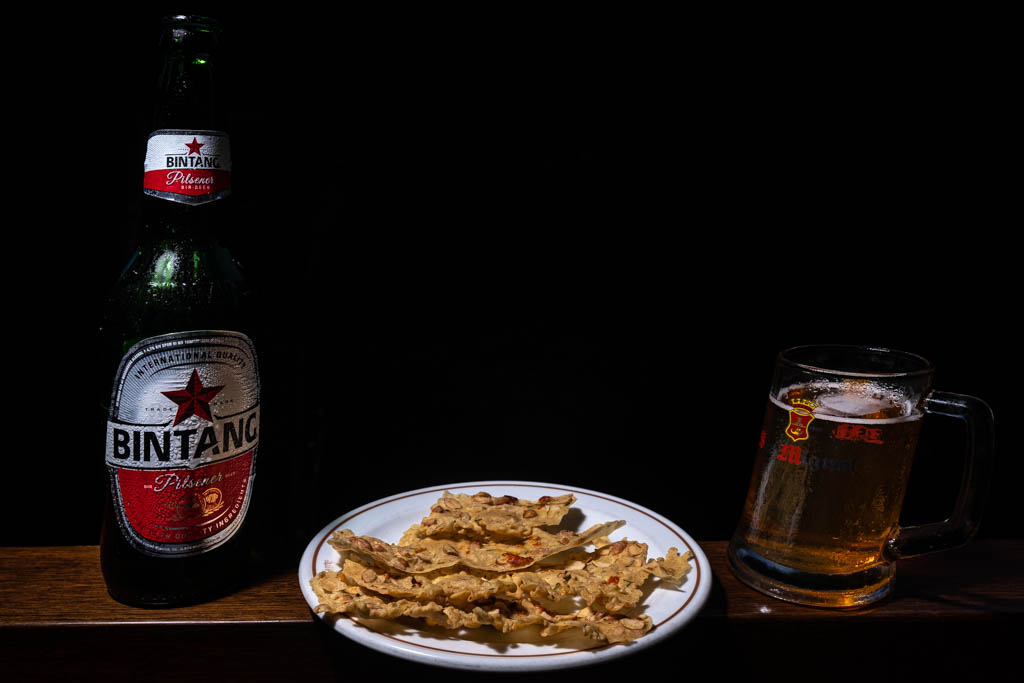
The snack is Rempeyek or ‘Peyek” for short. They are delicious Balinese, crunchy, savoury crackers, studded with peanuts. Peyek is the sound they make when you bite into them! Rempeyek are totally moreish – you can’t just stop at one!
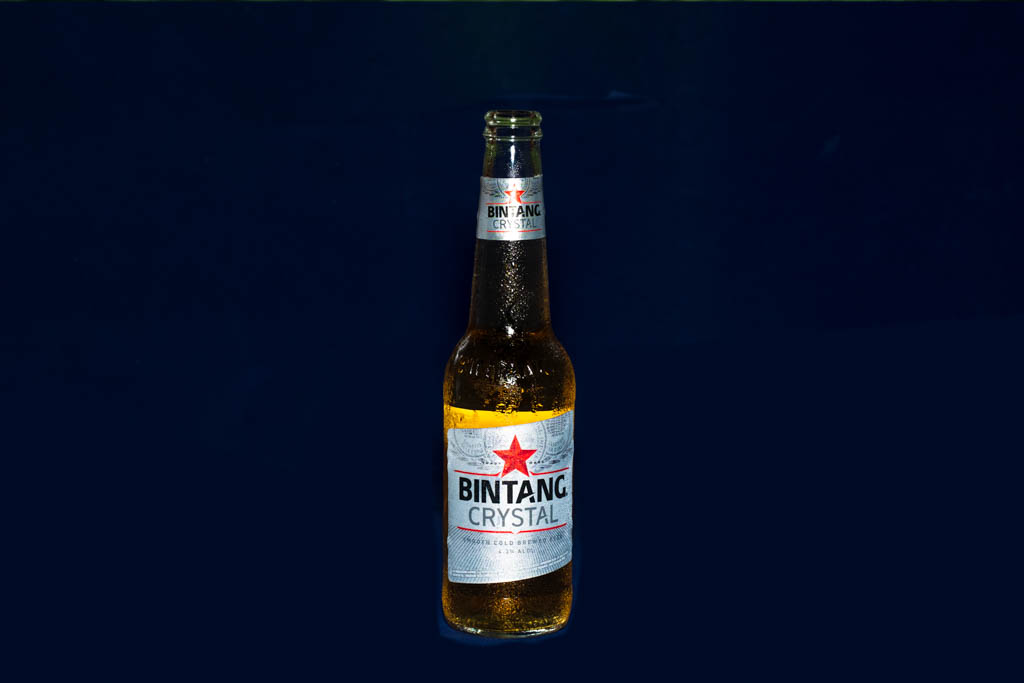
Bintang Crystal.
Bintang Crystal, Bali’s new, less bitter, smoother, cold-brewed beer.
Bintang and Rempeyek.
Bintang means ‘star’ in Indonesian. The star beer was first brewed in Surabaya in 1929 during Dutch colonial rule. In 1957, after Indonesia became independent, it was nationalised until Heineken retook control in 1967. The 4.7% alcohol malty beer is on every menu in Bali. We recommend our crunchy home made delicious Balinese snacks with every mouthful.
A household name in Bali, Ni Wayan Murni started out with Murni’s Warung, the first restaurant to open in the town of Ubud in the early 1970s. Now, Murni’s is an enterprise that includes a hotel, a spa, and a store. Besides embodying Balinese culture and hospitality, she has published a book and exhibited a collection of textiles in San Francisco. When planning a trip to Bali, a full experience at Murni’s will guarantee a wonderful vacation. Reserve a table and enjoy traditional Indonesian cuisine at a restaurant with an excellent view of the river, get a massage at the award-winning Tamarind Spa, and book a room inside the peaceful confines of Murni’s Houses. Keep reading because all these and more await at Murni’s in Bali.
Before Murni became a restaurateur and businesswoman, she was selling food and beer at the local market. Murni’s Warung opened just as tourists were starting to discover the wonders of Ubud. An establishment that has stood the test of time, this is an iconic eatery in Bali that definitely warrants a visit. Guests typically come to taste the lauded Balinese duck and beef rendang, but you can also sample their delicious nasi goreng (Indonesian fried rice) served with homemade peanut sauce. The extensive à la carte menu includes a list of desserts, with must-tries like Murni’s world-famous carrot cake and the ooey-gooey cashew pie, as well as a list of cocktails, wines, and spirits from the lounge bar. Murni’s in Bali Trip 101.com
By Stephanie Brookes, Indonesia Expat, 20 November 2019
I stood near the rim of Kintamani volcano, taking in the sweeping views of Mount Batur and its expansive crater lake shimmering in the early morning light. Ahead of me lay the 35-kilometre, downhill bicycle ride to Ubud.
I headed off with my cycling guide and, soon enough, we started to weave through small villages, sharing the quiet, scenic roads with the people going about their day. We passed by duck farmers with long bamboo poles, a white flag on top, each with their gaggle of ducks trailing behind them. Vibrant green fields panned out on either side as we rode through the back lanes; many with groups of women threshing rice and sifting the grains with giant bamboo baskets.
We passed lines of beautiful women dressed in bright, ceremonial finery with lacy white tops and brightly coloured sashes, as they made their way to the local village temple. They walked in procession, single file, carrying tall towers of fruit on their heads.
This made for extraordinary photo opportunities. Believe me, you do not see this in downtown Kuta, Nusa Dua, Canggu, or Seminyak.
By travelling at just 10km per hour, I felt like I was able to make intimate contact with the world around me and could see, hear, and feel so much more than I would have in a car or on a motorbike. I could hear temple bells in the distance. The quaint lanes we passed made me feel like I was discovering the authentic Bali, opening up to impromptu moments that might come along.
We stopped in a small village for a break and I got talking to a young Balinese man named Kadek, who was sitting under a makeshift shelter next to a small, ancient, stone temple. He had been clanging away on ancient-looking cymbals, surrounded by an array of other instruments.
“These are all part of our gamelan orchestra,” Kadek explained, pointing to the gongs and drums. He said, “these have been played at our temple ceremonies for many centuries.” I learned that they are still played at weddings and funerals as well as for other rites of passage and ceremonies. Gamelan is mastered by memory, by heart.
Kadek invited me to come back the next day to join his family temple birthday celebration. Not only would I hear the gamelan being played, but I would also meet the shadow puppet master and watch the wayang kulit, the ancient Indonesian art of shadow play. What an offer!
“No need to bring anything,” Kadek stressed. “We have prepared plenty of food, and we welcome guests. It is our great honour to share our customs with foreign guests.” He quickly gave me his Facebook name, we exchanged phone numbers, and I made a promise to return.
It seems that all the conversations you have with Balinese, from the hotel concierge to the local fruit seller, always seem to include some discussion of their culture and tradition. Balinese traditional life is still very much alive outside the main tourist areas of Bali. By basing yourself in the town of Ubud, for example, you get to observe a ritualistic Bali which is steeped in Hindu religious practices. For me, every day seemed to offer another lesson, unravelling slowly and naturally. Bali is, in all essence, a living culture.
The island has over 20,000 temples and shrines. For such a small island (153km x 112km), one is bound to run into a ceremony of some description. All you need to attend a ceremony is a sarong, a long sash, and a top that covers your shoulders. Men wear an additional item, an udeng, the Balinese male headdress.
If you choose to travel around Bali with a driver, these are pretty much a given item, tucked away neatly in the back of the car, at the ready for an impromptu moment. When you catch sight of a line of women walking down a road with offerings on their heads, all you need to do is join the procession at the back, and you will likely end up at a temple where you can participate in the celebrations and experience the culture.
As a foreigner, you’re always welcomed to join a temple prayer session and, if you are lucky, you can also catch temple dancing, and sometimes drama plays being acted out. These ceremonies often go late into the night, many ways past midnight.
My cycle tour finished with lunch, including a traditional Balinese salad with green beans and sprouts (urab), tempe with delicate spices, tantalising spicy, shredded, steamed chicken, satay on bamboo skewers with peanut sauce, and steamed vegetables cooked in coconut cream. This was served on a pile of steaming red rice. Our beverage was my favourite, fresh and young coconut water served in the shell, a natural energy drink and electrolyte replacement. We all hailed our coconut water with a “cheers” to celebrate our accomplishment of completing the ride.
The next day, my body told me it was time to take a rest. I booked in for a three-hour relaxation and rejuvenation treatment at Murni’s Tamarind Spa in Ubud. Locally, Murni is affectionately known as “the Mother of Ubud.” She pioneered tourism in Ubud in the 1970s by setting up her legendary restaurant, Murni’s Warung, where artists, adventurers, and academics hung out, drank mango lassies, ate smashed avocado on toast, and devoured Murni’s famous apple pie.
Murni lovingly presides over her dream creation on the jungle-clad Campuan gorge above the Wos River, and 50 years later, it’s still the same. The award-winning Tamarind Spa is the latest addition to Murni’s businesses and it was under the tamarind tree I discovered my massage therapist, Kartini, was the former personal therapist of the President of Seychelles.
After a welcome drink, cold towel and foot ritual, Kartini started to weave her healing magic on me. This began with an hour-long traditional massage, deeply relaxing, mind soothing, and muscle quenching. This was followed by a fragrant green tea scrub and a yoghurt rubdown. My treatment finished by soaking in a warm bath with orange and red flower petals floating on top. To finish it off, I was served a pot of organic herbal tea and fresh tropical fruit.
The next day, I was on a mission to discover Bali’s secret photography spots. I decided on a David Metcalf Photography tour after reading some rave reviews online. I was collected bright and early, in time for the dramatic 6.00am sunrise over Mount Agung. Next, we ventured to a local traditional market which was teeming with piles of colourful, hot-red chillies, purple dragonfruit, snake fruit, bright green guavas, and pyramids of multi-coloured local spices. Next, we spent time at the river capturing some dramatic morning sun rays through the trees, and had a lovely chat with the local rice farmer.
After that, we headed to a beautiful 10th century water temple which we had entirely to ourselves. Lunch was up next and sumptuous traditional fare of steamed fish wrapped in banana leaves, coconut yellow curried vegetables, traditional Balinese salad with bean sprouts, and rice steamed in bamboo over an open fire. We ate in the home of a beautiful Balinese family. It was a delightful surprise to see a glimmer of gold shining through the thick foliage in the back of the garden, and soon enough, two delightful young dancers appeared.
They performed the Legong dance for us. It turned out these two little girls were temple dancers and loved to take the opportunity to dance for visitors. They were all of five and six years old and danced so elegantly, with beautiful flowing movements infused with pure grace and spirit. It was spellbinding.
What I really loved about my photography day, which also included plenty of one-on-one photo tips, was how immersed I was in Balinese culture all day. We did not see another foreigner all day. My kind of Balinese day.
Next on the agenda was yoga. Wandering the small streets of Ubud, I found myself walking towards “The Sari Organic Pathway,” which was well signposted from the centre of town, wending my way to the Yoga House; a yurt shaped building situated in the rice fields.
Sheila, the owner, offers classes five days a week and refers to them as yoga for everyone. Indeed, it was. As I eased into my gentle flow yoga class, my view was framed by three stunning, volcanic peaks fanning out from the yoga platform. The yoga studio was also surrounded by terraced rice fields that encircled the studio like a living green carpet. By being amongst nature, in the outdoors in this idyllic setting, I felt deeply connected to the yoga philosophy which connects the mind, body and spirit, through breath and movement.
In the late afternoon, I headed off to a remote, rural Bali village, Lokaserena, on the outskirts of Ubud. I was welcomed into the home of Kadek, who is an Ubud Village Plate host. Ubud Village Plate is a local initiative that supports the community and connects travellers over a shared lunch or dinner in the home of a Balinese family.
Cooking classes are offered as well, but I decided on the dinner-only option. On arrival, I was taken on a tour of Kadek’s house, which is part of his larger family compound. He explained the layout of his traditional compound and told me the history behind the ornate carvings and entranceways and the cultural aspects of the directions of the buildings.
Dinner was a succulent affair with sizzling chicken sate on bamboo sticks and steamed tuna baked in banana leaves, accompanied by a pile of fresh vegetables from Kadek’s garden. All was finished off with traditional black rice pudding with fresh coconut cream. We talked late into the night about tradition and customs and I didn’t want to leave.
My next journey of discovery was into the spiritual heart of a timeless temple called Gunung Kawi; my temple of choice, located only 20 minutes out of Ubud. I decided to visit this ancient 10th-century temple complex at 7.00am, which allowed me some solitude and a few quiet, reflective hours before the tourist buses arrived for 9.30am.
By chance, I meet Wayan, the temple sweeper, near the entrance and he offered to take me to some lesser-known parts of the complex. “Come with me. I will show you the way to a waterfall and a hidden temple, and we will pass by some ancient rice fields.” I eagerly took up Wayan’s kind offer, and he explained how the terraced rice fields, which grow right in the temple itself, date back to the 9th century and are now World Heritage-listed.
As we walked along the small path, the misty jungle clung to the edges of the steeply terraced rice fields. Wayan took me on a little trail where we passed by a waterfall on the way to some old meditation caves. Chiselled from the rock, I came to a series of open doorways, which stood in a straight line symbolically representing an open door. “A door to the other world,” Wayan said with a smile. Near the caves was a shrine, which Wayan explained, stood as a representation of King Anak Wungsu, 1050 AD.
I spent the rest of the morning walking in the shadows of a series of seven-metre high temple tombs known as the Queens Tombs. Wayan was excellent company and highly informative.
As Wayan continued with his morning temple sweeping routine, happy to have been interrupted by a lone traveller, I reflected on the beautiful Balinese people I had encountered over the week, whether that be by bicycle, in a Balinese home, or leaning on a broomstick. The famed Island of the Gods breathes with an even rhythm and welcomes the curiosity of a stranger to explore a very pure and authentic Bali.
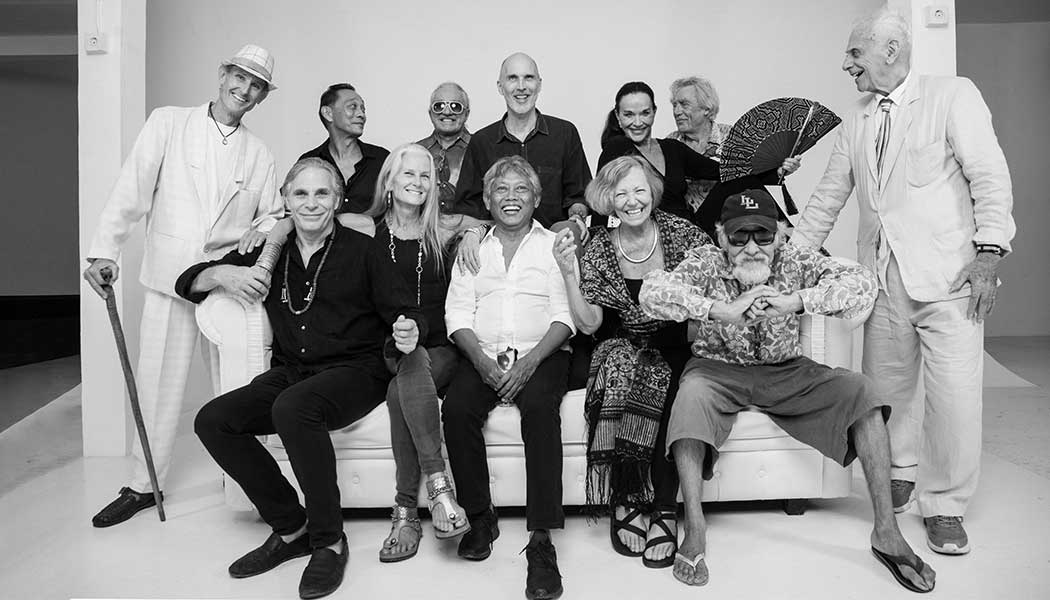
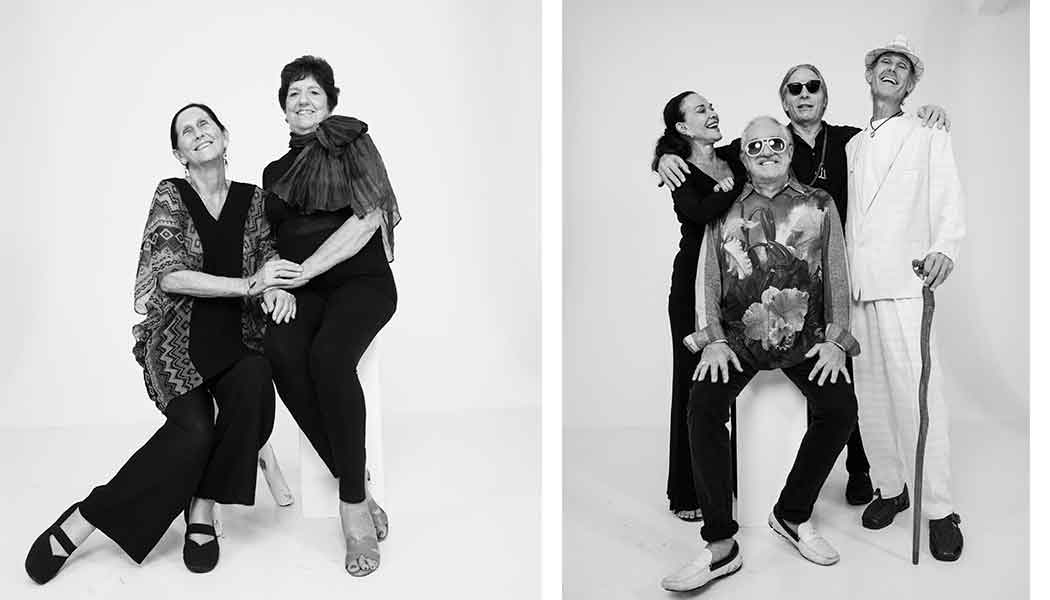
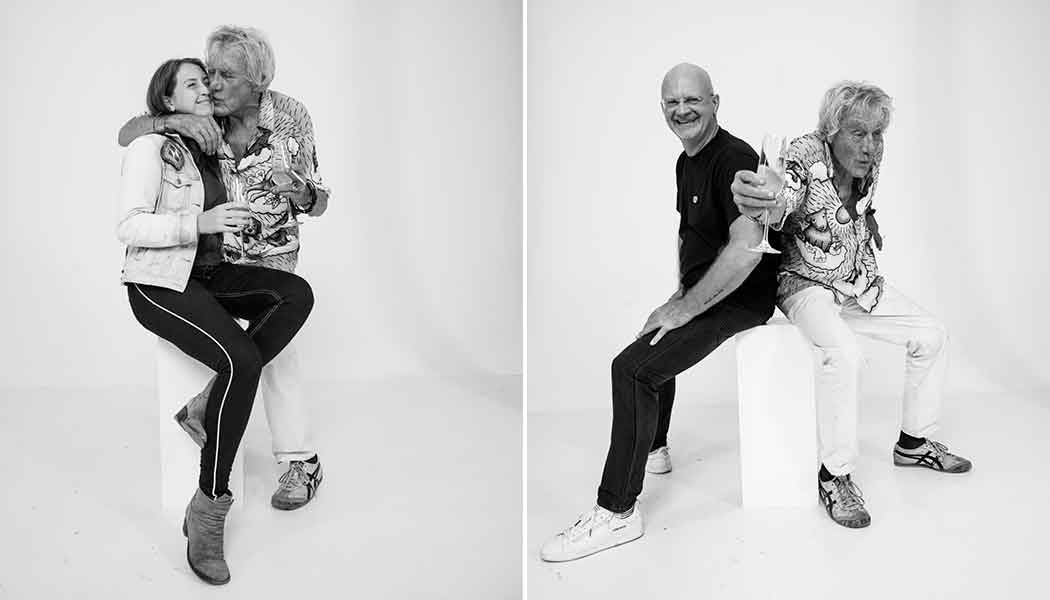
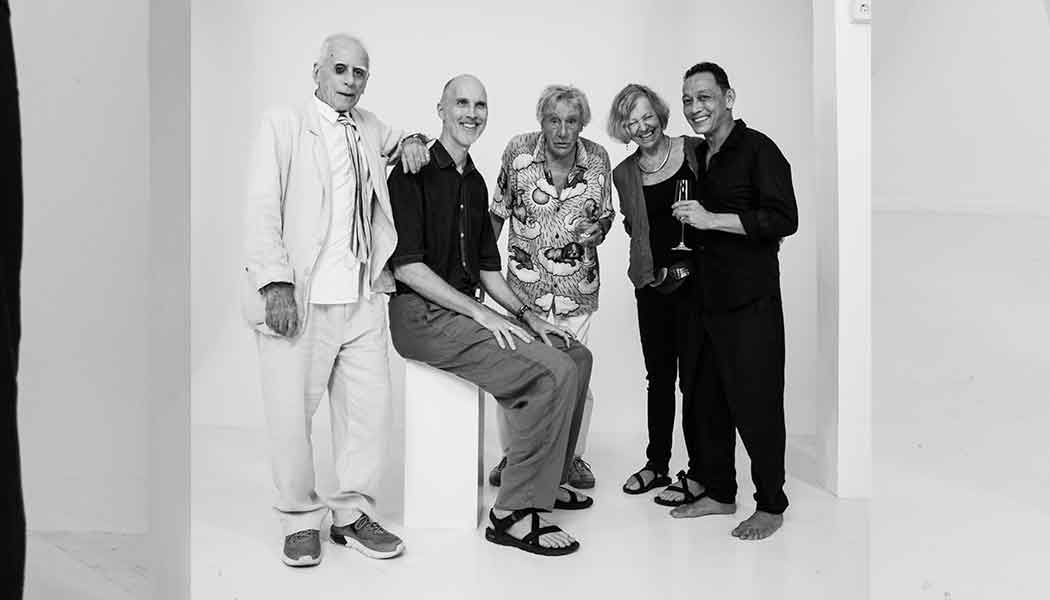
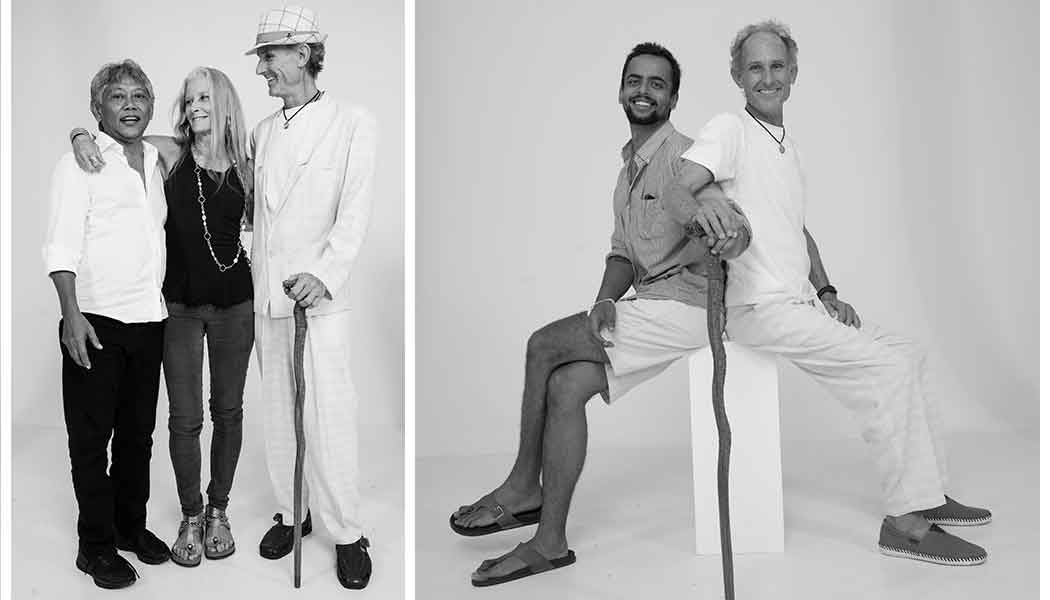
Why did you come to Bali? We asked Diana Darling to dissect a generation of island refuseniks who made the move more than three decades ago. Images: Oscar Munar. Styling by Angie Anggoro.
The Yak, May 2019
Seated, left to right: Bruce Carpenter Collector and connoisseur of Indonesian tribal art. Cynthia Hardy Muse, businesswoman and co-visionary with her husband John. Amir Rabik Entrepreneur and host to the stars. Jean Howe California-sunshine carrier and co-founder of Threads of Life. Leonard Lueras Writer, publisher, and consumer-researcher for Bintang beer. Standing, far right: Arthur Karvan Founder of the famous Arthur’s club in Sydney; designer of fashion fabrics and boutique residences Standing, left to right, back row: Emerald Starr Chocolate entrepreneur and developer of spiritual resorts in bamboo. Pintor Sirait Sculptor in steel and expert best friend. Milo Fashion designer, devoted son, and celebrity host. William Ingram Co-founder and chronicler of Threads of Life; former computer geek. Ananda Hart Painter and socialite; former Hollywood movie star super-hero. Ian van Wieringen Painter; expert on long-legged beauties.
FOR one thing, we were young. Even so, most of us already had a past. Some of us had recently been in the movies or bereaved or divorced or bankrupt or had just got out of jail. Most of us had been travelling for a while – often rough, sometimes dangerously.
Everyone was good at something, although some hadn’t yet discovered what it was. Everyone was looking for something, even if they didn’t know exactly what it was.
Some were looking for a sort of perpetual high, where the air was always gentle and there was always someone cool down the beach or at the next table, and no one would bother you about who you were or how you spent your days and nights, and if you ran out of money it was easy to make some more, if only enough for the next week.
Some of us were just looking for something to do. Some of us were looking for a cheaper place to do what we were already doing. Some of us were looking for each other. None of us would have said at the time that we were looking for ‘healing’.
We were all sorts of people – actors, scholars, con artists, filmmakers, fashion mavens, lawyers, fortune-tellers, potters, musicians, mystics, chefs, beach bums, heiresses, poseurs, photographers, traders, painters, stockbrokers, surfers, dancers, published and unpublished poets, and publishers, too. Some were good at taking rich people around the archipelago. Everyone had a go at designing something; some made a fortune at it.
John Hardy had legendary success designing jewellery when he teamed up with his wife Cynthia. “He had the ideas, I had a business model,” she once said. Neiman Marcus, a high-end retailer, saw one of his silver key chain ornaments and said, basically, “Can you make us a gazillion of these as earrings?” They did, and John Hardy became a worldwide luxury brand.
Before the late Linda Garland became “the bamboo queen”, she designed nice things for the home, made by Balinese artisans. Her genius lay in persuading rock stars and tycoons that they needed these things. She decorated homes for David Bowie and Sir Richard Branson. Everyone who was important adored her.
And the much-missed Madé Wijaya, né Michael White – who famously arrived in Bali in 1973, having jumped ship and swum ashore in a storm – designed beautiful gardens for resorts and moguls all over Southeast Asia. But his brilliance was his uncanny understanding of Bali.
Each of us had a private Bali, peopled with Balinese friends and families, who gave us a place to live and opened up worlds to us, introduced us to young craftsmen and old sorcerers, took us to holy places, and showed us the way to behave around ‘the gods’. They taught us the gamelan tuning systems and how to carve masks and make them come alive in the dances.
Perhaps we took our Balinese friends on tour to New York or India. We helped with their medical bills, and many put the children of their Balinese families through school. When our Balinese friends died, we went to their house; later we gathered in a corner of the graveyard, smoking kreteks with the gong orchestra.
As expats, we were not nearly as nice to each other as we were to our Balinese friends; but then, unlike the Balinese, life among us was unstructured. Some people were extroverts and threw ‘full moon parties’ where everybody had to wear white.
Others were introverts and avoided foreigners, often irritating other expats by punctuating their speech with Balinese slang.
We used to gather at places like Murni’s, Mak Beng, the Tandjung Sari, the Blue Ocean and Madé’s Warung. We got our mail at the poste restante of the local post office. (The late Shane Sweeney, a seminal expat, once waited for months for an important letter, only to find it filed under “M”, for “Mr.”) We shared tailors and sent each other presents with our driver, if we had one. When we started having children, some expats started schools, and later organic farmer’s markets. All the expat kids had Balinese children’s rites. Madé Wijaya said of the sons of Linda Garland and Amir Rabik that they had full Anak Agung wardrobes.
Snob appeal was varied, depending who you were. For some it was simply a matter of making a pile of money and spending it on building a fabulous house. For others it was having chic Balinese friends – venerable dance masters or priests or artists, or princelings in the government. In some circles, it was cool to be able to read Balinese script or to be treated for black magic. Status symbols also varied. Everyone appreciated heirloom keris and rare Balinese textiles, and a few could wear these things with flair. What you drove, on the other hand, was never a big deal. It was more impressive to have a driver who could negotiate the bureaucracy and possibly wrangle snakes.
Anthropologically, we felt a tribal kinship of oppression under Indonesia’s murky immigration laws; and we were serially polygamous. Our culture prized achievement and gratification. There was no point in being political, because we were foreigners and could be expelled on a whim. But as we got older, people became engaged with problems facing society and the environment, and many expats now work with Balinese in charitable foundations.
Today, as the group shot here shows, the early expats are still sexy. The man-eating divas may have gone vegan, but the fire of life is still blazing.
Murni’s Warung, Jalan Raya, Ubud
✆ +62 361 975233 www.murnis.com
Au niveau du pont de Campuhan.
Ouvert tous les jours de 9h à23h. Plats àpartir de 45 000 Rp.
Demandez Murni’s àvotre arrivée à Bali et votre chauffeur saura oùvous emmener. Car tout le monde connait la proprietaire des lieux, la personne la plus charmante d’Ubud vous diront meme certains.
Murni concocte depuis des decennies une cuisine indonesienne et thaïet àla fois authentique et travaillé(elle a heritédes recettes de sa mere et de sa grand- mere), àbase d’ingredients frais et de qualite. Le warung fut le rendez-vous des branches des annees 1975-1980. Dans un superbe cadre (descendre les terrasses successives accrochees a la gorge pour arriver tout en bas, dans un bain de fraicheur et de vegetation). Les gateaux maison sont simplement divins. Murni’s Warung est une institution!
Murni’s Warung is a trailblazing modern restaurant in Ubud, and the name Murni is taken from the owner, Ibu Ni Wayan Murni. Where Murni’s Warung now stands, 41 years ago there were just four tables and a batik shop. Ibu Murni offered a simple menu, of coffee, toast, and customer favorite, bubuh injin, which she made herself.
Through persistence, hard work, and hospitality this small warung expanded. Together with her American husband, Pat, Ibu Murni opened a larger restaurant and enlarged the menu. Now there is not only traditional Balinese fare but also a number of international items to satisfy her customers, most of whom are foreigners. Ayam betutu is served with nasi kuning, and babi guling and bubuh injin remain favorites. To satisfy a sweet tooth, the Balinese Caramel Cake (created by Ibu Murni) and the apple pie are the most popular.
Because the restaurant is on the edge of a cliff next to the Campuhan River, it was built on four levels. Aside from the dining area, on the second floor there is a lounge bar where customers can enjoy snacks and drinks while listening to music. Choose whatever you want from the menu, then choose a great view to accompany your meal.
Murni’s Warung, Ubud – 100 Best Foods of Bali
by Bondon Winaro, Lidia Tanod and Harry Nazarudin, Penerbit Jalansutra, 2015
You know Ubud is the creative heart of Bali – it’s bustling, busy and unbelievably beautiful. And while people might visit for the unique and vibrant local art, the scenery at Ubud is just as amazing as any masterpiece.
Why bother to take a sightseeing tour when you can enjoy the amazing scenery over a leisurely lunch or a romantic dinner?
Ubud has it all – jungle, valleys, waterfalls and paddy fields. Fortunately it isn’t just a feast for your eyes – the food is equally divine!
These are the dining experiences that you, and your photo album, will remember forever!
The Queen of Ubud – Murni’s Warung
Everyone in Ubud knows Murni’s – ask any taxi driver and they will take you to her fantastic hillside restaurant.
Murni’s Warung is iconic; it’s almost as well known and popular as Ubud itself.
Murni opened her little Warung with just 1 table, 2 chairs and an icebox in 1974, and her devoted and ever growing number of satisfied customers has been increasing ever since.
The restaurant now sprawls over four levels down the side of a steep valley – land that used to be farmed by Murni’s father.
Murni’s Warung by the roadside on level 1, and immediately look out on to the luscious hillside greenery. If you want to be by the river, then descend down to level 4 and find a table on the terrace. The lazy river snakes past below you, and in front of you is a sprawling wall of foliage.
The only reminder of modern day life is the bridge above you; which makes the valley haven look and feel even more precious.
Murni’s serves a wide variety of homemade dishes with plenty of external influences from travellers that Murni has met over the years. Daily specials ensure that you never get bored of the menu – no matter how many times you go back!
The best thing? You can order as many desserts as you want and be guilt-free as a good workout is available via the steep stairs down to the river.
If you love Murni’s Warung, make sure to check out her guesthouse and craft shop for a truly authentic Balinese experience.





 To pay Murni’s Warung: